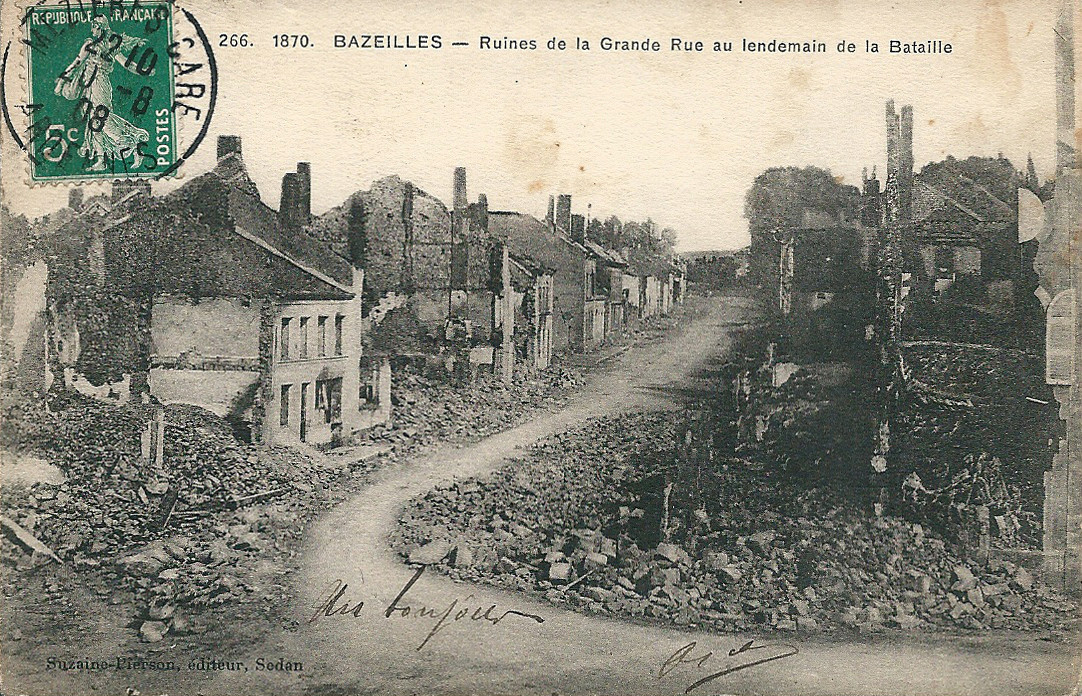
The News Year’s Day, 1871 letter of Liebknecht to the U.S. is somber to say the least as the war brings out the worst in Germany, and France stands on the precipice of revolution or military despotism.
‘Letter from Leipzig, III’ by Wilhelm Liebknecht from Workingman’s Advocate (Chicago). Vol. 7 Nos. 22 & 23. January 28 & February 4, 1871.
Jan. 1, 1871. To the Editor of the WORKINGMAN’S ADVOCATE.
Never in modern times–perhaps never in her whole history–has Germany passed a Christmas which was so little merry as the Christmas of 1870, and never has she entered a new year in such gloomy spirit as she is now entering the year 1871. And this is not to be wondered. Since the 15th of July–that is, in the space of five months and a half–at least one million of men in the prime of life, one-fourth of them beads and nourishers of families, have been sent to the seat of war. Of these there had been killed and wounded, according to the last official returns, which, however, reach only to the end of November and which are far from complete, fully one hundred thousand–a number to which the sanguinary battles of the last month must have added half as much again. But bullet and sword are not the soldier’s deadliest enemies. We know from the statistics of the wars in Italy (1859), in the Crimea, in the United States, and of the war of 1866, which was ended in three months, that under the most favorable circumstances far more soldiers are carried away in war by disease than by arms. And in the present war the circumstances have been and continue to be as unfavorable as can be imagined. Damp and cold summer was followed by an autumn so wet that it would have reminded one of the rainy season in the Tropics, if it had not been so chilly; and this autumn–very similar to that famous autumn which seventy-eight years ago saved the first French Republic from the invading armies under the Duke of Brunswick–has been followed by a winter of almost unexampled severity–a winter the like of which Europe has had but once in this century, in that portentous year (1812) which saw the hosts of the mightiest Emperor annihilated by a still mightier monarch, “King Frost.” How many of our soldiers have succumbed to the inclemency of the weather and to those hardships inseparable from a campaign on so large a scale and against such powerful and warlike enemies; how many have become the victims of bad administration and neglect, we do not know and shall probably never know; for it is not to the interest of our rulers to let the people see the whole extent of the wear and tear in human material. Yet so much is sure–the losses through sickness and fatigues are enormous, it can be safely be asserted that there are very few families in Germany which have not lost either one of their members–may be the head–or some near relations And no end is yet to be perceived! And those that have been spared till now must be in constant dread of being afflicted in their turn.
Compared with this misery the disastrous influences of the war on trade and commerce–the blockade alone is estimated to cause a loss of one million thalers a day–are hardly remarked. And what is to be the reward of the nation? What is to be put in the scale to counterbalance the weight of so many lives lost, of so much happiness destroyed? An Imperial crown! We are to have an Emperor. William I of Prussia, who twenty-two years ago sent to military executions the defenders of the constitution framed by the German Parliament and settling the Emperor’s crown on the Kings of Prussia–this self-same William has, out of the hands of small German princes, accepted that Imperial Crown which he and his kin spurned when it was offered by the people, and he is to be called in future “Emperor of Germany and King of Prussia,” an increase in title which of course must be accompanied by a corresponding increase of salary, 4–to avoid mistakes I write it in letters–four millions of thalers a year being, perhaps, tolerably good payment for a king, but far too little for an emperor, who must not be outdone in splendor by bis two older colleagues in rank, the Emperors of Russia and Austria.
Excepting this titular advancement of King William, no concession is made to the fools who were clamoring for a German Empire, for the so-called new. Empire is nothing but the old North German Confederation, to which, by three different treaties, the four South German States–Hesse, Baden, Württemberg aud Bavaria–are to be added for form’s sake. I say for form’s sake, because a real union is not established–not even in military things. The King of Bavaria, for instance, retains the absolute command over his army, which, by the by, is 150,000 men strong. Prussia would never have condescended to this solution of the German question, which not only does not increase the power of Prussia, but actually diminishes it by breaking the unity of the North German Confederation, if she had not been taught by the bitter logic of facts. The Southwestern princes who had helped her in conquering Bonaparte, and without whom she could not have conquered him, were not to be reduced to vassalage (“mediatized”), like the King of Saxony, who in 1866 was fighting on the side of Austria and had to submit to the conditions of the victors.
The Reichstag was not at all satisfied with the treaties. However, not being allowed to annul them, it gave its assent amongst deafening peals of laughter, which horrified the serious politicians, and are a fresh proof that we Germans are bad actors. Bonaparte’s Corps Legislatiff would have played their comedy far better, at all events with more solemnity. A week after the Reichstag closed, Babel and Liebknecht were asserted under the accusation of having committed preparatory acts of high treason. This fact speaks for itself, and beyond the fact, I cannot communicate anything today. You know we were prepared for it, and we are not shaking. We shall do our duty to the last. Nothing can be more silly than to talk of France being tyrannized by Gambetta and the Republicans. Where is their power to tyrannize with? When they took the direction of public affairs, there was really no government machinery in existence, and the army had ceased to exist. How could they have done violence to the nation? The fact is, in themselves they had, and they have still, no power at all but that of private individuals; and if the national defence under their guidance is being carried on with an energy drawing forth the admiration even of the enemy. This only proves that the republican government has been founded in full accordance with the wishes of the whole French nation, A people of nearly 40 millions rising against its own will at the command of half a dozen men, who had neither a policeman nor a soldier at their disposal–the idea is so absurd that newspaper writers propagating their nonsense must have a very low opinion of the intellectual capacities of their readers, or at least consider them docile pupils of that catholic churchfather, who invented the famous: Creda quia absurdum. I believe because it is absurd. (Of course believing what is not absurd, is too simple, though unfortunately, not too common to be meritorious in the eyes of such a saint.) Gambetta and his colleagues are, in the truest sense of the word, the organ of the French people; all through the people, all with the people, and–nothing against the people. While the French continue the war we must conclude that they are resolved upon the war. If they were not resolved upon the war, they would not continue it.
How fully the Republican Government feels itself in harmony with the immense majority of the people is best shown by the unlimited liberty which it allows to those few wretched newspapers (Frances, Constitutionel, Liberte, etc.) which are in the pay of the Bour bon, Orleanistic and Bonapartistic usurpers, and by the moderation shown in the squabbles with the socialistic “hotspurs” of Paris and Lyons. Only the consciousness of strength can act thus; and I think the example now set by the French Republic has no parallel in history. The first French Republic, which had to fight under circumstances nearly as disadvantageous, made exertions nearly as gigantic, but it had recourse to terroristic measures, and oppressed liberty in order to save it. Your great commonwealth in its titanic struggle with the southern Barons had no recourse to terroristic measures, but it was never in such extreme danger as the present French Republic has been from the moment of its birth up to the present hour. And I do not recollect another case of national rising to be compared in the point of grandeur with the two just mentioned.
What a different spectacle does Germany, victorious Germany, offer us at present. Papers suppressed and forbidden, and those citizens that oppose the policy of the Prussian Government thrown into prison. Indeed, if the French Government, situated as it is, resorted to such measures, we would not be astonished; but that the Prussian Government–and of this alone we have to speak here, though it is clever enough to have the work partly done by some of the minor governments–but that Prussia, whose armies have met with fabulous success and are standing in the heart of the “hereditary” enemy, considers it necessary to proceed in this manner must be incomprehensible to everyone who trusts in appearances and regards this war a national one on the part of Germany, as a war approved of by our whole people, a small minority excepted. The truth is, the war is not a national one; the enthusiasm, which existed up to Sedan, has totally evaporated, in spite of the inflammatory articles of the Government and bourgeois press, the mass of the people are sick of a war, which, as the dullest begin [sentence missing in scan] well aware of the impossibility to destroy the French Republic, and fully sensible of the fact that the Republic in France means the downfall of Younkerdom in Germany, see their only chance in prolonging the war and in stifling all resistance to this horrible shedding of blood.
And it is getting more horrible from day to day. War “unfettered the beast in man;” the so-called “law of nations” has indeed contrived a few tender threads by which the “beast” is to be directed and to some extent controlled; but they do not stand the tent of practice, and are, in the heat of the carnage, broken like so many silk ribbons by a maddened bull. And never, not even in the times of the wars with the first French Republic and the first French Empire have the passions on both sides been lashed into such demoniac fury as at the present. “It is indeed but too true,” a celebrated writer says, “that the taste tor blood is a taste which even not naturally cruel may, by habit, speedily acquire.” And when has there been more “habit” of carnage than in this war, which during the last two months has brought a dozen great battles, and at least a hundred bloody skirmishes and minor fights, net to out the innumerable collisions with Franctireurs. I am far from making the common soldiers responsible for the cruelties perpetrated by them–the responsibility lies at the door of those who are responsible for this war–and I am just as for from putting the whole blame on the Prussian civil and military leaders, but it cannot be doubted that substantially the Memorial of Chandordy is founded on truth. It has been officially announced that the Prussian Government would publish a refutation, but, although there has been ample time, this refutation has not yet appeared, and the fact that the organs of the Prussian Government, in order to weaken the impression of Chandordy’s Memorial, have been obliged to rake up the infamies committed by the generals of Louis XIV. and the I Napoleon, is an ample proof that they are at a loss to bring similar outrages on humanity home to the new French Republic. That Louis XIV. and Napoleon I. were heartless despots, and execrable criminals, nobody will deny, but as the Frenchmen themselves have knocked to pieces the throne of Louis XIV. and finally disposed of the Napoleonic “Legend,” it is the most flagrant injustice to charge them with deeds for which they have made signal atonement. Well it would be for humanity, had all nations in a like manner expiated the crimes of their governments.
There are people even amongst those who sympathize with the French Republic, that augur ill from the way in which Gambetta treats the generals. Certainly it is rather a delicate thing to interfere with the military action at a moment when all depends upon Macaulay, while speaking of Argyle’s ill-fated expedition1, says: “Representative assemblies, public discussions, and all other checks by which, in civil affairs, rulers are restrained from abusing their power, are out of place in a camp. Machiavelli justly imputed many of the disasters of Venice and Florence to the jealousy which led those republics to interfere with every act of their generals. The Dutch practice of sending to an army deputies, without whose consent no great blow could be struck, was almost equally pernicious. It is undoubtedly by no means certain that a captain, who has been entrusted with dictatorial power in the hour of peril, will quietly surrender that power in the hour of triumph; and this is one of the many considerations which ought to make men hesitate long before they resolve to vindicate public liberty by the sword. But if they determine to try the chance of war, they will, if they are wise, entrust to their chief that plenary authority without which war cannot be well conducted. It is possible that if they give him this authority he may turn out a Cromwell or a Napoleon, but it is almost certain that if they withhold from him that authority, their enterprise will end like the enterprise of Argyle.”
Nobody will deny that there is truth in these remarks. However it would be very wrong to conclude that in war the commanders of the armed force to be left at liberty to do what they like. The army is only an executive instrument of the civil power, and the generals are part of this instrument They have to follow the direction of the civil power. If they raise themselves above it, then, with the civic power, public liberty in overthrow and the commonwealth is delivered that worst form of government, military despotism, which is equally ruinous and degrading to a nation, whether exercised by a Napoleon I. or by a Napoleon III. To render such a catastrophe impossible must in time of war be the uppermost care if a free government. You will recollect how during the late rebellion of the Southern slaveholders many “blackseers” prophesied you a military dictatorship at the head of devoted soldiers, would treat the Congress to an improved edition of the Eighteenth Brumaire2. Those were unfounded apprehensions since you had no soldiers that did not feel as citizens; on the continent of Europe things are different; except in Switzerland, everywhere the military element is domineering. France only now emerged from military despotism; the fate of the new Republic rests on the armies it has stamped out of the soil; there has been no time for a thorough change in the administration, which Bonapartes’ military despotism left to the Republic. Who looks at these facts must perceive that the leaders of the French Republic have two equally vital tasks: the to deliver France from the foreign invasion, and the second, to guard France against the danger of becoming the prey of the victorious army. In order to accomplish this double task the civil authorities have to develop and organize the whole strength of the nation for the defence of the country, and to keep under their close direction the military forces so developed and spurring the action of the general without crippling it. And that is exactly what the French Government, Gambetta foremost, are doing in worthy imitation of the glorious example set by the “convention” of 1792 and 1793.
Notes
1. Argyle tried to raise Scotland against James II. (1786), failed in the attempt, and died on the scaffold.
2. Napoleon’s (I.) coup d’etat.
The Chicago Workingman’s Advocate in 1864 by the Chicago Typographical Union during a strike against the Chicago Times. An essential publication in the history of the U.S. workers’ movement, the Advocate though editor Andrew Cameron became the voice National Labor Union after the Civil War. It’s pages were often the first place the work of Marx, Engels, and the International were printed in English in the U.S. It lasted through 1874 with the demise of the N.L.U.
Access to PDF of issue: https://chroniclingamerica.loc.gov/lccn/sn89077510/1871-01-28/ed-1/seq-1/
PDF of issue 2: https://chroniclingamerica.loc.gov/lccn/sn89077510/1871-02-04/ed-1/seq-1/
 Revolution's Newsstand