
O’Flaherty remembers shared prison experiences of his comrade and long-time factional opponent, Charles E. Ruthenberg, on his 1927 death.
‘Ruthenberg Under Fire’ by T. J. O’Flaherty from Labor Defender. 2 No. 4. April, 1927.
WHEN death claimed the militant working class fighter, C.E. Ruthenberg, a Michigan penitentiary was cheated of a victim, the American labor movement lost an outstanding lead- er and the International Labor Defense of one of its staunchest supporters. Only a few months ago the Labor Defense was sadly obliged to record the death of Eugene V. Debs, an outstanding rebel and also a member of the National Committee of the I.L.D. The loss of two such men within a few short months is a severe blow to the working class movement in the United States.
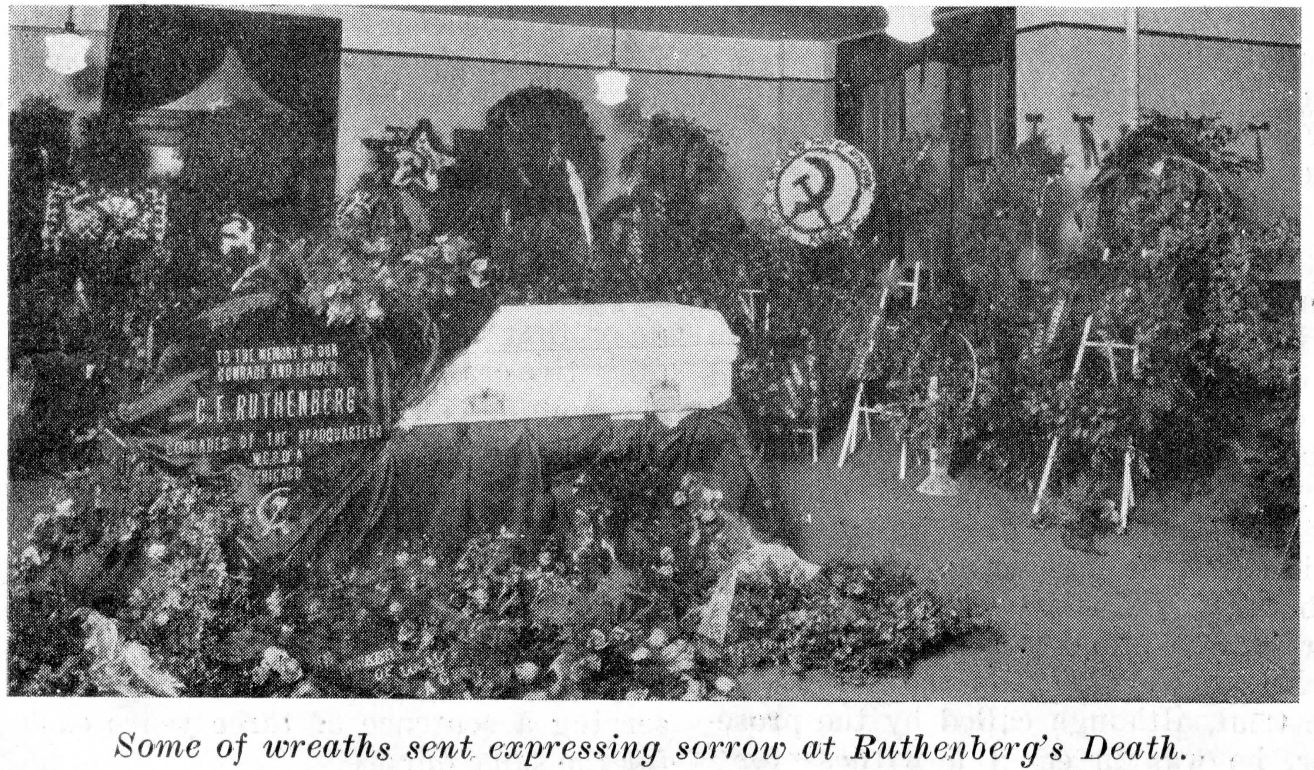
Ruthenberg died on March 2, after being operated on for an acute attack of appendicitis which developed into peritonitis. He fought against the implacable onslaught of death as valiantly as he did against the capitalist sys tem whose mortal foe he was.
Ruthenberg was General Secretary of the Workers (Communist) Party, a position held by him since the party was organized in 1921. Since 1909 until the time of his death this man, a son of a Cleveland longshoreman, devoted his entire time to the revolutionary movement, always in the front of the fight, never sparing himself.
Since 1917 Ruthenberg was under constant indictment and at the time of his death he was awaiting a decision of the United States supreme court on his appeal from the verdict of a Berrien County jury which found him guilty of an alleged violation of the criminal syndicalism law of that state arising out of the famous raid on the Communist convention in Bridgeman in August, 1922.
This case attracted nation-wide attention and aroused the entire labor movement against the authors of the raid, the notorious Harry M. Daugherty, grafting attorney general and attorney general and anti-labor injunctionist and the gang of capitalist servants that served Wall Street at that time, a gang that was followed by servants equally loyal and equally odoriferous in the nostrils of the working class.
My association with Comrade Ruthenberg during the Bridgeman raid, the time he spent in Berrien County jail with us and afterwards during his trial gave his associates an insight into a side of his character that those less intimate with him might not know. Beneath Ruthenberg’s seemingly cold exterior there was a heart as warm as ever throbbed in a human breast. And those who had the pleasure of working with him not only will feel the great gap left in the revolutionary ranks by his death but their sense of personal loss will be keen.
I remember vividly that beautiful morning in August as we lay on the grass or in the little canvas tents awaiting a train to take us to Chicago. But instead of a train a small fleet of automobiles arrived and gathered us into the county jail. Ruthenberg sat on the grass as the detectives rushed hither and thither nervously with drawn revolvers, cursing and using profane language. I can still see that calm face with the twinkling eyes and the contemptuous curling lip as he gazed on the capitalist mercenaries.
The small-town petty-bourgeois babbitts of St. Joseph, Michigan, expected to witness the arrival of a collection of wild men who would look more at home in a zoo than in a county jail. But after a few visits to the local hoosegow they changed their opinions though unfortunately the jury that brought in a verdict of “guilty” in the Ruthenberg trial did not consider the most ferocious of jungle beasts more dangerous to their liberties than the presence of men who would overthrow the capitalist system.
Ruthenberg, as the leader of the arrested men was singled out for special treatment by the jailers. He was not allowed to have the pleasure of associating with his comrade on the more agreeable upper floor of the jail. The department of justice agents feared that his advice would be helpful to us and that his companionship would encourage us. They took him down stairs to one of the vilest detention pens I ever saw. When our lawyer visited the jail to consult with the prisoners we had an opportunity to see Comrade Ruthenberg for a few minutes on his way to the visiting room. He was always smiling and his manner was contagious.
This was the real Ruthenberg, thinking of the movement rather than of his own comfort, thinking of his comrades. What a tower of strength he was to us. In court, chained to another prisoner he arose and made the customary plea. He towered over the capitalist hacks like a giant. Their moral superior, the capitalist flunkies realized their own smallness.
Ruthenberg was indicted and convicted. His testimony on the witness stand at the Berrien County contributed a glorious page in the history of the class struggle in America. As the spokesman for the working class movement Ruthenberg carried himself gallantly. We who were very close to him were proud of the way he handled himself on the witness stand and even his most bitter foes outside the movement were forced to admit that here was a man among men, a man who knew no fear, a man who was ready to lay his great ability at the feet of the labor movement and lay down his life on the altar of working class emancipation.
C.E. Ruthenberg is gone from our midst. He died in the prime of life. at the moment when his experience and ability were needed most, when the working class movement could least spare him. It is the fortune of war and though the revolutionary workers mourn his loss, they and the movement he helped to fashion with them will grow in power until the robber system that he fought so strenuously during the greater part of his adult life will sink beneath the weight of its iniquity and from the mighty blows of a working class in revolt and until the Republic of Labor is erected on its ruins.
Labor Defender was published monthly from 1926 until 1937 by the International Labor Defense (ILD), a Workers Party of America, and later Communist Party-led, non-partisan defense organization founded by James Cannon and William Haywood while in Moscow, 1925 to support prisoners of the class war, victims of racism and imperialism, and the struggle against fascism. It included, poetry, letters from prisoners, and was heavily illustrated with photos, images, and cartoons. Labor Defender was the central organ of the Scottsboro and Sacco and Vanzetti defense campaigns. Editors included T. J. O’ Flaherty, Max Shactman, Karl Reeve, J. Louis Engdahl, William L. Patterson, Sasha Small, and Sender Garlin.
PDF of full issue: https://www.marxists.org/history/usa/pubs/labordefender/1927/v02n04-apr-1927-ORIG-LD.pdf
 Revolution's Newsstand