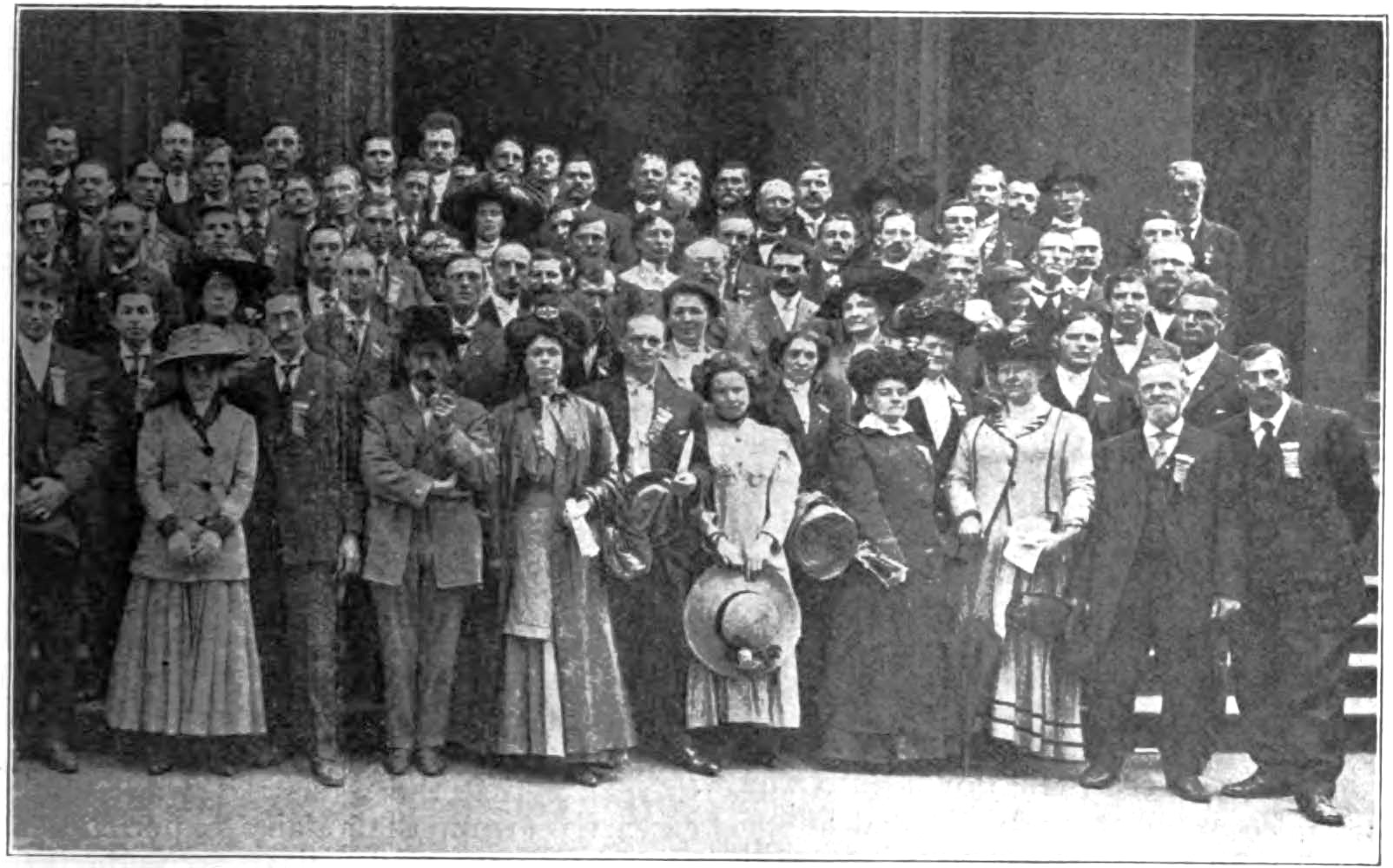
A leading partisan of the Socialist Party’s left wing, Charles H. Kerr with series of vignettes from the 1910 National Convention offers us insights into its politics and personalities. That year the Socialist Party had an average monthly membership of 57,383. The year following this convention, in 1911, the average was 97,773.
‘Sparks from the National Convention’ by Charles H. Kerr from International Socialist Review. Vol. 10 No. 12. June, 1910.
We are glad the forms of the Review do not have to close before we can get in a few words about the spirit of the Convention held in Chicago this month.
Many comrades of the revolutionary wing of the party feared that some of the old spirit of revolt would be lacking this year. Some of us feared that the party might be swung off its feet, and out of the path of progress into the snares of opportunism, that we might forget our one great aim–the abolition of wage-slavery–for immediate and doubtful “victories.” And now we are singing a song of great rejoicing.
Although the Convention is only half over and many of the proceedings have dragged along tiresomely, the re-union has strengthened those of us who had grown weary into renewed faith in the party and our comrades.
There were hot debates over tactics to be pursued by the Socialist Party in securing the ballot for women. Much to the surprise of the Convention some of the women delegates were in favor of a socialist union with suffrage societies.
Comrade Prevey of Ohio, said:
“I want to stand on the street corner and talk as a socialist and not as a suffragette.”
Comrade Joe Cannon, of Arizona, gave a talk against catering to the society suffragette element. And, by the way, Comrade Joe Cannon can be depended upon to forge straight ahead for the revolution and the movement of the wage-workers for the abolition of capitalism. If we did not know where he stood before the Convention, his uncompromising stand upon each and every question was enough to inspire a wooden image. Count on Comrade Joe.
“I don’t care for this dilettante and bon ton suffragette movement that would tend to disrupt the socialist party,” said Comrade Cannon.
The vote of the Convention was almost unanimous to keep the socialist movement intact, class conscious and revolutionary. We are not to go rainbow chasing after the Belmont and Morgan suffragettes. The ballot for working-women is a class demand and not a sex movement alone.
On all questions the women delegates of the Convention acquitted themselves nobly.
Comrades Fred Merrick and Joe Cohen, of Pennsylvania, materially aided in expediting the work of the Convention. Keep your eye on Fred Merrick. He is a comrade who knows that the only help for the proletariat is to be found in the abolition of wage-slavery.
“The Whirlwind of the Pacific Coast” was the name given Comrade Tom J. Lewis, of Oregon. Lewis believes in the wage-workers, first, last and all the time.
Some of the Chicago socialists became so enthused over the speeches. made by Delegate Tom Lewis, at the Convention, and Ed. Moore, of Philadelphia, that they inveigled both comrades into lecturing before the Twenty-first Ward Branch.
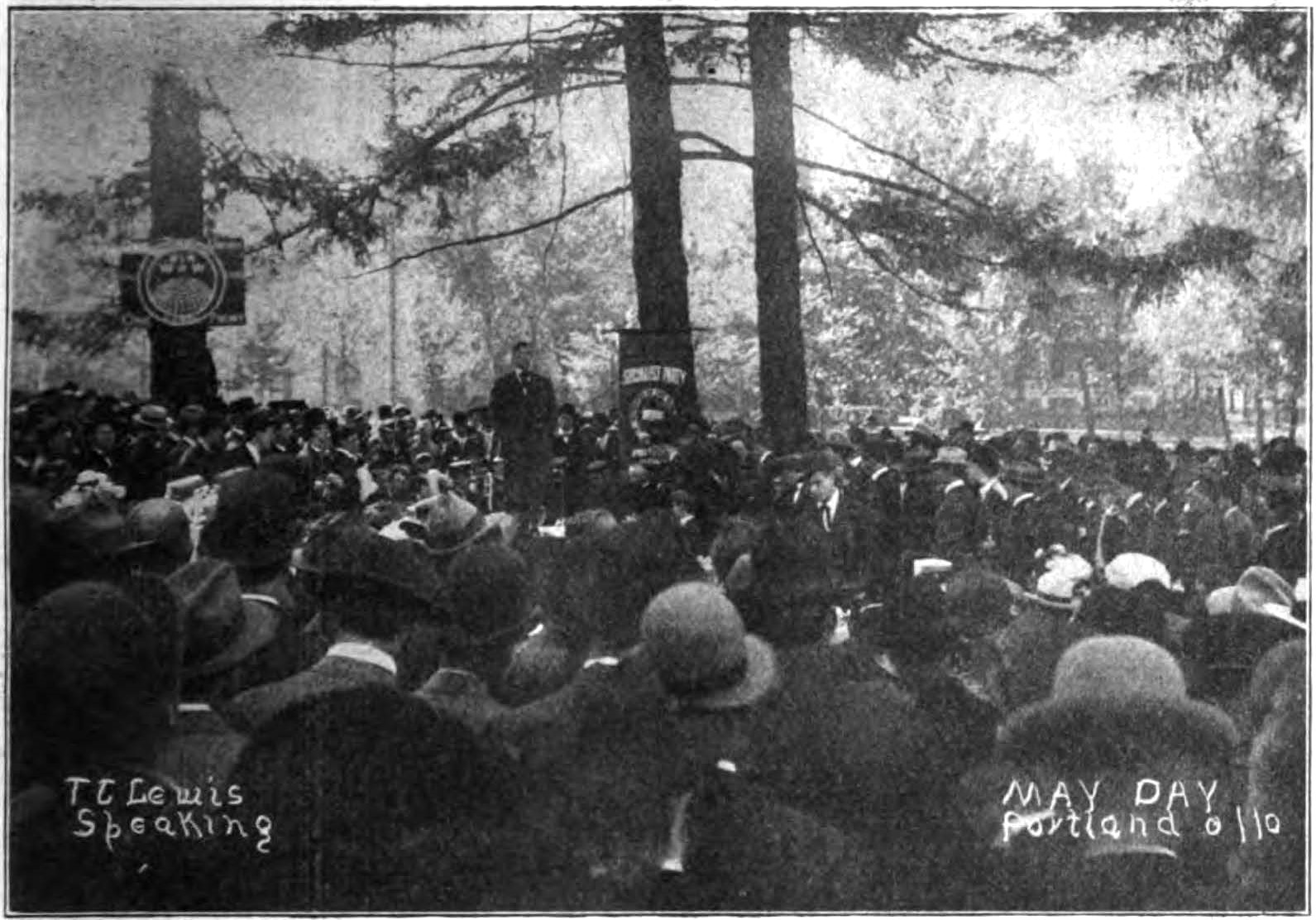
And the Chicago Socialists were given such a wakening up at that meeting as they have not had for a long time.
Comrade Moore’s talk upon the strike in Philadelphia was simply inspiring. We found, in Philadelphia, he said, that we had loads of revolutionary material that we had always called reactionary. When the pinch came, it was not the paid organizers, officials, editors, lecturers or writers who displayed the strongest degree of class consciousness, but the unorganized, often unskilled and ill-paid wage-workers. The way these. men and women struck and stuck to their class the solidarity they showed, has encouraged us socialists more than anything we have seen in many years. We didn’t know how strong we were.
“Don’t go out for low rents, or cheap reforms,” said Tom J. Lewis. “Low rents mean lower wages and are only a help to the capitalists. They want low rents and cheap bread more than you do. Wages sink as the cost of living sinks, so you can’t get anything by going out for low prices.”
Tom Lewis does not waste his brilliance before cultured and “high” (?) class audiences, in marble halls. He goes to the heart of the revolutionary element–to the wage-workers, and comrades from Oregon assure us he often speaks to 2,000 workingmen and women in Portland, in a single evening.
The Convention was an inspiration to us all. We did not know how many splendid, uncompromising workers the party possesses until we met some of them at Masonic Temple. You don’t often see some of their names in the papers, but they are the men and women without whom the revolution would be but a flimsy farce–the brawn and brain of the great class struggle that will only end when wage-slavery has been abolished and the working class come into its own.
It was recommended in the supplementary report of the Committee on Commission Form of Government that if the comrades fail to win in primaries in cities under a Commission Form of Government, the Congress advise the comrades nevertheless not to abandon the struggle but to leave the members free to vote (for capitalist candidates) in the second election. Delegates Thompson, of Wisconsin, and Simons, of Illinois, championed this recommendation. But it was voted down by a vote of 48 to 17, with the Milwaukee delegation solidly supporting it. We are not yet ready to abandon our policy of no compromise; no political trading.
Delegate Merrick, of Pennsylvania, added his portion of inspiration to the comrades who think straight socialism is good enough for them. Comrade Barnes, of Louisiana, lined up for industrial unionism. “It is the only thing that will solve the race problem of the South,” he said.
Delegates Steve Reynolds and James O’Neal, maintained the reputation of the Hoosier State for producing some of the finest.
Frank M. Cassidy, of Buffalo, N.Y., former editor of the Switchmens’ Journal, said, “We have to have a revolutionary economic organization to back up the political fight at the ballot box.”
Comrade Cassidy speaks from practical experience in one of the strongest fighting labor organizations and not from ruminations in the libraries.
Delegate Geo. Brewer, of Kansas, didn’t seem to feel the need of any party compromises. There is nothing the matter with Kansas.
Delegate Meyer London and John Spargo, of New York, will be able to look future International Japanese and Chinese delegates to the International Socialist Congresses in the face and say “Comrade.” Both gave splendid arguments against the Asiatic Exclusion Recommendation.
“The men in the craft unions are simply aching for a change,” said Delegate Maurer, of Pennsylvania, in his plea for an endorsement of industrial unionism.
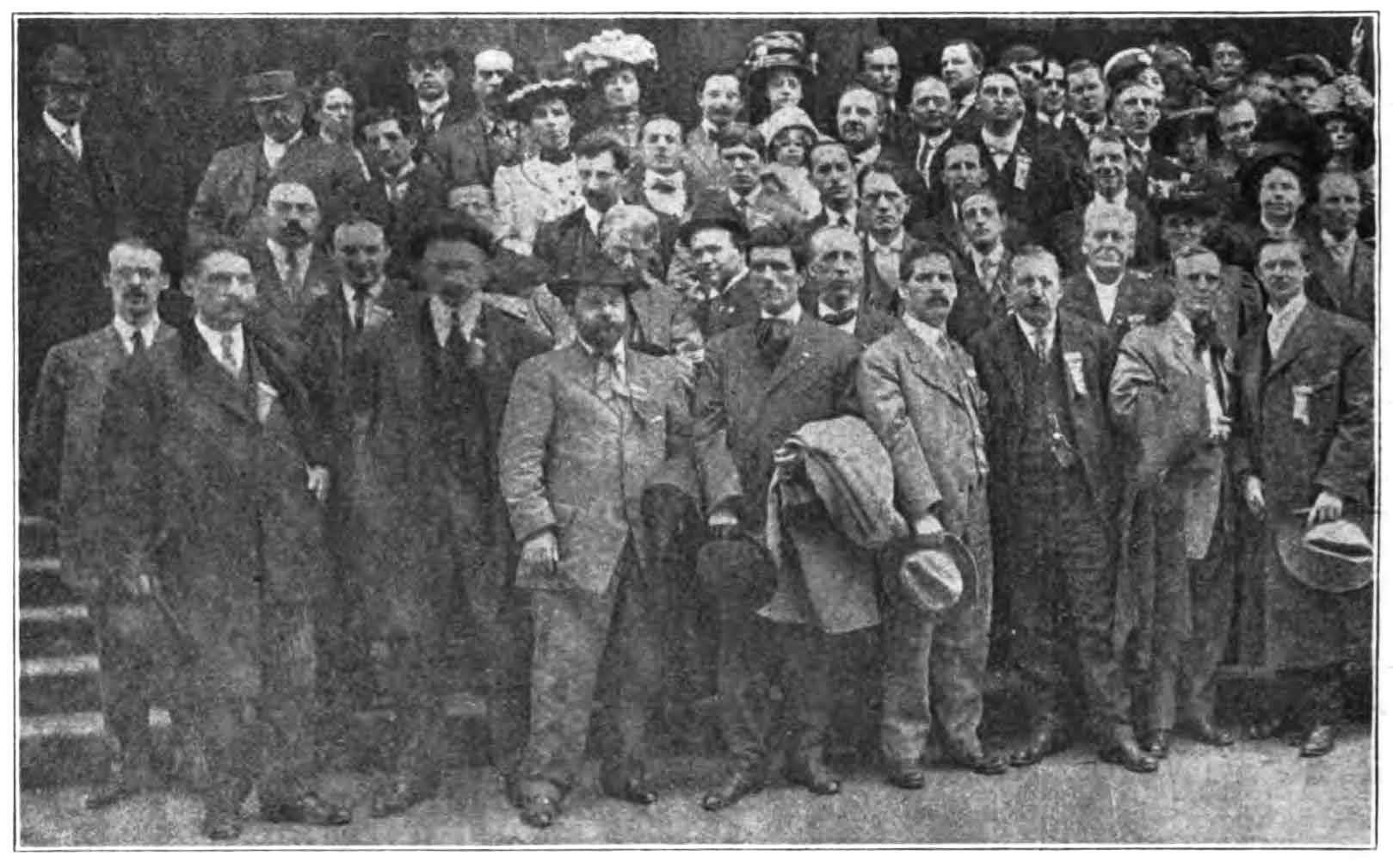
We all took a liking to Mayor Seidel, of Milwaukee. “We all make mistakes,” he said, “but we must do the best we can.”
Delegate Berger, of Wisconsin, wanted all delegates to be paid for time spent at the Convention. The motion was voted down. Comrade Berger said the Convention delegates were as much entitled to pay as the International Delegates.
Delegate Robert Ringler, of Pennsylvania, was always on the job for straight class-conscious socialism, without any opportunistic trimmings.
Did anybody hear anything about the Report of that Farmers’ Committee? Read it over carefully and you will understand why it fell with such a sickening thud.
Delegate Bell, of Texas, was instructed by the farmers of that state to say they only wanted straight socialism. There is nothing the matter with the Texas farmer.
Delegate Thomas Morgan, of Illinois, was right on the job with both eyes open. Evidently Comrade Morgan thinks it is better to have a small organization of people who know what they want than a big one of folks who want any old thing.
Chicago comrades had more than one treat in hearing Theresa Malkiel, of New York, speak. Every word came straight from the heart and we all wanted to keep her here.
Comrade Lena Morrow Lewis, member of the National Executive Committee, was made a member of the Woman’s Committee.
Every Red who attended the Convention went home overflowing with enthusiasm. Watch us work. We never knew before how strong we were. Delegates Caroline Lowe and Kate Richards O’Hare both old friends–and Delegate Winnie Branstetter, of Oklahoma, inspired every one who heard them talk.
Big Bill Haywood was at the Convention and those who had been on the firing-line in any part of the country, were glad to see him.
What was the matter with the Michigan Delegation? Not a single thing. If you don’t know what the Party needs–go to Grand Rapids. The only thing we hate to see is so many good ones in a bunch. They ought to spread out more. The Finnish delegates from the Northern Peninsula, all members of the Western Federation of Miners, were on the right side of every question.
Delegate Waynick, of Washington, knows what he wants. Nothing was able to shake him loose from a revolutionary program. Read the Report for Industrial Unionism by Waynick and Delegate Cannon, of Oregon.
Doc Miller, of Akron, attended the Convention. “The man who swears,” he said, “is not a respecter of ‘sacred institutions'”. We would like to hear Doc debate it out with Comrade John M. Work. Doc ought to have been in on that organization Committee.
Comrade John G. Willert, of Ohio, was an innovation as a chairman. He was always able to see and to recognize the delegate unknown to fame.
There were two Cannons at the Convention, and they always made the right kind of a noise.
The International Socialist Review (ISR) was published monthly in Chicago from 1900 until 1918 by Charles H. Kerr and critically loyal to the Socialist Party of America. It is one of the essential publications in U.S. left history. During the editorship of A.M. Simons it was largely theoretical and moderate. In 1908, Charles H. Kerr took over as editor with strong influence from Mary E Marcy. The magazine became the foremost proponent of the SP’s left wing growing to tens of thousands of subscribers. It remained revolutionary in outlook and anti-militarist during World War One. It liberally used photographs and images, with news, theory, arts and organizing in its pages. It articles, reports and essays are an invaluable record of the U.S. class struggle and the development of Marxism in the decades before the Soviet experience. It was closed down in government repression in 1918.
PDF of full issue: https://www.marxists.org/history/usa/pubs/isr/v10n12-jun-1910-ISR-gog-EP-f-cov.pdf
 Revolution's Newsstand