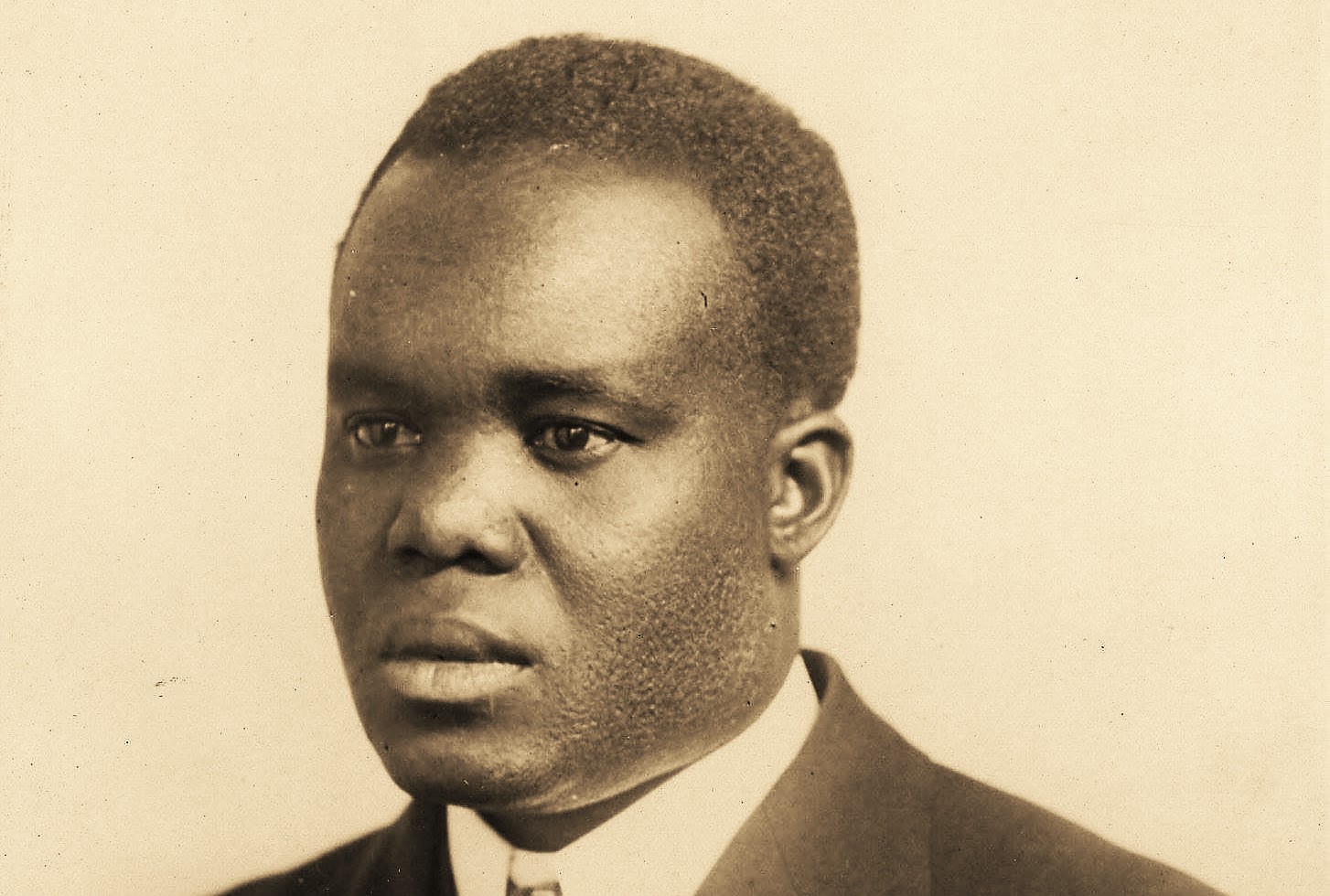
In a war over African colonies, what would be the place of Africa at the peace conference? Hubert H. Harrison on Africa at Versailles.
‘Africa and the Peace’ by Hubert H. Harrison from When Africa Awakes. Porro Press, New York City. 1920.
“This war, disguise it how we may, is really being fought over African questions.” So said Sir Harry Johnston, one of the foremost authorities on Africa, in the London Sphere in June, 1917. We wonder if the Negroes of the Western world quite realize what this means. Wars are not fought for ideals but for lands whose populations can be put to work, for resources that can be minted into millions, for trade that can be made to enrich the privileged few. When King Leopold of Belgium and Thomas Fortune Ryan of New York joined hands to exploit the wealth of the Congo they did it with oiled phrases on their lips. They called that land of horrors and of shame “The Congo FREE State!”
And, so, when Nations go to war, they never openly declare what they WANT. They must camouflage their sordid greed behind some sounding phrase like “freedom of the seas,” “self-determination,” “liberty” or “democracy.’ But only the ignorant millions ever think that those are the real objects of their bloody rivalries. When the war is over, the mask is dropped, and then they seek “how best to scramble at the shearers’ feast.” It is then that they disclose their real war aims.
One of the most striking cases in point, is the present peace congress. Already President Wilson has had to go to look after democracy himself. Already responsible heads of the Allied governments are making it known that “freedom of the seas” means a benevolent naval despotism maintained by them, and that “democracy” means simply the transfer of Germany’s African lands to England and the others. Africa at the peace table constitutes the real stakes which the winners will rake in. We may read in headlines the startling item “Negroes Ask For German Colonies,” but Negroes of sense should not be deluded. They will not get them because they have no battleships, no guns, no force, military or financial. They are not a Power.
Despite the pious piffle of nice old gentlemen like Professor Kelly Miller, the King-word of modern nations is POWER. It is only Sunday school “kids” and people of child-races who take seriously such fables as that in the “Band of Hope Review” when we were children that “the secret of England’s greatness is the Bible.” The secret of England’s greatness (as well as of any other great nation’s) is not bibles but bayonets—bayonets, business and brains. As long as the white nations have a preponderance of these, so long will they rule. Ask Japan: she knows. And as long as ‘the lands of Africa can yield billions of business, so long will white brains use bayonets to keep them—as the British government did last year in Nigeria.
Africa is turning over in her sleep, and this agitation now going on among American Negroes for the liberation of Africa is a healthy sign of her restlessness. But it is no more than that. Africa’s hands are tied, and, so tied, she will be thrown upon the peace table. Let us study how to unloose her bonds later. Instead of futile expectations from the doubtful generosity of white land-grabbers, let us American Negroes go to Africa, live among the natives and LEARN WHAT THEY HAVE TO TEACH US (for they have much to teach us). Let us go there—not in the coastlands,—but in the interior, in Nigeria and Nyassaland; let us study engineering and physics, chemistry and commerce, agriculture and industry; let us learn more of nitrates, of copper, rubber and electricity; so will we know why Belgium, France, England and Germany want to be in Africa. Let us begin by studying the scientific works of the African explorers and stop reading and believing the silly slush which ignorant missionaries put into our heads about the alleged degradation of our people in Africa. Let us learn to know Africa and Africans so well that every educated Negro will be able at a glance to put his hand on the map of Africa and tell where to find the Jolofs, Ekois, Mandingoes, Yorubas, Bechuanas or Basutos and can tell something of their marriage customs, their property laws, their agriculture and systems of worship. For, not until we can do this will it be seemly for us to pretend to be anxious about their political welfare.
Indeed, it would be well now for us to establish friendly relations and correspondence with our brothers at home. For we don’t know enough about them to be able to do them any good at. THIS peace congress (even if we were graciously granted seats there); but fifty years from now —WHO KNOWS?
When Africa Awakes by Hubert H. Harrison. Porro Press, New York City. 1920.
Harrison’s uniquely important collection of writings from 1917-1920 published in various journals from the time, published by Porro Press (personally published).
PDF of full book: https://archive.org/download/ldpd_13339574_000/ldpd_13339574_000.pdf
 Revolution's Newsstand