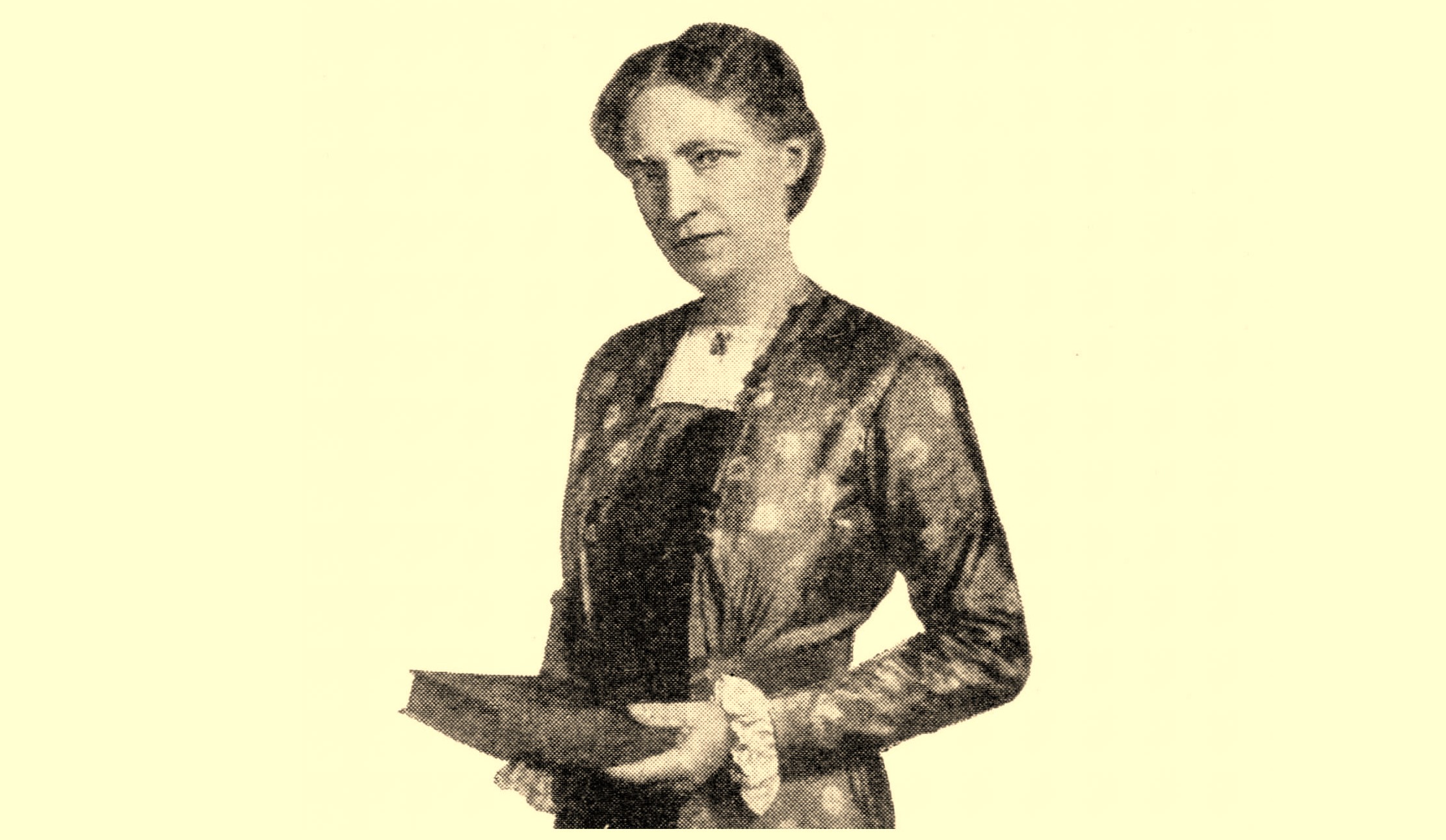
A generation of women Marxists particularly inspired by the English translations of Engels’ ‘Origins of the Family’ and Bebel’s ‘Woman and Socialism’ eagerly applied what they had learned to their own, and U.S. conditions. Hundreds of books, pamphlets, and articles embraced the new ‘materialism’ in looking at society from the perspective of women, however ‘vulgar’ that materialism sometimes was. Lida Parce (1867-1923) was one of the most consistent challengers to male supremacy in the Socialist Party of the Debs era, and one its leading theoreticians of women’s liberation.
‘Competition vs. Sociality’ by Lida Parce from The Masses. Vol. 4 No. 1. July, 1912.
IT is customary to set individualism and Socialism over against each other, as if they were opposed in such a way as to be mutually exclusive and destructive. Competition is confounded with the development of the individual, and sociality is confounded with the sacrifice of him. It is represented that the individual can only be developed at the expense of society, and that the latter, if it thrives, must do so by sacrificing the individual. The defenders of the old order contend that the individual is developed by the competitive system and that he would be “leveled down” by the co-operative commonwealth.
It is a master stroke of the defenders of competition to defend it in the name of the right to individuality, and to identify Socialism with the submergence of the individual; for nature has made us individuals, and it is the law of Life that we must defend our individual identity, freedom and power, wherever we believe them to be attacked. But Nature does not require the sacrifice of the individual in order that the race may prosper. On the contrary, she can only look after the race if the individual takes care of himself. He must do that; but he is not doing it now. The time has come when the individual man cannot take care of himself, under the competitive system. That system has become so complex and powerful that the man has no chance under it; and all the power of it is lodged, along with the ownership of the machinery of production, in the hands of a few men, who use it for their own profit against the masses. It has become a competition of classes, and that class which represents the vast majority of society has no prospect of survival in the struggle, unless it gives up competition within itself and turns all its strength against the other class. By substituting sociality for competition among themselves by means of co-operative selling of labor and co-operative buying of commodities, the workers will be able to withstand the crushing power of the system. And after they shall have learned to co-operate still further, they will be able to take over the system itself and to operate it in favor of all the people. It is not a question of submerging the individual; but one of making a change of methods, by which to protect the individual from corporations having special privileges and power, and to give him the opportunity for self-expression.
The confusion of individuality with competition and the confusion of sociality with the sacrifice of the individual are not abreast of scientific thought, but belong to the old topsy-turvy, theological way of thinking–that we–think. The progressive social psychologist of to-day tells you that there is no such thing as individual development outside the social process. The social process is one of mutual give-and-take, action and reaction, stimulation and response. The mental machinery of the individual is put in motion by the stimulations which he receives through his contact with society. The social attitude consists in a state of readiness to respond to stimulations, whether of need, of love, of friendship or of any of the innumerable interchanges which constitute social life. If society is highly organized and complex, the individual receives a great number of stimulations and he is developed, rounded out, on many sides. If the individual is in close contact with society, so much the better, for then society presses a great number of buttons which start more machinery into motion. Man comes into the world with an infinite variety of mental machinery set up and ready for action; but he cannot start it off himself; he knows nothing about it. Society must do that. And this social give-and-take is the thing which is opposed to competition in its nature. It is an even exchange, but competition is an uneven exchange. In the competitive attitude one sets his face against his fellow; he tries to receive without giving an equal return, to gain at the other’s expense. And where this attitude steps in, the social attitude, with its unlimited possibilities for individual development, is cut off. Of course, in our present society both exist side by side in most of the transactions of life; but wherever the other fellow is sacrificed to the self, to even the slightest extent, an injury is done to the individual. Thus there is no basis for the contention that competition is the system which promotes individuality. Competition is the system which kills it, and sociality is the system which promotes it.
We wonder why, with all our mechanical facilities and vast wealth, our level of culture is so low; why even the rich, the few who have gained possessions by competition, are not happy. And this is the reason why: The more competitive the individual, the more the social stimulations by which the faculties are awakened are shut off, and the less his powers of understanding, feeling and enjoying are brought into action. If, as Ward says, the greatest happiness consists in the most vigorous exercise of the largest number of faculties, happiness cannot be promoted by any system which shuts off the social give-and-take.
Competition may develop the individual pocketbook, but if the capacity of the rich for happiness is limited to the region of the pocketbook, the man has not been developed in culture to any noticeable extent.
Culture consists in the capacity for appreciation and of enjoyment, not through the elementary emotions, but through the finer derivative emotions. But there is nothing in the competitive attitude or process to cultivate those finer powers of enjoyment and understanding. The social process is the one by which culture must be acquired.
Socialism is organized sociality in industry. It will require everyone to produce as much as he or she consumes. But close and complex organization on the industrial side does not imply control of the individual in his personal actions and relations. It does not imply social control in private matters; but it will liberate the individual from control in private affairs, because he will no longer depend upon any person for a chance to earn his living. While compelling every man to earn his living, it will protect him as a producer and insure to him the enjoyment of the full value of the fruits of his labor. Thus he will have money enough to develop his individuality, and he will have leisure enough for culture, for he will not have to work to the point of exhaustion all the time in order to feed himself. Under the competitive system the worker has neither money nor leisure sufficient for culture or happiness.
The American Indian lived under a social organization of industry, and he was the most perfect and uncompromising individualist that ever lived. His opportunities for culture and happiness were low, because the arts of life were still imperfectly developed; but he combined individuality with sociality in a high degree. His organized sociality was the means of setting his individuality free.
We live now in an age in which the arts of life are highly developed, and in which the potentialities of culture and happiness are therefore immensely heightened. But they are only potentialities, not actualities as yet, because through the enormous growth of class commercialism we have lost the balance between individuality and sociality. Socialism comes to restore on the plane of civilization that balance which mankind enjoyed on the plane of the higher barbarism.
The Masses was among the most important, and best, radical journals of 20th century America. It was started in 1911 as an illustrated socialist monthly by Dutch immigrant Piet Vlag, who shortly left the magazine. It was then edited by Max Eastman who wrote in his first editorial: “A Free Magazine — This magazine is owned and published cooperatively by its editors. It has no dividends to pay, and nobody is trying to make money out of it. A revolutionary and not a reform magazine; a magazine with a sense of humour and no respect for the respectable; frank; arrogant; impertinent; searching for true causes; a magazine directed against rigidity and dogma wherever it is found; printing what is too naked or true for a money-making press; a magazine whose final policy is to do as it pleases and conciliate nobody, not even its readers — There is a field for this publication in America. Help us to find it.” The Masses successfully combined arts and politics and was the voice of urban, cosmopolitan, liberatory socialism. It became the leading anti-war voice in the run-up to World War One and helped to popularize industrial unions and support of workers strikes. It was sexually and culturally emancipatory, which placed it both politically and socially and odds the leadership of the Socialist Party, which also found support in its pages. The art, art criticism, and literature it featured was all imbued with its, increasing, radicalism. Floyd Dell was it literature editor and saw to the publication of important works and writers. Its radicalism and anti-war stance brought Federal charges against its editors for attempting to disrupt conscription during World War One which closed the paper in 1917. The editors returned in early 1918 with the adopted the name of William Lloyd Garrison’s The Liberator, which continued the interest in culture and the arts as well as the aesthetic of The Masses/ Contributors to this essential publication of the US left included: Sherwood Anderson, Cornelia Barns, George Bellows, Louise Bryant, Arthur B. Davies, Dorothy Day, Floyd Dell, Max Eastman, Wanda Gag, Jack London, Amy Lowell, Mabel Dodge Luhan, Inez Milholland, Robert Minor, John Reed, Boardman Robinson, Carl Sandburg, John French Sloan, Upton Sinclair, Louis Untermeyer, Mary Heaton Vorse, and Art Young.
PDF of full issue: https://www.marxists.org/history/usa/pubs/masses/issues/tamiment/t18-v03n06-jun-1912.pdf
 Revolution's Newsstand