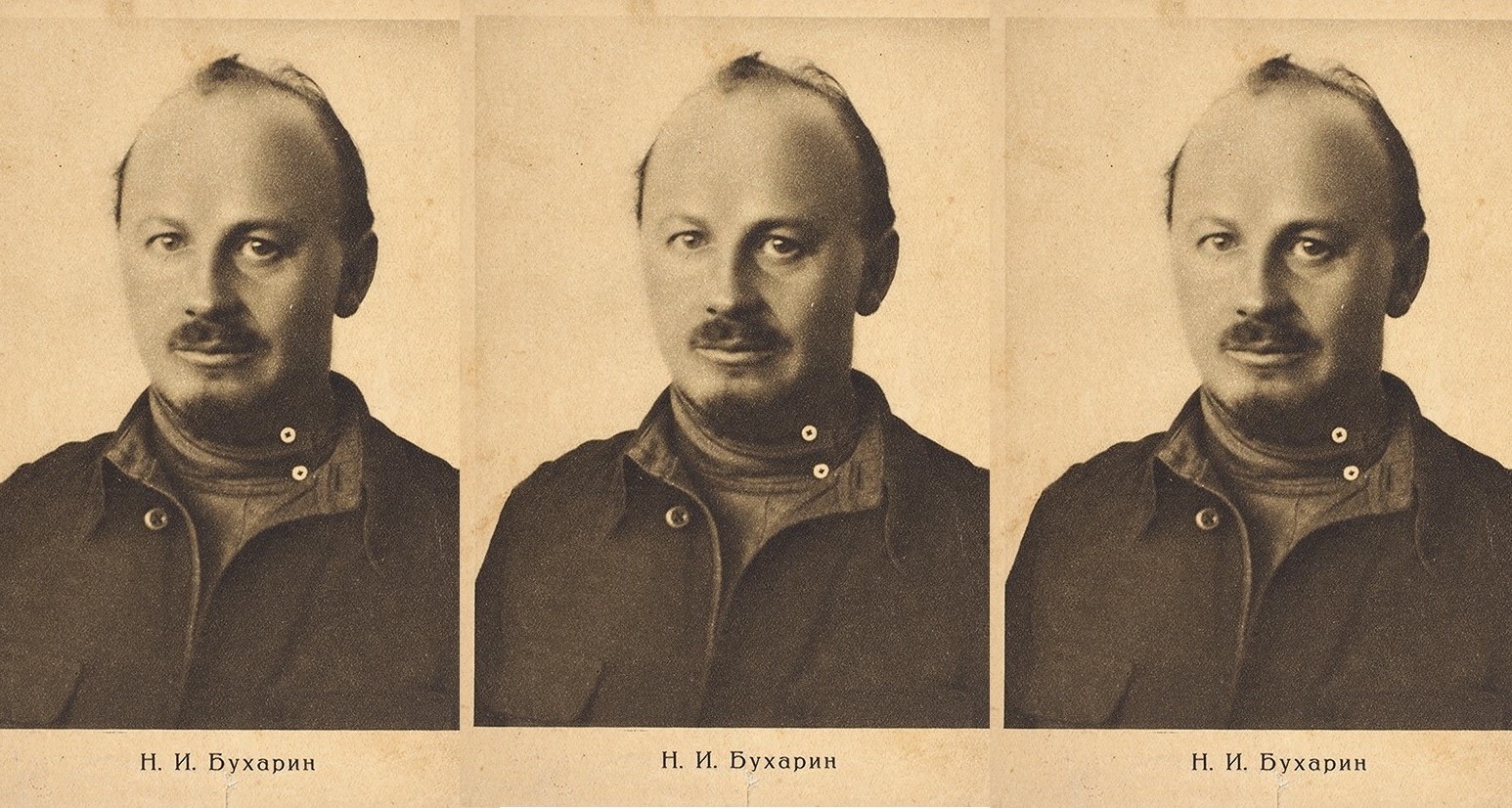
A rich section from Bukahrin’s work, a critique of the ‘Austrian School’ of economists, originally written in 1914, with the 1927 International Publishers edition being its first English translation.
‘Objectivism and Subjectivism in Political Economy’ by Nikolaĭ Bukharin from The Economic Theory of the Leisure Class. International Publishers, New York. 1927.
Werner Sombart, in the well known article in which he reviewed the third volume of Marx’s Capital, after having contrasted the two methods of political economy, the subjective method and the objective method, designates Marx’s system as an outgrowth of “extreme objectivism”; while the Austrian School, in his opinion, was “the most consistent development in the opposite direction.1 We consider this characterisation perfectly accurate. It is true that the study of social phenomena in general and of economic phenomena in particular may be approached in either one of two ways: we may assume that science proceeds from the analysis of society as a whole, which at any given moment determines the manifestations of the individual economic life, in which case it is the task of science to reveal the connections and the causal chain obtaining between the various phenomena of social type and determining the individual phenomena; or, it may be assumed that science should proceed from an analysis of the causal nexus in the individual life, since the social phenomena are a certain resultant of individual phenomena — in which case it would be the task of science to begin with the phenomena of the causal relation in the individual economic life from which the phenomena and the causation of the social economy must be derived.
No doubt Marx is an “extreme objectivist” in this sense, not only in sociology, but also in political economy. For this reason his fundamental economic doctrine — the doctrine of value — must be sharply distinguished from that of the classical economists, particularly Adam Smith. The latter’s labour due theory is based on an individual estimate of commodities, corresponding to the quantity and quality of the used labour. This is a subjective labour value theory, as compared with which Marx’s theory of value is objective; i.e.. Marx’s theory is a social law of prices. Marx’s theory is accordingly an objective theory of labour value, based by no means on any individual evaluation, but expressing only the connection between the given social productive forces and the prices of commodities as the latter are determined on the market.2 In fact, it is with the example of the theory of value and price that Sombart best shows the difference between the two methods. “Marx does not for a moment concern himself,” says Sombart, “with the individual motives of those engaging in the exchange, or with assuming as his starting point considerations as to production costs. No, his reasoning is as follows: prices are made by competition; how they are made, that is another matter. But competition, in turn, is regulated by the rate of profit: the rate of profit by the rate of surplus value; the rate of surplus value by the value, which is itself the expression of a socially conditioned fact, the social productive forces. Marx’s system now enumerates these elements in the reverse order: value — surplus value — profit -competition — prices, etc. If we must formulate the situation in a single crisp sentence, we may say that Marx is never concerned with motivating, but always with defining (limiting) the individual caprice of the economic person.” (Werner Sombart, op. cit., p. 591) Quite different is the subjective school. We find “nothing but ‘motivation’ everywhere, for each [individual] economic transaction.” (Ibid., p.592.)
The difference is here beautifully expressed. As a matter of fact, while Marx considers “the social movement as a process of natural history governed by laws not only independent of the human will, consciousness and intelligence, but rather, on the contrary, determining that will, consciousness, and intelligence,”3 the point of departure for Böhm-Bawerk is an analysis of the individual consciousness of the economic person.
“The social laws,” writes Böhm-Bawerk, “whose investigation is the task of political economy, depend on coinciding transactions of individuals. Such uniformity of action is in turn a consequence of the operation of like motives determining action. Under these circumstances, it is not easy to admit a doubt as to the propriety of explaining social laws by tracing them back to the impelling motives determining the actions of individuals, or, by starting with these motives.”4 The difference, therefore, between the objective and the subjective method is nothing more nor less than the contrast between the social and the individualist methods. (R. Stolzmann: Der Zweck in der Volkszwirtschaftslehre, Berlin, 1909, p.59.) Yet the above quoted definition of the two methods needs still to be amplified. We must emphasise above all the unimportance of the will, the consciousness or the intentions of men, of which Marx speaks. In the second place, the “economic individual” must be more clearly defined, since it is the point of departure of the Austrian School. “These determined social relations are as much produced by men as are the cloth, the linen, etc.” (Karl Marx: The Poverty of Philosophy, Chicago, Charles H. Kerr, p.119.) It by no means follows, however, that the social consequences, that “social product” of which Marx speaks, is contained within the consciousness of these individuals as a goal or an impelling motive. Modern society, with its anarchic structure (the theory of political economy makes precisely this society the object of its study); with its market forces and their elemental action (competition, fluctuation of prices, stock exchange, etc.), offers numerous illustrations in favour of the assumption that the “social product” predominates over its creators, that the result of the motives of the individual (yet not isolated) economic men, not only does not correspond to these motives, but at times even enters into direct opposition to them.5 This may best be explained by the example of the formation of prices. A number of buyers and sellers go to market with a certain (approximate) idea of the value of their own goods as well as of each other’s goods; the result of their struggle is a certain market price, which will not coincide with the individual estimates of the great majority of the contracting parties. Furthermore, in the case of a number of “economic individuals” the established price may actually operate with destructive effect; low prices may force them to go out of business; they are “ruined.” This phenomenon is even more striking on the stock exchange, where gambling is the rule. In all these cases, which are typical for the modern social-economic organisation, we may speak of the “independence” of social phenomena of the will, the consciousness and the intentions of men; yet this independence should by no means be understood as involving two different phenomena, completely independent of each other. It would be absurd to assume that human history is not being made by the will of men, but regardless of this will (this “materialist conception of history” is a bourgeois caricature of Marxism); precisely the opposite is the case. Both series of phenomena — individual transactions and social phenomena — are in the closest genetic relation with each other. This independence must be understood only in the sense that such results of individual acts as have become objective are supreme over all other partial elements. The “product” dominates its creator; at any given moment, the individual will is determined by the already achieved resultant of the clash of wills of the various “economic individuals.” The entrepreneur defeated in the competitive struggle, the bankrupt financier, are forced to clear the field of battle, although a moment ago they served as active quantities, as “creators” of the social process which finally turned against them.6 This phenomenon is an expression of the irrationality of the “elemental” character of the economic process within the frame of the commodities economy, which is clearly expressed in the psychology of commodities fetishism, as first exposed and brilliantly analysed by Marx. It is precisely in a commodities economy that the process of “objectivism,” of relations between human beings, takes place, in which these “thing-expressions” lead a specific “independent” existence by reason of the elemental character of the evolution, an existence subject to a specific law of its own.
We are thus dealing with various series of individual phenomena and with a number of series of social types: no doubt a certain causal connection obtains both between these two categories (individual and social) and between the various series of the same category, particularly between the various series of social phenomena dependent on each other. Marx’s method consists precisely in ascertaining the causal law of relations between the various social phenomena. In other words, Marx examines the causal nature of the resultants of the various individual wills, without examining the latter in themselves; he investigates the laws underlying social phenomena, paying no attention to their relation with the phenomena of the individual consciousness.7
Let us now turn to the “economic subjects” of Böhm-Bawerk.
In his article on Karl Menger’s book (Untersuchungen, etc.), Böhm-Bawerk, in agreement with the opponents of the Austrian School and with Menger himself, admits that the “economic subjects” advanced by the representatives of the new School are nothing more nor less than the atoms of society. The task of the new School is “the elimination of the historical and organic methods as the dominant methods of theoretical investigation in the social sciences …and…the restoration of the precise atomistic tendency.” (Böhm-Bawerk: Zeitschrift für Privat- und öfftentlickcs Recht der Gegenwart, Vienna, 1884, vol. XI, p.220.)
The starting point of the analysis is evidently not the individual member of a given society, in his social relations with his fellow men, but the isolated “atom,” the economic Robinson Crusoe. The examples chosen by Böhm-Bawerk in order to clarify his views are also of this type. “A man is seated by a spring of water which is gushing profusely” — such is Böhm-Bawerk’s introduction to his analysis of the theory of value. Böhm-Bawerk: “Grundzüge der Theorie des wirtschaftlichen Güterwerts.” Hildebrandt’s Jahrücher für Nationalökonomie und Statistik, vol. XIII, p.9.) He then introduces: a traveller in the desert (ibid., p.9), a farmer isolated from all the rest of the world (ibid., p.9), a colonist, “whose log-cabin stands lonely in the primeval forest” (ibid., p.30), etc. We encounter similar examples in Karl Menger: “the inhabitant of the forest primeval” (Karl Menger: Grunsätze tee der Volkswirtschaftslehre, Vienna, 1871, p.82), “the dwellers in an oasis” (ibid., p.88), “a nearsighted individual on a lonely island” (ibid., p.95), “an isolated farmer” (ibid., p.96), “shipwrecked people” (ibid., p.104).
We here find the standpoint once so neatly formulated by Bastiat, the “sweetest” of all economists. In his Economic Harmonies, Bastiat says: “The economic laws operate in a uniform manner, whether we are dealing with a totality of lonely persons or with only two persons, or with a single individual, obliged by circumstances to live in isolation. If the individual could live for a period in isolation, this individual would simultaneously be a capitalist, an entrepreneur, a worker, a producer, and a consumer. The entire economic evolution would be realised in him. By reason of his opportunity to observe every step in this evolution, namely: the need, the effort, the satisfaction of the need, enjoying the free use of profit of labour, he would be able to form an idea of the entire mechanism, even though it might be in its simplest form.” (Frederic Bastiat, Harmonies économiques, Bruxelles, 1850, p.213.)
Earlier in the same book, Bastiat says: “I maintain that political economy would attain its goal and fulfill its mission if it had finally proved the following fact: that which is right with regard to one person is also right with regard to society.”(Ibid., p.74.)8
Jevons makes an equivalent declaration: “The general form of the laws of economy is the same in the case of individuals and nations.”9
However venerable this point of view may have become by reason of its age, it is nevertheless entirely fallacious. Society (as is consciously or unconsciously assumed) is not an arithmetical aggregate of isolated individuals; on the contrary, the economic activity of each specific individual pre-supposes a definite social environment in which the social relation of the individual economies finds its expression. The motives of the individual living in isolation are entirely different from those of the “social animal” (zoon politikon). The former lives in an environment consisting of nature, of things in their pristine simplicity; the latter is surrounded not only by “matter” but also by a peculiar social milieu. The transition from the isolated human to society is possible only by way of the social milieu. And indeed, if we were dealing only with an aggregate of individual economies, without any points of contact between them, if the specific milieu which Rodbertus has so appropriately termed the “economic community” should be absent, there would be no society. Of course, it is theoretically quite possible to embrace a number of isolated and remote economies in a single conception, to force them into a “totality” as it were. But this totality or aggregate would not be a society, a system of economies closely connected with each other with constant interaction between them. While the former aggregate would be one we had artificially constructed, the second is one that is truly present.10 Therefore the individual economic subject may be regarded only as a member of a social economic system, not as an isolated atom. The economic subject, in its actions, adapts itself to the given condition of the social phenomena; the latter impose barriers upon his individual motives, or, to use Sombart’s words, “limit them.”11 This holds true not only of the “economic structure of society,” i.e., of the production conditions, but also of the social-economic phenomena arising on the basis of a given structure. Thus, for example, the individual estimates of price always start with prices that have already been fixed; the desire to invest capital in a bank depends on the interest rate at the time; the investment of capital in this industry or that is determined by the profit yielded by the industry; the estimate of the value of a plot of land depends on its rent and on the rate of interest, etc. No doubt, individual motives have their “opposite effects”; but it must be emphasised that these motives from the start are permeated with a social content, and therefore no “social laws” can be derived from the motives of the isolated subject.12 But if we do not begin with the isolated individual in our investigation, but consider the social factor in his motives as given, we shall find ourselves involved in a vicious circle: in our attempt to derive the “social,” i.e., the “objective,” from the “individual,” i.e., the “subjective,” we are actually deriving it from the “social,” or doing somewhat worse than robbing Peter to pay Paul.
As we have seen above, the motives of the isolated individual constitute the point of departure for the Austrian School (Böhm-Bawerk). To be sure, the works of the representatives of this School sometimes present quite correct conceptions of the essence of the social structure as a whole. But, as a matter of fact, this School begins at once with an analysis of the motives of the economic subjects, disregarding any social connection between them. This point of view is quite characteristic of the latest theorists of the bourgeoisie. And it is precisely this point of view that the Austrian School consistently applies in all its development. It follows that the School will be inevitably obliged to smuggle the notion of the “social” into the individual motives of its “social atoms,” as soon as it attempts to derive any social phenomena at all. But this situation will force it into an inescapable and monstrous circulus vitiosus.
In fact, this inevitable logical fallacy is already apparent in the analysis of the Austrian School’s theory of subjective value, that cornerstone of the entire theoretical structure of which its representatives are so proud. Yet this fallacy alone is sufficient to destroy the significance of this scientific economic ideology of the modern bourgeoisie, constructed with so much ingenuity, “for,” as Böhm-Bawerk himself rightly observes, “it is a mortal sin of method to ignore that which one should explain, in a scientific investigation.”13 “We thus arrive at the conclusion that the “subjectivism” of the Austrian School, the intentional isolation of the “economic subject,” the ignoring of the social relations,14 must inevitably lead to a logical bankruptcy of the entire system; this system is as unsatisfactory as the ancient theory of the costs of production, which also revolved helplessly in its magic circle. There now arises the question whether it is possible to set up a theoretical formulation of the economic life, to determine its causal laws, without involving the causal laws of individual motives; in other words, is the “objectivism” possible which constitutes the basis of the Marxian theory? Even Böhm-Bawerk admits this possibility: “Not, to be sure, causally conditioned actions without causal motivation, but indeed a recognition of causally conditioned actions without a recognition of the attending motivation!”15 But Böhm-Bawerk assumes that “the objectivistic source of knowledge … can contribute at best only a very small part, and one especially insufficient for its own purposes, or the total attainable knowledge, since we are concerned in the economic field particularly with conscious, calculated human actions.” (Zum Abschluss der Marxschen System, p.202, translated into English under the title: Marx and the Close of His System, — references are to the German edition). We have already seen, as opposed to the above, that it is precisely the individualistic psychological abstractions promulgated by the Austrian School that yield so sparse a harvest.16 And we are speaking, here not of abstraction as such. In fact we have emphasised above that abstraction is a necessary element in any acquisition of knowledge. The fallacy of the Austrians consists in their ignoring precisely the social phenomena which they are studying. This condition is excellently formulated by R. Stolzmann: “The types of economy may be simplified by means of isolation and abstraction as much as you like, but they must be social types; they must be concerned with a social economy.” (R. Stolzmann, op. cit., p.63; also his Soziale Kategorie, pp. 291, 292; cf. also D. Lifschitz: Zur Kritik der Böhm-Bawerkschen Werttheorie, Leipzig, 1908, chapter iv, particularly pp. 90, 91.) For it is not possible to proceed from the purely individual to the social; even if there had once existed in reality such an historical process of transition, i.e., even if human beings had actually — even in this case — would be an historical and a concrete description of this process, a purely idiographic (cinematographic) solution of the problem. Even in this case, it would be impossible to set up a nomographic theory. Let us assume, for example, that certain isolated producers enter into relations with each other, are united in an exchange of goods and gradually construct a society of exchange on the modern model. Now let us examine the subjective evaluations made by modern man. These evaluations are based on prices formerly established (as will be shown in detail below); these prices would, in turn, be shaped out of the motives of the economic subjects of some former epoch; but those prices also have been dependent on prices established at a still earlier period; these again have been the result of subjective evaluations based on still more ancient prices, etc. We thus finally encounter the evaluations of the individual producers, evaluations which in reality no longer involve any element of price, since all social bonds, all society itself, are lacking in them. But such an analysis of subjective evaluations, beginning with modern man and ending with an hypothetical Robinson Crusoe, would mean nothing more or less than a simple historical description of the process of transformation of the motives of isolated man into the motives of modern man, with the difference that the process proceeded in the opposite direction. Such an analysis is merely a description; it is just as impossible to base a general theory of prices or a theory of exchange on such foundations. Any attempts at such a construction of a theory must inevitably lead to fallacious circles in the system, for so long as we wish to remain within the framework of a general theory, we must — instead of explaining the social element — begin with it as the given quantity. To advance beyond this quantity would be equivalent, as we have seen, to a transformation of theory into history, i.e., to entering into an entirely different field of scholarly work. There remains for us, therefore, but a single mode of studying, namely, a combination of abstract deduction and objective method; this combination is extremely characteristic of the Marxian political economy. Only by this method will it be possible to set up a theory that will not involve repeated self-contradictions, but will actually constitute a means of examination of capitalist reality.
1. Werner Sombart: “Zur, Kritik des ökonomischen Systems von Karl Marx,” in Braun’s Archiv für soziale Gesetzgebung und Statistik, vol. VII, pp. 591, 592. Cf. also Robert Liefmann, op cit., p.5: “The principal methodological problem in the future appears to me to be the contrast between individualistic and social modes of regarding questions, or, in other words, between the profit and the general economic point of view.” We recommend Liefmann’s work to the reader as that in which the individualistic method is most consistently and clearly carried out.
2. Cf. for example, Adam Smith: An Inquiry into the Nature and Causes of the Wealth of Nations, London, 1895, vol. I, p.129: “Equal quantities of labour, at all times, and places, may be said to be of equal value to the labourer. In his ordinary state of health, strength and spirits; in the ordinary degree of his skill and dexterity, he must always lay down the same portion of his ease, his liberty and his happiness (italics mine. — N.B.). A number of similar quotations might also be included here. For this reason it is entirely wrong for Georg Charasoff to state, as he does in his polemic against Karl Kautsky: “There can be no serious doubt in our mind of the fact that the Classical School by no means advocated in its doctrine of the laws of value an individualistic point of view, but rather a consistent social point of view, precisely as did Marx himself.” (Cf. Charasoff: Das System des Marxismus, Berlin, 1910, p.253.) On the other hand, Charasoff’s assertion that even certain Marxian studies contain a subjective interpretation of the Marxian theory, is entirely correct; but this is not the place to discuss this question.
3. Karl Marx: Capital, vol. I, p.23. The quotation is taken from a criticism by Kaufmann, which is quoted by Marx himself and with which Marx expresses himself as fully in agreement.
4. Böhm-Bawerk: “Grundzüge der Theorie des wirtschaftlichen Güterwerts,” in Hildebrandt’s Jahrbücher für Nationalökonomie und Statistik, vol. XIII, New Series, p.78; also Karl Menger: Untersuchungen über die Methoden der Sozialwissenschaften und der politischen Ökonomie insbesondere 1883; also Robert Liefmann, op. cit., p.40.
5. This circumstance alone is sufficient to destroy completely the teleological view of society as a “purposeful structure” which is found in particularly definite formulation in Stolzmann: “Just as we find completely lacking in the life of nature all definite tendency of purpose, all systematic intention, economy, husbanding of resources ….. so is the case also with the relations between humans.” (Professor Wipper: Foundations of the Theory of Historical Science, Moscow, 1911, p.162, in Russian.) Cf. also the brilliant presentation of the “independence” of the result of individual actions in Friedrich Engels: Ludwig Feuerbach. R. Liefmann, in his criticism of the “social,” i.e., the objective method, attaches himself precisely to the criticism of the teleological view, in which he claims that the latter must be accepted by everyone who consistently advocates this method. He accused even the Marxians (Hilferding, for example) of practicing teleology, and his victory over the latter is therefore comparatively easy. As a matter of fact, the Marxist theory treats society as a completely non-subjective system.
6. “In economic relations,” says Peter Struve, “the economic man is considered in his relations with other men, who are also economic men, and the intermediate economic categories [i.e., the categories of a commodities economy — N.B.] express the objective resultants (or those that are becoming objective) of such relations: they contain nothing “that is subjective” although their origin is “in the subjective.” On the other hand, they include no direct expression for the relations between economic men and nature, the external world; in this sense they include no “objective” or “natural” element. (Peter Struve: Economics and Price, Moscow, 1913, pp. 25, 26, Russian.) Struve, however, points out the naturalistic element in the value theory (“coagulated labour”) and thus builds up a contradiction between this element and the “sociological” element. With this we must compare Karl Marx’s Theorien über den Mehrwert, vol. I, p.277: “But the materialisation of labour is not to be taken in so Scottish a sense as Adam Smith takes it. When we speak of a commodity as the material exponent of labour — in the sense of its exchange value — this is of course merely an imaginary, i.e., a merely social mode of existence of the commodity, which has nothing to do with its corporeal reality.” “The fallacy in this connection is traceable to the fact that a social relation has expressed itself in the form of an object.” (p.278.)
7. Peter Struve creates a connection between a “universalistic” method of this type and a logical realism (as opposed to the “singularistic” method which is associated in logic with the so-called nominalism). “In social science,” says Struve, ‘”the realistic trend of thought evidences itself particularly in the fact that the system of the psychical relations between men, i.e., society, is regarded not only as a real unit, as a sum, or (!) system, but also as a living unit, a living creature. Such concepts as society, class, power, either appear as, or they may easily be regarded (!!!) as ‘universalities’ of sociological thought. They are easily hypostasized” (op. cit., p. XI). Struve does not adduce this opinion — as one might think — in order to prove the incompetence of the Marxian mode of investigation, which he identifies with the “logical-ontological realism of Hegel … and the scholastic philosophers” (op cit., p.XXVI). Yet it is quite clear that Marx offers not even the slightest indication of any tendency to regard society and social groupings as a living creature (the expression “living unit” is something different and even more vague). It will suffice, in this connection, to compare Marx’s method with — let us say — the method of the “social-organic” movement which finds its latest formulation in the work of Stolzmann. Marx himself was quite conscious of the fallacies of the Hegelian logical realism. “Hegel fell into the error … of considering the real as the result of self-coordinating, self-absorbed, and spontaneously operating thought, while the method of advancing from the abstract to the concrete is but a way of thinking by which the concrete is grasped and is reproduced in our mind as a concrete. It is by no means, however, the process which itself generates the concrete.” (Karl Marx: Introduction to a Critique of Political Economy, in Contribution to a Critique of Political Economy, Chicago, 1913, p.293.)
8. It may be pointed out that Bastiat is speaking of isolated human beings, an abstraction which he considered useful from the methodological point of view, while historically he considers this abstraction to be merely “one of Rousseau’s deceptive delusions” (see also pp. 93, 94).
9. W. Stanley Jevons: The Theory of Political Economy, London and New York, 1871, p.21. The “mathematical economists” and the “Americans” for the most part abandon this position. Cf. Leon Walras: Etudes d’économie sociale (Théorie de la réparation de la richesse sociale), Lausanne, Paris, 1896: “It should not be said that the individual is the basis and the goal of all society without adding, simultaneously, that the social condition is also the centre of all individuality” (p.90). In John Bates Clark, objectivism is dominant. But the extent to which all this thinking is unclear and undigested may be gathered, for instance, from the following definition presented by the American economist, Thomas Nixon Carver: “The method pursued is that of an analytical study of the motives which govern men in business and industrial life.” (The Distribution of Wealth, New York, 1904, p. XV.) Yet Carver himself attempts to “objectivise” the theory of value.
10. “To such totalities, constructed by ourselves, as do not exist at all outside of our consciousness, we may oppose the real totalities, constructed by life itself. Among all the infants existing in the entire territory of European Russia, there is no other relation than that set up in our statistical tables: the trees in the forests are engaged in a process of permanent mutual interaction and constitute a certain unit, regardless of whether they have been associated under a generalising concept or not.” (A. Chuprov: Foundations of a Theory of Statistics, St. Petersburg, 1909, p.76, in Russian.)
11. “Proceeding inductively from the facts, a consideration of the economic reality will bring us face to face … with veritable mountains of facts proving to us that the individual engaged in economic practices, in spite of all his thoughts and actions, is dependent on the given state of an objective framework of the existing economic order.” (R. Stolzmann, op. cit., p. 35)
12. The point of departure of every social phenomenon is always the individual; but not the isolated individual who is investigated by the critics of Marx as well as by the students of the eighteenth century… . But the individual in his connections with other individuals, the totality of individuals … in which the single individual himself develops a different mental life than he would in a condition of isolation.” (Louis B. Boudin: The Theoretical System of Karl Marx, German translation, Stuttgart, 1909, Karl Kautsky’s Preface, p. XÜI.) Marx himself has often depicted in very realistic form the necessity of a social point of view. “Material production by individuals as determined by society, naturally constitutes the starting point. The individual and isolated hunter or fisher who forms the starting point with Smith and Ricardo belongs to the insipid illusions of the eighteenth century.” (Karl Marx: Introduction to a Critique of Political Economy, printed with A Contribution to a Critique of Political Economy, Chicago, 1913, pp. 265-266.) “The production of the isolated individuals outside of society … is as much a monstrosity and an impossibility as the evolution of a language occurring without individuals living together and speaking to each other” (op. cit.). Rudolf Hilferding very appropriately remarks on this point: “From the motives of the operating economic individuals, which are themselves, however, determined by the nature of the economic relations, we may never derive more than a tendency toward the setting up of an equality in economic conditions: uniform prices for uniform commodities, equal profit for equal capital, equal pay and equal rate of exploitation for equal labour. But I shall never arrive at the quantitative relations themselves in this manner, proceeding thus from the subjective motives.” (Das Finanzkapital, p.325, footnote.)
13. Böhm-Bawerk: Zum Abschluss des Marxschen Systems. (Staatswissenschaftliche Arbeiten. Festgaben für Karl Knies.) Berlin, 1896. This work was translated into English by Miss Alice Macdonald, with a Preface by James Bonar, London, 1898.
14. Of course, even the Austrians admit that they are here dealing only with an abstraction: “Man does not carry on his husbandry of resources as an isolated creature; an individual establishment in the strict sense of the word is an abstraction.” (Emil Sax Das Wesen und die Aufgaben der Nationalökonomie, Vienna, 1884, p.12.) But not every abstraction is an admissible abstraction; Böhm-Bawerk himself states on this point that “in science even the thoughts and the ‘logic’ may not be permitted to wander away from the facts in too unbridled a manner…. Only those peculiarities may be abstracted which are irrelevant to the phenomenon to be subjected to investigation, and they must be truly, actually, irrelevant to be so abstracted.” (Böhm-Bawerk: Zum Abschluss des Marxschen Systems, p.194.)
15. Böhm-Bawerk, ibid., p.101. Struve, who calls this mode of study scholastic (see the notes on pp. XXV and XXXII of the Russian edition) speaks in another passage of the empirically correct application of the universalist method. But this does not prevent the same author from stating that the sociological point of view which is necessary in political economy must proceed in the last analysis from the human being, from his psyche [i.e., from the “individual.” — N.B.] p 26. At the same time, Struve will assign “no particular importance to the subtleties of psychological subjectivism,” as if these “subtleties” were not necessarily and logically related with their “bases.” The reader will discern that Struve has selected a very convenient position for himself. A negative answer to Böhm-Bawerk’s question is afforded by R. Liefmann, op. cit.
16. Even John Keynes, an adherent of the theory of marginal utility, assumes that the “phenomena of industrial life in all their compass may be explained by the deductive method alone, beginning with a few elementary laws of nature.” (The Object and the Method of Political Economy, quoted from the Russian translation edited by Manuilov, Moscow, 1899, p.70.)
First written in 1914, with this 1927 publication being its first English translation of Bukharin’s critique of the ‘Austrian School’ of economists. Full online text here.
The Economic Theory of the Leisure Class by Nikolaĭ Bukharin. International Publishers, New York. 1927.
Contents: Preface to the Russian Edition, Preface to the American Edition, Introduction, Chapter I. Methodological Foundations of the Theory of Marginal Utility and of Marxism, 1. Objectivism and subjectivism in political economy, 2. The historical point of view and the unhistorical point of view, 3. The point of view of production, and the point of view of consumption, 4. Conclusions, Chapter II. The Theory of Value, 1. The importance of the problem of value, 2. Subjective and objective value; definitions, 3. Utility and value (subjective), 4. The measure of value and the unit of value, Chapter III. The Theory of Value (continued), 1. The theory of utility by substitution, 2. The amount of marginal utility and the quantity of commodities, 3. The fixing of the value of commodities in various types of consumption; Subjective exchange value; Money, 4. The value of complementary goods (the Theory of Imputation), 5. The value of productive commodities. Production costs, 6. Conclusions, Chapter IV. The Theory of Profit, 1. The importance of the problem of distribution; Formulation of the question, 2. The concept of capital; “Capital” and “profit” in the “Socialist” State, 3. General description of the capitalist production, Chapter V. The Theory of Profit (continued), 1. Two causes for the overestimation of present good, a. The difference in the relation between needs and the means for their fulfilment at various times, b. The systematic underestimation of future goods, 2. The third cause for the overestimation of present goods; Their technical superiority, 3. The subsistence fund; The demand for present goods and the supply of such goods; The origin of profit, Chapter VI. Conclusion, APPENDIX. The Policy of Theoretical Conciliation, 1. Tugan-Baranovsky’s formula, 2. Tugan-Baranovsky’s “logic”, 3. Tugan-Baranovsky’s fundamental fallacy Notes, Bibliography.
PDF of original book: https://books.google.com/books/download/The_Economic_Theory_of_the_Leisure_Class.pdf?id=NxWluubSKYwC&output=pdf
 Revolution's Newsstand