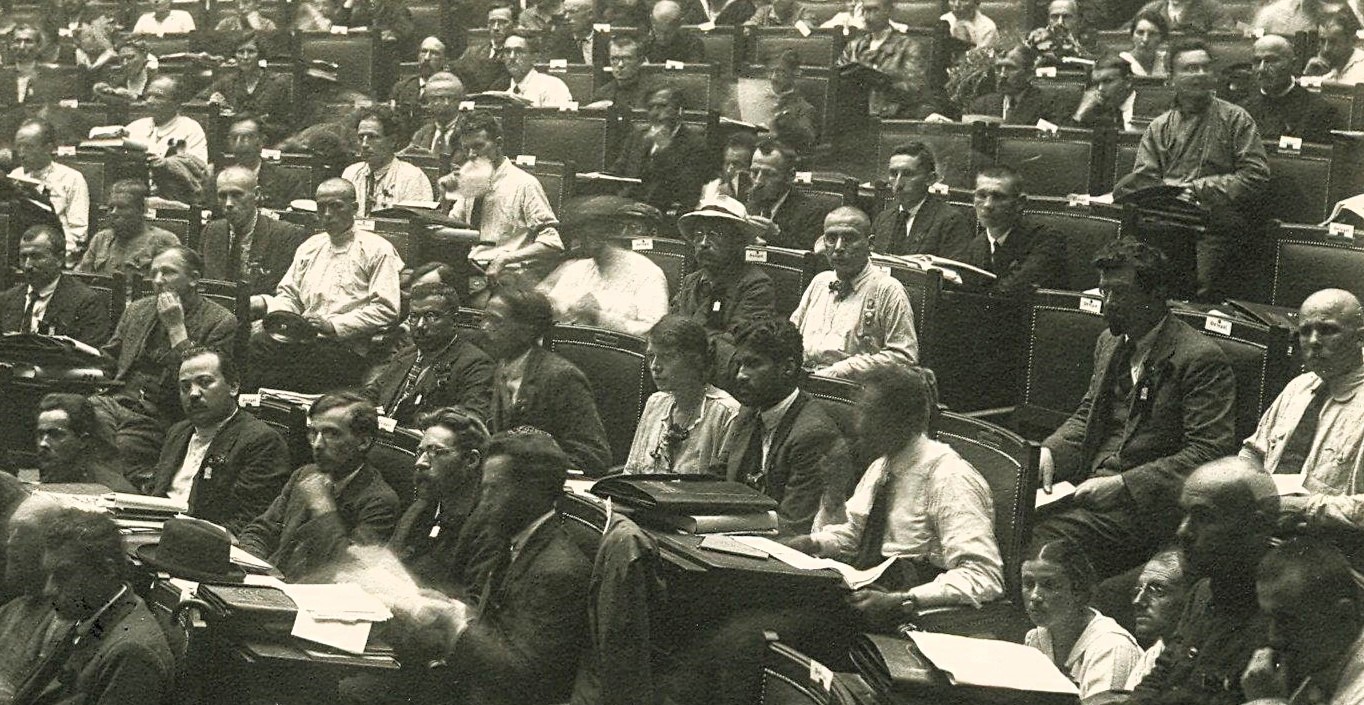
Zinoviev gives a summary of ‘four periods’ in the history of the Third International from the Zimmerwald and Kienthal through the first three World Congresses.
‘The Principal Stages in the Development of the Communist International’ by G. Zinoviev from Bulletin of the E.C.C.I. Vol. 1 No. 4. December 23, 1921.
We consider that there are approximately four stages in the development of the Communist International. The first period–approximately from Zimmerwald to the beginning of the Russian revolution. The second–from the end of 1917 to the well-known appeal of the Central Committee of the Russian Communist Party (end of 1918) and up to the First Congress of the Communist International (beginning of 1919). The third period, from the First to the Second Congress, and the fourth, from the Second to the Third Congress of the Communist International.
The first period–from Zimmerwald to the Russian revolution–is, so to say, the incubation period of the Communist International. The chief problem at that time was the new doctrinary orientation. The attempts at organisation in those days were of a very timid nature.
At first our Party (the Russian Bolsheviks) was almost completely isolated, when in the well-known manifesto of its Central Committee, published in No. 33 of our central organ, a few weeks after the outbreak of the imperialist war, it produced the slogan of: “The Third International”.
“The Second International is dead, overcome by opportunism. Down with opportunism and long live the Third International, cleared not only of “deserters” but of opportunism as well”. Thus wrote comrade Lenin at the end of October 1914 in his article entitled: “The position and tasks of the Socialist International” (see the almanac “Against the Stream”) And he continues:
“The Second International has accomplished its share of the useful preparatory work for the preliminary organisation of the proletarian masses during the long “peaceful” epoch of the cruelest capitalist slavery and the most rapid progress of capitalism in the last three decades of the nineteenth and the beginning of the twentieth century. The Third International is faced by the task of organising the forces of the proletariat for a revolutionary onset on the capitalist governments and for civil war against the bourgeoisie of all countries for the seizure of political power and the victory of socialism“.
This is how comrade Lenin formulated the task in 1914.
“In the present epoch of imperialist wars the slogan cannot be other than the transformation of the imperialist war into a civil war“.

We must raise the banner of civil war. An International really deserving its name will either be regenerated under this slogan, or it will be doomed to simple vegetation. Our task is to prepare for the approaching battles, to train ourselves and the whole labour movement in the idea that we must either die, or conquer under the banner of civil war”. I wrote this end of November 1914, in an article published in our then central organ (see “Against the Stream”).
“When opportunism and chauvinism triumphed for a time in the principal European parties the Second International ceased to exist. It will be replaced by a new International”. This is what Lenin asserted in the article on “the International” and “the defense of the fatherland” in the beginning of December 1914.
In remembering the past we cannot conceal from ourselves that at that time very few shared these views with us. The group of the “Zimmerwald left wing” which had formed itself at the Zimmerwald Conference put forward in its resolution the following demands: “Voting against war credits, against the withdrawal of the socialist ministers from the bourgeois governments, the denunciation from the parliamentary tribune in the legalised and–where necessary–the illegal press, of the capitalist and anti-socialist nature of the war, organisation of street demonstrations against governments, propaganda in the trenches in favour of international solidarity, assistance in the economic strikes and efforts to turn them into political actions under favourable conditions, civil war instead of civil (bourgeois) peace”.
The Zimmerwald Conference rejected our propositions. Its official organ declared that “even the idea should in no wise be suggested that the Zimmerwald Conference wished to cause a split and create a new International”. At the Conference itself some of the left-wingers protested vigorously against the idea of creating a Third International. They had not assembled in order to “give the formula of a Third International”. This was announced by the Zimmerwald majority. It was no easy task at the time to struggle in favour of a split in the old official social democratic parties. Let the reader bear in mind that even Karl Liebknecht belonged officially at. that time to the old “United” German social democracy.
“The weak attempts to restore the international ties, which had been made up to then, had pursued this dangerous course of mutual “amnesty”. The very first conference in Lugano decided that no one was to be “condemned”. As if one could fight unprecedented monstrous treachery, without condemning it, without calling it by its proper name! The Copenhagen Conference was turned into a simple comedy; it was afraid to make one single definite utterance. The London Conference did all that was required by the English and French bourgeoisie, but was careful not to cut off all roads leading to mutual amnesty. The Women’s International Conference at Berne held the same petty bourgeois views, that no one was to be “condemned”. Its resolutions were completely adapted to the idea of “amnesty”.
This is how the author of these lines characterised the situation in his article “On the “Amnesty” and its Prophets” (ibidem).
However, the work of the Zimmerwald left wing had not been done in vain. The seed that had been sown began to crop up. At the Kienthal Conference our ideas wielded a greater influence than at Zimmerwald. The Zimmerwald left wing began to be more closely welded in respect to organisation. The conference we held just before our departure for Russia, after the February revolution, with the comrades of the left wing of the French, German, Swiss and Swedish labour movement was practically the first preparatory conference for the Third International.
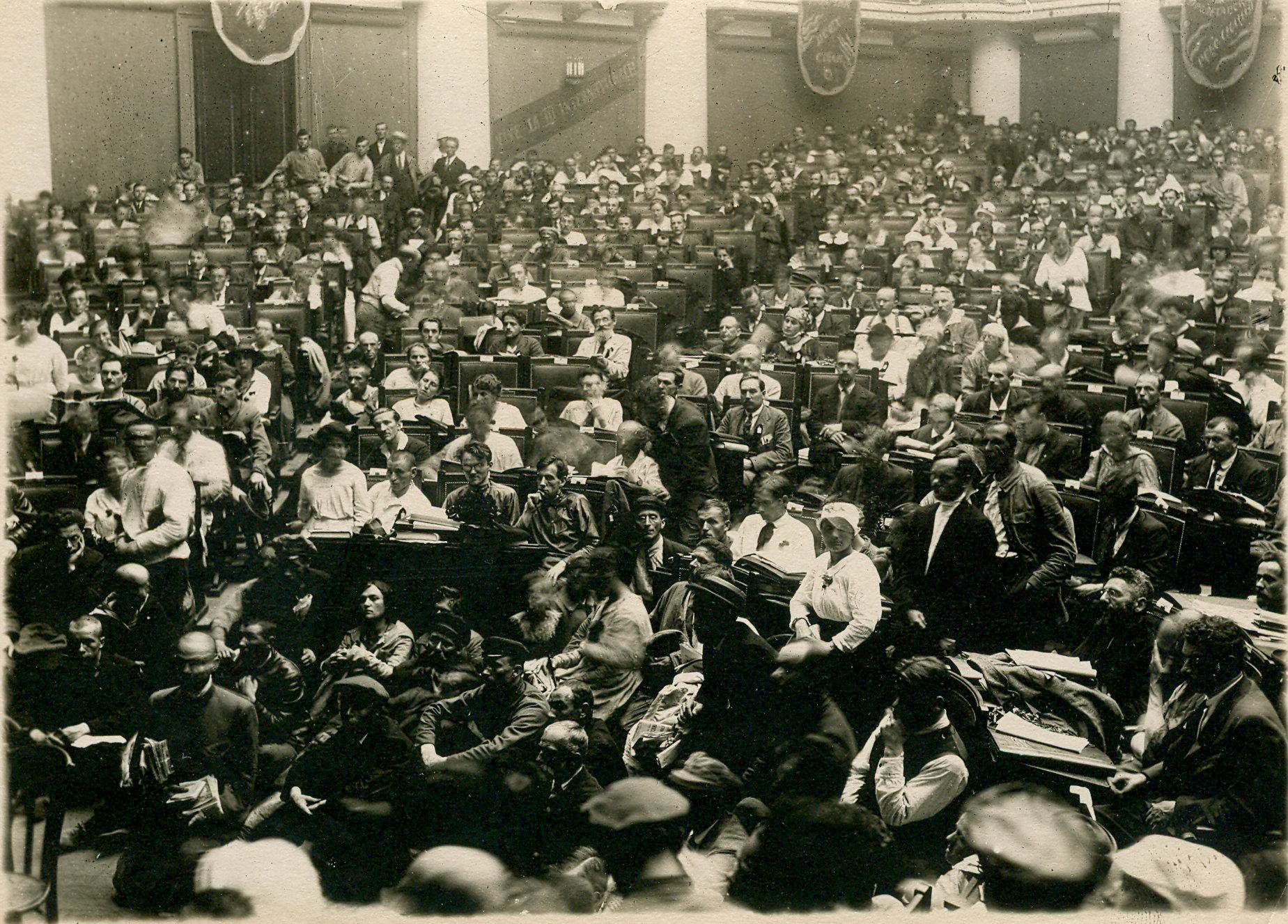
Since the spring of 1917 the slogan: “For the Third International” continued to acquire an ever greater popularity. From the very first day of its existence, the Third International united its fate with that of the proletarian revolution in Russia. By degrees, as this revolution was winning its way, the slogan: “For the Third International” began to acquire flesh and blood. And by degrees, as the proletarian revolution was gaining strength in Russia, the position of the Communist International grew ever more solid throughout the whole world.
By the end of 1918 the Central Committee of the Russian Communist Party, which was assuming ever more the practical role of organiser of the future Third International, published an open letter to the German Spartakists and the Austrian Communists. It was called forth by the fact of an international conference being fixed in Lausanne for January 6th 1919 by the British Labour Party. The Central Committee of the R.C.P. announced its refusal (just like in 1917 we had refused to attend the much talked of Stockholm conference) to take part in a conference which was to be attended by social patriots, and called upon its partisans to back this refusal. The Central Committee enumerated all the organisations which were at one with it, namely: the Communist Parties of Finland, Estonia, Lithuania, White Russia, Ukraine, Poland, and Holland. It mentioned also such groups of the Swedish, Swiss and Italian socialists which had expressed solidarity with it as well as the partisans of McLean in England, Debbs in America and Loriot in France. This is all that we had on our side then.
On January 24th 1919 the Central Committee of the Russian Communist Party published a direct invitation to the Communists of the whole world, to take part in the First Congress of the Communist International. This invitation was signed by the Central Committee of the Russian Communist Party, the Foreign Bureau of the Communist Party of Poland, the F.B. of the C.P. of Hungary and the F.B. of the Austro-German Communists, the Russian Bureau of the Central Committee of the Lettish Party, the Central Committee of the C.P. of Finland, the Executive Committee of the Balkan Social-Democratic Federation and the Socialist Labour Party of America. As the reader may see, the initiators were not very numerous even then.
But the slogan “For the Third International” was becoming more attractive day by day. At that time the first glorious fights of the Spartakists against the bourgeoisie and the social democrats were drawing nigh in Germany. In Germany and Austria the imperial thrones had just been overthrown. A revolutionary whirlwind was beginning to rage in Europe.
It seemed at the time that the commencing hurricane would easily and promptly blow away the old social democratic parties, like a house of cards. It was impossible to foresee then, for instance, that the German social democracy would become such a powerful counter-revolutionary factor. The German bourgeois professor Richard Foerster says in his book entitled “The International in 1914-1919”: “It is true that the German social democracy did not succeed in preventing the German revolution, but it has managed nevertheless to stem its course and to organise a resistance against Bolshevism”. (The above mentioned pamphlet, page 29). These words were written after the first defeat of the Spartakists in Berlin. But in the honeymoon of the German revolution only a very few could think that the German social democracy would become the chief and almost only support of the bourgeois counter-revolution.

The delegates who attended the First Congress of the Communist International were not numerous, and the content of the work was chiefly declarative. In the above mentioned invitation to the Congress the “aims and tactics” of the Third International were laid down in the form of twelve theses. On the whole the work of the First Congress remained within the limits of those 12 theses.
Be that as it may, it was an accomplished fact, the Third International had come into being as an organisation.
The years 1919-1920, that is to say, the period stretching between the First and Second Congress, was a time of the most rapid growth of the Communist International. A vehement mass labour movement was raging throughout Europe, and in the first period after the end of the imperialist war it was getting more and more stormy. The Communist International won gradually the sympathy of large masses of the proletariat. A wave of sympathy with the Communist International penetrated into the ranks of the old socialist parties. This led to a turn of feelings in its favour even among a number of the old leaders of the “centre”. In the Spring and Summer of 1920, as Martov has admitted recently, many of the centrist leaders, acting under the pressure of the surrounding circumstances, entertained the idea of a block between the “centre” and the left wing. This explains the appearance at the Second Congress of the Communist International of such leaders of the “centre” as Crispien and Dittmann, as the delegates of the American Socialist Party, headed by Hillquit, etc. The Communist International was in danger of being flooded by these centrist elements. At that time it was becoming, so to say, “fashionable”. The blockade had cut off Soviet Russia and the leading centre of the Communist International for many a long month. Its real views were but little known abroad, and many of the representatives of the centre began to cherish serious hopes that it would be easy to transform the Third International into an organisation that would practically be very similar to the Second International. This frame of mind was eloquently expressed by Modigliani, leader of the Italian centre, in the Spring of 1920, when he gave the following motive for his advocacy of the affiliation to the Third International: Why should one not join the Third International? This does not impose any specially heavy duties. It is hardly a difficult task to send a picture post-card once in three months to the Executive organ of the Communist International”…
In view of this danger the Communist International had to take the necessary measures for its own protection. Hence the celebrated 21 conditions, around which such a passionate struggle has been raging since.
Having made itself safe from the right wing elements, the Second Congress of the Communist International drew the line between itself and the so-called left tendencies. At that time already it protested most decisively against the ideology of the Communist Labour Party of Germany. It re- pulsed the pseudo-“left” tendency, which was pronouncing itself against the Communists who took part in the labour unions. It did all it could to win the sympathy of the best part of the revolutionary syndicates, of the “Industrial Workers of the World” and other similar elements. It did not cede an inch of its doctrinary positions to them.

During the period between the Second and Third Congress of the Communist International, i.e. in 1920-1921, the mass labour movement in Europe, which had spread so strongly immediately after the close of the imperialist war, calmed down considerably, and the Third Congress met in a period of comparative calm. The bourgeoisie had become stronger and so had its lackeys-the social democrats. The bourgeoisie was first inclined to ridicule the Berne Conference–the first after the war–which had restored the “Second International”. The above mentioned professor Foerster wrote: “The only positive result of the Berne Conference was the agreement on question of international labour legislation” (page 30 of the above mentioned pamphlet). But now the bourgeoisie sees that the partisans of the Second and the Two-and-a-Half Internationals have been very useful to it. The adversaries of the Communist International: Amsterdam, the London Second and the Vienna Two-and-a Half Internationals are now trying to unite.
The Third Congress has had to reckon with a slower pace of the international proletarian revolution than had been estimated by the First Congress. The period of comparatively easy victories is now followed by one, in which we have to fight for each inch of the way, for each step for- ward, when only by an by an obdurate struggle we shall be able to win over one position after another from the bourgeoisie and its flunkeys–the followers of Amsterdam.
The program and tactics of the Communist International have now been delineated with sufficient clearness and precision. The Communist International has now entered upon the period of its organisation. During the year which has elapsed between the Second and Third Congresses the parties affiliated to the Communist International have grown everywhere. There is almost no country in the world in which the Communist International does not possess a solid base.
The Communist International cannot refuse to take part in any minor everyday work. Our parties are bound to and they do participate also in the election struggles. The French Party is acting correctly when it gives sufficient attention to the comparatively minor question of the tactics of Communists, say, during by-elections in one or other of the separate districts. The German Communist Party is also quite right when it recommends to its representatives not to occupy an all-round boycotting position in Thuringia or Saxony, where the existence of the so-called “Socialist” Government is dependent on the votes of the Communists. Our parties are right also when they resort to the method of a lasting siege in their struggle with such Amsterdam strongholds as are not liable to be taken yet. But pressing past all difficulties and pushing their way through the barbed wires set up by the bourgeoisie and the heroes of the Second and Two-and-a- Half Internationals, the parties of the Communist International do not for a single moment forget the great tasks which face them.
The principal slogan of the Third Congress was: “To the masses!“
The earlier stages in the development of the Communist International were characterised by the fact that the working masses looked on it almost religiously. But at the same time those earlier developments were also characterised by the extraordinarily weak organisation of the separate Communist parties and the Communist International in general. Communism at the time was a sort of bodyless, although very attractive idea for the masses. The present period is quite different. Not only Communism “in general”, but also the Communist organisation, must penetrate into the very depth of the masses. In the countries of the old European labour movement we have to do not only with the bourgeoisie, which has again armed itself to the teeth, but also with the old social democratic parties and labour unions, which have for years been creating their organisations and are now systematically carrying on the struggle against the proletarian revolution. Enthusiasm alone is not sufficient to overcome the bourgeoisie and the heroes of Amsterdam and the Two- and-a-Half International. We must set up against them a state of organisation three times as strong as their own. It is in this sense that the Third Congress understands the slogan: “To the masses!” Only after conquering the sectarian loft” tendencies will it be possible for us to deal a mortal blow to the heart of opportunism. Some people consider as a waning of our influence the regular siege of the bourgeois and social democratic strongholds, which has just begun but as yet is going on slowly, as well as the minute and seemingly not very showy preparatory work of the Communist International in the field of organisation, which is now setting in. Not only Martov speaks of the “crepus cule” of the Communist International, or the weak-willed Levy laments over the pseudo-decline of the Communist influence, making it a point of honour to prove that the German Communist Party has perished, but also some younger and more impatient Communists blindly believe the prophecies of our enemies. As a matter of fact there are no grounds for pessimism. The first year of the Communist International’s existence seemed “easier” simply because it was passing through its period of rosy and happy dreams of youth. The Communist International is now an adult, it is entering on a more difficult, but also a more decisive period of its work.
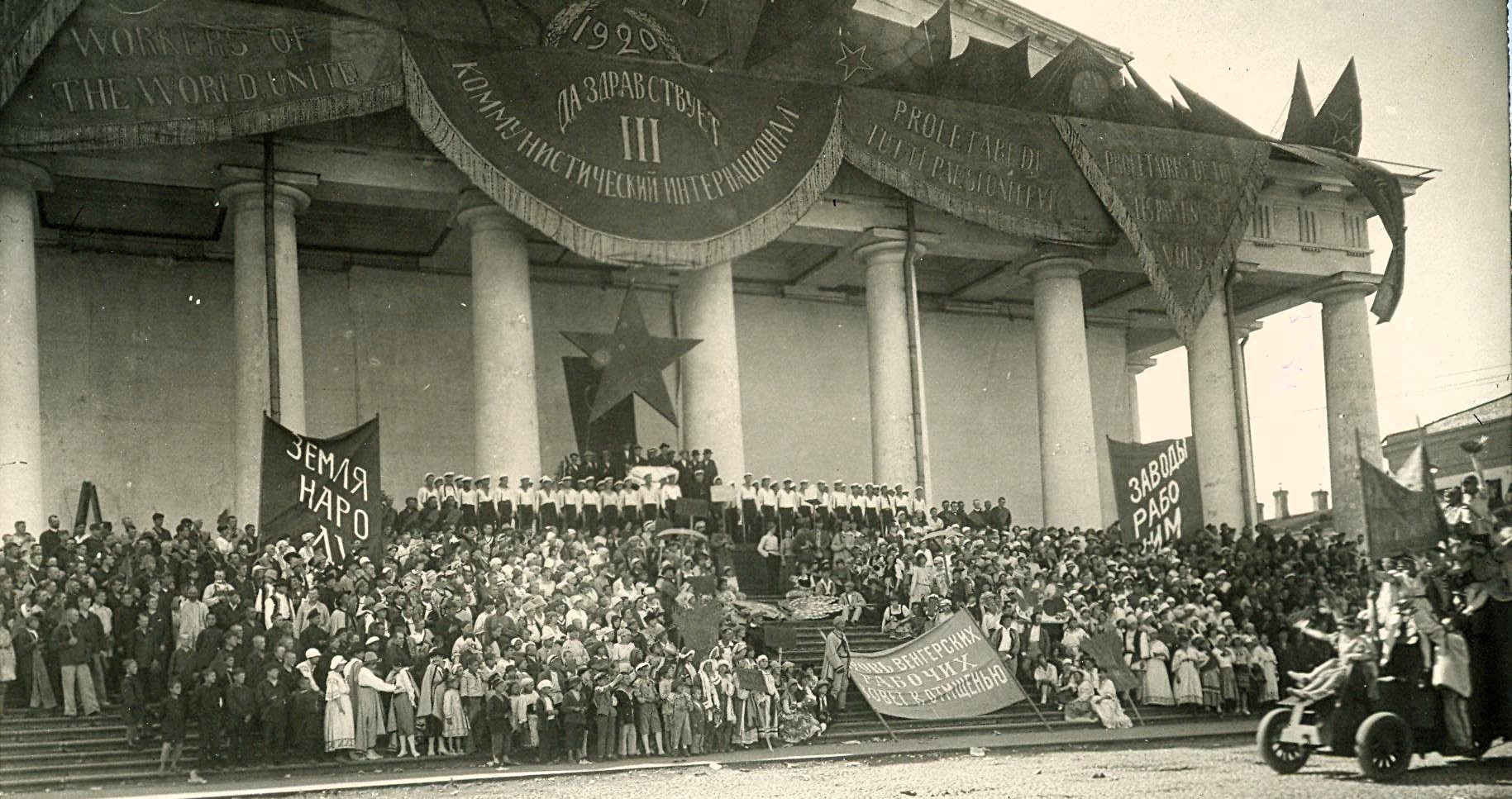
The Communist International was born under the slogan of civil war. This war will inevitably pass through a number of good and evil chances, at times waxing stronger and reaching the boiling point, at times seeming to grow weaker and recoiling upon itself. The latter case may be noticed in some places even at present. At any rate, long past are the times which the little French socialist soldiers’ song speaks of:
Une guerre plus légitime— C’est la guerre à qui vous opprime, La seule que nous ne faisons pas. (A more rightful war-that is the war against our oppressors, the only one we are not waging).
Well, the only lawful war is going on now throughout the whole world. The civil war will continue; this is as inevitable as the advent of spring after winter.
The Russian Communist Party may take pride in what it has already been able to do for the Communist International. It will continue its work to the end.
“The development of events has created of Russia a country of Soviets, of Moscow–the capital of the International, of the Russian moujik–the ordainer of the destiny of the world culture”. This was written by one of the most prominent representatives of the Russian bourgeoisie in the much-talked of almanac: “Changed landmarks”. A group of collaborators of this magazine belonging to the Russian bourgeois intellectuals, who have finally recognised the Soviet Power out of a national patriotic feeling, are looking upon the mutual relations between the Soviet Government and the Communist International from their own and very simplified point of view. They “defend” the Soviet Government against the Russian counter-revolution: “What are you crying out against the anti-patriotism and treachery of the Soviet Government, because of its being on friendly terms with the Third International? Is it wrong for the Kremlin to make use of the Third International in its policy as a great Power?
“By a fatal irony of destiny, or perhaps by impartial and faultless verdict of history, the Russian national work can be carried on at present not in the broken down Russia of the “Third Rome” but in the Russia of the “Third International”. These are the words of J.N. Potekhin, one of the above mentioned group of followers of Ustrialov, a former member of the Kolchak cabinet. (“Changed landmarks”, page 83.)
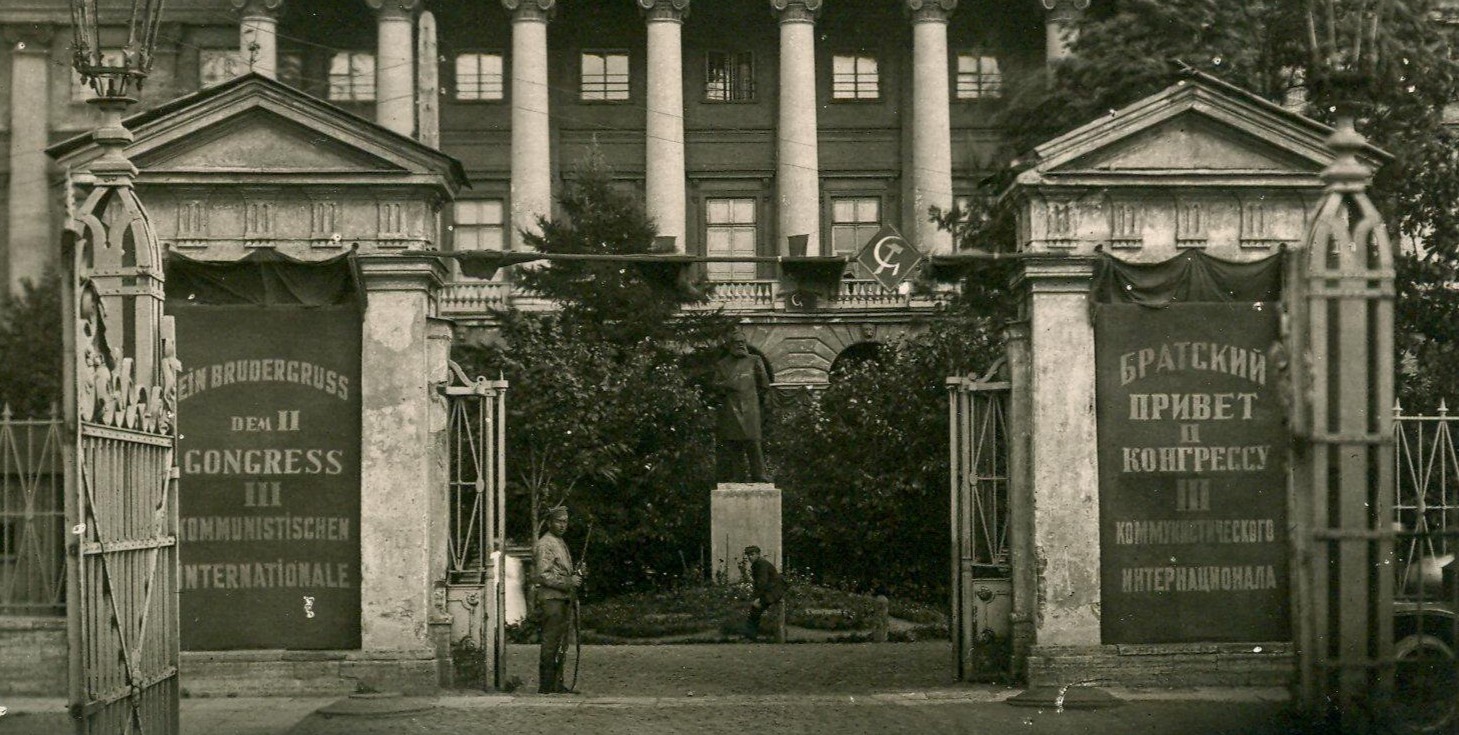
These proselytes have really come to believe that the Soviet Government are looking upon the Communist International as an auxiliary weapon for their foreign policy. Even the most enlightened and the “most far-seeing” bourgeois are incapable of understanding what the International Workers’ Association really is for the first Government of callous hands in the world. It is not the case of the Communist International being for the Kremlin, gentlemen, but all of us, we exist for the victory of the world proletarian revolution, whose organiser the Communist International is. You will understand this post-factum, gentlemen, because you are crude empirics, you only believe what you can see and feel. Give us time, gentlemen! When the world revolution will move forward a step or more, when the Soviet power will be established in two or three more countries, then may be you will understand the really international, really universal importance of the Communist International.
The ECCI published the magazine ‘Communist International’ edited by Zinoviev and Karl Radek from 1919 until 1926 irregularly in German, French, Russian, and English. Unlike, Inprecorr, CI contained long-form articles by the leading figures of the International as well as proceedings, statements, and notices of the Comintern. No complete run of Communist International is available in English. Both were largely published outside of Soviet territory, with Communist International printed in London, to facilitate distribution and both were major contributors to the Communist press in the U.S. Communist International and Inprecorr are an invaluable English-language source on the history of the Communist International and its sections.
PDF of full issue: https://www.marxists.org/history/international/comintern/ci/publications/n1-n5-jul-07-1921-sep-08-1922-Bull-Exec-CommCI-Feltrinelli-reprint-1967.pdf
 Revolution's Newsstand