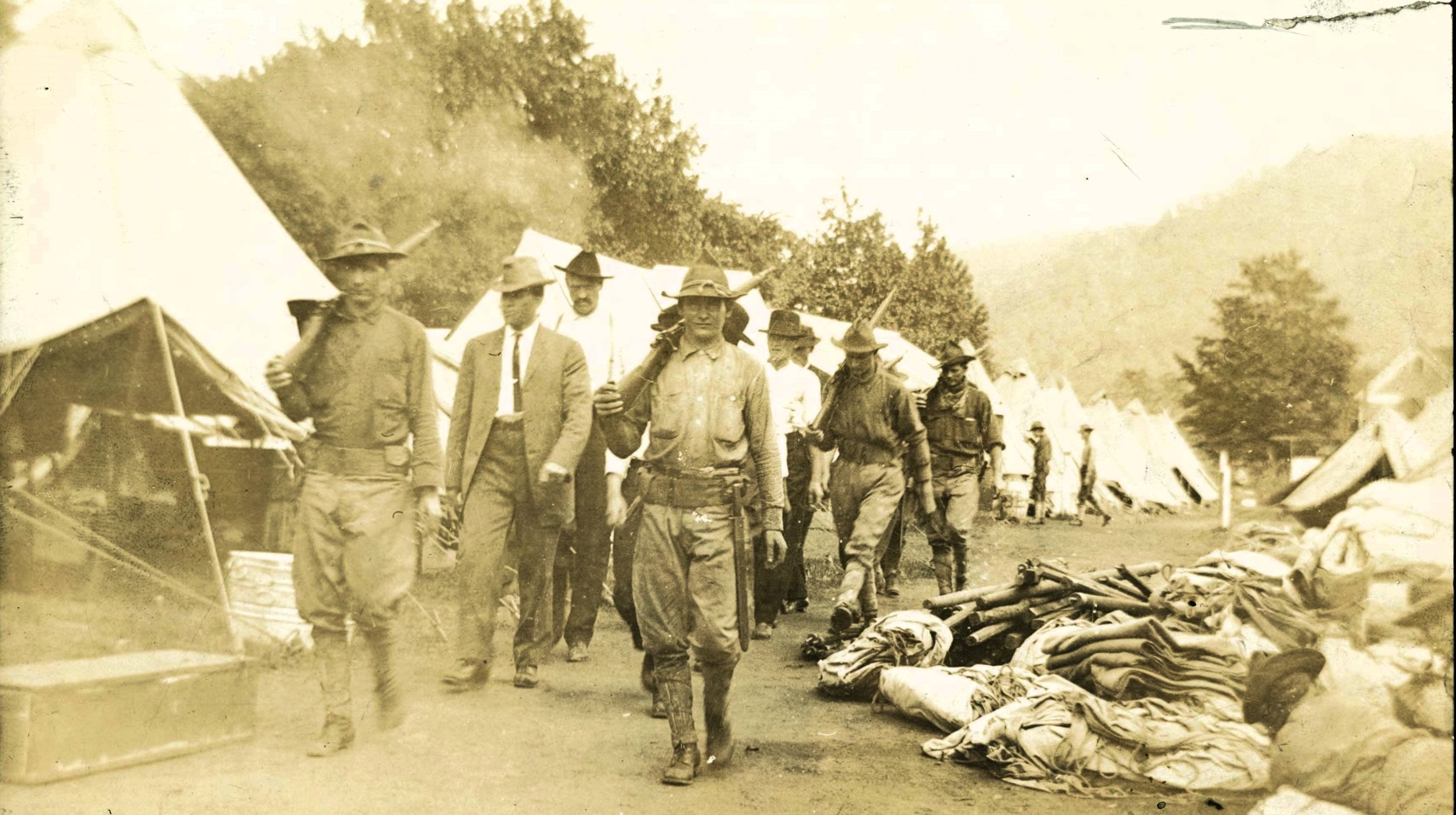
An absolute classic from Ralph Chaplin, the man who wrote ‘Solidarity Forever,’ as he travels through the seat of conflict, deep into the hill of West Virginia during the 1912-13 Kanawha Mine Wars. Along the way he meets the miner combatants and their families, union leaders and Socialist organizers, tours the battlefields and tent camps, spars with the enemy and gives us a most vivid picture of a place and time.
‘Violence in West Virginia’ by Ralph Chaplin from The International Socialist Review. Vol. 13 No. 10. April, 1913.
“THEY got my gun when they run me out of the creek, but I done borried my buddy’s, and I’m goin’ back.” This is what a slender, grimy lad of sixteen told me one night in the freight yards of a town not far from the martial law zone. He was picking coal for his mother and sisters at “home” in the tent. His father was in the bull-pen at Patt. The boy had a bullet wound on his shoulder and numerous bayonet holes in the seat of his ragged breeches. “Took seven of them to run me out,” he boasted, with a grin.
“What are they doing to you all down there?” I asked.

“It isn’t what they’re doin’; it’s what they’re trying to do. If they had their way about it, they’d give us hell-but we won’t let ’em. It’s a whole lot better living in a tent than in a company shack, and we’re just goin’ to stick there until we win. Just wait till the leaves come out, so they cain’t see us. Buddy, we’ll show ’em!”
After spending four or five days in the strike region and talking with hundreds of miners, I can say that the boy summed up the entire situation in his few words. The strikers have “kicked over the traces “and have made up their minds to win at all costs. They are determined to do this all by themselves, if necessary-and in their own way.
In spite of the “heart throb” articles in some of the daily papers, these people are not objects of pity. They are doing pretty well in their tents. There is no atmosphere of martyrdom about these fighting West Virginians-nothing but a grim good humor and an iron determination. There is no pretense about them-no display. They are in deadly earnest, and they mean business. Lots of kind-hearted people who would shed tears for the “poor miners” living in tents would probably think these same miners in their right places if they were picking away at a coal bank in some black pit. The fact that many of the strikers seem to rather enjoy the situation and rest from the mines makes some of the local respectables furious with rage. Isn’t just what one would expect of a striker to see him holding his head high and walking around as if he owned the whole valley.
Of course, there are sufferings and hardships. Many men wear mourning on their hats and many women have husbands, brothers or fathers in the bull- pens—but they are going to win this strike; they are sure of it, and this fact makes them feel equal to anything.
It is true that they have tasted of hell since the strike began, but before that time they lived in hell all the time. Conditions in West Virginia are and have been without parallel in the United States. Peonage and serfdom have flourished under the most brutal forms. West Virginia is the one state that has tried to make abject slaves of its miners—that has herded them in peon pens without a vestige of “constitution” liberty, with cut-throat mine guards to protect them from the contaminating influence of organizers and agitators.

For many years the grisly vampire оf Greed has fluttered its condor wings and fattened on the very heart’s blood of these men—helpless for want of effective organization. Miners are working in company towns who seldom see money— nothing but paper script—men who dare not speak a word of criticism of the intolerable conditions under which they labor, or even hint that organization is desirable. The blacklist and the brutal mine guards are every ready to punish such indiscretions.
Women have been beaten on the breasts and kicked into convulsions while in a state of pregnancy—men have been shot up and man-handled, all because they had dared to raise their voices in protest. Indignity after indignity has been heaped upon the workers in the hellholes of this state, until they have united into one big Brotherhood of Revolt. They are standing shoulder to shoulder with the only weapons available in their hands, fighting to overthrow the dismal industrial despotism that is crushing them. These miners are remarkable in many ways. In spite of all they have endured, their spirits have not been broken. They have been hoarding their hate for many years and biding their time. At present they are wasting for the leaves to come out.

Types of Americans are to be found in the Kanawha valley that have been extinct in other parts of this country for years—the types that still cherish the instinct of self-reliance and independence which characterized the frontiersman of a couple of generations ago. Each one of these miners was raised with a rifle and is at home on the hillsides. Solidarity is something more than a word in Kanawha county; it is a tremendous and spontaneous force—a force born in the hot heart of the class struggle. As yet the tactics of modern industrial warfare are a closed book to these men, but they are learning fast. Kanawha county showed the largest gain on record t0 Socialist votes during the last election. When the powers that be nullified any benefits the miners might derive in this way, by means of martial law—well, they just returned to their rifles. And when the officials of the United Mine Workers tied their organization up with a thousand clumsy contracts—each contract as heavy to drag along as a ball and chain—so that they could not strike in sympathy with their brothers—well, they just returned to their rifles. They are excellent shots, absolutely fearless, and as staunch and determined a bunch of fighters as ever learned through bitter experience the need of class brotherhood. When they once learn the supreme lesson of unity on the job and in the strike, these men will be a tough proposition for the bosses to face.
The class struggle means something to West Virginia miners. They are using violence only because no better weapons are handy. Gladly would they go out on strike, in every part of the state, if the union “officials,” with their sacred contracts, would permit of it. If there is anyone more to blame for this violence than the blind and insatiable coal operator it is the labor faking official who has tied the miners’ hands with stupid agreements, leaving no other recourse but the rifle. They would be willing and glad, to the last man, to participate in a state-wide strike, and eventually they will insist upon it, and Germer and his bunch, who are always howling at the fallacy of aught but the pure and simple way, will be swept to one side, while the revolution goes marching on. A strike of all the coal miners would be so much simpler, so much more effective. Violence is the last resort of a divided “organization.” The general strike would enable the workers to fight the bosses without fighting their own class at the same time.

The miners are learning—learning fast. Learning by watching union miners at work—under contract, all around them; union railroad men hauling mine guards and strikebreakers into the strike zone and hauling scab-mined coal out. Some of them cannot forget that it was men with union cards in their pockets who put steel plates on the private war engines of the masters! An armored train was being assembled at the C. & О. shops here in Huntington a short time ago. It was to be perfectly bullet-proof, in order to insure the safety of such scabs and soldiers as the operators might see fit to pour into the strike zone when occasion required. A hellish contraption it surely was—covered with steel plates, bristling with machine guns and loop-holed for rifles. The union men at the shops looked at the thing askance, realizing that it was to be used against members of their own class. The machinists shied at it like mules from a white blanket, and so it was up to the boilermakers and the car-men. These were pretty much undecided as to whether they would touch it at all or not, when some Holy Rollers among the latter said they would pray and ask Jesus what they should do. So they prayed and asked Jesus, and came back with the report that Jesus said it was all right, to go ahead and put on the plates!
The operators, realizing that violence has always been their big trump, thought they would have everything their own sweet way when trouble started. Everything was in their favor—armed guards and regiments of militiamen—so why should they not feel confident? But it is evident that the miners have fooled them. The miner knew the hills better than the blood-hounds that were sent to track them down. After a few months of it, the odds are just about even, and the fight is not half over. Soldiers in the strike zone are becoming uneasy and are using the slightest excuse to make a getaway. Many of the guards have deserted their posts of duty in a panic. One hundred and fifty of them have paid for treason to their class with their lives! They are in mortal fear of the time when the bleak hillsides will be covered with greenery—when “the leaves come out!”

The miners have been hounded into the using of violence. Just an instance in which the above-mentioned armored train figures conspicuously: This train is called, for some reason or other, the Bull Moose Special. Needless to state, it is thoroughly hated by the miners. The engineer and fireman and others of the train crew are reported to be extremely proud of the union cards they carry. This hellish contraption was a lovely plaything to put into the hands of the cut-throat, coyote-hearted guards and, like children with a new pop-gun, they were simply aching for an opportunity to use it against the strikers. The opportunity soon presented itself. Just how it came about nobody seems to know. The guards claim that some of the miners had fired into an ambulance carrying wounded mine-guards to the hospital. The strikers claim that the train was first used to avenge the death of a couple of guards who had been held to account for insulting some of the girls in the tent village. I, myself, have spoken with miners who claim to have been eye-witnesses to the insulting of these girls.

Mine guards are noted for their inhuman and brutal treatment of the women of the miners. Their authoritative positions often gave them advantages over the helpless women, especially in the absence of the men, and the full record of their unrestrained animal viciousness will never be written. Between the miners and the guards there is an open war to the knife. More than once these Kanawha cossacks have evicted mothers, in the pangs of childbirth, from company houses, and children have been born in the tents of the strikers while the murderous bullets of the guards were whistling and zipping through the canvas. At all events these cut-throats of the coal operators had the long wished for chance to use the Bull Moose special. They would have their revenge. So in the dead of night, and with all lights extinguished, the Death Train drew up over the sleeping tent village at Holly Grove and opened fire with machine gun and rifle. Miners’ huts were torn to splinters and tents were riddled with bullets. One woman had both legs broken by the murderous rain of lead; and a miner, holding an infant child in his arms and running from his tent to the shelter of a dugout. fell, seriously wounded. The baby was. by some miracle, unhurt, but three bullet holes had tattered the edge of its tiny dress. Men, women and children ran hastily through the dark night seeking the cold security of the woods. The miners, as could be expected, were desperate enough to do most anything and returned the fire as best they could. Bonner Hill, sheriff of Kanawha county, who was only elected by a small and suspicious majority over Tincher the Socialist, candidate, was on the train, and it is claimed by the train crew that it was he who gave the order to fire the first murderous volley.

In the morning the miners attempted to return to the ruins of their “homes,” but the mine-guards on the hillsides continued to fire upon them in order to drive them back. All day and all night the battle raged, but the guards had the advantage. So on the following morning the miners decided to remove to a less exposed location. Thereupon the little band of valiant but homeless wanderers started for Mucklow, with their few belongings on their backs. But their troubles were not yet over. They had not traveled far when their march was opposed by the cowardly mine guard captain, Fred Lester and his gang. The guards unexpectedly opened fire at first sight. The miners surrounded their women and children and the situation began to look serious. Captain Lester was getting a machine gun ready for use when the miners let loose a well aimed broad- side in the general direction of that prolific little blood spiller. The gallant cockroach captain was unaccustomed to do battle with men who would fight back. So he ordered a hasty retreat, and he and his delectable gang broke for the tall timber, leaving the machine gun to the miners. It is reported that Captain Lester led the retreat by about six hundred yards. A short time later the weary and wayworn band of hounded outcasts were completely surrounded by the uniformed scab-herders of the operators—the militia men. Seventy-five miners were arrested and thrown into bull-pens, where they are now awaiting court martial trials.
For a few days after this episode even from nearby states came rumors of revolt. Armed miners poured into the trouble district from all sides and it is reported that an attempt was made to destroy the hated Death Train.
In a pitched battle sixteen men we killed, or rather four men and twelve mine guards. The miners fought like demons, at times standing directly under the death-spitting machine guns of the train, and firing into the loop holes at the guards. After the battle the Bull Moose Special was just about as much shot to pieces as is the record of Roosevelt, its namesake. More miners were arrested; among whom was John Brown, organizer for the Socialist party. Mother Jones, C.H. Boswell, Paul Paulsen and Charles Batly were also arrested, but in Charleston, as “accessories before the fact.” Charleston happens to be over twenty miles from the martial law zone. So these people were kidnapped and spirited away to that greed-sanctified section, there to await a military trial, with five distinct charges placed against them charges varying in gravity from stealing machine guns to murder! Writs of habeas corpus were secured and the ” felonious culprits” were brought to Charleston under a heavy military guard. They were brought into the dimly lighted court room to witness a farcical drama of “Justice.” White-haired, venerable Mother Jones and the rest of the undesirables listened with smiles of unconcern while the Supreme Court declared that the military authorities have a perfect right to “hold and detain” the accused parties until peace could be restored.
It was hoped by some that martial law would be held to be unconstitutional. The Supreme Court, however, refused to consider the question of its legality. Attorney Harold W. Houston, of Charleston, rested great hopes on the successful outcome of the struggle to wring justice from the courts. He is a splendid fighter and an excellent lawyer, but it is evident that even lawyers are learning things these days. Socialists will do well to watch closely the result of these trials and the after effects: They are bound to prove interesting.
A brief account of a trip made by Comrade Rumbaugh, of Hurricane, W. Va., and myself to the danger zone, might be of interest to readers of the REVIEW.

We rode into Charleston “on the front end” and found that city to have the appearance of a place preparing for a siege. Martial law had been declared but a short time previously and the streets were full of soldiers. Yellow-legged sentries were stationed in front of the state house and the governor’s residence. It was rumored that machine guns were mounted in the upper windows of the former building, commanding both entrances to the capitol grounds. A sentry was also stationed in front of the office of the Labor Argus to guard Comrade W.H. Thompson, who is editing that paper while Comrade Boswell is being “detained” in the bull pen. Comrade Thompson is an ex-Kanawha county coal miner and is unblushingly “red.” He is the editor of the Hunting- ton Socialist and Labor Star and he has put up as staunch a fight for the cause of the miners as any man in the state. At the city jail we witnessed the interesting spectacle of a bunch of “tin horns” bringing a prisoner from the military district to the city lockup. As the great iron gates swung open to receive them, the spectators commenced hissing the soldiers, calling them “scab herders” and other expressive names. Some of the “yellow legs” glared at these people brazenly but, may they be given due credit, others ‘of the soldiers hung their heads with shame, as if such condemnation from members of their own class was more deadly to them than bullets.
From Charleston we took the labor train that was to carry us into the martial law zone. At Cabin Creek we were almost arrested with a bunch of miners in the car who were poking fun at the grave and ludicrous antics cut by some of the would-be man-killers in khaki. At the Paint Creek junction we remained for several hours, ostensibly to visit some soldier boys of our acquaintance, but in reality to secure information and photographs for the Review and the Labor Star. Comrade Rumbaugh was afterwards arrested and relieved of his camera for attempting to take photographs to illustrate this article. We spoke with dozens of the soldiers, and one of them, an ex-mine guard, admitted that the guards use dum-dum bullets against the miners. He told of two miners who had been killed with these proscribed missiles, one man who had the top of his head completely shot off and another who received a death wound in the breast large enough to “stick your fist into.” “The freight house at Paint Creek has been converted into a bull pen, and over fifty men are now incarcerated there, only three of whom are not native West Virginians. The interior of this place would make a Siberian prison pen look like a haven of refuge. The sleeping accommodations are in- adequate, ventilation poor and the floors filthy beyond description. Even with two or three men sleeping in the coalbin there is no room for the others. The only papers the prisoners are permitted to read are the reactionary local rags and the National Socialist. Mother Jones, Charles Boswell and John Brown have somewhat better quarters elsewhere in town. A sentinel is constantly measuring his paces before the door of each. Dear old Mother Jones in the bull-pen and guarded by armed mercenaries of the Mine Owners! The very thought of it makes blood boil, here in West Virginia.
From Paint Creek we hiked up the Kanawha river to Montgomery and from thence to Boomer. We wanted to have a look at the dauntless Boomer men who are reported to have so willingly gone to the assistance of their brothers down stream, on a certain memorable night. In every little town we passed through. miners were gathered together in little anxious and excited groups. These were all discussing the various phases of the strike, the latest war news, martial law and the coming military trial of the bull-pen prisoners. The feeling is prevalent, throughout the Kanawha valley, that if these people meet with an unjust sentence at the hands of the “tin horn” Commission. there will simply be HELL to pay. Nor is this sentiment confined to the strike zone. It extends far out into union territory, not yet affected by the strike, and even into other states.

On my last trip I traveled all through the New River and Green Briar sections of this strife torn state and even on into old Virginia. This entire region seems rotten ripe for real revolutionary unionism. If the splendid spirit of solidarity displayed by these miners could be used effectually against the Operators and their tyrannical system, the result would be inspiring. If these strikers were permitted by their officials to use the tremendous and irresistible power of the state-wide strike they would set an example for the world. Seldom has the class struggle produced such a splendid and deeply rooted feeling of class solidarity, backed up by such unswerving will and singleness of purpose. Each and every one of them is willing and anxious to get into the fight. They are all ready at a moment’s notice to shoulder the musket of their forefathers and to fight and die for the cause of the strikers. And they would be just as willing to use the bloodless high pressure method of merely putting their hands in their pockets, until a greater degree of justice could be obtained for every organized and unorganized section of the state! These men are not in this struggle to fight; they are in it to wan. They would be glad to fight in a bigger and less violent manner—if the Labor “leaders” would only let them.
From Boomer we freighted to Dickenson and had the rare opportunity of watching the whole panorama of the danger district unfold before our eyes. At the two junctions we could plainly see the yellow wigwams of the “yellow legs” with stacked rifles glistening beside them. Sentries were on duty here and there, and once or twice we thought we could catch glimpses of the deadly little machine guns in the rocks overlooking the town. Now and then we could see the frail tent villages of the miners, clustering lonesomely against the hillsides.

At Pratt, four machine guns are peas kept in the parsonage of the local Presbyterian minister. This anointed of God is reported to have kindly donated his residence for this purpose in order to testify to his great admiration for “law and order.” And this is the spirit of all of the middle class apologists of the state, not only preachers, but newspapers, politicians and labor fakirs. They are hysterical in proclaiming their love for the “law” and those who uphold it. Noble creatures they are, filled with wrath and fervor, exhorting, denouncing, directing. Mingling with one breath, faded half truths with blackest lies, and hypocritical praise of peace with the hoarse blood-cry of middle-class mediocrity.
But the workers of West Virginia are fast learning that this sickening grimace of respectability is only a mask with which to hide the grimness and cruelty of their real purpose, which purpose seems to be demoralization or organized resistance to the greed of the Operators. These gentlemen are all making violence the only weapon that the miner can possibly use. They all, more or less, favor violence —but violence against the miner only. Violence on the part of a mine guard with his dum-dum bullets or the militiaman with his machine guns is called—heroism, on the part of the striker with a rusty Springfield, it is called insurrection, lawlessness and felony. Had the miners throughout the state laid down their tools when the strike first commenced, they would have won out, bloodlessly, months ago. But it was not given them to do so: Since that time everything has tended to make them more desperate. The boasted constitutions of the state and nation have been trampled upon before their very eyes, and they themselves have been shot at, scoffed at and outraged repeatedly. And all of these things only served to further stir up newer and fiercer flames in the seething crater of the volcano in Kanawha County. If the miners, as a last resort, seek to use the selfsame weapons which their oppressors are using against them— who is to blame?

Violence is here. I have seen it with my own eyes and I want to ask you “problem solvers” what you are going to do about it. Remember it | was the Operators who first thought of using it. They went down into the bowels of the earth and evoked violence to use against the strikers. They dragged it up – through the black mouths of the mines and turned it loose. And since that time it has been stalking over the hills like a red Thing from Hell. Some of the more desperate of the strikers welcomed it grimly and bade it do their bidding; some of the more faint-hearted, hid and cowered before it praying that the rocks would fall and hide them from it. Timid people shuddered at the sight of it, and “respectable” folk, labor fakirs and students of “tactics,” shook their feeble fists at it, and told it how “wrong” it was. The yelping editorial whores of the local newspapers snarled at it, snapped at its heels, threatening it with hanging, deportation and military execution. But the Thing only sulked away and squatted by the ruins of a burned coal tipple and leered unconcernedly over the bleak hill tops—waiting — “waiting for the leaves to come out. WHO IS TO BLAME?
The International Socialist Review (ISR) was published monthly in Chicago from 1900 until 1918 by Charles H. Kerr and critically loyal to the Socialist Party of America. It is one of the essential publications in U.S. left history. During the editorship of A.M. Simons it was largely theoretical and moderate. In 1908, Charles H. Kerr took over as editor with strong influence from Mary E Marcy. The magazine became the foremost proponent of the SP’s left wing growing to tens of thousands of subscribers. It remained revolutionary in outlook and anti-militarist during World War One. It liberally used photographs and images, with news, theory, arts and organizing in its pages. It articles, reports and essays are an invaluable record of the U.S. class struggle and the development of Marxism in the decades before the Soviet experience. It was closed down in government repression in 1918.
PDF of full issue: https://www.marxists.org/history/usa/pubs/isr/v13n10-apr-1913-ISR-riaz-ocr.pdf
 Revolution's Newsstand