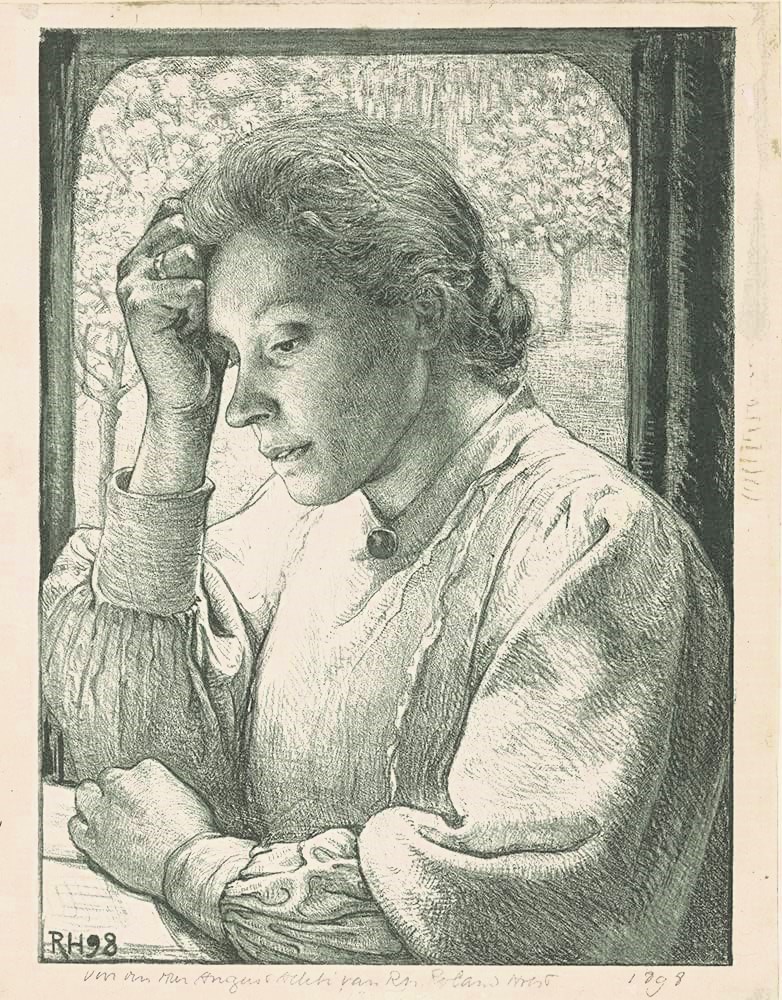
Henriette Roland-Holst decries the incapacity of bourgeois culture to create beauty and art; urges saving what can be saved, and moving on.
‘Communism and Civilization’ by Henriette Roland-Holst from Truth (Duluth). Vol. 3 No. 30. July 23, 1920.
As in the social evolution, there is an uninterrupted development of civilization. Nevertheless, there are periods of civilization, and in these periods we can distinguish budding, flowering and withering.
A civilization is a creation of new ideas incorporated in instruments, ships, paintings, works of art etc.; in the process of work in the conditions of production as well as in the relations of classes. It develops itself under the directing class, attaining with this class its highest pinnacle and then falling with it. The new directing class creates a new culture which in its essential characteristics is generally contrary to its forerunner.
I shall sketch the traits of bourgeois civilization in its decline and one can then see that the coming proletarian civilization, while in many respects a negation of bourgeois civilization, yet continues the march forward of civilization. The eternal progress of life is a reflex of the continual developments of labour.
The idea of a Communist civilization is not mere scheme as it was until lately. It flourishes now in our midst and this we owe to the Russian proletariat and their courageous leader.
Each civilization has one central idea. The civilization of the Middle Ages had the idea of God, the unification of all classes in the Church. The development of production of commerce, of money, the power of the princes, the voyage of discovery and travel caused the fall of this society, and consequently the waning of their central idea, the idea of God.
When the modern bourgeois mode of production began to develop in the eighteenth century the idea of liberty was arising. The religious conscience of the century became juridical and the ideas of liberty inflamed all hearts inspiring Statesmen, Thinkers, and Poets–Shelley, Byron, Schiller, Goethe, and also Beethoven. The period of the decadence of bourgeois civilization is detestable to we Communists above all for two reasons. Firstly, on account of its double dyed hypocrisy, and, secondly, on account of its deadly mechanization by means of which it has degraded and poisoned life. The mode of bourgeois production favours hypocrisy because it is based on exploitation. While the bourgeois holds power the bourgeois State promises liberty and equality. But this equality is only juridical equality, concealing the economic servitude. Their liberty is only illusory, and the more production increases the greater becomes the contrast. The feudal system was not hypocritical, but capitalism is. This is why bourgeois civilization has never flourished in the domains of public life, architecture and the drama. There is no trace today of the high development attained by the drama and architecture in antiquity and the Middle Ages. There may exist today something which faintly resembles architecture in the country houses, banks and warehouses, but the drama has degenerated into a refined intrigue of the drawing-room or into a game of pure sensuality.
The phenomenon of mass production resting on the development of the natural sciences and technique which are the elemental necessities of bourgeois society, imparts at the same time to capitalist civilization a deadly unilaterality, the gramophones of the bourgeois have deified this for any anti-capitalistic civilization; for example, the beautiful flowering of Oriental civilization. Production is merely mechanical production en masse, because it is inspired merely by gain,
The quality is of secondary importance. It is the quantity that counts, which simply means that all pleasure in work is destroyed. The beautiful fabrics of India have given place to cotton prints. In the measure that capitalist civilization penetrates everything, it brings upon everything its deadly mechanization of public life. “Humanity,” says Huzinga, “threatens to become the impotent slave of its property and perfected means of technique, material and social.” A striking example is given us by the decadence of manuscript writing, fallen from the beauties of Oriental writings and the manuscripts of the Middle Ages to the deadly standard of cold print. Everything is now rushed and produced in a vertiginous whirl, but Communism will inaugurate a society where one shall produce without haste solely for the realization and the beautifying of life.
The mechanization of the spiritual culture of capitalism appears most clearly in the cinema, which excites and which corrupts the brain and the heart like alcohol. The growing cinema, in the domain of so-called popular art, under the thirst of competition, its influence is penetrating literature, and famous writers have sacrificed themselves to it. A little part of production is constituted by “objets de luxe” which are distinguished by the finer quality of material and the artistic character of the workmanship. A little portion of art corresponds, the anemic art of the dilettante bourgeois. A snatch of modern lyricism shows itself, lyricism subtly refined, foreign up to the present time to real life, like the bourgeois elite for whom it was written.
Other civilizations were also based on domination, but they differed from the capitalist system in these two respects (i.e. mechanization and hypocrisy). Between the culture of the classes of the Middle Ages existed the bond tie of religion. By means of it the masses had still a personal culture. In their farces, proverbs, ballads and songs, in their myths and legends, the mases see represented their feelings and thoughts. They laugh at their lot and make for themselves a world of beauty, simple but pure. But capitalism has cruelly annihilated the profession of art and of poetry as it existed in the Middle Ages. Capitalist civilization has made life a purgatory, a desert for the masses. In Russia, Louneschansky has been able to intervene and rescue the things worth saving. But in Europe and America it will be necessary to create a now culture. The links which formerly bound masters and subjects, and thanks to which their labour was incarnated creative joy, have disappeared under the deadening stupefying capitalist regime. The culture of the bourgeois is a hollow farce, pretentious yet without foundations. Imperialism had for its task the setting of the masses in motion. It has made desperate efforts to place science and art at its service. The mechanization of labour has been carried to an unheard of degree. Hypocrisy and mechanization are surpassing themselves. The Press, cinemas, art, sermons vie with one another in deceiving the masses.
Translated from “L’Avenir International” by A. Ferguson for “The Socialist” Scotland.
Truth emerged from the The Duluth Labor Leader, a weekly English language publication of the Scandinavian local of the Socialist Party in Duluth, Minnesota and began on May Day, 1917 as a Left Wing alternative to the Duluth Labor World. The paper was aligned to both the SP and the I.W.W. leading to the paper being closed down in the first big anti-I.W.W. raids in September, 1917. The paper was reborn as Truth, with the Duluth Scandinavian Socialists joining the Communist Labor Party of America in 1919. Shortly after the editor, Jack Carney, was arrested and convicted of espionage in 1920. Truth continued to publish with a new editor J.O. Bentall until 1923 as an unofficial paper of the C.P.
PDF of full issue: https://www.mnhs.org/newspapers/lccn/sn89081142/1920-07-23/ed-1/seq-3
 Revolution's Newsstand