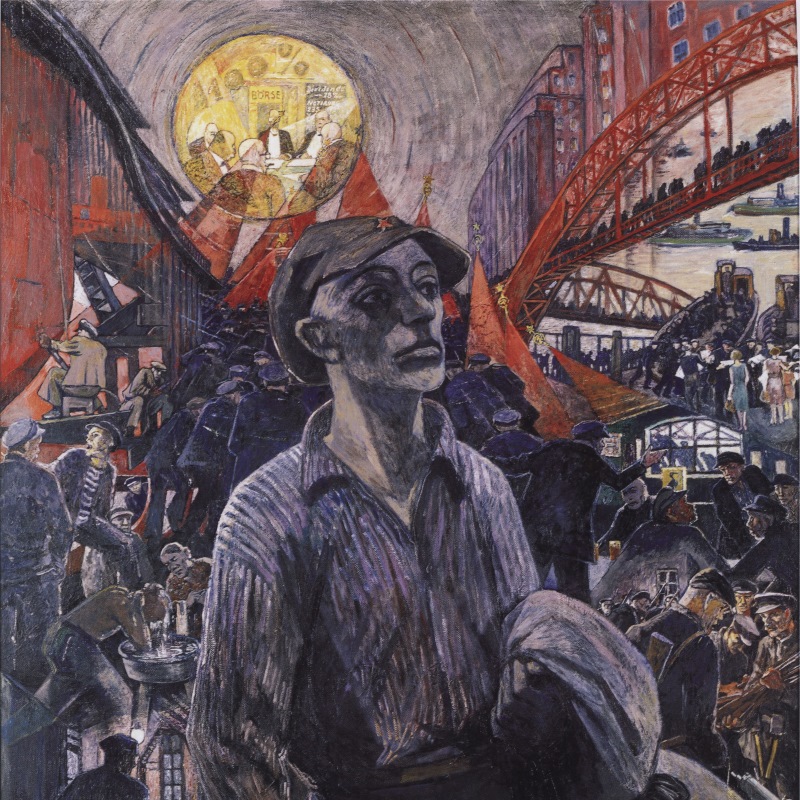
A turning point in German and European workers’ history was 1923’s failed ‘German October’ and its aftermath. A divided party before October remained divided after. Below is a dossier of four documents printed together in the The Liberator; an introductory article by August Thalheimer, the ‘Right’ theses of those around Brandler and Thalheimer, the ‘Left’ theses by those around Maslow, Thalmann, and a ‘Center’ theses associated with Ernest Meyer. Original images by Georg Grosz.
‘The German October: A Dossier’ from The Liberator. Vol. 7 No. 3. March, 1924.
‘The Present Situation in the Communist Party of Germany’ by A. Thalheimer.
THE retreat which the German working class began in October and the difference between the tense expectations and preparations of the Party and the actual course of events has naturally not failed to produce certain reactions in our German Communist Party. These reactions found expression in a temporary reduction of activity which found its ideological expression in the cry, “All or nothing.” That is, since the deciding struggle could not be carried out, a strong feeling of hesitation grew up against entering upon the organization of those minor actions which were necessary and possible. This reduced activity became temporarily noticeable in the neglect of the elementary tasks which were laid upon the party by its relegation into illegality and the reprisals of Fascism. Examples of this were the distribution of illegal literature, placards, small posters, the carrying out of illegal propaganda and the other preparations of minor actions. One can say that this condition has been for the most part overcome and that the greater part of the party is taking up the tasks of the present with earnestness and eagerness. Thus for example in Berlin the circulation of illegal literature has been successfully raised from 5,000 to 20,000 copies three times a week within a few weeks. A corresponding increase in the activity of the party is visible in the other districts. In the matter of organization, the complete illegalizing of the party has not caused the difficulties which our opponents expected. Benefitting by the experience of the old guard of Communism in Germany, the Party has been able to adapt itself to this illegal work in a thousand ways. The chief organization work of the party in the present moment is to transfer the focus of the party efforts into the workshops and especially into the party cells there. This work is now being carried out. It is rendered more difficult by the fact that unemployment and short time have affected the members of the party very severely. The employers have made use of the opportunity to “purify” their works of Communists. However, the party has also found methods of organization to meet this situation. The numerous arrests of members of the party have left practically no gaps which it was not possible to fill up at once. In this respect the members of the party have shown a wonderful tenacity and self-sacrifice which disperses any doubt as to whether the long period of legal work has caused the party to lose something of its revolutionary character. Naturally shortcomings show themselves everywhere which, however, are unavoidable in a task of such gigantic proportions. Loss of members on a large scale has not taken place. For the present however, the transfer of members from the German Social Democratic Party is a movement of individuals.
In the domestic politics of the party there are at present three chief currents. The party debates centre themselves around two chief questions:
1. The cause of the October defeat; 2. the general prospects of the revolution in Germany. As to the present tasks, a wide-reaching unity exists in the party. These debates have led to the laying down of theses by the various groups which will shortly be made accessible to the members of the party.
The group that has so far led within the executive held the view that the reasons for the October defeat are to be found first of all in objective circumstances. It sees the chief cause in the hindering power of the Social Democrats and the yellow trade unions which was underestimated by us. The experiences in Saxony, Thuringia, and also in Hamburg show not only that the Left Social Democratic leaders were not prepared to fight for the defence of bourgeois democracy against Fascism, but that the same held good in the case of the majority of the Left Social Democratic workers. As a result of this it was impossible to fight the deciding struggle in October. With a divided front in the forces of labor and an insufficient technical preparation, it would inevitably have led to a shattering defeat of the party. As to the party, it recognizes that in the preparations there were a number of mistakes and weaknesses, both political and structural, which, without exception, can be traced back to one fundamental fact: the over-estimation of the speed of the revolution, the over-estimation of our own strength and the underestimation of the strength of the opponent, above all the hindering power of the Social Democrats and the Amsterdam trade unions. At present the chief task is to call a halt to the retreat of the workers which is proceeding almost without any effort at resistance, and, at every point where the offensive begins, to attempt to build up centres of resistance through the party and to rally the workers around these centres. In the question of the revolutionary prospective, this group is of the opinion that none of the fundamental political or economic questions in Germany can be solved by the Junker-industrial military dictatorship, that the situation still remains objectively revolutionary as it was before, and that the class differences must become more intense. On the other hand this group sees no possibility at present to say at what rate this new sharpening will proceed, and what form it will take in its details. Certainly the party is an essential factor, but it is not the only one.
The group which up to the present has been the Left wing of the party considers the real causes of the October defeat and the revolutionary prospect to be quite different. It supports the view that the party should have accepted a decisive battle in October even at the risk of a defeat. In the October retreat it does not see a result of the relative strength, but an essential breaking down of the party and especially of the party staff. As a result, this group demands that the leadership of the party shall be placed in the hands of the Left. That the transition to minor actions has come up against considerable hindrances within the party is to be attributed in a large measure to the effects of this view. In respect to the present task this group lays the chief emphasis upon the propaganda of the final objectives of the dictatorship of the proletariat and Socialism. This tendency within the party is to a certain extent emotionally directed, in a large measure by those sections within the working class, the unemployed and short-time workers, who as a result of their situation tend to overlook the objective difficulties of the path of revolution. The revolutionary prospective presented by this group states that within a very short time the situation will once more sharpen into a decisive struggle.
Between the two groups there is a middle group which chiefly criticizes the fact that the October retreat took place without sufficiently making use of the possibilities of minor struggles, and who tend to find the causes of the retreat chiefly in subjective mistakes of the party. It is difficult to give the views of this group clearly, as they are not a unit, and it is in the nature of a middle group to unite contradictory elements. Both in the Left and Middle groups there is a disposition, in the same way as after the March Action, to neglect the analysis of the objective situation and the consideration of the role of the party in connection with the strength of the other chief factors. These groups also feel that they can now say with certainty that as early as in the next few months the basis for extensive mass struggles will be present.
In our opinion the debates which are now taking place within the party are unavoidable and they will prove fruitful for clearing up the methods of the revolutionary struggle in German conditions. The process of the proletarian revolution in Germany is not simply a weak imitation of the Russian revolution, and so we must simply regard it as a sign of health that the party is endeavoring in all earnestness, by its own efforts to draw lessons for the future from the experience that it has had. In spite of all the sharpness of the debate it is certain beyond all doubt, that the overwhelming majority of the party will not tolerate any shaking of the unity of the party.
‘Theses on the October Defeat and on the Present Situation’ by August Thalheimer and Heinrich Brandler.
I. On the October Defeat.
1. The October retreat was unavoidable and justified.
2. The fundamental causes of the October defeat are of an objective nature and are not due to essential tactical mistakes on the part of the Communist Party of Germany. The decisive cause is the influence of the Social Democratic Party still being too strong and hampering. The majority of the working class was no longer ready to fight for the November Democracy, from which it no longer derived any material advantage, and was not yet ready to fight for the Soviet Dictatorship and for Socialism.
Or in other words: the majority of the working class was not yet won over for Communism.
3. The mistake, common to the Executive Committee of the Communist International as well to the Central Committee of the Communist Party of Germany, was the false estimation of the proportion of forces within the working class between the Social Democratic Party and Communist Party.
The Communist Party of Germany adopted a critical attitude in this respect towards the Executive Committee of the Communist International, but was not energetic enough. The Executive Committee of the Communist International has not attached sufficient importance to this criticism.
4. The consequences of this false estimation of the proportion of forces were:
a-The fixing of too early a date for the final struggle.
b-Neglect of the partial struggles and of the political preparation.
c-As a result of the lack of connection between the political and the technical preparations, the military-technical preparations also suffered.
5. Defects of a second and third category were:
a-In Saxony and Thuringia insufficient exploitation of the given positions in regard to disintegration of the Social Democratic Party, attracting Social Democratic workers into the Communist Party as well as to organizing military defense.
b-Clumsiness in the organizational adaptation of the Party for the task of civil war.
6. All these mistakes and defects do not essentially alter the fundamental relationship of forces between the bourgeoisie and the working class.
II. On the Present Situation.
1. The military dictatorship of Seeckt bases itself socially on heavy industry and the great agrarians. It tries to subordinate the independent movement of the middle classes (petty bourgeois Fascism), partly by concessions and partly by repressions. It attempts to retain and to deepen the division of the working class into fractions, on the one hand by maintaining the appearance of bourgeois democracy and thereby winning over the Social Democrats as defense troops, and on the other hand by repressions against the Communist Party.
2. The duration of the military dictatorship depends upon:
a-The possibility of re-establishing temporary economic equilibrium by increased exploitation of the working class and of the middle classes, by reduction of expenditure, and by requisite payment of taxes by the possessing classes. The first two measures are possible owing to the present conditions of power, the last is problematical and will be decisive.
b-The pace of winning over the majority of the workers for Communism and disintegrating and neutralizing the middle classes.
3. The pace of the renewed objective aggravation of the situation cannot yet be estimated. At all events a general sharpening of the class antagonisms and struggles must be expected.
4. The rate of winning over of the majority of the workers for Communism depends upon the Communist Party of Germany. All forces are to be concentrated on the political and organizational liquidation of the Socialist Party of Germany.
5. The political platform of this liquidation is: Negative: destruction of the democratic and social-reformist illusions.
Positive: winning over of the workers for the struggle for the proletarian dictatorship and for socialism.
6. With this work of propagation of principles and criticism there must be combined political, economic and military partial struggles. The decisive struggle is the culmination and the resultant of these partial struggles.
7. The next task: obtaining liberty of movement (in the streets etc.) by revolutionary mass action (at first by peaceful and armed demonstrations, strikes, armed and protected meetings etc.).
8. Transference of the organizational centre of gravity into the shop nuclei.
9. Increasing the activity and discipline in the Party. Elimination of passive elements from the Party, at the same time closer connections with the broad masses.
Session of the Enlarged Executive of the Communist International, followed by a Special Conference of the Communist Party of Germany.
‘Theses of the Left Wing: Outline of Theses on the Political Situation and on the Situation of the Party’ by the Political Bureau of the District Committee of Berlin-Brandenburg.
1. By the increased acuteness of the reparations crisis in January 1923, the economic chaos in Germany as well as the political collapse was furthered enormously.
2. This increasing economic and political pressure transformed the movement of the working class, which up to that moment had been retrogressing, into a rising proletarian movement of an offensive revolutionary character.
3. The first signs of the new revolutionary wave were the Ruhr struggles in May, the struggles in Upper Silesia, the metalworkers’ strike in Berlin, the wage struggles in the Saxon Erzgebirge. These movements reached their culmination in the Cuno strike.
4. The significance of the Cuno strike lay in the following: The workers started with economic demands (note printers’ strike, inflation crisis), and in the movement itself the strike assumed a sharpened political character (Berlin shop council refused to fight for economic demands and opened up the question of the government!). The Cuno strike revived and stimulated the forces of the proletariat and frightened and disintegrated the bourgeoisie. After the Cuno strike the bourgeoisie stood in fear of the “second revolution,” the strata of the rural and of the urban petty bourgeoisie began frankly sympathizing with the working class and with the Communist Party. The objective conditions of Germany between the August strike and the October events had become ripe for the seizing of power by the proletariat.
5. Thus the Executive Committee of the Communist International was perfectly right when in October 1923 it ordered the Communist Party of Germany to prepare for the final struggle.
This fight could eventually have been introduced by a series of partial struggles, but it was the duty of the Party to enter the struggle in this historical situation with all its forces and to bring on a decisive battle between the bourgeoisie and the proletariat. The chances for a victory of the Communist Party in October were very great. But the Communist Party ought to have ventured on this struggle even with the risk of a defeat which would have created good revolutionary traditions among the proletariat in favor of the Communists and thus would have prepared for victory. The best proof for the truth of this statement is the Hamburg struggle, which has been of very good service in enhancing the reputation of the Communist Party among the Hamburg workers.
6. The retreat of the Communist Party of Germany without any struggle in October, rendered easy the victory of heavy industry and demoralized and depressed huge portions of the proletariat. Confusion was also carried into the ranks of the Party itself, which confusion up to the present has not been eliminated (the Communist Party had promised to prevent Fascism from being victorious etc. etc.).
7. The causes of the October collapse of the Communist Party in Germany are as follows:
a-The Central Committee of the Party refused right up till October to prepare the Party members for the final struggle and did so only after having been compelled by the Executive Committee of the Communist International. (Prospects of a Government of left wing Social Democrats consisting purely of Trade Unionists in August). This preparation could therefore be done only very superficially and without real, practical effect in the press, propaganda, organization and general policy of the Party.
b-The limitation of the preparation to a purely military and technical one, without preparing the party politically and by propaganda for the slogans of the final struggle, in addition to which there had been practically no military technical preparations since the March Action; this neglect could not be remedied in the short period between the October Conference at Moscow and the decisive events.
c-The revisionist united front tactics and the alliance with the left wing of the Social Democratic Party, which was exhibited in its extremest form in Saxony and Thuringia. The Party had, by its tactics, rendered the left wing Socialist Democratic Party more popular among the working class than ever. The Communist Party had, by its years of united front tactics, created among the Communists themselves the sentiment of weakness and the prejudice that struggles, especially decisive ones, could only be risked in an alliance with the Social Democratic Party. (Theory of bringing over the Social Democratic Party from the left wing of the bourgeoisie to the right wing of the working class!)
d-Particularly, by its constant propaganda of the transition slogans within the frames of democracy and of the constitution (seizure of real values, Workers’ Government!), the Party had neglected to keep alive the Communist program among the large masses. The most serious thing is that the Party did not correct this mistake even after the May struggles in the Ruhr district, not even after the Cuno strike, and in fact not even after the October defeat, and that right up to the October Conference at Moscow it obstinately clung to the theory and practice of gradualism.
From the theory and practice of the transition demands there resulted the concentration of the work of the Party majority in certain districts, where it was possible to proceed along with the left Social Democrats (Saxony and Thuringia!) and the neglect of other important fighting positions of the German proletariat, especially of the Ruhr district and of the Ruhr problem. (The Leipzig Party Congress did not deal in a specific manner with the Ruhr occupation!)
e-From the theory of the transitory demands, from the practice of proceeding along with the Social Democrats there arises the bitter struggle of the Party majority against the left wing of the Party, the organizational and personal effects of which have contributed to the inner weakening of the Communist Party.
8. The Enlarged Central Committee (Zentralausschluss) which held its conference after the October events, neglected to deal with all the problems pending in the Party. Since then, the crisis in the working class and in the Party has increased. The German working class has surrendered the eight hour day to the employers without any fight, largely owing to the fault of the Communist Party of Germany. The Ruhr district is in a process of separation from Germany, the Micum negotiations will be followed in the next few weeks by official negotiations between the Governments. The dictatorship of the white generals brings hundreds of proletarians under preventative arrest and into prison, without the workers defending themselves with sufficient energy. After a period of rising revolutionary tendencies within the proletariat, before and after the Cuno strike, we have arrived now at a period of dejection and depression.
9. The international crisis and the crisis of German capital will bring a series of new acute aggravations in the next months. The Communist Party of Germany must not meet with a second “German October” if it is not to lose all its prestige as a revolutionary party among the masses. A clear pronouncement on the mistakes committed, a final settlement with the revisionists within its own ranks, rupture with the theoreticians and practisers or gradualism and the quickest knitting together of all forces of the Party for illegal work must be carried out at once. Every week of further delay in this process of clarification renders the situation of the Party still worse and damages its fighting capacity.
10. Starting from the summing up of the October defeat, the Party must create a program of action. The most important points of the work in the next months are as follows:
a-Adaptation of the Party for the struggle for power, political, organizational, military and technical.
b-Stirring, concrete, immediate propaganda for the Dictatorship of the Proletariat. (The Party must show, in its daily agitation, how the white dictatorship is settling the problems of the proletariat and how the red dictatorship is to settle them.)
c-Propaganda of socialization. (Program of salvation, enraging propaganda against the big trusts and concerns. There must be started against the thirty or forty heavy industrialists, the same enraging propaganda as against Seeckt, Ludendorff and Hitler, even in a more concentrated manner. We must demonstrate to the largest masses, who is actually retaining the power and how the connection between the government apparatus and heavy industry is working).
d-Extension of the factory council movement into a political one, making use of the factory council movement for preparing the political Workers’ Councils. Tireless propaganda for the proletarian councils as a pre-condition of proletarian dictatorship (control committees).
e-Working amongst the unemployed in connection with the factory councils, creating councils of the unemployed.
f-Provoking struggles for the eight hour day against the Special Courts, under the leadership of the Communist Party and of the factory councils.
g-Complete rupture with the right and left wings of the Social Democratic Party, in theory as well as in practice, strongest fight against the Social Democratic Party and against the Trade Union bureaucrats within and without the Trade Unions.
h-Intensified working for the Communist program amongst the peasants, agricultural laborers, middle classes, officials and intellectuals.
11. For reorganizing the Party there is necessary:
a-Reduction of the Central Committee to nine men, reduction of the central apparatus to one tenth, elimination of the right wing from the leadership. Vital connection of the Communist Party with the political work of the districts.
b-Liquidation of the fight against the left wing on the part of the Party majority, by a common fight of the Party center and of the Party left wing against the Party right wing.
c-Convocation of a session of the Enlarged Executive Committee of the Communist International not later than in January.
d-Convocation of a Party Congress not later than in February.
This outline is only intended to serve as a basis for discussion; the detailed theses will be published later.
‘Theses on the Tactics of the October Retreat and on the Next Tasks of the C.P. of Germany’ by the Majority of the Central Committee of the Communist Party of Germany.
I. The Situation before the October Events.
THE political situation in Germany before and during the October events was objectively revolutionary in the highest degree. The November republic was completely exhausted by the international complications of Germany resulting from the liquidation of the Ruhr adventure, by the rapid economic decay and by the increasing class antagonisms. Civil war seemed unavoidable. The Coalition parties hastened to do away with the democratic form of state through fear of the imminent proletarian revolution. They surrendered power to the Fascist generals, in order to save the bourgeois society and the capitalist form of ownership from the proletarian dictatorship. The Social Democratic Party of Germany including all tendencies, was a helper and an accomplice of the White Dictatorship, which alone could still save the domination of the great bourgeoisie.
II. Mistakes of Preparation and of Strategy.
The retreat of the party in the October struggles is to be explained not only by organizational, military or technical defects, nor by the unfavorable general proportion of forces, which was far more unfavorable when the Party adopted its measures for struggle than in the decisive month, but before all by the mistakes in regard to the tactical and strategical attitude of the party in the struggle for winning over the majority of the proletariat, which was the first premise for success. These mistakes were the result of a false valuation of the Party’s role in these struggles. The main mistakes to be recorded are the following:
a-The Party did not perceive at the right time the importance of the great proletarian mass struggles in the Ruhr District and in Upper Silesia, and of the Cuno strike, and hence it did not change its position accordingly. These struggles were clear signs of increasing vigor and desire to fight on the part of the German proletariat.
b-The Party, furthermore, began its preparation for an armed uprising, not at the same time as it declared the dissolution of democracy (Cuno epoch and Ruhr occupation), but only immediately before the coming of the White Dictatorship, from which resulted the feverish, eleventh hour preparation for the military struggles and the feeble arming of the workers in the decisive days.
c-The Party tried to delay elementary mass movements before the October events up to the “final stroke” and thereby hindered mass movements, instead of furthering them. The press and the united front organs were utilized too little for preparing the struggle politically and for engaging in it. As a result, the struggle was taken up almost entirely as a struggle of the Party and not as a united struggle of the proletariat; the Party failed to connect its final aim, Dictatorship of the Proletariat, closely with the transition demands and with the partial struggles.
d-The Party has misjudged the role and the character of the left Social Democratic party leaders and has allowed the rise within the ranks of the Party of the illusion that these leaders would fight together with the proletarian vanguard.
e-In the governments of single states, the Party has not sufficiently utilized for strategic position for mobilizing the masses for organized resistance.
f-The cardinal mistake of the strategic attitude was, however, the Party’s preparing itself exclusively for a “final struggle” for obtaining political power, and its rejection and prevention of partial struggles, struggles with partial demands and with less aggressive means and methods of struggle.
g-Following on this cardinal mistake, there was constructed an abstract calculation of the proportion of forces, without knowing or having examined the real proportions of forces. The examination of the proportion of forces and the determination of the date of final struggle can only be calculated and fixed by following these struggles themselves. This false theoretical strategy led to the evasion of any fight.
h-Finally, in the days decisive for the Party, the importance of the number of arms was generally overestimated, while the enormous subjective force and the readiness of the proletarian vanguard to offer sacrifices (lessons of the Hamburg struggles) were generally undervalued.
i-The fixed determination only to pass from the defence of the position in Central Germany to the final struggle, was false. As a consequence, after the White troops entered Central Germany, a great disorientation took place.
III. The Role of the Party in the October Crisis.
The Party mobilized resistance against the attack of the White Dictatorship with all the forces and means at its disposal. In the decisive moment, however, after the enemy had engaged in the most violent offensive, it evaded this struggle. This abdication without struggle made the masses confused, weakened confidence in the revolutionary leadership of the proletariat, lessened the great sympathies existing for the Communist movement, strengthened the vigor and the self-confidence of the enemy, hindered disintegration and derangement within the ranks of the White bands, and thus in an objectively revolutionary period, made more difficult the future struggles of the proletariat. The retreat of the Party during and after the Chemnitz Conference resulted from the great mistakes in the preparations for the final struggle mentioned above.
The retreat without struggle was false, because:
a-The Party and the active portion of the proletariat, being ready for the final struggle, did not understand the surrender of the positions in Central Germany without a struggle and did not comprehend the necessity of this retreat.
b-Among the hesitant and those portions of the proletariat and the impoverished middle strata sympathizing with the Communist Party of Germany, confidence in the revolutionary solution of the economic, political and national problems by the Party was weakened.
IV. Perspectives of the Revolutionary Development.
The question put on the order of the day within the Party after the October defeat: a revolutionary rise or a deep decline of the revolutionary wave? can only be answered by the perspective of international development. This question is most closely connected with the question of the development of the capitalist system and of the aggravation or mitigation of the relations of the imperialistic powers, groups and States of Europe. Germany, being cut off from her sources of raw materials and from her most important industrial districts, is more than ever dependent upon the international groupings of the powers and upon the international reciprocal relations of these groups. In spite of the apparent pacifistic improvement afforded in the last weeks, an essential aggravation of the international relations can be reckoned with as a result of the French bourgeoisie utilizing its victory in the Ruhr District. In the sphere of economics also these are no symptoms whatever of a consolidation of capitalism, but, on the contrary, an increasing aggravation of class antagonisms. Above all things, in Central Europe (Germany, Poland, Austria) an extraordinary sharpening is to be expected before long. The rise of the revolutionary wave in Central Europe is therefore immediately imminent. It will take place at a quicker or a slower rate, accordingly as subjective revolutionary forces influence objective revolutionary crises in an accelerating or in a retarding manner. In this, readiness for struggle and desire to fight on the part of the German proletariat will be of decisive importance.
The White Dictatorship will not be able to maintain itself in Germany for very long, since the foundations on which it is basing itself are already beginning to waver. The forms of resistance, which it is not able to master, are the following:
a-The international dependence of Germany and the opposition of France against its strong armament;
b-the economic bankruptcy, accompanied by increasing unemployment which is becoming obviously chronic, above all as a consequence of the flight of Rhenish-Westphalian heavy capital into the spheres of French imperialism, a fact by which Germany is deprived of her most valuable provinces;
c-the complete bankruptcy of the finances of the Reich, the states and of the municipalities;
d-as a consequence of the financial bankruptcy, the impossibility of longer maintaining the forces of the state and also the military forces;
e-the increasing antagonisms in the very ranks of the interested bourgeois groups, antagonism of great land owners, middle propertied class and of heavy industry;
f-the proletariat, depressed, it is true, by the White Dictatorship, but not beaten;
g-the large strata of officials, employees, technicians and of the self-dependent petty middle classes, being proletarianized and becoming ever riper for the class struggle;
h-the agrarian proletarian and semi-proletarian population, becoming revolutionized at an increasing rate;
i-Fascism, decomposing ideologically, itself, owing to the open treason of heavy industry.
For all these reasons, tremendous tension and huge proletarian mass struggles are to be expected in Germany in the next months.
V. The Role of the Party.
The Party is not only a portion, but the vanguard of the proletariat. Its position in the labor movement and in the struggles of the proletariat is not only within the masses, but one step in advance. When retreat becomes necessary the Party has to render this comprehensible to the masses, in an unflinching manner, and the Party will thereby maintain the confidence of the masses in itself even in rearguard struggles. The Party is at the same time the brain, the nervous system and the revolutionary will of the masses.
Acceleration of the pace of revolution depends upon its activity, its resoluteness, its courage, its clearness and insight, its tactics and strategy, its capacity for remaining in the closest contact with the proletarian masses and of leading them in the mass struggles in a skillful and comprehensive manner.
VI. The Next Tasks of the Party.
a-The immediate and most important task of the party is to re-order the Party ranks so that they offer perfect resistance to the attacks of the White Dictatorship, so that the Party conserves absolutely its character as a mass party and maintains and strengthens its connections with the masses;
b-the fight against the prolongation of the working time, against the abolition of the eight hour day and against the reduction of wages must be organized by the Party everywhere by rousing propaganda and by extending and leading the defensive struggles. Even in cases where such struggles lead to a defeat, the masses must perceive clearly and distinctly that the Communist Party has tried with all its forces to take up and to lead this struggle;
c-the Party must stand everywhere at the head of the unemployed, lead their struggles, and unite them; all the unemployed must recognize that the Communist Party is caring for their needs and is fighting for their interests;
d-the connection of the Party with the working masses by the coordination of the movement of the unemployed with the organs of the Weimar Conference, with the Factory Councils, with the movements of Control Committees and of the “Centuries,” as well as with all other united front organs of the proletariat, intensification of the Factory Councils movement, so as to make them the strongest organs of the united front in all the struggles of the proletariat;
e-the leadership of the economic struggles of the proletariat expressed in elementary outbreaks in connection with the Factory Councils movement and with the united front organs;
f-the political demonstrations of the employed in the shops with the unemployed, with clear and distinct slogans, with economic and political demands;
g-especially intensive work among the strata of the officials, the employees and technicians, as well as among the proletarian agrarian population;
h-the winning and the saving of the Trade Unions, which has become easier as a result of the present debacle due to the reformist leadership;
i-destruction and disintegration of the Social Democratic Party by ruthless exposure of its counter-revolutionary character; before all in this respect, the endeavor must be made to rid Social Democratic workers of any illusion as to the possibility of an eventual improvement and radicalization of the Social Democratic Party of Germany by the “left” leaders;
j-the leadership of the struggles having partial aims or the leadership of general struggles throughout the Reich with partial aims, together with the united front organs;
k-the fight against the White Dictatorship with the very methods and means employed by the White hirelings against ourselves;
l-the Party must, in an intelligible and vivid manner, raise in opposition to the Dictatorship of the Bourgeoisie and its generals and its Fascist unions, the slogan of the Proletarian Dictatorship, concretizing and utilizing it in all vital problems of the proletariat for propaganda purpose;
m-for this purpose, the Party must set up a program of salvation showing the Proletarian Dictatorship as the only way to the social and national emancipation of the working strata of Germany.
VII. Organizational and Inner Political Tasks
The next organizational tasks of the Party are the following:
a-The transformation of the Party upon the Shop Nucleus system, so that all functions of the local organizations are transferred to the shop nuclei and are carried out by them under the control of the Party;
b-the transformation of the Local and District Committees, so as to secure the deciding influence to the representatives of the shop nuclei;
c-in the Zentralausschuss (enlarged Central Committee) the greatest influence must be secured to the representatives of the most vitally important undertakings and of the most important branches of industry.
The next inner political tasks of the Party are:
a-Closest knitting together of all the forces of the Party;
b-fighting against any attempt at division, from whichever side it may come, denouncing such attempt as counter-revolutionary;
c-the centre of gravity of the inner party discussions must be transferred to the ideological camp, and not to the organizational, keeping, however, perfect communist discipline;
d-maintaining, deepening and employing in a corresponding manner the united front tactics, as they have been fixed at the Congresses of the Communist International.
The Liberator was published monthly from 1918, first established by Max Eastman and his sister Crystal Eastman continuing The Masses which was shut down by the US Government during World War One. Like The Masses, The Liberator contained some of the best radical journalism of its, or any, day. It combined political coverage with the arts, culture, and a commitment to revolutionary politics ay a pivotal time in Left history. The writings by John Reed from and about the Russian Revolution were hugely influential in popularizing and explaining that events to U.S. workers and activists. Increasingly, The Liberator oriented to the Communist movement and by late 1922 was a de facto publication of the Party and was sold to the Party by Eastman. In 1924, The Liberator merged with Labor Herald and Soviet Russia Pictorial into Workers Monthly. The Liberator is an essential magazine of the US left.
PDF of full issue: https://www.marxists.org/history/usa/culture/pubs/liberator/1924/03/v7n03-w71-mar-1924-liberator-hr.pdf
 Revolution's Newsstand