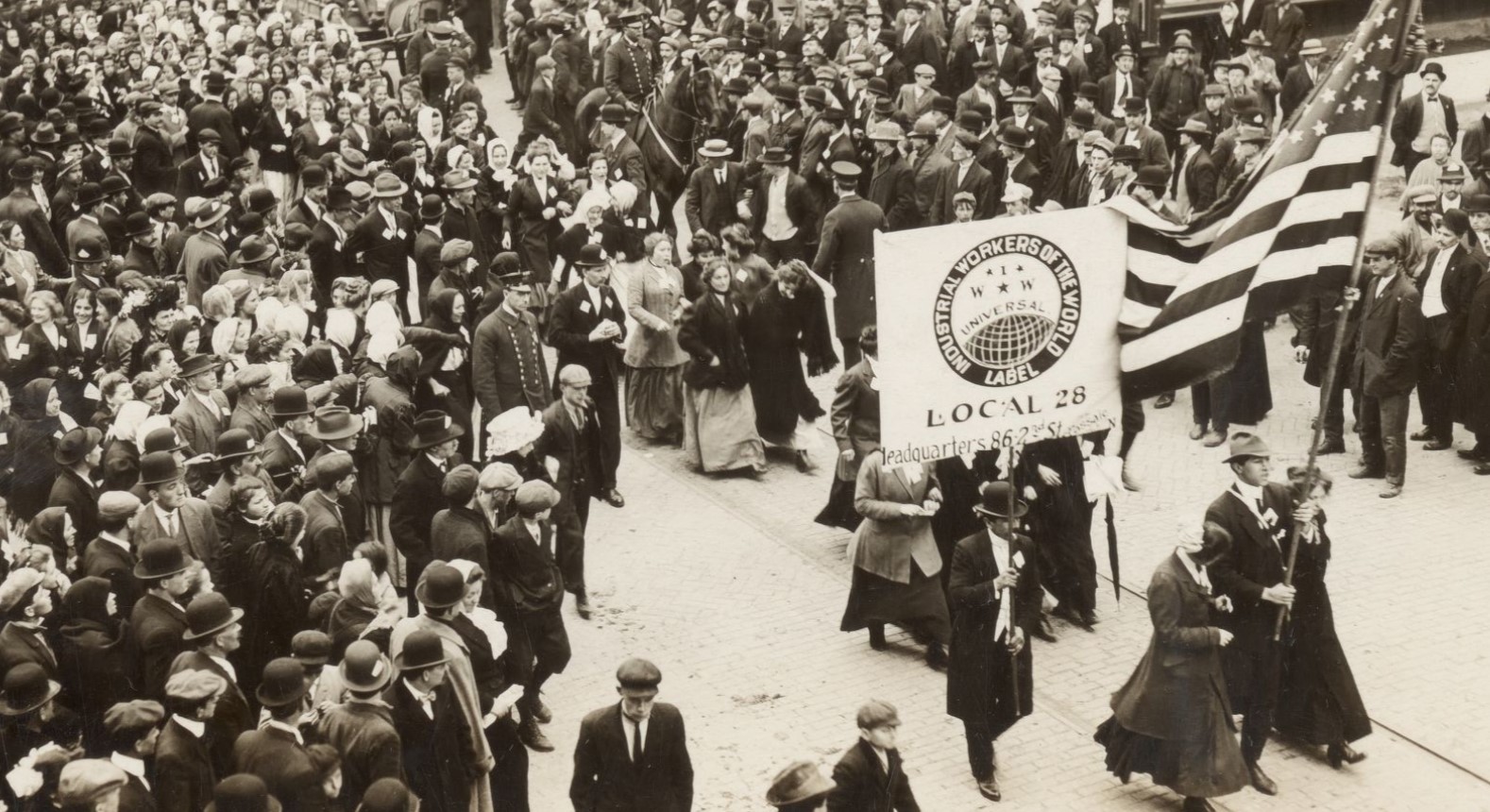
Justus Ebert with and inside look at the work of the I.W.W. and its competitors in New Jersey during the Passaic and Paterson confrontations.
‘The I.W.W. in Jersey’ by Justus Ebert from Solidarity. Vol. 3 No. 16. April 13, 1912.
Its Steady Growth Arouses Desperate and Futile Opposition of Capitalists and Their Reactionist Allies.
Paterson, N.J., April 6. The newspapers of this city, Passaic and New York City have been teeming the past few days with sensational and blood-curdling reports of strikes at Passaic and Garfield, and the part played therein by Haywood, Thompson and the I.W.W. The latter was pictured as a breeder of violence, an organization of dynamiters, etc., which ought to be suppressed. Accordingly, the reports justified and applauded the suspensions of the right of free speech at Garfield and the determination of the police authorities of both Garfield and Passaic to put out of business any hall proprietor who would rent a hall to the I.W.W. for meeting purposes. The brutality of special deputies was freely pictured and exultingly upheld as a proper treatment for such “lawlessness” as the I.W.W. was alleged to stand for.
Nothing happens in life without a cause. The cause of these lying reports and the drastic action is the continued growth of the I.W.W. in Passaic, Paterson and vicinity, despite the continued opposition of the capitalist class and certain spurious elements in the labor movement who are helping it in its nefarious oppression of the working class. For some time the I.W.W. has been steadily increasing its membership and demonstrating its principles with an ability that has won the respect and adherence of the workers and the hostility of the opposition already described.
The means by which this has been accomplished have been many. As already reported in Solidarity, it has consisted mainly in practical demonstrations of the soundness and need for industrial unionism as opposed to craft unionism. The I.W.W. men in Paterson fraternize with all divisions of the working class. For instance, in one of the large silk mills of this city the I.W.W. is represented by over 125 wage slaves, while the opposition organization has a membership of 40. Nevertheless, our members make no attempt to force these 40 to their way of thinking or to join our organization. They believe that they will come as a result of united action rather than abstract argument. Consequently, they act in perfect accord with their principles of solidarity with the opposition organization against the mill bosses and in the class interests of their exploited wage slaves themselves. Such an exhibition of tactful, patient solidarity is not without its effect; it is winning in Paterson, hence capitalist hatred and venom; hence the futile obstruction of fake elements.
Another method has been the systematic holding of shop meetings for agitational purposes. The Paterson I.W.W. men believe in occasional big mass meetings as an agency of publicity during strikes. But they pin their faith to shop meetings–to agitation on the job–as a means of recruiting membership. Big mass meetings arouse interest in a general way for a limited period. But shop meetings, tackling shop problems and discussing specific shop grievances, awaken a concrete and permanent interest.
So shop meetings are held, with increasing success. At these meetings the hearing of all sides is urged. The opposition speakers are asked to present their side, and the pros and cons are weighed, with the I.W.W. men as the winners most frequently.
To the end that the shop method of agitation may be most effective the Paterson Locals, led by 152, have elected Ewald Koettgen permanent local organizer. Koettgen is the General Executive Board member of the National Textile Industrial Union. He is not a cigar manufacturer, nor the keeper of a mythical drug store, nor the husband of a physician, but a practical textile worker, acquainted from actual experience with the needs and aspirations of his co-workers and the tendencies of the textile industry, and industry in general. He has the respect and confidence of all his associates and is justifying both by his able conduct of affairs entrusted to him for execution and achievement. He has many calls for his services.
He is to-day at Sterling, N.J., organizing textile workers.
There have been other methods used, all of the same character as the above. These have contributed to I.W.W. growth. For instance, Koettgen and Adolf Lessig were accused by the organ of the opposition body with having advised the return to work of strikers at one of the local mills. Instead of growing infuriated at the falsehood and losing their self-respect, Lessig went before a shop meeting of the mill in question, read the statement, and asked his bearers if it were true. A thunderous “NO” was the answer, and some more recruits were made. In like manner a discussion was conducted in the local press with like results. Recruits are coming in by the hundreds every week.
Effect of the Lawrence Strike.
But it remained for the Lawrence strike to boom the I.W.W. in Paterson and vicinity. The textile workers are terribly underpaid and overworked in all branches and everywhere throughout the land. In Passaic and Garfield, for instance, the girl and women operatives of two looms earn from $3 to $5 for a week ranging from 60 to 72 hours. The conditions are even worse than in New England and the South. The successful waging of the Lawrence strike filled the textile workers with ‘hope and the prospect of improved conditions. On all hands, consequently, discontent manifested itself; revolts occurred and organization became the need of the hour. The textile workers turned to the I.W.W., to the organization that won the Lawrence strike, to Haywood, Trautmann, Thompson, St. John, etc. But the I.W.W. is small, its task mighty; so mighty as to overwhelm it at times. This was the case in Paterson and vicinity. The Lawrence strike commanded all the available resources of the I.W.W. and thus left the local field exposed to the machinations of spurious elements. These, led by the Socialist Labor Party and its press, placed. Rudolph Katz here. This man made use of the Lawrence strike to deceive textile workers. He declared that his organization had won the Lawrence strike; and thus inveigled the textile workers into joining it.
It was amid these circumstances that two strikes occurred hereabouts; one at the Botany mills at Passaic and the other at Forstman & Hoffman’s at Garfield. These two strikes were organized by Katz’ Socialist Labor Party. At the Botany, which is a strategic mill, the strike was a partial and craft strike. It involved only weavers and dyers, the latter coming out of their own accord. In all, only 20 per cent of the mill hands were involved, 80 per cent remaining at work and scabbing in on their fellows on the outside.
At Forstmann’s the percentage of strikers were greater and much more favorable to victory. Here special deputies were numerous and picketing was practically suspended.
Both strikes were accompanied by police attacks and brutality from the very start. Mr. Boris Reinstein, a pharmacist, better known as Doctor Reinstein, Katz’s representative. He led the two strikes and was busy raising bail for and interceding with the authorities on behalf of the strikers from the very outset of both.
During the past week Bill Haywood and James P. Thompson, general organizer of the I.W.W., entered on the scene at Passaic and Garfield, on invitation of the strikery. They pointed out the craft character of the Botany mill strike and the ineffectual method of picketing at Forstmann’s. Both called aloud for an industrial strike and for mass picketing to save the day. Both exposed the Socialist Labor Party and its deceptive course. Thompson captured one of Reinstein’s meetings at Passaic. Here he made a most eloquent speech. Holding his hand aloft with his fingers spread in fan shape, he cried: “Workers, don’t strike like this, but like this!”–and here he closed his strong fingers into his clenched fist. The applause. was stupendous. Then Thompson, starting with his thumb and taking each of his fingers successively, said: “Don’t strike as Italians, Hungarians, Germans, Poles or Americans, but,” closing his hand in a tight grip, “but as one solid body.” This vivid illustration of solidarity, for which Thompson plead, regardless of craft, national or organizational differences, secured the triumph of the I.W.W. This was further reinforced when Thompson suggested the joint meeting of the strike committees representing Katz’s Socialist Labor Party and the I.W.W. An additional factor was the autocratic parliamentary conduct of Reinstein, as compared to the democratic behavior of Thompson. Reinstein sought to carry out the practical S.L.P. principle of rule from above; he decided what the meeting should do; that is, he tried to; while Thompson urged the placing of all matters before the meeting for its approval or rejection, and carried his point.
Socialist Labor Party Helps Police.
It was after these occurrences that the cry of “violence,” “dynamite,” etc., was raised in Passaic and Garfield, and free speech was suspended and the I.W.W. barred from the halls of both cities. The capitalists did not want an industrial strike at Botany’s or industrial picketing at Forstmann’s. They wanted the defeat of the workers on “a civilized plane;” that is, by craft weakness, middle class incompetence and autocracy and capitalist intimidation and oppression. They feared Bill Haywood, Thompson and the I.W.W., not because they carried bombs or preached violence, but because they had won the Lawrence strike and were showing the Passaic and Garfield strikers how to win their strike by the same peaceful methods. And so they raised an uproar, in which Mr. Reinstein ably helped them. Dr. Reinstein, according to newspaper reporters in a position to observe, consulted daily with the commissioners of Garfield (this is a commission governed town, regarding the moves to be made against the I.W.W. Simon Knebel, our Philadelphia organizer, attempted to hire a hall and was told that he could rent one if he came armed with a note of approval from Reinstein. Three sympathizers of our organization, including a well known Socialist Party writer and investigator, were in one of the halls when a police officer entered. He shouted to the proprietor: “Don’t you rent halls to the Chicago I.W.W., if you want to keep out of trouble. You can rent a hall to Reinstein, but not to Haywood or Thompson.” The press in is city and New York rejoiced over Reinstein’s co-operation with the police and openly proclaimed the fact. Reinstein shouted “dynamiters,” violence,” etc., loudest, and gave the cue to capitalist oppression. The files of the capitalist press will bear out this statement. The co-operation between the Socialist Labor Party and the police was best seen when Thompson appeared in Garfield after his first appearance before the strikers. The police were drawn up in line before the hall in which the strikers met, they were scattered throughout the audience, awaiting Reinstein’s word to assail Thompson. Reinstein, backed by the police, refused to permit Thompson to speak. Thompson, true to I.W.W. principles, counseled all hands to go into the meeting and keep the strike agoing with renewed vim and vigor. Reinstein played the I.W.W. game.
At present the air is full of rumors of warrants for Haywood’s arrest for “inciting to riot.” Bill was called to Lawrence during this outcry, and is now in Ohio filling lecture dates. The “warrant” outcry is, most likely, a. bluff.
The strikes continue, with the Socialist Labor Party and Reinstein losing prestige. Their co-operation with the capitalist class is too transparent; their incompetency and autocracy is disgusting and disheartening. In the meanwhile, the I.W.W. is standing by the strikers, arguing more industrial action and more industrial picketing. In addition, Thompson is planning a free speech fight. In this he is likely to win widespread support. Already are the capitalist papers–the World, Evening Sun, Times, etc.–editorially advising the Garfield authorities to remember Lawrence and to back down from their untenable position. The New York Call and the socialist press generally promise Thompson support, if he makes the fight. Will the I.W.W. grow? Say, ask something less easy.
Birds of stolen feathers don’t wear their plumage long; assess in lions’ skins deceive no one with their bray.
Watch the growing I.W.W. grow some more despite spurious labor elements and their first aid to capitalist reaction.
The I.W.W. spells, not “I Won’t Work,” but “I Work Well.” Too well to suit the capitalist class, but well enough to please the workers, thank you.
JUSTUS EBERT.
The most widely read of I.W.W. newspapers, Solidarity was published by the Industrial Workers of the World from 1909 until 1917. First produced in New Castle, Pennsylvania, and born during the McKees Rocks strike, Solidarity later moved to Cleveland, Ohio until 1917 then spent its last months in Chicago. With a circulation of around 12,000 and a readership many times that, Solidarity was instrumental in defining the Wobbly world-view at the height of their influence in the working class. It was edited over its life by A.M. Stirton, H.A. Goff, Ben H. Williams, Ralph Chaplin who also provided much of the paper’s color, and others. Like nearly all the left press it fell victim to federal repression in 1917.
PDF of full issue: https://www.marxists.org/history/usa/pubs/solidarity-iww/1912/v03n16-w120-apr-13-1912-Solidarity-SD.pdf
 Revolution's Newsstand