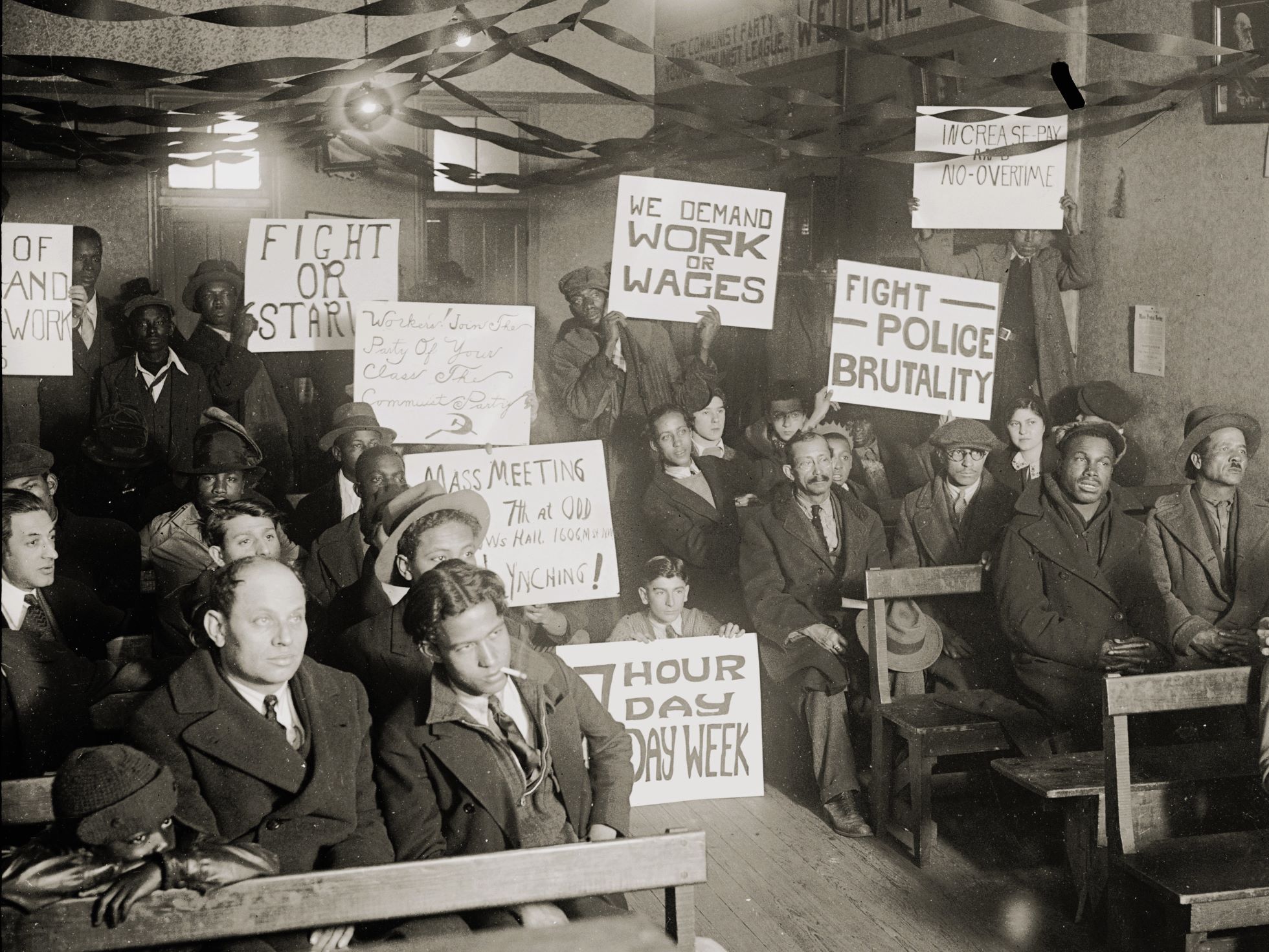
Eugene Gordon, a leading Black Communist during the 1930s, on the ‘religion’ of capitalism fervently embraced by the Black bourgeoisie, even though money is no protection in a violently white supremacist United States.
‘Black Capitalists in America’ by Eugene Gordon from New Masses. Vol. 7 No. 8. January, 1932.
There has spread among the American colored folk the naive superstition that if the masses could only procure wealth and culture they would thenceforth be free of oppression, immune to persecution, and above and beyond all the subtle but insidious influences of white chauvinism as represented in the august person of Colonel James Crow. Belief in this superstition has spurred countless rugged–and ragged–individualists-opportunists to feverish emulation of Rockefeller, Ford, and parasitic white “high” society, causing them to forget the very masses they purport to love; causing them to leave the plodding masses to be overtaken by the bloodhounds of capitalism: the employer, the landlord, and the policeman.
I cannot say why the superstition has gained so wide a currency, but suspect that it owes its spread largely to the seeming security of Rockefeller, Ford, and parasitical white “high” society. The place where it assumes the importance of a religion is in the South, although the North, too, has adherents aplenty. The reason that the superstition flourishes more luxuriantly in the South is that jimcrowism has driven the blacks into race-conscious compactness. Race-consciousness, not class-consciousness, motivates the Negro’s southern existence (and much of his existence on the upper side of the Mason and Dixon line), and race-consciousness, until the coming of Communism, meant to all Negroes of that section the same thing that class consciousness now means to the worker. The Negro of the South who still hopes to achieve the Ford and Rockefeller class, and to see the delicate, blue-veined, manicured hand of white society extended to him in fellowship, believes fanatically that, race-consciousness having elevated him to his present eminence by compelling a kind of race autonomy, it will further elevate him to a plane equal to that occupied by the most rarefied of American aristocracy. He believes just as earnestly that when that plane has been reached, white “high” society will suddenly realize its errors of generations and welcome him within its immaculate and sacrosanct portals. For these reasons there is little or no likelihood that the Negro bourgeoisie will turn back contritely toward the masses. Everything they cherish is ahead, not behind.
If this last statement seems to be a contradiction of my earlier assertion that the Negro bourgeoisie believe in race solidarity through race-consciousness, let me explain that there is no contradiction. The Negro upper class does believe in and preach race-consciousness as a policy of racial advancement, those advanced being themselves; but race-consciousness to the Negro middle-class does not mean race-exclusiveness so much as it does auto-propulsion. The value of race-consciousness lies in its potency as a propellent of individual achievement within the race. The masses should be willing to see members of their own race advance; the masses should advance them, as a matter of fact. Once the more gifted, the more favored, the better qualified, of the race, have reached the heights, these great men may then, perhaps, turn round and draw the masses up there, too.
It is the purpose of this paper to examine briefly the charges of the South and the counter charges of the North, the questions raised and answered being these: Is the Negro capitalist of the North more secure than the Negro capitalist of the South? Is the Negro capitalist in free America secure in either the South or the North? Has white chauvinism any respect for education or culture when it is possessed by a Negro? The answers to these questions are furnished by the news columns of the Negro press.
II.
Charles Clinton Spaulding, of Durham, N.C., is president both of an insurance company and a bank. For years he has been associated with capitalist enterprises in Aframerica. He is a member of the Inter-Racial Commission at Durham, member of the executive committee of the National Urban League, and a respected deacon in the Baptist (Negro section) church. He is vice president and chairman of the executive committee of the National Negro Finance Corporation, vice president and chairman of the executive committee of the Bankers’ Fire Insurance Company, and is of the National Negro Bankers’ Association. He has been awarded the first prize of $400 and a gold medal by the Harmon foundation for “creative achievement in industry, including business.” In short, Mr. Charles Clinton Spaulding represents the type of Negro that both the southern and northern colored bourgeois boast about as the kind of man every colored boy should strive to be. A man like Mr. Spaulding, they tell you pridefully, is respected by “the best white people” even of the South, and respect of the “best white people” of the South as a matter of course implies respect of those whites who are not of the “best.” The rich white man, they say, as well as the middle-class white, whether in the North or South, respects wealth, no matter who possesses it; therefore get wealth, and respect will be added unto you. Emulate Charles Clinton Spaulding and be respected by all the white folks. Don’t be a common worker all your life. Be somebody.
Well, not long ago Charles Clinton Spaulding, Esq. (Charlie, to the good white folks of Durham) was visiting in the neighboring city of Raleigh, when, the weather being warm and he feeling expansive, decided that he would like a drink of coca-cola. He entered Conyer’s Smoke Shop, at the corner of Wilmington and Horgett streets in a building said to be owned by a Negro capitalist, and (quoting the Baltimore Afro-American) “the white clerk, Brown ordered him to go outside and drink it, and when the customer refused, the clerk shoved him out the door, and when Mr. Spaulding cursed him, he went to work on him with his fists.” The Negro millionaire, born and bred among the good whites of North Carolina, apparently did not care to do anything to hurt their feelings, for it was a colored friend who had Brown arrested, charged with assault and battery. Describing the trial, the AfroAmerican goes on:
“Mr. Spaulding, who is about 60 years of age, stated that the clerk smacked the bottle from his hand, threw him out of the store, and kicked him several times as he lay on the sidewalk. He denied that he had used profanity and declared that he had not the slightest intention of causing trouble.
“John W. Hinsdale, white attorney employed by Brown, asked Mr. Spaulding if he had not recently returned from Europe with continental ideals of social equality which he wanted to establish here.”
Commenting editorially, the newspaper says: “…Unless the white law machinery as well as the white public opinion in the state clears itself of the stigma Brown has fastened upon it, North Carolina will stand condemned in the eyes of thousands of citizens throughout the country.” The editorial then appeals to the “liberal white citizens” of the state to “bring their attitude of everyday human justice up to the educational standards” (which, although low, are higher than they are in other southern states). What was the result of this fervent editorial appeal from an influential Negro newspaper? How did the “liberal white citizens” respond to this indignity upon a native black son, a millionaire with a fine cultural background?
Brown, the petty-bourgeois clerk who resented a black bourgeois’ drinking from a bottle in a white drug store located in a Negro landlord’s building, was fined the staggering sum of $15. Indignantly appealing the outrageous fine, Mr. Brown was held in $25 bail — which he immediately paid.
The Negro workers of the South, where rich colored men are free because segregation developed race-consciousness, are used to such acts of playfulness as this of Mr. Brown’s, the soda jerker. Mr. Spaulding himself seemed rather pleased with the outcome of the trial, indicating that he was accustomed either from experience or observation to what happened to him and was hardly astonished at it. For immediately after the trial he declared that he was satisfied, saying that the matter was a “closed incident” with him. The South is still the best section of this best of all good lands for the Negro capitalist.
“Three thousand whites,” says the Pittsburgh Courier, “gathered around 4600 Columbus avenue, Minneapolis, on the night of July 15th, and on the following evening more than 4,000 assembled in an effort to intimidate A. A. Lee, Negro post office employe, into evacuating the home he had just purchased…The mob was defiant of the police and openly threatened Lee and 20 of his friends who had gathered in the home to help him protect himself, family, and property.”
In Washington, D. C., some of the more militant Negroes are growling because of the “appointment of a jimcrow committee…to outline activities for colored participants in the George Washington Bicentennial celebration in 1932,” the Afro-American reports; and that incident reminds us of another in which the United States government is kicking patriotic and loyal Negroes in the face. This other incident is that of the Tenth cavalry, which is being disbanded by the war department, the Negro troopers being dispersed. It may be that Washington has not yet forgotten the bloody stand made by these black men at Houston, Texas, against attack by the whites of that benighted and god-forgotten hole. Anyway, loyal, devoted, patriotic Negroes who are begging on their knees for Uncle Sam to give them another chance to die defending his benign democracy are being told to go to hell. For Uncle Sam is becoming chary of having Negroes armed in peacetime, what with all this Communist propaganda, and such, going around. No telling what these Negroes’ll do. If they turned on the police of Houston they might also turn on the police of Washington.
Minneapolis, where the 20 Negroes stood against 4000 to protect a friend’s house from destruction by envious neighbors is not in the South; but neither is Philadelphia. Yet, look what happened in the Quaker City. A news item in the Negro press tells us that “Dr. Burnett and his companions were returning to North Carolina from New York, where they had gone to consult a radium specialist, when they were stopped on the outskirts of Philadelphia about 2:00 a.m. by the police.” Why did the police stop the doctors? Did they resemble crooks a police dragnet had been spread to catch? Let us see. “Although they identified themselves and told the police that they were doctors, the officers refused to accept their cards, license, etc., asking them tauntingly, ‘What kind? Horse doctor or root?’ The police demanded to know whose car they were driving, and when told that it belonged to them, the police called them liars and stated that in North Carolina Negroes are not allowed to drive cars like that.” The answer to the question why these men were arrested is in the reference to the car. It was too good for Negroes.
This story was reprinted from the Memphis Commercial Appeal by the Baltimore Afro-American: “Congressman Oscar De Priest, together with some friends, was driving on a road detour between Waterproof and St. Joseph, in Louisiana, when the car in which De Priest was riding forced the car containing a white highway engineer off the road. When the white man called to the occupants of the DePriest car to aid him in pushing the car back, all but the congressman got out and helped. The white man walked to the car and said: ‘Aren’t you going to help push?’ ‘You don’t know who I am, do you?’ DePriest is quoted as answering. ‘I don’t care who you are,’ the engineer is said to have said, and with this statement he drew a gun, telling DePriest to get out and help. According to the story DePriest got out and pushed.”
Keep in mind that DePriest runs neck and neck with the Ku Klux Klan in persecuting the foreign born and the Reds; that he represents one of the richest districts of Chicago; that he is a government official; that he is a millionaire and an influential citizen of a great and free country; that, like Spaulding, he is the kind of Negro held up for emulation by Negro leadership, because a man like him is respected and honored by the “best white people” even of the South.
The spectacle of the pompous and boastful DePriest pushing a white bully’s automobile out of the mud in darkest Louisiana must have been more pathetic than humorous. I wonder that he can still hold his noble head up.
But speaking of exclusiveness, here is a case of it in its most acute form. The incident offers further testimony that culture as a cure for the evils of Jimmy Crow lacks potency. The Associated Negro Press says that “More than 300 whites signed a petition at Memphis protesting the erection of the proposed College for Girls, at Tate and Orleans streets,” while Tonawanda, N.Y., a little town near Buffalo, “allows colored people to work here, but at nightfall they must wend their way to Buffalo, the nearest city.” It is significant that this second incident involves foreign born whites, who only a little while ago protested hotly that they were being persecuted because they were foreigners. Evidently they have learned the ways of Uncle Sam not only quickly but well. As the upper class Negro who is persecuted by the white man above him turns and spits upon the black man below, so these foreign born whites, having no one else to feel superior to, turn also upon and persecute the black worker.
A Macon, Ga., correspondent of the Pittsburgh Courier writes that an invitation to Mayor G. Glen Toole to speak at a “harvest drive” for the Greater Sunday Schools was abruptly cancelled following the mayor’s statement that “the colored man is the greatest curse in the country today,” while a Negro woman is reported in the press as lynched in Virginia because she stood firmly against a number of white men taking her daughter out riding.
Finally — not because there are no more incidents to cite but because I think my case is already proved — there is the shooting to death in Atlanta of young Dennis Hubert, a college student and son of “a prominent colored family, whose members are noted all over the country for their culture and their enterprise in the field of education.” The youth was standing on the sidewalk when some white men got out of an automobile and assaulted and shot him. They charged that he had insulted a white woman. The man who killed this cultivated son of wealthy Negro parents will serve from 12 to 15 years — perhaps.
This is the state of Negro capitalists in free America. This is the pretty bauble that the Kelly Millers, the Gordon Hancocks, and other Major Generals of Negro Leadership are holding out to the masses as preferable to organization for the class struggle. This is the superstition that has the standing of a state religion among thousands of our best Colored People.
The New Masses was the continuation of Workers Monthly which began publishing in 1924 as a merger of the ‘Liberator’, the Trade Union Educational League magazine ‘Labor Herald’, and Friends of Soviet Russia’s monthly ‘Soviet Russia Pictorial’ as an explicitly Communist Party publication, but drawing in a wide range of contributors and sympathizers. In 1927 Workers Monthly ceased and The New Masses began. A major left cultural magazine of the late 1920s and early 1940s, the early editors of The New Masses included Hugo Gellert, John F. Sloan, Max Eastman, Mike Gold, and Joseph Freeman. Writers included William Carlos Williams, Theodore Dreiser, John Dos Passos, Upton Sinclair, Richard Wright, Ralph Ellison, Dorothy Parker, Dorothy Day, John Breecher, Langston Hughes, Eugene O’Neill, Rex Stout and Ernest Hemingway. Artists included Hugo Gellert, Stuart Davis, Boardman Robinson, Wanda Gag, William Gropper and Otto Soglow. Over time, the New Masses became narrower politically and the articles more commentary than comment. However, particularly in it first years, New Masses was the epitome of the era’s finest revolutionary cultural and artistic traditions.
PDF of full issue: https://www.marxists.org/history/usa/pubs/new-masses/1932/v07n08-jan-1932-New-Masses.pdf
 Revolution's Newsstand