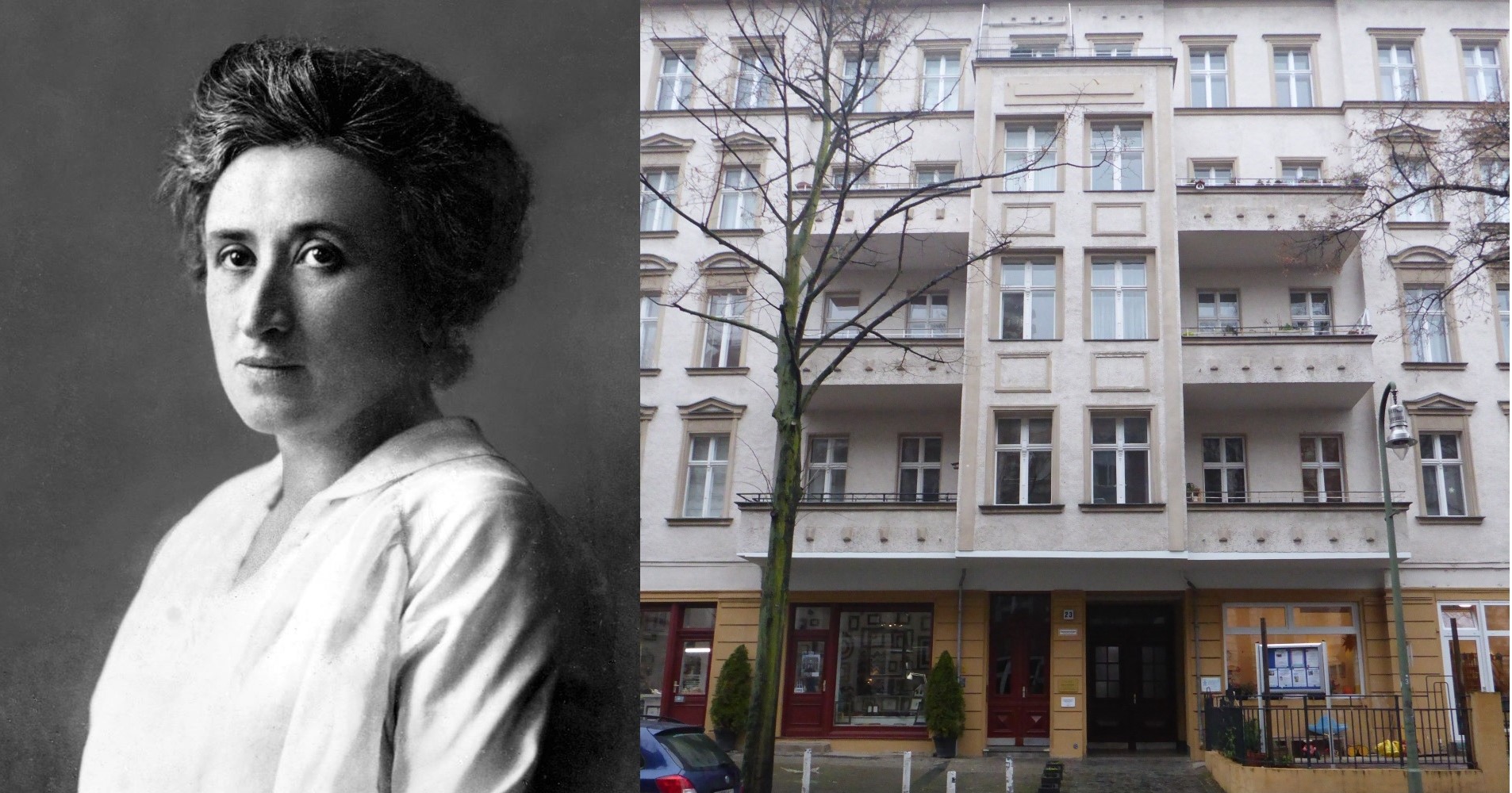
Rosa writes to the Kautsky’s of Franz Mehring, Heinrich Cunow, parliamentary cretinism, and the mysteries of the sea.
‘Letter from Friedenau’ (1900) by Rosa Luxemburg from Letters to Karl and Luise Kautsky from 1896 to 1918 by Rosa Luxemburg. Edited by Luise Kautsy, Translated by Louis Lochner. Robert M. McBride and Company, New York. 1925.
Friedenau, 13.7.1900, to Sellin, on the Island of Rugen.
My Dears: Many thanks for the charming post card. So you are enjoying a wonderful stay in this excellent weather et tout va pour le mieux dans ce meilleur des mondes! Enclosed herewith the reply of Mehring, which I received today and from which you will learn the Telemachide of my article. I found myself in a comical position indeed: no reply from M., so that I could, of course, not send it to Cunow1; nor could I notify him (C) not to count upon me for this issue of the “Neue Zeit,” since I don’t know C’s address (I have failed to note it down). And I also could not ask you, dear Karl, — I did not know your address either until the card arrived! I have a terrible memory (in Poland we call it a “cat’s head”) for names, addresses and similar details concerning an “object,” and I was certain, for instance, that I had accompanied you to Sassnitz. — Now the whole matter is cleared up and in order. M, then, agrees with you with reference to the opportuneness of the article, and this confirms the intention which I already had after my talk with you, namely, to turn the article over to the gnawing of criticism — well, let us say of the moths, considering the time of the year! I simply wanted to know M’s opinion; as for the rest, I admit my tactical error only with reference to the political moment and not with reference to the parliamentary Cretinism within the party itself, which you denied. — But to have to read or think or discuss about “parliamentary Cretinism” in the midst of a bright June sun, in the green, fragrant, shady temple of nature (i.e., the forest on the post card), and amid the peaceful rush of the eternal Thalatta? * * * * I will spare you this.
Let us, therefore, speak of Thalatta. Apropos, are you thinking, while it rushes forever by your feet, of the pretty story of the blind Greek singer, who played on his lyre at the shores of the sea and took the splashing of its waves to be the murmurings of the people; and who, when he heard no applause of the multitude upon completing his most beautiful song, complained bitterly of their ingratitude and in his bitter despondency cast the lyre far from him so that it might break to pieces, but it was caught by a wave of the sea and was lovingly wafted on by it? And have you any illusions there, of the whole sea smelling of freshly baked cake — a baked Fata Morgana, an illusion such as that experienced by the fisherman with whom our darling lived on Helgoland?
It seems to me that the most overwhelming feeling in connection with the sea must be that — of one’s own nothingness in comparison with the eternal, the unchanging, the proudly indifferent character of the ocean. This feeling seized me when I visited the Fall of the Rhine in Switzerland; its incessant roar, never abating for one second, but going on day and night and continuing through centuries, created a horrible feeling of destruction in me. I returned home quite dashed and dazed, and every time, even now, when I ride past there and from the window of my train behold the terrible spectacle, the evanescent foam, the white, boiling, watery cavern, and hear the deafening roar, my heart contracts and something within me says, there is the enemy. You are surprised? Of course it is the enemy — that is, of human vanity which otherwise imagines itself to be something and which here collapses suddenly into nothing. A somewhat similar effect, by the way, is that produced by a philosophy of life which says of all happenings, as also Ben Akiba, “it was always thus,” “things will turn out all right by themselves,” and the like, and man with his will, his ability and his know edge seems so superfluous. * * * For this reason I hate that sort of a philosophy and insist, mom cher Charlemagne, that one ought rather to throw oneself into the Fall of the Rhine and go under in it like a nutshell, rather than let it continue to rush on, wisely noddingits head, as it used to rush in the time of our forebears and as it will continue to rush after us. — Dear Lulu! your reseda and carnations are still in bloom and are still “as gloriously fragrant as on the first day.”
I send you all heartiest greetings, including the children and the Gansmddle.2
Your Rosa.
P.S. The latest issue of the “Sozialistische Monatshefte” contains three articles on the trade union question: Legien, Bernstein and Wetzker.3 Have you it or shall I send it? Please return M’s letter.
NOTES
1. At that time associate editor of the “Neue Zeit.” L.K.
2. Literally “little goose shepherdess” — a term, rather *of affection, applied to Kautsky’s domestic, Zenzi, a Suabian girl. Transl.
3. Carl Legien was for many years president of the German Federation of Trade Unions, a position corresponding to that held by Samuel Gompers in America. Legien died in 1920. Wetzker was at that time one of the editors of the Vorwarts. Transl.
Letters to Karl and Luise Kautsky from 1896 to 1918 by Rosa Luxemburg. Edited by Luise Kautsy, Translated by Louis Lochner. Robert M. McBride and Company, New York. 1925.
Contents: Introduction by Luise Kautsky, Beginnings, 1896-1899, Incipient Friendship1900-1904, From the Imprisonment at Zwickau to the First Russian Revolution, The First Russian Revolution 1905-06, Up to the World War 1907-1914, Letters from Prison During the War 1915-1918, Postscript by Luise Kautsky, Appendix: Biography of Karl Kautsky. 238 pages.
PDF of original book: https://archive.org/download/lettersofrosalux0000unse/lettersofrosalux0000unse.pdf
 Revolution's Newsstand