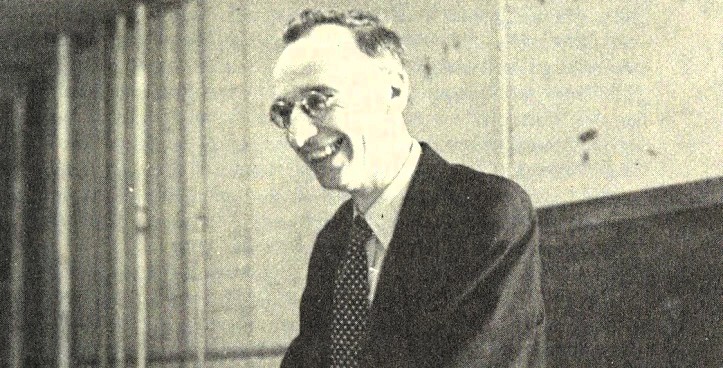
‘Militancy vs. Defeatism In Meeting Labor’s Present Difficulties’ by A. J. Muste from Labor Age. Vol.17 No. 12. December, 1928.
In the last issue some questions were raised about union-management cooperatism in an article captioned, “The Devil and the Deep Sea.” Brother Muste indicated that, on the one hand, a trade union must inevitably “cooperate” in certain ways with the employer, but that cooperation for increased efficiency under present conditions, on the other hand, raises many difficulties for the union, such as an aggravated unemployment problem, etc. This article offers some suggestions as to how union policy might be directed to meet some of the difficulties on either hand.
1. Every union must take account of the realities of the moment. It is not a propagandist society, a political party or a revolutionary committee. The union must be absolutely clear, however, as to what is its first and basic task and what is secondary and incidental. A union that keeps steadily before itself that it’ is an organization of, for and by the workers, that it must get gains for them and must constantly strengthen itself as over against the forces that would destroy it, and which compromises and cooperates in order to strengthen itself and get results for the workers, is one thing. A union which, consciously or unconsciously, comes to think of itself as an agency to help the employer get efficient production, and which tells itself that as a result of this the workers will inevitably benefit and the union get strong, is a very different thing. The one is an honest-to-God union; the other is a company union, no matter what sign it may have in the front window. If the union has the former point of view, almost any compromise may be temporarily justified; if the union has the latter attitude, any compromise is a step on the road to ruin and the betrayal of the workers. In other words, so long as there are employers who own machinery and capital, and workers who work for wages, the union must first of all be a militant organism to protect the workers, improve their conditions and advance their status. Everything else comes behind.
2. Such a union will drive a hard bargain with management, not because it enjoys being hard boiled, but because in an age of mechanization, it takes determination and backbone to protect human beings from being completely submerged. The trade unionism of the old days, Gompers’ unionism, pursued this policy. It insisted on something substantial in wages, hours, conditions, in exchange for every concession it gave the employer. It was in no sense ashamed to go out and fight in order to get a good bargain. Modern industry should be able to give much to workers, and a unionism that will insist on getting from industry what industry is in a position to supply will have their allegiance.
3. Such a union when it is compelled to give ground because the odds against it are too great, will not fool its members by stories of how the interests of capital and labor are the same, and the workers are bound to profit because the union is making it possible for the employer to keep in business and to make money. On the contrary, it will admit defeat and rally the members to greater effort, prepare for the next battle. There is no disgrace in being licked. There is both | disgrace and danger in lulling workers to sleep and getting them out of the habit of battling for their rights and for the strengthening of their union.
The Acid Test
4. A very good test of whether a union is bonafide or not is in its attitude to organization work. A union which neglects the unorganized, which merely becomes a club for protecting a number of workers in a trade or industry, has “sold out,” regardless of whether any money passed, regardless of whether anybody wanted to sell out or not. Incidentally, when a union keeps trying to extend its sway, the employers are not apt to be too friendly and the union is not likely to fall into false dreams of how peaceful and beautiful everything is.
5. A union which has genuinely the will to organize will not confine itself to a particular trade or industry. Such a union will want to see a labor movement which is pushing out into new territory, waging battles constantly against the open shop and the company union. It will make its influence felt for this sort of thing. It will contribute money to organizing campaigns and strikes. It will understand that a labor movement that is standing still may win the public approval of employers, but will secretly be despised by them and will be digging its own grave. Cooperate, yes, if you organize the basic industries at the same time, organize them by winning the allegiance of the workers and fighting their battles, not by trying to “sell” trade unionism to employers on the ground that it will do more for them than company unions can.
6. Since the process of organization is general, and under modern conditions every group of workers is dependent upon every other, all of them suffering when, for example, some are thrown out of employment, or are shelved because of old age, since all unions are weakened if great numbers are unemployed and willing to take jobs at any price, a genuine union will recognize that all workers must be given security and must have their purchasing power sustained at all times. Such a union, therefore, will be concerned about social insurance against unemployment, old age, sickness, and all the various hazards of life in an industrial society. To recognize that the working force in a particular industry must be reduced and to provide effectively for those who are caught in the process is one thing; to permit the working force to be reduced and not to do anything effective for those who are caught in the process is a very different thing, and will have a very different effect on the morale of the labor movement.
7. At many points what the labor movement cannot gain by action on the economic field, it might gain by political action. Political campaigning gives a chance to reach workers who might not be reached at such a time as this by a trade union appeal. In a complex industrial society, where the every day life of the workers depends, for example, on whether the. foreign policy of a country is militaristic and imperialistic and likely to involve them in a bloody and costly war. everything that the workers do on the economic field may be undone on the political. A live union in these days instead of leaning to the old parties and going back on its tradition of independent political action, will therefore recognize that now is precisely the time when the working masses must be prepared for independent political action. When unfortunately the economic arm is tied down, to conclude that the political arm must be permitted to wither is surely the height of folly and a shameless surrender.
8. As life becomes more complicated and industry more mechanized, the worker finds himself living more and more in an impersonal world that thwarts many of his instincts and desires. One of the great services his unions have rendered him is that they have constituted a democratic, humane society where he counted for something, where he was more or less on an equality with others, and where he found brotherhood and sympathy. If now the union also becomes a part of the mechanism of industry, if it becomes predominantly a business institution, if it ceases to have the old human personal touch, the democracy, the free fellowship of older days, the worker will certainly lose interest. There will be another reason why he should take to running about in flivvers, to movies, dance halls, this or that, anything except the union. In other words, precisely because of the special conditions of our time, the labor movement must make special effort to keep up the morale, loyalty, enthusiasm of its rank and file members.
A Well-Balanced Policy
How may that be done? Partly by taking pains to keep union meetings democratic, resisting the inroads of bureaucracy and “gangsterism,” giving the members a goodly share in determining policy. Partly by looking upon the workers as human beings, and having the labor movement provide for the recreational and cultural needs of the workers and their families. Partly by developing a sound, vigorous, large scale educational movement, teaching the workers what is actually going on about them, developing in at least a respectable minority a genuine interest in the economic, social, political, cultural problems of the day, breaking the power over the workers of the patriotic and other fetishes that enslave them today. Partly by keeping a touch of idealism alive in the labor movement. Men live by bread and therefore a trade union must produce immediate bread and butter results. The workers will give the laugh to idealists and intellectuals who cannot produce results and follow men who do, without being too squeamish perhaps about their methods. Yet it remains forever true that men shall not “live by bread alone.” The labor movement also perishes, if it loses its idealism, no matter what immediate results it may obtain. Workers want a vision of a new world in which they shall be free men indeed and slaves to no man or system. Partly by enlisting the workers in cooperative enterprises and thus utilizing energies which the union once it is established may not need. These enterprises, however, must be genuinely cooperative, enlisting the thought and activity of the membership. Otherwise, they will fail of their purpose. A bank which is a business enterprise pure and simple represents just a bank to a worker, whether you call it a labor bank or the National City Bank, which, of course, is not to say that a labor bank ought to be run in an unbusinesslike manner.
Trade unions which were a part of such a labor movement as this would undoubtedly compromise on all sorts of matters all of the time, as trade unions have always done. The workers belonging to them would continue to cooperate, to build industry, as workers have always done. It is not only since the war that the world has been able to feed and clothe and house and educate and enjoy itself because of the cooperation and sweat and toil of the workers! But such a labor movement would live in and for the workers, not in and for industry. It would be constantly seeking to extend its bounds and its power. It would not be losing membership. It would not resign big industry to the company union and open shop crowd. It would not be apathetic and defeatist but militant. Doubtless it would find that no matter how eager it was to make industry indeed efficient for the service of the people, there are forces wanting to use it for private gain, regardless of the needs of mankind, forces entrenched and powerful. It would find further that it would have to battle against these forces more intensively and on a wider front as the workers gained intelligence and power. How that conflict would ultimately be resolved, who shall say? That bridge too we may cross when we come to it. In the meantime, we shall not lay down arms. We shall strive ever to increase the power and the intelligence of the organized workers of the world, never fearing that they will not use the power and intelligence they develop.
Thus does the situation challenge us. There is no cause for discouragement. The labor movement is always “between the devil and the deep sea.” It always fights its way through, for the workers need it and the future is with them.
Labor Age was a left-labor monthly magazine with origins in Socialist Review, journal of the Intercollegiate Socialist Society. Published by the Labor Publication Society from 1921-1933 aligned with the League for Industrial Democracy of left-wing trade unionists across industries. During 1929-33 the magazine was affiliated with the Conference for Progressive Labor Action (CPLA) led by A. J. Muste. James Maurer, Harry W. Laidler, and Louis Budenz were also writers. The orientation of the magazine was industrial unionism, planning, nationalization, and was illustrated with photos and cartoons. With its stress on worker education, social unionism and rank and file activism, it is one of the essential journals of the radical US labor socialist movement of its time.
PDF of full issue: https://www.marxists.org/history/usa/pubs/laborage/v17n05-may-1928-LA.pdf
 Revolution's Newsstand