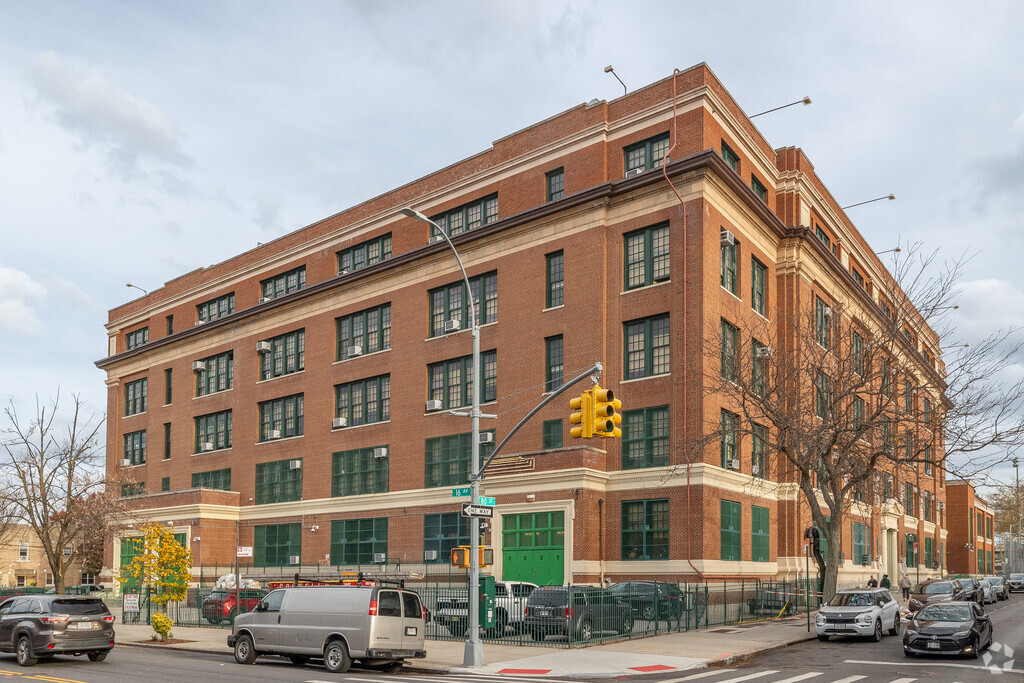
The full story of the student struggle to get decent, affordable food at Brooklyn’s New Utrecht High School.
‘New Utrecht Students Strike’ by Herbert Witt from Student Review (N.S.L.). Vol. 2 No. 3. February, 1934.
The very first week that the spotless new building at 79th Street and 16th Avenue in Brooklyn was opened to them in 1925, students of New Utrecht High School complained to one another about the school lunchroom. And in the succeeding eight years, without cease, murmurs of disgust with conditions existing there and of protest against the excessive prices and correspondingly small (reported) profits were always to be heard, if one listened closely enough. But Dr. Harry A. Potter, principal, always turned a deaf ear to the faint murmurs, and was permitted to do so by the student body which did not yet know how to organize a student fight for students’ rights.
On Tuesday, January 2 of this year, the New Utrecht chapter of the National Student League circulated among the five thousand students in the Main Building petitions which demanded the eradication of all existing lunchroom evils through the following three moves:
1. An open lunchroom. (Since the opening of the building students had been required by administrative order to remain in the lunchroom during their lunch periods, to buy their lunches there or bring cold lunches from home in the morning to stink up their lockers till lunch-time. Some few students living in the very immediate neighborhood were permitted to run home for lunch. No student was permitted to leave the building and buy his lunch in a neighborhood shop where prices have been consistently lower and the quality of food consistently higher, although the principal of each high school has authority to allow students to go out of the building for lunch. Dr. Potter has maintained throughout the struggle that the “moral responsibility” on him is too great for him to allow boys and girls of high school age to eat lunch together. The school lunchroom is separated into boys’ and girls’ divisions; boys are not permitted on the girls’ side, and vice versa.)
2. Lower prices in the lunchroom. (In 1926 the nation was entering a period of wild speculation and high prices. In 1934 the nation is rotting in the fifth year of the most devastating economic crisis it has ever experienced. But outside forces exert no influence on the isolated New Utrecht lunchroom. For from 1926 to 1934 the same outrageously high prices have prevailed, all the more outrageous because of the adulterated, actually unhealthy food students have been forced to buy.)
3. A complete accounting of the lunchroom books by. an impartial C.P.A. (For years the inner workings of the lunchroom have been kept secret from the students. At the end of each semester the Faculty Treasurer of the General Organization would announce that the lunchroom had recorded a profit of such-and-such for that term. Last semester the profit was $233.10. How that sum is arrived at, how much is the salary of the dietician whom Dr. Potter appoints to supervise the lunchroom, who determines the salaries of the workers in the lunchroom, pays for the meals that Dr. Potter eats in a little e room, where does the unannounced profit from the lunchroom go–all these are questions which the students, according to the administration, need not bother their heads about. Three years ago students who organized an independent student council and published a Bulletin demanding answers to these questions saw two of their number arrested for distributing the Bulletin, and on September 25, 1931, sent to jail besides!)
Less than three days after the issuance of the petitions more than fifteen hundred indignant students had signed them. The National Student League chapter then called to the students to mass in the main hall of the school be- fore Dr. Potter’s office to present the petitions they had signed and to receive Dr. Potter’s answer. This was Friday, January 5. The assembling students were met by a horde of service squadders (student police), teachers and uniformed policemen, bolstered by the perspiring presence of Dr. Potter himself. Potter’s forces succeeded in driving the students out of the hall, into the adjoining auditorium or out into the street, but not before they had forced him to consent to speak with a committee of five students. The committee entered Dr. Potter’s office and made known their demands, presenting the petitions and saying that they represented the fifteen hundred students who had signed them. Potter screamed back, “You represent nobody but a bunch of comoonists.” The “red herring” was now officially on the scene, and the service squadders, police and teachers in the crowded office pressed closer, watching to see that the committee did not pull a bomb from under its coat. Potter suddenly announced that the interview was at an end and told the students to leave. Insisting that the interview would not be at an end until their demands had been met, the committee refused to leave. Potter called to a policeman to arrest the committee if it did not leave immediately. The cop and his nightstick ended the interview.
A complete boycott on the school lunchroom was the N.S.L. chapter’s reply to Potter’s bare-faced defiance of the student demands. Such an action had never been taken before, and the success of the whole fight depended on the amount of support the boycott received right from the start. The main building students jumped enthusiastically into the struggle on Monday, January 8, the first day of the boycott, and welcomed the leadership of the N.S.L. Sales in the lunchroom were few and far between. When the one-day boycott evoked no action from the administration, the students voted overwhelmingly to continue the boycott indefinitely.
Packed with an extra detail of teachers and Dr. Potter himself, the lunchroom on Tuesday during the first of the four lunch periods was set perfectly for the dramatic events which were to occur. Morris Oshatz, a leader in the New Utrecht N.S.L., stood up on his chair and, ex- plaining once again the situation in New Utrecht, shouted to the hundreds of students to carry on the boycott until victory had been won. Oshatz was immediately dragged downstairs by Dr. Potter himself, and suspended. The angry students booed and hissed Dr. Potter’s suppressive action long after he had left the lunchroom with Oshatz. Throughout the afternoon speaker after speaker addressed his fellow-students, calling on each one to support the boycott. And as each finished speaking, he found Dr. Potter waiting at his elbow to escort him from the room, and suspend him. Potter and his teachers could not keep step with the demonstrating students and consequently missed a few. Nine students were suspended.
Potter’s attempt to kill the struggle by firing the leaders out of school failed; his action served only to make the students more militant and more determined and to supply new leaders for the fight. Students who had been doubtful about the boycott now joined actively in the fight. The rights of students were not to be abrogated by any autocratic, suppressing administrator. The leaflet issued the following morning by the N.S.L. chapter explained that the fight had now broadened, that the demands must now be not only those previously set forth in regard to the lunchroom, but also: the immediate reinstatement of the nine suspended students, and the right to free speech for students. The fight was now not only for a boycott, but for the right to boycott.
By Thursday, news of the struggle in New Utrecht had spread by word of mouth to several of New Utrecht’s most prominent alumni. Those who were free rallied eagerly to the National Student League’s call for support. The justice of the fight had never been in doubt, and now from all sections of the city, former New Utrecht students squeezed college schedules or took whole days off from work to aid in the struggle each wished had been developed during his days at New Utrecht. Former editors of the school magazine and weekly newspaper, now members of the N.S.L., former big-shots of New Utrecht now in the Young Communist League, former Arista leaders and major office holders not affiliated to any organization but rejoicing that the rumblings of years had now at last mounted to a roar, all volunteered their services in speaking at the daily open-air meetings, in writing and mimeographing the daily leaflets and in the thousand and one other details that needed attention.
Reinstatement was won for eight of the suspended students when their parents came to Dr. Potter in a body and protested that their boys and girls had committed no crime in leading the boycott. Oshatz, who had been expelled from New Utrecht the previous year for anti-R.O.T.C. activity, and then reinstated because of city-wide protest, was not permitted to return to school.
At the indoor mass meeting on Thursday night sponsored by the National Student League chapter the large audience worked out a plan of action for the continuation of the boycott. During the meeting about twenty-five boys, slightly younger than the rest, entered the hall and ranged themselves along one wall. Their spokesman introduced them as students of Annex 180. (Annex 180 is one of the four auxiliary buildings from which New Utrecht feeds its main building. About 1100 boys are in attendance there.) The spokesman, invited to speak, told how one of the leaflets issued in the main building had been picked up by an annex student, how the news spread throughout the annex about the struggle in the main building, how the annex students realizing that they were faced with the same conditions in their lunchroom had resolved simply and immediately to go out in a protest strike. The teacher-in-charge at the annex, the boy continued, heard of the impending strike and called a fire-drill just before the time set for the walk-out. The students marched out of the building in orderly lines, and then refused to go back. Four hundred of them refused to enter the building until the hastily summoned riot squad combined its efforts with the teachers to drive them back forcibly.
The meeting, excited by the unexpected militancy of the annex students, was on the verge of calling a main building strike–even the most conservative of the students in the fight were swayed by the emotion of the tense moment. But realization that student sentiment had not been sufficiently organized to insure a powerful strike as yet and that they were then not sufficiently prepared for a wholesale walkout kept the students at the meeting from making what might have been a fatal error. Instead, a broad General Boycott Committee was to be chosen to guide the work inside the school building. Non-N.S.L.ers volunteered, and were elected along with Student Leaguers.

At 8:20 a.m. Friday morning the Annex 180 students held an open-air meeting and decided to organize a similar General Annex Boycott Committee to carry on a thorough boycott of the annex lunchroom. The open-air mass meeting at the main building held after school showed increasing student militancy. The Boycott Committee reported that the boycott was increasing in effectiveness. Besides a student mass meeting Friday night, a meeting of parents, alumni and representatives of thirteen local organizations was held, at which a permanent group, the Supporters of Students’ Rights (S.S.R.), was formed. Plans were made for the holding of a mass S.S.R. meeting the following Thursday night.
Metropolitan papers picked up the story and ran daily accounts of the struggle after the New York Evening Post had splashed an exclusive account of the fight thus far all over the front page of the Saturday afternoon edition. Newspaper publicity gave a valuable impetus to the fight. Meanwhile the administration refused to act, claiming that nothing would be conceded to this “small group of Communist agitators.” The executive committee of the General Organization (supposed student governing body) sabotaged the fight by insisting that it was the real leader of the student body, that Oshatz, Berenson, Ross and the others therefore were not playing fair when they led the fight, and that therefore (what logic!) the fight was all wrong and should be dropped immediately, while a G.O. committee would straighten out everything with Dr. Potter. That the G.O. executives themselves did not step into the real fight was shown clearly when they confined their activity to sending a committee to Dr. Potter who threw them out, to holding a secret meeting on Sunday to which no student representative was invited, and to appointing a committee to investigate the lunchroom when I saw finally that the students were going to win anyway.
The most obvious consideration in a discussion of the G.O.’s reactionary conduct is the fact that at no time did the G.O. executive come out openly in full support of the struggle and offer to lead the student struggle further in accordance with the students’ own militant program.
The fight was brought to a head Tuesday morning when Potter had the police detail arrest four students who were handing out leaflets before the school. Students rushed from classes to the open-air meeting which was waiting for them. A mass delegation of over fifty was chosen to visit Mayor LaGuardia and present the demands of the students, which now included: Free Lunches for Children of Unemployed Parents, Immediate Release of Four Arrested Students, Immediate Reinstatement of Morris Oshatz.
LaGuardia refused to act. He listened to the case as presented by Joseph Greenspan, a New Utrecht alumnus, and heard that a woman who had previously worked three years in the New Utrecht lunchroom had come forward to aid the students win their fight. “Mrs. Kelly”-thus she prefers to be known for the present-was ready to tell a city investigating committee that only the cheapest grade of meat and eggs was purchased for the students, that two sandwiches were made from one egg and sold for 15 cents, that salmon was watered to spread over thirteen 8-cent sandwiches from a single can. LaGuardia heard that apples were bought six for 10 cents and sold to the students for 5 cents apiece; that the cocoa recipe was four cans of evaporated milk to a large container–and the rest water. LaGuardia heard that Potter ate in a private room where he was served porterhouse steaks and whole chickens-sometimes two if entertaining a guest, that three cigars (at 3 for $1) bought at the corner candystore are on his table-cloth every noon, and that all this is paid for by the lunchroom fund, by the students. LaGuardia referred the delegation to Paul Blanshard, Commissioner of Accounts, and to the Board of Health. He refused to act.
The quality of food in the lunchroom had been noticeably improved by Thursday. But students still refused to buy, determined that continued struggle should win for them every demand. A parents’ delegation called on Dr. Potter Friday morning and asked that their sons’ and daughters’ demands be granted. Potter had his police throw them out!
A major victory was scored on the demand for lower lunchroom prices and better quality of food. Defeated by the students’ refusal to abandon the boycott despite the coming Regents and finals, despite the suspensions, arrests and threats, the administration cut prices in the lunchroom. Now it offers a “lunch-box” containing two sandwiches, a piece of pie, a piece of fruit and a piece of pickle for 15 cents. But Potter still refuses to admit that the boycotting students had forced the change. He hung a little sign in the lunchroom to the effect that the new lunch-box system was instituted at the request of the (of all things!) G.O. executive committee!
HERBERT WITT,
Former Editor, New Utrecht Nuhs.
Emerging from the 1931 free speech struggle at City College of New York, the National Student League was founded in early 1932 during a rising student movement by Communist Party activists. The N.S.L. organized from High School on and would be the main C.P.-led student organization through the early 1930s. Publishing ‘Student Review’, the League grew to thousands of members and had a focus on anti-imperialism/anti-militarism, student welfare, workers’ organizing, and free speech. Eventually with the Popular Front the N.S.L. would merge with its main competitor, the Socialist Party’s Student League for Industrial Democracy in 1935 to form the American Student Union.
PDF of original issue: https://archive.org/download/student-review_1934-02_3_3/student-review_1934-02_3_3.pdf
 Revolution's Newsstand