Foster’s contribution to the discussion of the united front at the second Red International of Labor Union Congress in 1922.
‘The World Crisis and the United Front’ by William Z. Foster from Labor Herald. Vol. 1 No. 12. February, 1923.
IN the prevailing world crisis no labor movement has suffered so heavily as that of the United States. It has been literally devastated by the employers and is now actually in danger of temporary extinction. The creation of a united front in America, one that will enable the workers to resist successfully, politically and industrially, the aggressive capitalist class, is of supreme international importance. This is because the United States Government, which is almost entirely free of labor influence, has made its notoriously reactionary influence felt all over the world, to the general detriment of the revolutionary movement. It can only be checked in its ultra-capitalistic program by the development through a united front of a vigorous and revolutionary labor movement.
During the war and the 18 months immediately following thereafter, American industry underwent a tremendous period of prosperity. Factories multiplied and expanded to an extent unheard of previously in the United States. Labor was in extraordinary demand and commanded higher wages than ever before in its history. Consequent upon this situation the trade unions grew rapidly, increasing in membership from about 2,500,000, in 1916, to 5,000,000 in 1920. The official figures of the American Federation of Labor, which do not include the independent unions, showed 2,072,000, in 1916, and 4,078,740, in 1920. The labor organizations enjoyed wonderful prestige and their leaders hob-nobbed with the great “statesmen” and capitalists of the country. The optimistic thought that the millennium of the Brotherhood of Capital and Labor had arrived.
The Great “Open Shop” Drive
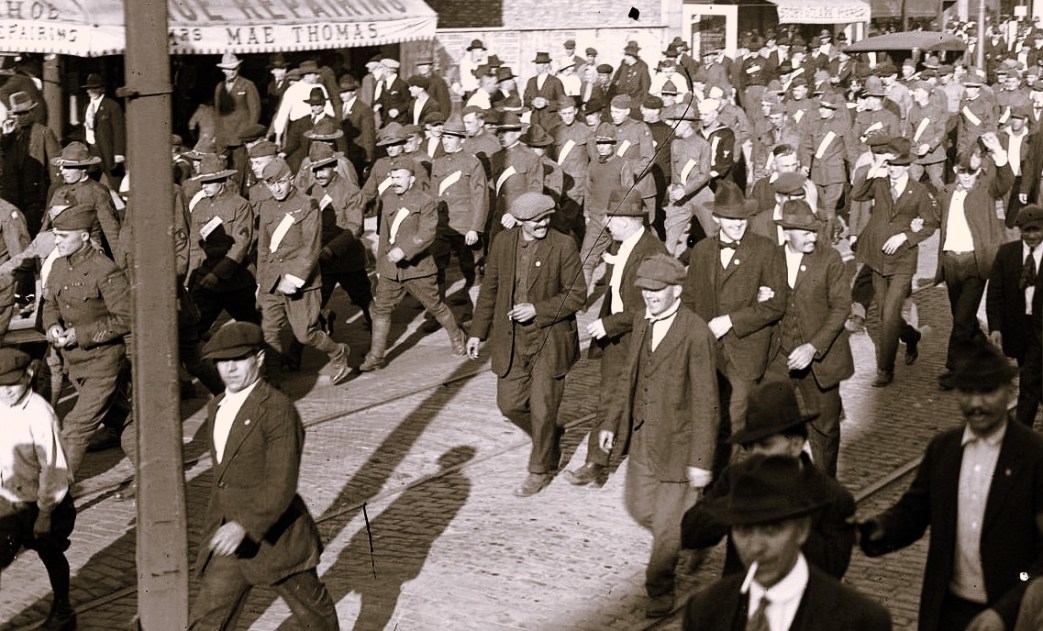
But the employing class, alarmed at the growth in strength and prestige of the labor movement, suffered from no such Utopian illusions. They merely awaited a favorable opportunity to deal a fatal blow to the newly born labor unions. Already in the fall of 1919, while the period of prosperity was still on, they began attacking the unions successfully in various parts of the country. At this time they crushed every semblance of organization in the steel industry by defeating the great strike of 400,000 steel workers. The big “outlaw” strike of railroad men was also beaten. Likewise the coal miners, 500,000 strong, were driven back to work by the application of stringent war-time laws. Some six months later, about September 1920, the industrial boom collapsed. Factories and industries began to close upon all sides, until finally, a year later, the army of unemployed reached the unprecedented figure of 6,000,000. In the meantime the employers, taking advantage of the depressed state of industry, greatly intensified their “open shop” drive and made war to the knife against those very trade unions which, two years before, they had hailed as magnificently patriotic organizations and the saviours of the country. Under the leadership of the United States Chamber of Commerce, and other aggressive employers’ associations, the fight was spread to all localities and industries of America.
Wage cuts and lengthening of hours became the order of the day everywhere. For a time the labor movement, whose conservative leaders necessity for retrenchment, accepted the wage subscribed to the capitalistic doctrine of the reductions without resistance. But the capitalists were insatiable and determined not only to reduce wages, but to eliminate all traces of unionism as well. One of the first organizations to be attacked was the New York branch of the Amalgamated Clothing Workers, an aggressive independent union. 60,000 of their members struck against wage reductions and the establishment of the “open shop.” They compromised on the wage cuts but defeated the employers on the “open shop” demands. But the real open struggle began in the latter part of 1920. Since then there has been one great strike after another, nearly all of which were disastrous to Labor. The first organizations to fall were those in the meat-packing industry. In February, 1922, they called off their great three-months national general strike, during which their unions, numbering at one time 150,000 members, were completely smashed all over the country. In many centers the powerful building trades organizations, long looked upon as the very heart of the American trade union movement, were attacked and defeated. In San Francisco, a citadel of trade unionism, they were broken up in a big general strike in the Spring of 1921. Meanwhile the printing trades, including all crafts, have been fighting a defensive battle against their employers. After a year the International Typographical Union, notwithstanding the payment of the huge sum of $13,000,000 in strike benefits, still has 6,000 men on strike. The textile workers, beginning in January, 1922, 150,000 of them, fought for seven months against terrific reductions in wages, which they have been able to defeat to some extent. And finally there was the great national general strikes of the coal miners and the railroad shop mechanics, the former numbering 665,000, and the latter 400,000. The miners won a partial victory in checking the wage cuts and “open shop” conditions demanded by the coal operators, but the railroad shopmen have been heavily defeated, their organizations being destroyed on many great railroads.
The general result of the struggle to date. is that Organized Labor has been badly shattered. In nearly every industry its organization has been greatly weakened, and in several industries entirely destroyed. The A.F. of L. unions, as well as the independents, have lost largely in membership. The financial report of the A.F. of L. Secretary to the Cincinnati Convention in June, 1922, showed a membership of only 3,195,635. This is a decrease of 883,105 from the high point of 1920. But the real loss, not brought to light because of the unreliable financial system, is much greater. It is doubtful if there are, including the independent unions, more than 3,000,000 trade unionists in the United States and Canada, or a loss of about 2,000,000 since the peak figure in 1920.
The Revival of Industry
The terrible industrial depression, which has wrought so much havoc to the trade union movement, now seems to be passing. About March, 1922, the first signs of a business revival began in a falling off of the number of firms going into bankruptcy. At that time these totaled 2,463 for the entire country, whereas in August the total had been reduced to 1,714. Practically all the industries are now on the upgrade. Building is particularly flourishing. In 27 Northwestern States the permits issued for the first eight months of 1922 totaled $2,362,872,000, which is $7,000,000 more than for the whole of 1921. The automobile industry is undergoing a tremendous boom. During August, 1922, it produced 272,640 passenger cars and trucks— the largest production on record, and an increase of more than 200% over January, 1922. The textile industry, despite a terrific strike, is approaching normal production. During July, 1922, the receipts of wool in Boston were 71,307,000 pounds, as against 27,157,000 pounds in June, 1921. The steel industry, which has been heavily hit by the coal and railroad strikes, is nevertheless operating at 55% of capacity. This is more than twice the production average of last year. As for the railroads, the Labor Bureau (a private statistical organization) says: “The railroads of the United States face what will be the greatest traffic demand in history.” In the week ending September 30, 1922, they loaded 988,381 cars, which is 43,000 more than the same week in 1921, and only 3,000 less than the record week in 1920. Receipts of the United States Post Office are a reliable barometer of American business. In 50 of the largest cities they totaled. $19,543,143 in July. This is the largest July business in history, being 112% greater than July, 1921. August bank clearings for the entire United States are 14% higher than the same period in 1921. Postal Savings deposits are 3% more than a year ago. The estimated value of the corn, hay, cotton, wheat, potatoes, apples, oats, and other crops, on September 1, 1922, was $6,200,000,000 as against $5,000,000,000 in September, 1921.
This general business revival is carrying with it the inevitable rise in prices and wages. The wave of increase in the cost of living, which started at the outbreak of the world war, reached its summit in the latter part of 1920, when it totaled about 90% above pre-war figures. A period of decrease then set in until, in June, 1922, prices had fallen to but 66%% above pre-war levels. Now prices are advancing again rapidly in all basic commodities. This is particularly noticeable in the wholesale branches, retail prices advancing somewhat slower. The demand for labor is also increasing and unemployment is on the wane. In metal mining, automobiles, building trades, shipping, textiles, and other industries, workers are in demand. Wages have also taken an upward tendency. The turning point was about in May or June. At that time United States statistics showed that in the majority of cases where wage scales were changed it was to decrease them. But in September, of 42 industries reporting, 31 showed increases over August wage scales and II decreases. The most striking increase in wages was in the steel industry, where the United States Steel Corporation, followed soon after by the independent companies, raised wages 20%, September 1, in all its plants.
Will the Labor Movement Recover?
With the stimulus given by the industrial revival, will the labor movement be able to recover the ground it has lost and to march forward again increasing its numbers and strength? In past years when a period of depression set in, the first thing that happened was a slackening of industry, then prices fell, followed immediately afterward by wages, which in turn brought about a weakening of the unions. Then, when prosperity began to develop, the industries would first become active, prices would rise, then wages, and finally the trade unions would expand and flourish. Many labor men, with this typical experience in mind, are overjoyed at the present revival of industry, maintaining that it necessarily involves the recovery and re-establishment of the trade union movement. This is the position of practically all American trade union leaders. From Samuel Gompers downward they proclaim categorically that the “open shop” drive is stopped, and the anti-union plans of the employers defeated.
But these optimists overlook one most vital factor, a new element in the situation. The capitalist class of today is not the capitalist class of pre-war times, slip-shod and willing to semi-tolerate trade unionism. Now it is incomparably richer and more powerfully organized. And, above all, it has acquired a new militancy and an unshakeable determination to destroy Organized Labor root and branch. It is a full-grown tiger that has tasted blood. One need not be a prophet to see that, industrial revival or not, the “open shop” campaign is going right on as bitterly as ever. The aggressive, highly-organized capitalists will carry the war to Labor without respite. And so strong have they become, both in morale and organization, that the trade union movement, if it clings to its old methods and notwithstanding the help of better industrial conditions, will not be able to successfully resist them. Unless it modernizes its thinking, tactics, and organization forms, the American labor movement is in imminent danger of being wiped. out.
In this critical situation no real leadership may be looked for from the old trade union bureaucrats. Being entirely under the sway of the autocrat Gompers, who has not had a progressive thought for forty years, they are hopelessly reactionary. They cling desperately to the most antiquated forms of craft unionism, and refuse to recognize the necessity for even the most primitive type of working class political action. They even consider the yellow Amsterdam International as too “revolutionary” for the American labor movement to affiliate with. They have absolutely nothing constructive to offer. The more the capitalists press them down, the more timid and reactionary they become. If the movement is to be preserved, not to speak of developed, it must be the work of the rebel elements in the trade unions. They must join hands, all factions, in a united front against the Gompers bureaucracy. Until its dead dictatorship is broken no movements in America, political, industrial, or co-operative, can amount to anything. Surging up from the bottom, the rank and file militants must make their leaders act aggressively and intelligently or sweep them out of office.
Such a united front of the revolutionary and progressive elements in the labor unions is now developing through the Trade Union Educational League. With branches in all the leading localities and labor unions of America, this organization is carrying on an aggressive campaign in favor of the program of the Red International of Labor Unions, including a policy of aggressive class struggle instead of class collaboration, the workers’ republic, independent working class political action, affiliation with the Moscow International, the general strike, support of the Russian Revolution, industrial unionism through amalgamation, etc. Remarkable success is being had. The American working class, always militant in spite of a reactionary leadership, is responding in the most encouraging fashion. Particularly is this the case with regard to amalgamation, which is sweeping the labor movement under the direct leadership of the revolutionaries organized in the League. The Gompers bureaucracy, seeing the handwriting on the wall, are fighting desperately on the defensive. In America the future is bright for a united front on the industrial field, as advocated by the Red International of Labor Unions.
The Labor Herald was the monthly publication of the Trade Union Educational League (TUEL), in immensely important link between the IWW of the 1910s and the CIO of the 1930s. It was begun by veteran labor organizer and Communist leader William Z. Foster in 1920 as an attempt to unite militants within various unions while continuing the industrial unionism tradition of the IWW, though it was opposed to “dual unionism” and favored the formation of a Labor Party. Although it would become financially supported by the Communist International and Communist Party of America, it remained autonomous, was a network and not a membership organization, and included many radicals outside the Communist Party. In 1924 Labor Herald was folded into Workers Monthly, an explicitly Party organ and in 1927 ‘Labor Unity’ became the organ of a now CP dominated TUEL. In 1929 and the turn towards Red Unions in the Third Period, TUEL was wound up and replaced by the Trade Union Unity League, a section of the Red International of Labor Unions (Profitern) and continued to publish Labor Unity until 1935. Labor Herald remains an important labor-orientated journal by revolutionaries in US left history and would be referenced by activists, along with TUEL, along after it’s heyday.
PDF of full issue: https://www.marxists.org/history/usa/pubs/laborherald/v1n12-feb-1923.pdf
 Revolution's Newsstand