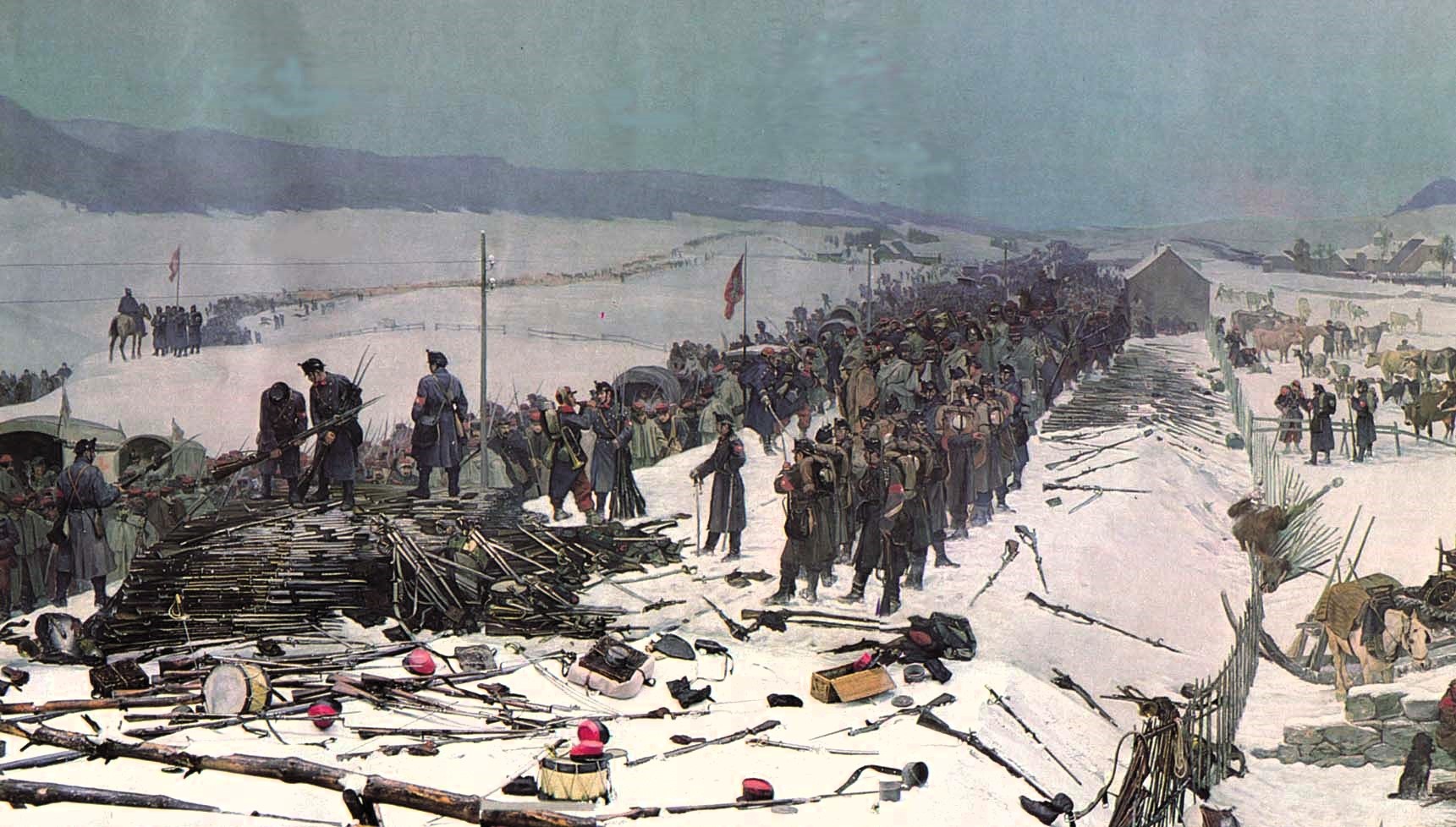
Written just before the capitulation of France on January 26, 1871, Liebknecht’s letter discusses the possibility of a ‘people’s war’ breaking out after the victory, and continues his valuable history of the Social-Demockratische Arbeiter Partei.
‘Letter from Leipzig, V’ by Wilhelm Liebknecht from Workingman’s Advocate (Chicago). Vol. 7 No. 25. February 18, 1871.
Leipzig, January 21, 1871
To the Editor of the WORKINGMAN’S ADVOCATE:
As I promised in my last letter, I shall give you today a short sketch of our organizations. If we were as free to found societies and to meet, as you are, the question of organization would not have occupied the Eisenach Congress for more than half an hour. We should simply have declared ourselves the German Branch of the International Workingmen’s Association, and should, without losing many words, have adopted the system of sections, councils, etc., prevailing in Belgium and Switzerland, where the right of meeting is unfettered. But this way was barred to us by our laws, which forbid the union and connection of political societies. Political societies may exist (of course under the restrictions thought necessary by the powers that be), but if they try to acquire practical influence by combining their activity, if they enter into correspondence with one another, they are at once dissolved and the luckless members found may be sent to prison.
To evade this fundamental difficulty several societies, for instance, Lassalle’s Universal German Workingmen’s Society,’ were formed, which, instead of being purely local, that is, confined to a certain town or village, were dispersed all over Germany, and could have their members everywhere without having separate branch societies anywhere. Everywhere the members belonged to the same society, which, for form’s sake, to satisfy the requirements of the law, had its seat and was chartered in some town of the minor States, where the law is either not so severe or not so severely handled as in Prussia.
Lassalle’s society had its seat in Leipzig. However, the Prussian government ordered the police to proceed against one of the societies so organized, and the highest tribunal of the country decided that such an organization was only an evasion of the law, and that societies organized on this principle were illegal. This decision, against which there was no appeal, had been published a few months before the Eisenach Congress, and forced us to devise another scheme. The problem to be solved was now no longer how to avoid constituting unconnected local societies, and thereby dividing our party into many scattered pieces (real, disjointed members), having no common life. The problem was how can single local societies be constituted, without on the one hand dismembering the party, and on the other infringing the law? It was solved in the following manner: The members of the Social Democratic party, which, as such, forms no tangible body in the eyes of the law, either constitute in their respective places of abode, distinct societies which, as such, have a separate and independent existence, and no relation whatever with similar societies in other places; or, they meet privately, in such a way as not to be entangled in the meshes of the law. In every place, the members of the party, whether they have chosen the former or the latter method, appoint privately one of their number, who in his turn has privately to keep up the necessary correspondence with the Central Executive Committee, and to transmit to it the money contributions collected from the members to defray the expenses of the party.
The Executive Committee (Ausschuss) is elected every year by the Annual Congress (indirectly, by fixing the town, the members residing in which choose from among them the Executive, an arrangement that saves much time and completely answers the purpose). It consists of five members, and has the direction and administration of the party; to control it, to audit the accounts, to mediate in cases of misunderstanding or disagreement between the Executive and members of the party, a Commission of Control is annually elected in the same manner as the Executive.
No member of either of these bodies is allowed to be editor of the newspaper founded by the party, and its property. This organ has to defend and develop the Social Democratic principles, has to publish the reports and correspondence sent by members of the party, and, being the focus into which the whole activity and thinking of the party radiate, it is in truth the center, the real Executive of the party, and its principal instrument of social and political propaganda. The editor, in whose hands great power is given, has to act in full harmony with the Executive and the Controlling Commission, and is, like all other functionaries of the party, responsible to the Congress. You see, at all events, our organization has a thoroughly Democratic character, and effective safeguards against abuse and mismanagement are not wanting. It has worked well in every respect. Since it has been in force, our party has gained in strength, extension and unity. No serious quarrel has arisen, and as to our position with regard to the law, I have only to state that, though the Governments are doing their best to crush us, yet they have not been able to break our organization. Here and there one of our societies was dissolved, but then the other day it was reconstructed in accordance with the letter of the law.
At present, all the members of the Executive, which had its seat in Brunswick and Wolfenbuttel (these two towns are only a few English miles distant from one another), and the editor of the organ of our party (The Volks-Staat Commonwealth, at Leipzig), with his assistant, are in prison. The first Committee of Control, which was to have had its seat in Vienna, is in prison. The President of the second Committee of Control, which had its scat in Hamburg, was in prison for three months, and would be in prison still, if the civil authorities of Hamburg had not energetically interfered in his favor, thus proving that even the worst of republics is better than the model monarchy of Prussia. Many other members of our party, and amongst them the most influential, are in prison, eppur si muove, yet we are constantly progressing. Now men step in the place of those struck down; the number of the warriors is fast increasing, and the army marches on full of confidence, conscious of its right, sure of victory!
Now to politics, in the narrower sense of the word. Of inner German affairs, I have to say little. To the unspeakable dismay and rage of the Bismarckians, the second Bavarian Chamber has not yet ratified the treaty with Prussia for the formation of the new Empire, and most likely it will not ratify it. This is all the more awkward, as the treaty ought to have been in force already on New Year’s day, when the coronation of the edifice was to have taken place. A dissolution of the Chamber will not help much, for the Bavarians have not the slightest inclination to enter voluntarily the “National Penitentiary,” as Heine, the greatest of German poets since Goethe’s’ death, prophetically called the Prussian edition of the German Empire.
When this letter reaches you, the fate of Paris is probably decided. There is very little doubt that the stores of provisions are nearly exhausted, and if the combined operations for the relief of the town, which have just begun, are again unsuccessful, the capitulation will most likely follow without much delay. Whatever the end may be it is impossible to deny that the inhabitants of Paris have during the last four months shown such noble heroism, and such stubborn perseverance as remind us of the proudest deeds of antiquity. They have done what everybody said could not be done. They flew to arms, completed the unfinished fortifications, raised immense earthworks; in a few days the town of pleasure was changed into a vast camp and arsenal, and the baffled enemy who had not bethought himself of any serious resistance, saw his victorious career stopped, and had to resort to a tedious siege, the cost of which in human life can only be measured by the unparalleled magnitude of the undertaking. How bravely the Parisians have fought, how valiantly they have borne hunger and want, how sublimely they have sacrificed the passions and the rancor of party spirit to the paramount duty of patriotism, is known to the world, and will be one of history’s brightest pages as long as man is capable of feeling for the truly great. Facts can only be judged by comparison. To do full justice to the people of Paris we must compare their course of action with the doings of other towns. similarly situated. We have not to look far for an example. A few weeks after the battle of Königsgrätz (or Sadowa), which overthrew the Austrian army, the Prussians appeared before Vienna (end of July, 1866). The capital of Austria is not regularly fortified, but its site on the banks of the Danube is naturally very strong, as 180 years ago the Turks found to their misfortune. Formidable earthworks had been erected on the surrounding heights, a river of half an English mile’s width lay between the town and the enemy, a strong garrison held the town, the shattered army was fast collecting again, a second army, flushed with its recent victory over the Italians was hurrying to the relief from the South, fresh levies were gathering everywhere under the standards. The ranks of the Prussians, on the contrary, already decimated by battle and weakened by the detachment of numerous bodies to secure the étappes, and to observe the fortresses on the road, were being fearfully thinned by cholera and other diseases. It was a matter of mathematic certainty that if Vienna held out for a fortnight only, the tide of fortune would turn and the hostile army be forced to retreat. How did the inhabitants of Vienna act in the emergency? The municipal council sent a petition to the emperor, imploring him not to expose the capital to the dangers of a bombardment, for unspeakable damage might be done, citizens killed, houses destroyed, and property ruined.
Nobody opposed the petition; the workingmen, as they told me afterwards, would indeed have liked to fight against the Prussians, but still more would have liked to fight against their own miserable government, which had brought such shame over the country. The chivalrous Emperor fulfilled the wish of the craven council and hastily concluded an ignominious peace, while victory was in his reach. So much for Vienna. Nor is there any reason to believe that the rival town of Berlin would have acted differently. When in the winter of 1806, after the battle of Jena, the Frenchmen entered the Prussian capital, they were received with such abject servility that the conquerors could not hide their contempt. It is true that was more than sixty years ago and the Berlin of today, containing a large industrial and commercial population, is not the Berlin of 1806, which was essentially a court town. However, if the present war had taken a different turn and if the Frenchmen had appeared before Berlin, instead of the Prussians appearing before Paris, it is quite sure not only that no resistance would have been made, but also that just the celebrities of the national-liberal (bourgeois) parties resident there would, shaking off their patriotic fury, have been foremost in rushing to the French camp and offering the keys of the town. I spoke about this contingency with several members of the Reichstags belonging to that party, and they were obliged to own that I was right in my supposition; but, they said, a resistance in such a case would have been madness, the Berliners could not be blamed for doing what was reasonable.
Well, courage and madness were often different names for the same thing: happily for the French Republic and for democracy all over the world, Paris has not been reasonable: by its madness it has procured for the provinces the time necessary for the organization of the military resources, and has, in every respect, provided the worthy capital of martyrized France which is condemned to wash off the dirt of the Empire in an awful sea of blood.
But another question arises here. Provided Paris is to fall shortly, what will be the consequences? It would be foolish to affirm that an event like this would not produce a mighty moral impression. Yet this must not be over estimated. The fall of Metz was, with regard to practical results, of far greater importance than the fall of Paris would be; it left France without a regular army and set 200,000 soldiers of the enemy free. With Paris the case is totally different. The besieging army is, perhaps, a quarter of a million strong. Trochu has about 150,000 men fit for fighting in the open field; with these, if the last hope for relief must be given up, he can, and as sure as he is no traitor, will, break through the Prussian lines, while the National Guard, together with the other less effective parts of the garrison, will rally out under the cover of all the Forts. to second the operation. That this is possible, nay, that it cannot be prevented by the besiegers, has been conceded by German officers of the highest eminence. After the capitulation a force of at least a hundred thousand men would have to remain in Paris and the surrounding works, to keep down the population. That number nobody will consider too high who recollects that Bonaparte even wanted more. If some of the larger Forts were retained by the Frenchmen–which is possible too–the Prussians would require a still greater force in and near Paris. Besides no power in the world could prevent thousands and tens of thousands of the younger inhabitants from leaving the town and entering the army of the Republic. Weighing all this, we come to the conclusion that the military advantages of the fall of Paris would be very small indeed for the Prussians, and would not, by far, be equal to those they derived from the surrender of Metz, even if Trochu should turn out a second Bazaine. And if the French Republic, then hardly seven weeks old, had strength enough to survive the fall of Metz and to neutralize its disastrous effects by redoubled exertions, it is evident that the Republic will not be upset by a blow, which is not, by far, so hard and which finds France ten times stronger.
Altogether the position of France is improving day by day. With the continuation of the war her chances increase in the same ratio as those of Prussia diminish. The well trained army, which the latter brought into the field and to which France, after the loss of her whole regular army, could only oppose fresh levies, has melted away like snow in the sun of May; and the troops that have now to fight Bismarck’s battles, consist in their great majority of young soldiers, who have been drilled but a few months and are, in a military point of view, about on the same level as the French Republican soldiers. It is true, they have the advantage of being embodied in the old regimental cadets, while the French cadets were mostly broken up by the double treason of Sedan and Metz: but this advantage, though considerable no doubt, is balanced by the patriotic enthusiasm which the consciousness of fighting for liberty and for their own country has kindled in the Frenchmen. In a very short time the superiority which the Prussian army still has with regard to the quality of the soldiers, will have wholly disappeared, and then the advantage will be on the side of the Frenchmen, because fighting in their own country, and being engaged in a people’s war, they can bring on the battlefields far greater numbers than the Prussians, who have to fight far from their country and cannot arm the whole people.
The Chicago Workingman’s Advocate in 1864 by the Chicago Typographical Union during a strike against the Chicago Times. An essential publication in the history of the U.S. workers’ movement, the Advocate though editor Andrew Cameron became the voice National Labor Union after the Civil War. It’s pages were often the first place the work of Marx, Engels, and the International were printed in English in the U.S. It lasted through 1874 with the demise of the N.L.U.
Access to PDF of issue: https://chroniclingamerica.loc.gov/lccn/sn89077510/1871-02-18/ed-1/seq-2/
 Revolution's Newsstand