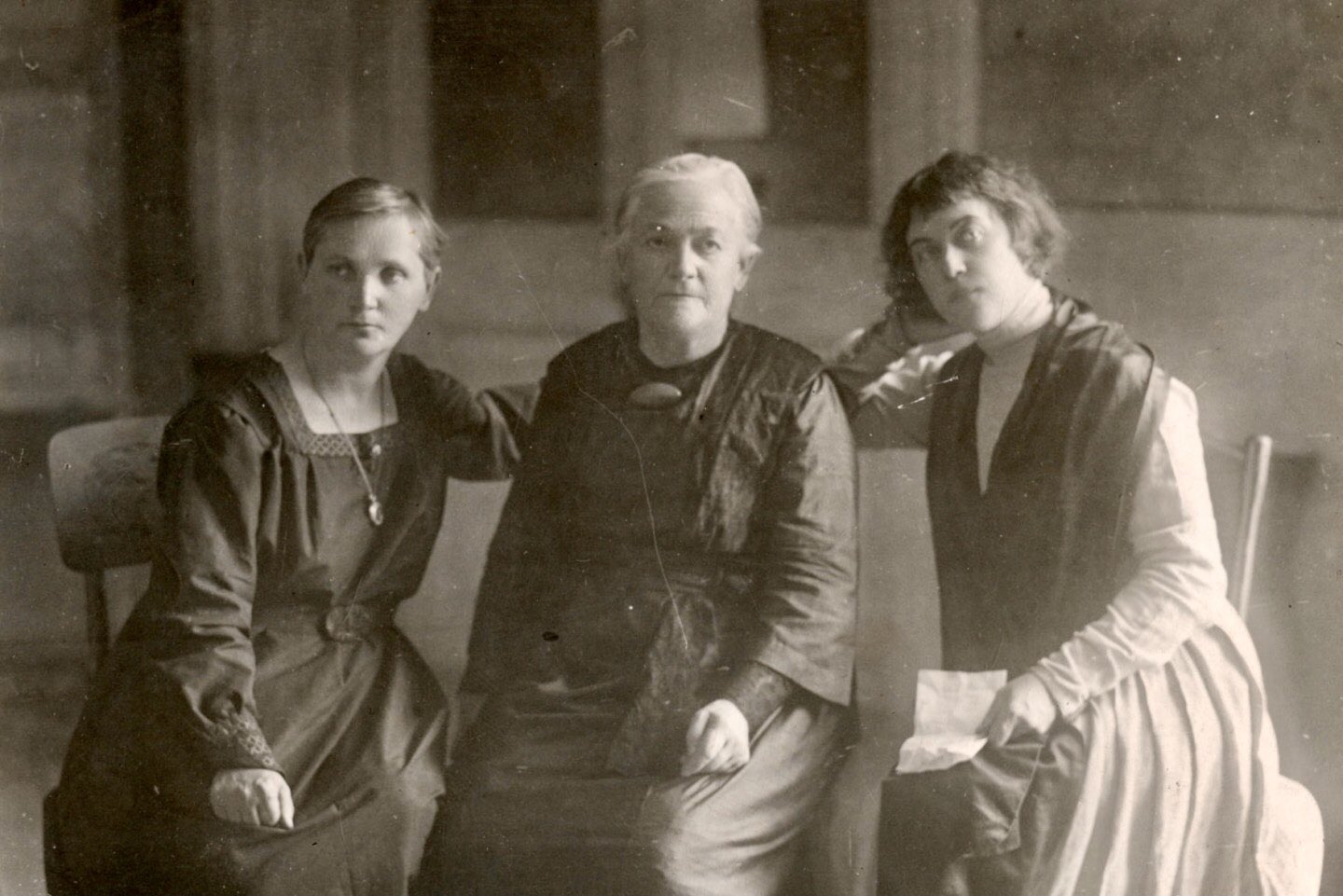
The Second International Conference of Communist Women took place in Moscow immediately before the Third Comintern Congress in June, 1921. Here is a report from the time of its opening evening with speeches from Zetkin, Kalinin, Lozovsky, Bukharin, and Kollontai, along with summaries of other speakers. Also included are the personal reflection on the event from a participant.
‘International Conference of Communist Women’ from Moscow. No. 15. June 11, 1921.
The second International Congress of Women Communists opened in Moscow on June ninth at six p.m. The following were elected to the presidium: Tahlheimer, Bucharin representing Executive Comintern, Clara Zetkin, Liza Gierten, Germany, Smythe England, Lessiak France, Bloch Switzerland. The following were elected secretaries, Lillina, Stahl, Kollontai; besides these representatives of Ukraine, Norway, Sweden and other countries were also elected. The following were elected honorary presidents Lenin, Zinoviey, Trotsky, Krupskaya, Sylvia Pankhurst, Kote Dahlstram.
In opening the congress, Kollontai declared that the Second International Conference of women communists will bring joy to the revolutionary proletariat of the whole world and inspire fear in the hearts of all our enemies. This conference once again proves to our enemies that the communist movement is growing and becoming stronger. Not only are representatives of the whole of the West present at this congress, but Eastern countries also. We are commencing the work of the conference with the firm conviction that the working women of the whole world will courageously carry the banner of communism to the victorious end.
Comrade Kollontai then proposed that the memory of fallen fighters for communism, particularly comrades Samoilova, Inessa Armand, and Ossen of Norway, be honoured by the conference rising.
Kalinin.
Greetings were then conveyed in the name of all the Russian Central Executive Committee by, Comrade Kalinin who was met by a storm of applause Kalinin said.
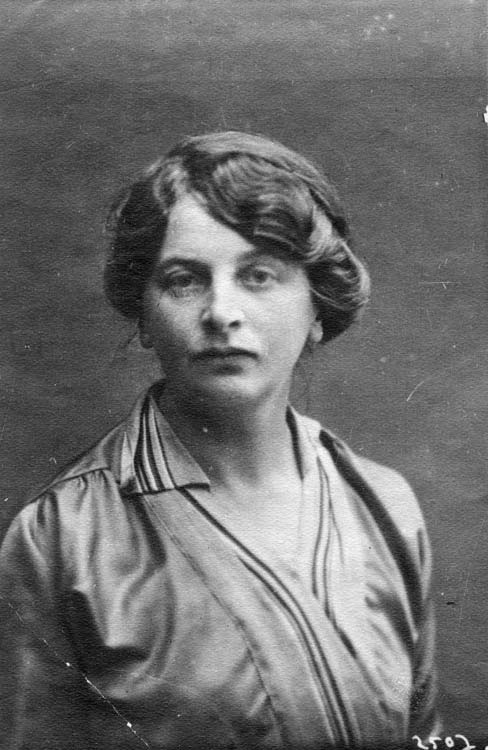
“The honour to welcome the women communists of all countries falls to the lot of the whole of the Russian proletariat. The Russian working woman who always marched side by side with the working men occupies an honourable place in the struggles of the Russian proletariat. We have fashioned our methods in the long and difficult struggle against capitalism. Our tactics are dictated by long revolutionary experience based on the Marxist method.”
As an example of how tactics based on living experience and actual conditions may change without departing from principle and diverting from the final aim, Kalinin referred to the attitude of Russian Communist Party to the question of the corn monopoly and agricultural tax. He believed that Russian experience will be of service to foreign comrades, and he wished them success in their great struggle.
In the name of German Communist Party greetings were conveyed by Comrade Tahlheimer. He declared that communism during the last year has had extraordinary success not only among men workers but also among women workers of all countries, this unceasing growth proves the inevitable collapse of capitalism. He concluded his speech by expressing the hope that the conference will mere strongly weld the ranks of women communists and hasten our proletarian victory.
Losovsky.
Comrade Losovsky greeted the conference in the name of the International Council of Trade Unions. He said:
“There is the one idea running through all the forthcoming conferences and congresses in Moscow namely, the possibility of more intense development of struggle of the revolutionary proletariat. They will be the banner around which will rally the organised masses of the proletariat and that large section of the working class not yet touched by the revolution. Women labour masses represent tremendous fields of activity for communist propaganda. The task of the present conference, and the forthcoming congresses of the Comintern and Red Trade Unions, is to work out an offensive policy for the final struggle with the capitalist world.”
Comrade Guseff greeted the conference in the name of the Red Army and said:
“Only thanks to the victory of the Rep army is it possible for an international conference to gather as it has done today? This is a pledge that very soon we shall have one International Red Army”.
Clara Zetkin.
Clara Zetkin then rose to reply to the greetings and was greeted by a grand ovation. She said:
“I accept your greetings not for the little that has up till now been done by the women communists of Western Europe but for what we have yet to do. The working women of the whole world learned with enthusiasm that we have once again gathered under the banner of Third International in Moscow. What does Moscow mean to us? It is a symbol of the Russian Revolution, a symbol of future struggles for emancipation. We working women belonged to the Second International but it deceived us as it deceived the whole of the proletariat. Nor will the Second and a half International, which vacillates and is totally unable to break with compromise, improve the position. We West European communists only recently were just a small group in each country. Now we are many and our numbers grow every day. What is the Third International? It is not an organisation of words but an organisation of revolutionary struggle, and it is precisely for this purpose that we have gathered here. We have suffered great losses during the past year. We have lost Inessa Armand who was the first to call upon working women to protest actively against imperialist wars. We have lost Comrade Samoilova. We, with you, feel the loss of these comrades and we grieve over them just as you grieve with us over our losses, for the loss of communist fighters is not only a loss to the proletariat of one country but to that of the whole world. In the persons of Rosa Luxemburg and Karl Liebknecht there fell not only fighters of the German proletariat but of the world proletariat. We honour the memory of our fallen warriors not with tears but in the struggle which they bequeath to us.

“Capitalism in all countries is living through its last days, the colossal growth of unemployment shows that we are on the eve of the complete collapse of the capitalist world. We have no time for dallying, we must all unite, we must say to all working women that the hour has come for a decisive struggle and that only by entering the Communist Party can they assist in the struggle; for the fate of women is the fate of labour and the emancipation of labor means the emancipation of woman. But the path to emancipation is not easy, it is a path of difficult and stubborn battles. There may be victories but there may be defeats. We must continually struggle untiringly until power is in the hands of the workers. We have here not only women of Europe, not only the Western European working women but women of the East. The women of the East has awakened and she looks with hope to the Third International in Moscow which calls her to complete emancipation. The presence of women of the East among us is the best proof that however great the work that confronts us is we will close our ranks still more in the struggle for a complete emancipation of working women, for the complete realisation of Communism. Long live the Third International! Long live the working men and working women of Russia! Long live the Soviet Government!”
Bukharin.
Comrade Bukharin then greeted the conference in the name of the Executive E Committee of the Comintern and the Central Committee of the Russian Communist Party. He said:
“Your present conference is much larger then that of last year; if we compare our attempts abroad in Zimmerwald Kienthal and Stockholm with this enormous conference we will see what colossal strides the Communist movement has made. This development proceeds parallel with the collapse of the capitalist world. As Old Europe is collapsing so the ranks of the workers are increasing and becoming stronger. In gathering here in Moscow we will not organise parades with badges and banners, but conduct business. Much work confronts us, perhaps defeats, but inevitable victory is guaranteed us. When we meet foreign comrades we have two greetings for them: one refers to ourselves we say, we are exhausted, we must hold out at all costs. We know that it is possible that our revolution may yet take other devious paths. The other greeting applies to our foreign comrades, we say “your duty is to support us and exert all efforts to make it impossible for capitalism to exist”. We not only can dream of what the best and brightest human minds have dreamt of, but to realise these dreams. In order to construct the new world and not be taken unawares by the catastrophe of the collapse of the capitalist world we must have not merely revolutionary temperament, enthusiasm, and applause, but calculating minds. At present we are faced with a crisis in the growth of the Communist International. Moscow has become a centre of attraction. The collapse of the socialist parties has brought considerable additions to our ranks which the Communist International has not yet managed to digest. Attempts are being made to form a right wing of the Comintern in Germany, Tchecko-Slovakia, and particularly in Italy. We must determinedly resist all opportunist inclinations. This is what we demand of the Women’s Congress. We will never permit our International to be converted into a two and three quarter international or even into a two and nine tenths International. It must be and remain a Third International and I am firmly convinced that together with that old revolutionary fighter comrade Clara Zetkin we will break all opportunist elements.”
International Greetings.
After the speech of comrade Boucharin comrade Tchakai greeted the congress in the name of Georgia. He said that up till now politically Georgis has been a most important centre where the imperialist powers, first Germany, and then England, attempted to establish their base and where the compromising leaders of the Second and a half international attempted to throw their nets. But the proletariat of Georgia tore the net that was set for it and preserved their alliance with the revolutionary proletariat of Russia. He expressed the conviction that this conference as well as the other forthcoming conferences will close up the ranks of the working men and working women of the whole world, unite the revolutionary West with the revolutionary East in which Georgia is a small but unconquerable vanguard.
Lucy Colliar speaking in the name of the French Communists said:
“Women proletarians and comrades, in the name of France I convey to you admiration and obeisance. The French delegation stepped on the soil of Russia with deep emotion, but this emotion is accompanied by shame and prickings of conscience. We were ashamed before the Russian proletariat for our peaceful and easy living. We thought that we had accomplished the task of the revolution when we stood up to defend France from imperialist Germany, and when we secured universal suffrage; but now we see that our revolution has not yet been accomplished. We solemnly vow to you however, that on returning home we will rouse our workers for the last fight. Heavy tasks still confront the French party, the task of gaining over the syndicates in which the Reds as yet are a minority, many obstacles still stand in the path of the French proletariat, but the victory of the Russian proletariat is a pledge of our victory”.
Then followed comrade Patchufareva, she said:
“In the name of Moscow and the Moscow Government I greet you dear guests. In pressing the hand of our dear leader Clara Zetkin with my toil hardened hand it seems to me that I am shaking the hand of tens of thousands of working women. They see the victory of the proletariat in Russia which they have not yet achieved. They ought to leave Russia infected with our militant enthusiasm and determination. When we referred to our martyrs, I recalled our late comrade Ynessa and Samuilova and I say that they are not dead, they are looking to us.”
Comrade Bluer [Bloor] speaking in the name of the American Comrades referred to the growing interest of the workers of America to the workers of Soviet Russia. The workers of America feel that the October revolution showed the real methods of fighting against capitalism. America which previous to the war was one of the freest countries is now a land of the reaction. In concluding her speech Comrade Bluer said:
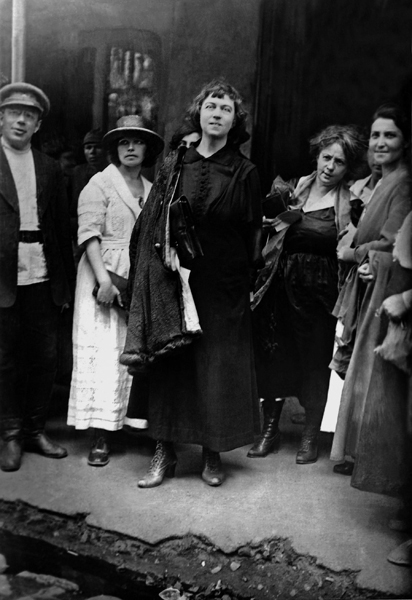
“Although I have worked twenty five years among the workers of America. I have not come here to teach you but to learn from your experience and on my return to America to call upon the proletariat of America to follow in your footsteps.”
Comrades Mussarbekova then spoke in the name of Armenia and Azerbeidjan. In greeting the conference she spoke of the difficult position in which the working women of the East still found themselves, and hoped that the great example of the Russian proletariat will assist in the emancipation of the women of the East. A representative of the Korean and Chinese Communist Parties said that women delegates from China and Korea would not be present because they were hindered by a double barrier of Korean and Japanese soldiers, but the working men and working women of the Far East are striving to unite around the general staff of the revolutionary proletariat, the Comintern in order to gather with the revolutionary proletariat of the West to conduct the task already commenced to a victorious end.
In the name of the working women and peasant women of the Ukraine comrade Tchernisheva greeted the conference and conveyed the assurance that they would exert all their efforts to facilitate the victory of the Communism in the whole world.
Kolontai
In the name of the Central Women’s Department of the Russian Communist Party comrade Kolontai greeted the working women of the West and the East. She said that there was not a corner in Soviet Russia, not a government, not an ouezd nor even a volost where there was not a women’s department and where women are not participating in the work of constructing a better system.
“Our conference has to carry out two special tasks. The first, to create in every party a special apparatus, as in the Russian Communist Party, for attracting women to the struggle for Communism. The second is to establish the principle that the women communist in every party form a strong left revolutionary centre capable of being a bulwark against all vacillation for women workers are more interested than men in the victory of communism”.
After the speech of comrade Kolontai a resolution was accepted conveying greetings to the martyrs of the white terror which said: “The Second International Conference of Women Communists sends hearty fraternal greetings to the communist men and women in all countries who are languishing in prison. The hearts and minds of the members of the conference on this solemn day are with you, Sylvia Pankhurst, Brandler and Muna, and many other thousands of comrades. The bourgeoisie are, endeavouring in vain to hang on to power, and by means of the bloody reaction attempt to postpone their doom. Capitalism has entered a cul de sac. It has no room for the development of productive forces. Only communism can save humanity from starvation ad degeneration, only communism guarantees the women the working class emancipation from their age-long enslavement. Over the heads of your torturers we call to you, comrades working men and working women of all countries, to overthrow the power of the capitalists and unfurl over the world the sacred banner of emancipation of the whole of suffering and propertyless humanity. Long live the struggle of the working men and working women of all countries for the dictatorship of the proletariat!”
‘Impressions of the Opening of the Women’s Conference’ by A.L. from Moscow. No. 15. June 11, 1921.
The Zimina Theatre and the streets around it represented not only a majestic picture but a clear and simple reflection of the hopes and despair of the Russian proletarian women. In seried ranks, singing martial songs, the women marched in columns through the wide doors of the theatre. Part of the women crowding round the entrances in white holiday dresses, in simple but spotlessly clean head-shawls, frequently decorated with red badges, greeted the International Conference with harmonious revolutionary songs.
In these old revolutionary airs, which had been sung thousands and thousands of times, there seems to run some new, fresh, bold, purely womanly strain. Involuntary one imagines that these sounds tell that Woman, the worker, is slowly but surely awakening, awakening to the life, to the struggle, to grand and untiring work of construction.
The theatre was full to overflowing. The Partier, the boxes, amphitheatre and gallery represented amass of colour and movement.
Part of the foreign delegates were seated on the stage. Here one saw a mixture of nations, races and tongues, and one heard snatches of conversation in all languages, western and eastern. These were the revolutionary working women–from Germany, France, England and America–these were women with glorious militant revolutionary pasts, and among them sat Clara Zetkin like an old general of Revolution, with her fine face; grey-haired and active, with lively unageing eyes, full of revolutionary fire and great love. The whole of the theatre seemed to be drawn as to a lighthouse, to this face, mobile and thoughtful, just as if everybody saw in it their symbol. The beauty of Woman the fighter and the women.
Comrade Kollontai declared the Conference opened. Then came greetings, but these greetings were a revolutionary review of the fighting forces of the feminine half of the proletariat.
Comrade Lucy Colliar a striking type of the French revolutionary woman, with a lively temperament and strong will, just as if she had stepped out of the Commune. The periods of her speech were bright and rapid, her language was eloquent and flexible. She spoke of the emotion which she felt when she crossed the frontiers of Proletarian Russia. Here she saw a picture of great heroism and great privation.
“In our emotion” said comrade Lucy Colliar “We involuntarily felt a sense of shame and the prickings of conscience. The difficult task that confronts us now–the winning over of the syndicates in which the Reds are yet a minority is a task which from now will inspire us more and more”.
An American delegate of middle age, with an energetic American face, spoke of her twenty-five years of work among American workers. She did not come here, she said, to teach, but to learn from Russian experience, for the American proletariat has become convinced from the events of recent years and by their own experience that the proper methods of struggle against capitalism were fashioned only by the Russian October Revolution.
The Women of the East were represented at the Conference by comrade Moussar-Beckova, whose Tartar speech sounded so melodious in the theatre, as if it were some Eastern chant.

“The woman of the East, this age-long slave” said comrade Mussar-Beckova “is awakening. Already tens of thousands of our sisters have discarded the turban and the veil. They are now acting independently, they are beginning to understand their feminine and human rights, and life and the ever-growing struggle of the working class is urging them to the great proletarian road.
The most clear, the most sonorous and the most majestic of all the speeches was that of Clara Zetkin. Her fine grey hair encircles her inspired face, which, as she speaks, seems to become radiant. Every expression, every living phrase seems to come from the depths of her soul. And it is this that causes that reverent silence and that concentrated attention,
“Only recently we Western European women communists” said comrade Zetkin “were a small handful. Now we are many and our numbers grow every day”.
This firm conviction of the European woman warrior was sounded like a trumpet call.
“The fate of woman is the fate of labour, and the emancipation of labour means the emancipation of woman”, the striking conclusion of comrade Clara Zetkin’s excellent speech, and this is the clear and brief programme of the women communist movement.
The Moscow working woman, Pachufarova, straight from the loom, was a striking example of the growing consciousness of the Russian woman proletarian. “You” said comrade Pochufarova, addressing the delegates must return to your countries infected with our militant enthusiasm and determination. You must not be satisfied with sops from your bourgeoisie but enter the final struggle as we, the Russian working men and working women did”. There was not a shadow of pride in these words, it was the voice of the Russian factory, of the Russian fields. They were the expression of the agonising thoughts of the Russian proletariat.
“When will the great and proud vanguard of the Western Proletariat come to our assistance?”
It is not surprising that this cry of the working woman Pochufarova, coming from the very depths of her soul, was drowned in a thunder of unceasing applause.
It was touching to observe later on how, Clara Zetkin and Pocufarova, by silent signs and with the aid of an interpreter, conversed in a corner of the stage. Comrade Zetkin pressed the hand of Pochufarova and with baited voice full of emotion told the latter how much she felt the sufferings of the Russian working men and working women waiting for assistance from the West, and expressed the conviction that that assistance is soon coming.
Comrade Kollontai finished her closing speech and the delegates rose and sang the International. The sounds rose and swelled through the whole of the theatre.
Yes, the formal opening of the Women’s Conference presented a majestic picture, but at the same time a clear and simple reflection of the hopes and despair of the Russian proletarian women.
Moscow was the English-language newspapers of the Communist International’s Third Congress held in Moscow during 1921. Edited by T. L. Axelrod, the paper began on May 25, a month before the Congress, to July 12.
PDF of full issue: https://www.marxists.org/history/international/comintern/3rd-congress/moscow/Moscow%20issue%2015.pdf
 Revolution's Newsstand