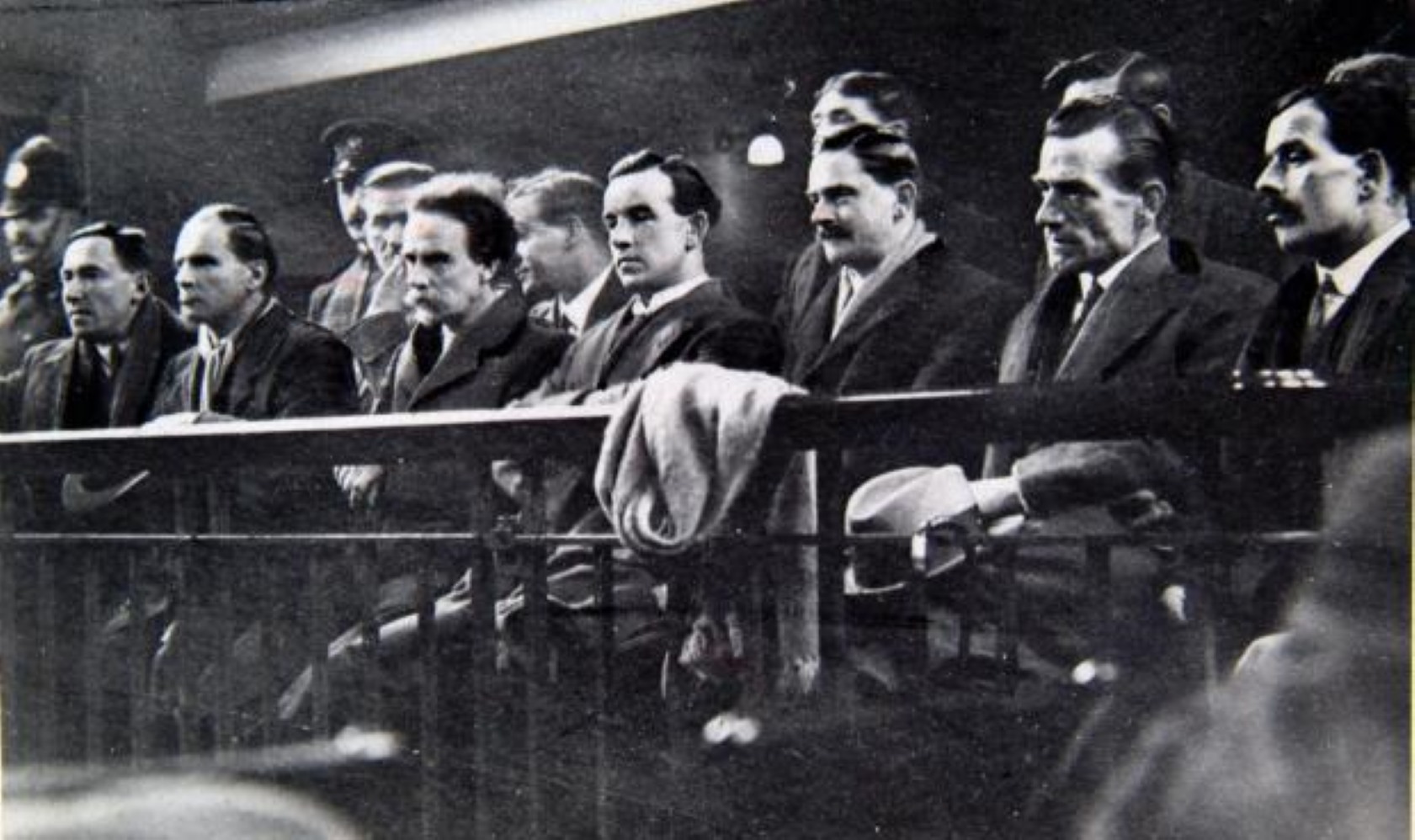
The emergence of shop steward movements have been a clear sign of radicalism in the working class, with Britain’s World War One-era experience being among the best examples.
‘The British Shop Stewards Movement’ by Tom Walsh from The Toiler. No. 140. October 8, 1920.
Secretary of the Building Industry, National Federation of Shop Stewards of Great Britain.
What is this Shop Stewards’ Movement? This question is often asked by those who realise the terrible mess in which the workers find themselves today.
The Shop-Stewards Movement is the organization of the Rank and File in the Factories, Shops, Works, and on the jobs, for these are the places where the Workers receive their miserable pittance which enables them to exist, with just a sufficiency of strength to continue in the production of Profits for the Capitalist-class.
It is quite obvious that the power of the Workers is in the shops and on the jobs, and not in Parliament, or even in their Union Branch. Few Workers are found in either place.
Take for instance, any Shop, Works, or job.
The Workers there may be members of any number of Unions, and are again divided into any number of Branches; about 30 per cent of the members of a Branch will attend and only a small proportion from any one job. These workers have grievances lying at the place where they are employed: the old method of attempting to have these grievances removed has been to report the matter to their respective Societies. But owing to the antiquated and cumbersome machinery of many Societies, it has been the custom for men to endure many injustices and simply wait. Wait for what? The Workers are sick of waiting and are taking action themselves in the Shops, Works, Factories, and on the Jobs. A number of Workers may report a grievance to their respective Branches and will receive sympathy from some quarters, as many of the members of all Branches of all Societies have fought hard for Labor and are much devoted to the best interests of the Workers.
Stumbling Blocks To Action
Still, one of the stumbling blocks to action, is that everybody is bound and virtually buried in Constitutionalism of a pre-historic character. The Rule Book may be referred to, and turning to Rule 44, page 4,444, it may be found that the said grievance does not come within the meaning of the Act, and the unfortunate Workers are driven back to the job where the grievance exists. The Workers are beginning to realize where their power lies.
It is not difficult to understand the hopeless state of the Workers while they use the out-of-date machinery in an attempt to free themselves. The Workers, in spite of being members of a Union are divided, subdivided and scattered to the four winds immediately they attempt any independent action away from the Factory, Works, Shop, or Job. The men and women on the various jobs will find on investigation that their interests are common in spite of being divided by Crafts. They associate with each other daily, but they seldom, or never at all meet at their Branches, it being impossible for them to do so as there are so many Unions, so many Branches, and the workers may reside miles apart and yet all from the same shop or job and while at the Factory, Works, Shop or Job, they not only belong to one Branch, but for all practical purposes, they are members of the One Big Union of the Workers on the Job.
“Sending Out Their Thinking”
The unfortunate part is that the working-class have been in the habit of sending out their thinking, just as some people do their washing. This is foolish, for it leads to the position that those to whom the thinking is given become Masters and Dictators and often meet in conference and fix up Agreements and Laws that few agree with, except the Master Class.
It should be the Mission of the Workers themselves, to do their own thinking and cease passing pious Resolutions but to take action, for that–is the thing that counts. The Workers cannot appeal to reason, as there is none.
The Workers themselves it is who will have to act, for they are the people who feel the unjust conditions arising on the jobs, and that is where the trouble is, and where the Workers will have to take organized action.
The Mission of the Shop-Stewards’ Movement is to consolidate the forces of the Rank and File where they are, in the Factories, Workshops, and on the Jobs.
It must be admitted, that while some of the Capitalist Class have improved their machinery of exploitation, the Workers’ Organizations have retained the old methods and continue their use long after they have become all but obsolete. The Rank and File are slowly but surely becoming conscious of this fact and quite a new spirit is spreading over the whole world. This spirit is not for a paltry increase of wages, but for the absolute abolition of the present system of robbery, the sweeping away of Capitalism, and the establishment of a People’s Commonwealth!
The Structure Of The Movement
It now becomes evident that the Shop-Stewards’ Movement is out for something greater than the continuation of the present hum-drum life. The Movement, in the first place, aims at the control of the Factories, Works, Shops, and Jobs, as a means to an end.
The Movement seems to suggest the following structure: that every Factory, Works, Shops, and Jobs shall elect a committee on the Job, consisting, say, of one Steward from each trade, grade, or department of the Job, and a Steward having been elected by each of the above grades, these Stewards become the Workers’ Committee for that Job.
They will elect their own Chairman and Secretary and such other Officers as the Job may apparently demand.
This Committee will not be Executive, but will be established to administer and act on the mandate as agreed necessary by the Workers on the Job; they will take “mass” action and never act sectionally. It requires no outside interference with its own affairs. It may possibly require assistance from other Jobs of the same Industry, and probably from other Industries organized on similar lines.
It will be up to the various Shops and Jobs to frame its own standing orders. The Committee referred to will be one of many of the same industry in the same district, and to solidify, further, that Industry of that district, all the Stewards from all the other jobs will constitute the District Council of that Industry.
Rank And File Control
This Council will elect a Chairman and Secretary, and, also, a Committee, say, consisting of one from each grade of that Industry. This Committee will be administrative and carry out the mandate of the Council of Stewards which, as already stated, is composed of all the Stewards from all the Shops and Jobs’ of that Industry in the district, and every decision to come from the Rank and File direct from the Jobs. The Movement will travel further ahead and link up all industries in the district, thus forming the Central District Council of all the Industries.
This Council should be composed of two Members elected by the Committee of each District Council of the said district. It will become necessary to step out still further and form a National Council of each Industry.
This Council should be composed of two Members elected by the Committee of each District Council of the said Industries.
The Movement is full of possibilities and the next step would probably be the establishment of a National Council of all Industries.
Emancipation Is The Object
The one object of the Movement is the emancipation of the Wage slave, and the construction of the necessary Machinery to help to accomplish the task in view.
The time has arrived for the Rank and File to determine their own destiny, and to get together as a class-movement, thus sweeping away all things which are obstructions in the path of progress, and thus with a stupendous effort bring into being the possibilities of a New Society, in which Bakers will not be called upon to make bread for Profit, but for the People to eat; and Tailors will not be required to make Clothing for dummy figures in a window show, but for human beings; and Builders will not be expected to put up Mansions for others and Slums for themselves; where Child, Mother, the Lame, the Aged and Infirm will receive the necessary care and attention and allowed ease and comfort, and those who are able and refuse a helping hand to produce all that is necessary for the welfare of all will be denied the right to eat! Having accomplished this task, let us try and forget the horrible past, pay strict attention to the present, and also give the future our careful consideration.
The Toiler was a significant regional, later national, newspaper of the early Communist movement published weekly between 1919 and 1921. It grew out of the Socialist Party’s ‘The Ohio Socialist’, leading paper of the Party’s left wing and northern Ohio’s militant IWW base and became the national voice of the forces that would become The Communist Labor Party. The Toiler was first published in Cleveland, Ohio, its volume number continuing on from The Ohio Socialist, in the fall of 1919 as the paper of the Communist Labor Party of Ohio. The Toiler moved to New York City in early 1920 and with its union focus served as the labor paper of the CLP and the legal Workers Party of America. Editors included Elmer Allison and James P Cannon. The original English language and/or US publication of key texts of the international revolutionary movement are prominent features of the Toiler. In January 1922, The Toiler merged with The Workers Council to form The Worker, becoming the Communist Party’s main paper continuing as The Daily Worker in January, 1924.
PDF of full issue: https://www.marxists.org/history/usa/pubs/thetoiler/n140-oct-08-1920-Toil-nyplmf.pdf
 Revolution's Newsstand