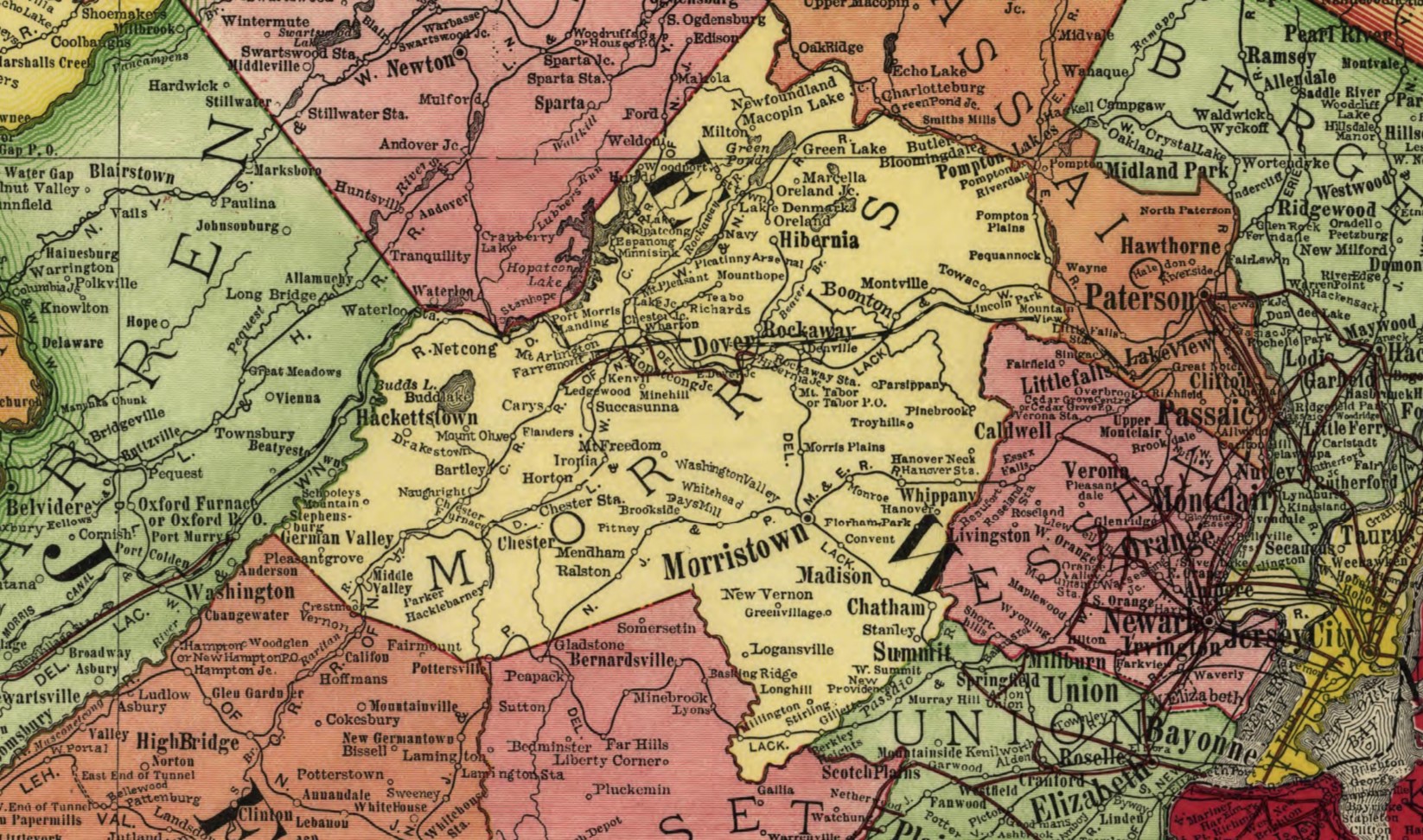
Two Socialist Party organizers have an adventure as they travel well off the beaten path, bringing the Good News to the wilds of rural New Jersey.
‘Campaigning in Morris County, New Jersey’ by Wilson B. Killingbeck from The New York Call. Vol. 5 No. 180. June 28, 1912.
Although only a few miles from New York City, there are towns in Morris County. N.J., which still retain the primitive conditions which prevailed during the Revolutionary War so far as homes and living methods of the workers are concerned, although the capitalist system of production obtains.
Being invited by Local Dover to spend a week in the unorganized sections of that county, the invitation was accepted and the first meeting arranged for a little town up in the hills called Mount Hope.
It is a mining town, where, during the Revolutionary War. guns were made for the use of the Continental troops. I asked one of the natives why the name Mount Hope, as the surroundings have anything but a hopeful look? He replied: “Why, because we are always hoping to be able to get away from here.”
In order to get there you take a wagon or other vehicle from Rockaway, otherwise walk. On our journey we encountered a very violent thunderstorm and as a result arrived at our destination somewhat moist outwardly, but the worst effect of the storm was to keep down the attendance, as many had to walk miles in order to attend the meeting. Nevertheless about 100 assembled, according to the capitalist press, and listened very attentively, and at the conclusion of the address asked several intelligent questions.
This was the first Socialist meeting ever held there, and the results were alarming, from a capitalist viewpoint, as all the miners went on strike the following day. However, the strike was successful on the second day, and as a result Socialist party stock is above par from the viewpoint of the miner, although the connection between the meeting and the strike was not very apparent.
Every evening during the week meetings were held in the small towns surrounding Dover, which were very successful. The population of these towns consists largely of miners, railroad workers and iron workers, and the careful attention with which they listened to the speakers augurs well for the future.
On Sunday came the climax. A meeting had been arranged in a town called Marcello. A diligent search of the map failed to show its location. However, we were assured that there was such a town, so taking compass and map we started from Dover. The first step in the journey is to take a rolling, rollicking trolley to Wharton, a mining village which polls about 10 Socialist votes. From there you take something which resembles a train, consisting of one car, combination sleeper, baggage, smoker and coach. In order to eliminate useless labor the engine is not turned around and you wonder in which direction you are going. However, with a rattle, bang and snort you start, the engine wrong end to, pushing you up a very steep incline. A combination baggageman, freight handler and conductor comes and demands tickets or money. As we had seen no ticket office, we had to produce the cash and received a return ticket to Greenwood. After perilous journey, your engine pushing around precipices hundreds of feet deep and up over a mountain, the conductor entertaining you with stories of disasters which occurred on the road and show you the place where the same engine turned turtle, you arrive at your destination. The conductor manifests his interest in the movement by placing you charge of a lone stranger who volunteers to guide you to Marcello. As the distance is about two miles over a very dusty road with the thermometer hovering around the 90’s, thoughts of deserting the Socialist party and taking a train to Baltimore enter your mind, but you resist temptation and start. But, oh, what a road: An exaggerated switchback plus inches of hot dust and the words of the poet come to your mind–
“I am out of humanity’s reach:
I must finish my journey alone:
Never hear the sweet music of speech–
I start at the sound of my own.
The beasts that roam over the (rocks) plains
My form with indifference, see:
They are so unacquainted with man,
That their tameness is shocking to me.”
At last a building: A combination grocery store, meat market, feed store, coal and wood yard and postoffice, but best of all, a shady grove and a well with an old oaken bucket. In spite of the danger of being thrown out of the party, sabotage was advocated by the writer, or, in other words, loafing on the job. The motion was carried unanimously, and doffing all possible clothing we came to anchor under the shade of the trees. Presently comes the postmaster and owner of the aforesaid building and immediately Comrades Matthews, Harvey and Reinhart, of Dover got busy trying to convert the proprietor of the miniature department store, who proved to be a Prohibitionist and believed that all the ills of humanity were due to the use of intoxicating liquors. All our combined eloquence failed to show the gentleman the error of his ways. However, our persistency and evident sincerity so pleased the old gentleman that he invited us to dinner and refused to take no for an answer, and such a dinner! Chicken, butter, vegetables, all raised on the place, with homemade bread, bringing back memories of the olden days.
After dinner, more hills, dust and heat with possibly six houses in sight and we began to wonder where our audience would come from. Finally, we arrived on the scene of action, with no buildings in sight except a vacant schoolhouse. A council of war was held and we decided to have a meeting, even if we spoke to the rocks and dead chestnut trees, but finally signs of life were seen, a couple of men came down the road, and no cat ever watched a mouse more intently then we did those two men, in fear and trembling that they might pass by. But no, they stopped and assured us that others would come. And soon they began to come, through the woods, over the dusty roads and around the hills. Some walked miles from the United States arsenal at Denmark and others from nearby villages. An insurgent preacher, who had the privilege of using the schoolhouse in which to preach, insisted that we do the preaching for that day: we accepted the invitation and held the meeting in the schoolhouse, which was fairly well filled.
As a reward of our efforts an organisation will result, and another wild part of Jersey will hoist the international banner.
We wended our way back over the hills and through the dust to the sued which does duty as a depot, tired but happy: boarded the combination car and were carried down the mountain and at the precipices safely to our destination. Thus, with irresistible force does our movement encompass the earth, bringing slowly but surely, the better time.
The New York Call was the first English-language Socialist daily paper in New York City and the second in the US after the Chicago Daily Socialist. The paper was the center of the Socialist Party and under the influence of Morris Hillquit, Charles Ervin, Julius Gerber, and William Butscher. The paper was opposed to World War One, and, unsurprising given the era’s fluidity, ambivalent on the Russian Revolution even after the expulsion of the SP’s Left Wing. The paper is an invaluable resource for information on the city’s workers movement and history and one of the most important papers in the history of US socialism. The paper ran from 1908 until 1923.
PDF of full issue: https://www.marxists.org/history/usa/pubs/the-new-york-call/1912/120628-newyorkcall-v05n180.pdf
 Revolution's Newsstand