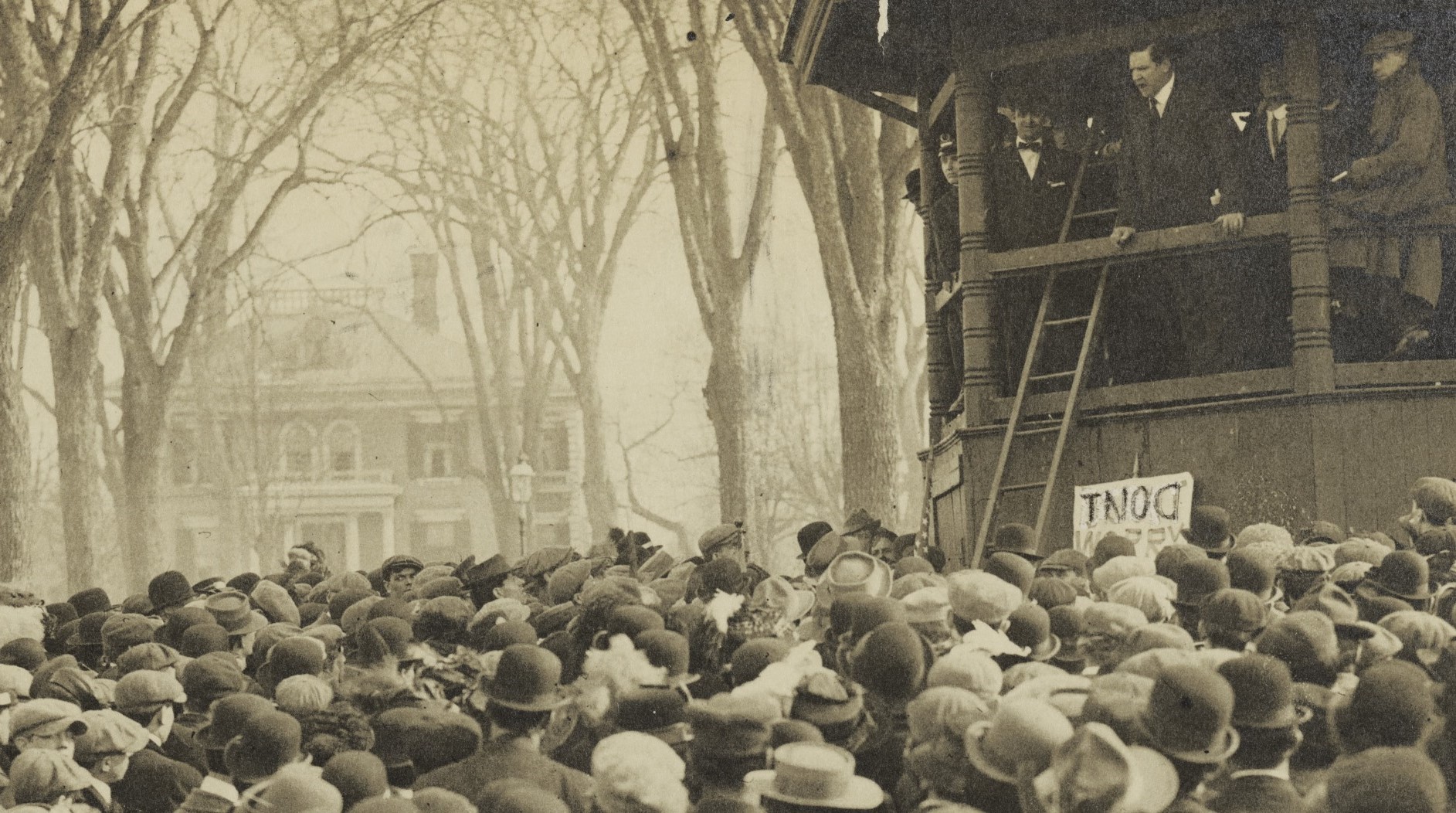
Dozens of marvelous class war missives from Bill Haywood. Sometimes called ‘Pick and Shovel Pointers,’ sometimes ‘Shots for the Work Shop,’ and sometimes ‘Blanket Stiff Philosophy,’ here all of Haywood’s irregular columns for ISR.
‘Pick and Shovel Pointers’ by William D. Haywood from International Socialist Review. Vol. 11 No. 8. February, 1911.
AGREEMENTS with capitalists are the death warrants of labor.
There can be no closed shop as long as the boss has the keys.
There is no chivalry in the work shop. Capitalism compels sex equality.
Every new invention of machinery makes the journeyman of today the apprentice of tomorrow.
Trade unionists keep men out of the union and then wonder why the Manufacturers’ Association can get scabs.
Labor organizations should be free’ to fight for their class interests at all times.
You recognize this fist as a fighting weapon. It is made up of five members, five organizations. They can all work independently when necessary but when called upon can become a united force.
Suppose one of them is tied up with an agreement — a white rag — for a year or more. What becomes of it? It will wither and decay. And what is true of this finger is true of a labor organization. It is useless to itself and stands in the way of its fellows.
An agreement between the capitalist class and the working class is an unholy alliance, and when entered into by any body of workingmen it removes them from their class and the class struggle and makes them auxiliaries of the enemy of labor.
When the soldier enlists he enters into an agreement to fight the battles of the capitalist class and shoot down his fellow workers. When the trade unionists sign an agreement with the capitalist class, they likewise enlist to furnish the soldiers with guns, with food and with clothing. They are the enlisted men behind the man behind the gun.
‘Shots for the Work Shop’ by William D. Haywood from International Socialist Review. Vol. 11 No. 10. April, 1911.
Poverty has nothing to arbitrate.
The capitalist has no heart. But harpoon him in the pocket-book and you will draw blood.
The manager’s brains are under the workman’s cap.
The bandage will remain upon the eyes of Justice just as long as the Capitalist has the cut, shuffle and deal.
Industrialism is socialism with its working clothes on.
One union of all workers in an industry; all industries in one union.
There can be no trade agreements between capitalist masters and wage slaves. If you would be industrially free, refuse to sign agreements that enslave you.
If you bore from WITHIN long enough you will come OUT.
Some workingmen are so proud of the dignity of Labor- that they wear overalls all the time for fear they will be mistaken for Capitalists.
The Capitalist Class starve Labor which they cannot profitably employ.
Would the Working Class be justified in destroying what they cannot peaceably enjoy?
Twelve hours is a bad habit. Get the Eight-Hour habit. Get it now.
We are going to turn this government from a political junkshop into an industrial workshop.
The Supreme Court of the United States is the Gibraltar of Capitalism.
To the Working Class there is no foreigner but the Capitalist.
The prosperity of a labor organization is measured by its activity.
Activity for improved conditions of employment or against the lowering of existing standards of living means that the membership is in arms against the exploiters.
Action against exploitation requires agitation, publicity, strikes, boycotts, political force — all the elements and expressions of discontent. Discontent is life. It impels to action. Contentment means stagnation and death.
‘Pick and Shovel Pointers’ by William D. Haywood from International Socialist Review. Vol. 12 No. 1. July, 1911.
It is better to be a traitor to a country than to be a traitor to your own class.
A battlefield is the Foolkiller’s paradise
Workingmen fighting for capitalists are their victims.
A live soldier is a hobo. A dead soldier is a hero. More monuments!
An armory is a school where the young idea is taught to shoot to kill.
A militiaman is a scab on the regular soldiers.
The regular army is an institution for making widows, orphans and pensions.
Capitalists have no country, no flag, no patriotism, no honor and no God but Gold! Their emblem is the dollar mark. Their ensign the black flag of commercial piracy. Their symbol the skull and cross bones of little children, and their pass word is Graft.
Society is in three layers. There are the dregs on the bottom, deputies, detectives, soldiers and strikebreakers; the working class – the great pay streak in the center; and the parasites – the scum on top.
The policeman is a pimple, the soldier a boil on the body politic, both the result of a diseased system. They can be readily eradicated by a strong dose of that medicine called Socialism.
The Socialist party is not a political party in the same sense as other existing parties. The success of Socialism would abolish practically every office existing under the present form of government. Councils, legislatures and congresses would not be composed principally of lawyers, as they are now, whose highest ambition seems to be to enact laws with loop-holes in them for the Rich. But the Congresses of the Workers would be composed of men and women representing the different branches of Industry and their work would be directed to improving the conditions of labor, to minimize the expenditure of labor-power and to increase production.
‘Blanket Stiff Philosophy’ by William D. Haywood from International Socialist Review. Vol. 12 No. 6. December, 1911.
A shorter day means bigger pay.
An aristocrat of labor is a step-brother of the Rich.
An officer of the law is a walking delegate of Capitalism.
The pick, the shovel and the hammer are mightier than the pen, the sword and the cross.
An Industrialist is class conscious. A pure and simple trade unionist is only craft conscious.
The dear “Public’ is a mysterious element in society neither fish, flesh nor fowl, laborers nor capitalists.
Every demand of the workers in the shop is an effort to twist the ownership of the tool out of the hands of the boss.
A Trust means less competition and more dividends. One Big Union means less competition among workers for jobs and bigger wages.
Reciprocity: A contract wherein the capitalists of two nations shake hands and agree upon a mutual system for robbing the producers.
Rags make paper. Paper makes money; money makes banks; banks make loans, loans make interest; interest makes poverty and poverty makes rags.
The workers being interdependent, they should organize as the capitalists have assembled them in the industries. Today the workers are divided according to position, name or shape of the machinery they use.
When you face an injunction and do not know how to win —take out the j, that stands for jails and judges; the c that means courts and cruelty; the t, that stands for trials and tragedies, and the answer will be found in the letters that remain—IN UNION.
The International Socialist Review (ISR) was published monthly in Chicago from 1900 until 1918 by Charles H. Kerr and critically loyal to the Socialist Party of America. It is one of the essential publications in U.S. left history. During the editorship of A.M. Simons it was largely theoretical and moderate. In 1908, Charles H. Kerr took over as editor with strong influence from Mary E Marcy. The magazine became the foremost proponent of the SP’s left wing growing to tens of thousands of subscribers. It remained revolutionary in outlook and anti-militarist during World War One. It liberally used photographs and images, with news, theory, arts and organizing in its pages. It articles, reports and essays are an invaluable record of the U.S. class struggle and the development of Marxism in the decades before the Soviet experience. It was closed down in government repression in 1918.
 Revolution's Newsstand