
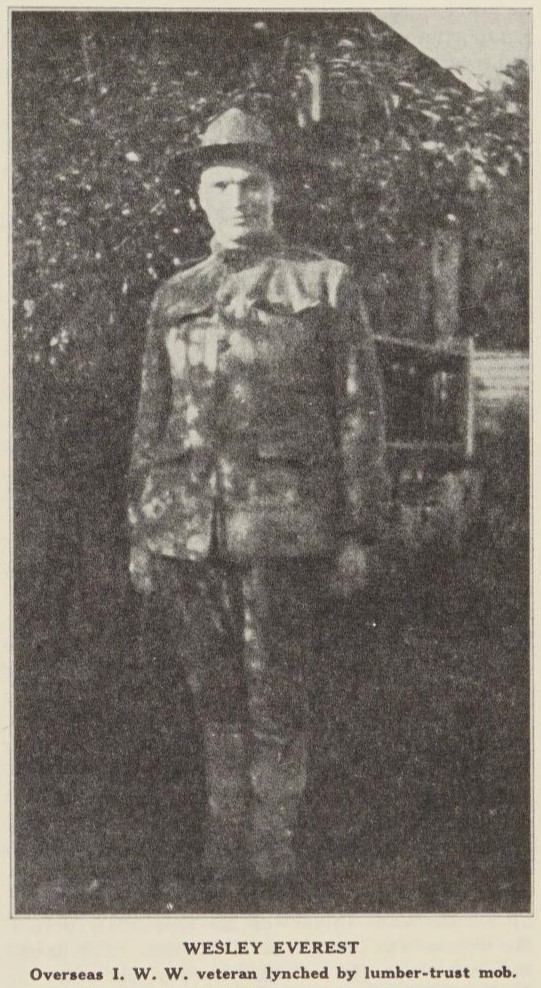
A fantastic investigation into the trials resulting from 1919’s so-called Centralia Massacre in which I.W.W. members defended their hall against American Legion thugs. Resulting in the deaths of fives reactionaries, it led to the lynching of I.W.W. activist, and fellow veteran, Wesley Everett as well as long jail terms for both heroic comrades and innocent bystanders.
‘The Centralia Conspiracy’ by Ralph Chaplin from Industrial Pioneer. Vol. 1 No. 8. December, 1923.
How did the Lumber Trust Succeed in convicting men of murder who merely defended their lives and property from a mob? Some of the facts are known; others are coming to light daily.
“There’s lots of justice in the United States, if you have money to pay for it!’:This cynical and unadorned remark was hurled in the face of an IWW prisoner in Leavenworth by an admitted and brazenly guilty German spy. It was occasioned by the innocuous statement that, “Some day the IWW cases will receive justice and the country will be ashamed of what it has done.” Less than a month afterward the German spy was released unconditionally. He was not even deported. The American workingman to whom the remark was made is still in the tentacles of the law. It is barely conceivable that money didn’t release the spy nor the lack of it keep the wobbly in. But the fact remains that, in a lawsuit, the goddess of Justice is always on the side of the biggest money-bags. A man is arrested, charged with a criminal offense, and taken to court. The far-famed Constitution guarantees him a speedy, fair and impartial trial before a jury of his peers. The profiteers violated the laws flagrantly and under the very nose of the government. Yet very few of them were hailed before “hizzoner.” These good citizens misappropriated millions upon millions of the people’s money, yet it is safe to say that not a single one of them is in prison at present. Yet workingmen, accused of violation of the war-time laws in 1917 were arrested upon the flimsiest of excuses, held, in some cases, two years and over awaiting trial and then given a speedy, fair and impartial conviction. And thirty-two of them are still behind the bars! Even more significant was the trial of the IWW loggers at Montesano. Perhaps it is not true that, “justice is a purchasable commodity” and that, “there is one law for the rich and another for the poor.” But if these things aren’t true then they are lies that are mighty hard to answer. At all events money, in America, is one of the mightiest factors in determining the innocence or guilt of a person accused of crime. Even if justice cannot be purchased at so much per, public opinion can be purchased that way. In the last analysis the ends of justice are shaped by public opinion, which is only making the purchase at the side door instead of at the front. That is why inconceivably huge sums are spent at election time, that is how the people of this country were. stampeded into participation in the late unpleasantness, that is how a considerable number of IWW members found themselves in prison just about that time. Money spent to influence public opinion isn’t a direct bribe nor an open purchase. Big business looks upon it as a safe and sane investment; which, no doubt, it is.
Fear A Factor
At the trial of the intended victims of the Armistice Day mob it is doubtful whether money was used to bribe the jurors. It is still more doubtful whether these jurors would have accepted it. The fact is bribery was not needed. Every juror and every witness was coerced by terror and this terror was paid for out of the swollen coffers of the northwestern lumber barons. And the terror did its work. How would YOU feel, if you were on a jury in a town like Montesano and all your friends and some of your most influential neighbors, their minds inflamed by lurid articles and suggestive editorials in the newspapers, advised you, “give the damned IWW’s what’s coming to them?” Of course you would want to be fair; but, at the same time, fairly comfortable; and, of course, you would not be particularly anxious to leave your home town—in a hurry, The jury in the Centralia case had a hard job. Doubtless not a single one of them would themselves have acted otherwise than the men they found guilty. Doubtless the majority of them would admit it to you in confidence if you were to ask them. Yet they brought in the verdict that sent six innocent men to prison for from twenty-five to forty years! You can gauge the success of the lumber trust’s investment by this one fact.
There were other things purchased besides the deadly publicity that poisoned the minds of the great mass of the citizenry of the northwest. Oh, yes, there were many things bought and paid for by lumber trust money besides the four dollar a day soldiers in uniform who gave color to the courtroom. The machinery of the prosecution ran far smoother than machinery does when it isn’t oiled a little! And the Judge, if not subtle was at least stubborn.
An Invented Legend
The prosecution, in order to cover up the crime of the real culprits, sought to press the absurd charge in court that the loggers had fired into the ranks of peaceful paraders. The evidence was all against them. Thanks to the capitalist papers however, the legend existed. It was a valuable asset to the prosecution—bought and paid for with lumber trust gold. And this legend was used to the limit to produce the passion and prejudice that would assure the unjust conviction. Only two deductions were possible: either the loggers fired in self-defense or they fired with the intention of committing wanton murder. It happened that the ten loggers were members of the IWW. This fact alone, in connection with the gravity of the charge and the atmosphere of hysteria that surrounded the courtroom, made a fair trial impossible. If the “evidence” of the prosecution would not convince, the admitted shooting and the admitted membership in the IWW of the men who did the shooting would be sure to convince. Then there was the terror to be considered, the obvious and determined bias of the Judge and the machinations of the prosecution lawyers who “framed” the trial.
Framed
Perhaps you think the word “frame” is too strong a word to use in this connection. Perhaps “framing” is not the right word. But if the ends of justice can be thwarted in an American court by powerful interests determined to convict workingmen in spite of evidence and facts, then it is time that someone invented a word to designate the process properly. Whether it is called “framing” or not, the thing smacks of the dark ages. It is medievalism superimposed upon the machinery of justice— the processes that are supposed to determine the guilt or innocence of any of us who ever happen to be charged of committing unsocial acts. It makes the courtroom a place where common men and women are not tried, but found guilty. It makes fair play and justice impossible and places any workingman at the mercy of any group of capitalists who wish to send him to prison. Read the facts and judge for yourself.
The defense admitted that there was shooting on Armistice Day in Centralia, that legionaires were killed and that the union loggers were armed. But the defense claimed—what everyone knew to be a fact—that the loggers had armed themselves as a measure of self-protection against a certain number of men who were bent upon murder and destruction. All things considered, in view of the repeated attacks upon the union hall, there should have been a verdict of “justifiable homicide in self-defense.” But the trouble is, all things were not considered—in fact, were not permitted to be considered in court. The Judge, subservient to the will of the lumber trust, ruled out, as inadmissible, all evidence that the union hall had been raided in 1918 and that the intention of the leaders of the Armistice Day parade was to raid it again. The Judge sought religiously to keep from the consideration of the jury all evidence of the conspiracy to raid the hall and of the complicity of Warren O. Grimm and others in this conspiracy.
Jurors’ Way of Thinking
After listening to the evidence on both sides, the jury was no doubt in a frame of mind something like this: “For some reason the union loggers fired at the legionaires and killed some of them. The Judge, at the last moment, instructed us to return either a verdict of second degree murder or one of not guilty. We feel that there are lots of facts withheld from us that we would like to know about. The Judge’s attitude and the state of public opinion are such that a verdict of guilty seems to be expected of us. But this, in fairness we cannot bring ourselves to return. The loggers are getting the worst of it, but if our verdict is ‘not guilty’ the Judge will declare it unsatisfactory. In addition to this we will be condemned and socially ostracized. Perhaps, too, the next jury will not be as generous as ourselves. There is no doubt about the killing, but we have no means of knowing from evidence submitted in court whether the killing was justified or not. Therefore let us give the Judge and the public any old kind of a verdict of guilty and at the same time demand of the Judge that he grant leniency to the defendants.”
Drilling Witnesses
The reasons the prosecution wanted the case confined to facts of the shooting, instead of the conspiracy of the Associated Industries’ officials that precipitated the shooting, are easy to be seen. But how did they manage to drill their witnesses so that the story would sound plausible? What kind of “machine” did they use to “frame” their case and “make’’ witnesses in order to put their version of the shooting across? How could they best manage to keep the defense from reaching the jury with the real facts, or as many of the real facts as possible? The real story of this machiavellian plot to defeat the ends of justice has leaked out since the trial. A special investigator for the defense has given his findings to the world. It reads like a page from fiction—but it is the gospel truth.
In the first place, there was probably not more than one man out of every ten in the “parade’’ who actually knew of the conspiracy of the “secret committee” to lynch the union secretary and destroy the union hall. The plan was to stampede the marchers into unlawful action at the opportune moment just as had been done previously in 1918, get the raid started and then use the rope. Not all of the legion boys who marched in that “parade” had murder in their hearts. Some of them may have wanted “roughhouse” and would have delighted in the work of making things hot for the wobblies. But only a comparative few either desired or were prepared for a lynching bee. Those who harbored these sinister intentions were members of the “secret committee.”
Truthful Legionaires
At least two of them were killed in the raid. So there were legionaires who could testify truthfully that they were ignorant of the murderous purpose of the “parade.” Some of these were located at the far ends of the procession and did not know what had happened until they were told about it or had read the hectic stories in the newspapers. Some of these testified on the witness stand that they thought the shooting took place before the raid started. There may have been a few legionaires who took this position—honestly. But for every legionaire of this type there were at least five who were willing and eager to make their testimony suit the case. These the prosecution without hesitation or scruples proceeded to use for “cat’s paws.” just as the lumber trust had used the legionaires in the “parade.”
In all fairness it must be admitted that a considerable number of legionaires were honest enough in the cause of truth and fairdealing to defy condemnation and ostracism and take the stand for the defense. It took courage to do this and too much credit cannot be given to them for their unselfish actions. Unfortunately the legionaires were not all of this type.
American Legion men had gathered together in considerable numbers in Montesano to attend the trial. The prosecution saw to this detail which, like the camping of regular troops on the courthouse lawn, was intended to create the proper “atmosphere.” Tacoma, Centralia, Chehalis, Bellingham, Port Angeles, Aberdeen, Hoquiam, Mt. Vernon, Anacortes and Bremerton—each of these towns and cities supplied its quota of delegates, all of them O.K.’d by the prosecution before they came. These men were sent to Montesano with the understanding that they were to submit to the orders of their commander, a Mr. Schant, a former army captain who was in charge of the Montesano American Legion. These men were paid four dollars a day by the lumber interests. In addition to this stipend they were given sleeping accommodations in the fire department section of the City Hall and in a garage nearby. This latter place was a veritable fortress, well supplied with high power rifles and ammunition of all kinds. A certain Lieut. Crawford of Mount Vernon was in charge of this little lumber trust army. The legionnaires did guard duty twenty-four hours each day in their fortress, The sentries were detailed by roster.
An Armed Camp
It must be remembered that these legionaires were private citizens, living in an armed camp of their own in the midst of a community that had ample protection from the customary law-enforcing machinery. Who armed them and gave them permission to camp in the heart of the city? Why had they been gathered together and for what purpose? Can it be that the lumber interests were waiting, as was openly intimated, for an opportunity to wreak vengeance upon the defendants in case the jury did not do its “duty?”

Lieut. Balcon was in charge of the secret service work for the prosecution. Under him were several legionaires dressed like loggers and workingmen. It was the duty of these lumber trust spies to gain the confidence of defense witnesses, learn in advance of the testimony they intended to give and, wherever possible, influence it to suit the programme of the prosecution. As soon as a defense witness had been interrogated by these sleuths, the findings were transmitted to Chief Balcon who was privileged to enter that part of the courtroom occupied by the attorneys. Balcon would then pass his information over to prosecution attorney Christiansen, who would in turn give it to prosecutors Cunningham or Able during the progress of the trial. Thus were the scales of Justice weighted in favor of the rich and powerful and against the penniless loggers who had dared to defend themselves from the mob.
Prosecutor Chief Detective
Christiansen was the most active of all the detectives for the prosecution. His position as Assistant, State’s Attorney afforded him absolute freedom of action. He had access to everything that went on at the courthouse and the American Legion fortress and headquarters. By examination of the subpoenas issued for the defense witnesses, it was a simple matter for him to keep the prosecution informed about all witnesses likely to be called.
It was a consistent policy of the prosecution to have each and every defense witness interviewed in advance. This was done for the purpose of obtaining advance information as to what the testimony would be and also to influence this testimony BY ANY MEANS POSSIBLE to make it substantiate the prosecution’s made-to-order case. To accomplish this end very elaborate methods were employed.
Intelligence Chief Lieut. Frank Van Gilder was one of the chief members of this Intelligence Department. Whenever possible this officious person visited prospective def ense witnesses before their arrival at Montesano and secured, or tried to secure, their testimony. Van Gilder’s method of approach was suave but forceful. He always boasted that he ‘knew his stuff.” And it was the smooth stuff that Van Gilder was supposed to put over. When this method failed to make the right kind of an impression on the witness other agents would follow him up with a different line. Threats and intimidation were indulged in and the witness would be informed in unmistakable language as to what their future in the community would be like and what would happen to him or her in case the testimony they were about to give would be found to be objectionable by the prosecution.
Upon the arrival of the defense witnesses at Montesano, Lieut. Balcon’s forces took up their work at once and every effort made to interview those who had escaped Van Gilder’s attentions. These men, in various attires intended to make them look as much like workers as possible, tried by confidential means to secure prospective testimony. Some defense witnesses were openly threatened in the court room immediately following their testimony. The arrest of two defense witnesses for perjury was part of the plan to intimidate other witnesses waiting their turn to go on the stand for the loggers.
High Speed Espionage
As the defendant’s attorney, George Vanderveer, neared the conclusion of his case the espionage machinery of the prosecution was already operating at high speed to manufacture the rebuttal witnesses to impeach all of the important testimony of the defense. Assistant State’s Attorney Christiansen was the man selected to put the polish on these ‘made’ witnesses. The testimony itself was ‘framed’ by Lieut. Van Gilder or his associates, before the witness was brought to Montesano. The finishing touch was put on by Attorney Christiansen. Then the witnesses were taken before special prosecutors for approval.
The above is merely a brief review of the many means used by the lumber trust to defeat the ends of justice at the Montesano trial. Even then there would of necessity be many angles of the sordid story still untold. The fact remains that at Montesano convincing proof was offered of the truthfulness of the statement that a workingman has no chance in an American court, especially if the workingman be a member of an unpopular and misunderstood labor union like the IWW. But the Centralia case proves more than this. It proves beyond the shadow of a doubt that until the workers gain economic power to match the power of the organized business interests labor prosecution will continue unabated. All power, then, to the class conscious and militant workers of the IWW who are determined to put a stop to such outrages against themselves and their class!
Outweighs All Cases
In the meantime we must not forget that the Centralia case outweighs all other IWW cases in importance. Not only are the sentences longer but the effect of the case as it stands on the other cases is harmful in the extreme. It is said, for instance, that President Harding’s stubbornness in refusing to consider the federal IWW cases was largely the result of his firm belief that the IWW loggers in Centralia fired without warning or provocation into a parade of marching ex-service men in uniform. It may be said, of course, that the foibles of a mere politician do not matter. If we had industrial power this statement would be far more true than it is today when we have such power only to a limited extent. President Harding’s frame of mind is indicative of the frame of mind of the entire country. The capitalist newspapers, by poisoning the sources of public information at the head waters have made the hideous lie about our fellow workers in Walla Walla “stick.”
It is up to us to undo their dirty work by convincing the entire country of the truth about the Centralia Conspiracy that sent the men who defended their hall to prison for from twenty-five to forty years. We owe this to the boys in Walla Walla and to our other imprisoned fellow workers whose cases will be affected by the Centralia case. In reality the Centralia case is the key to the entire IWW defense. Next in importance come the California state cases. These have a unique. organization character that differentiate them from the Centralia case. The federal cases, on account of being the first and biggest IWW persecutions have had a large amount of publicity—perhaps more than their share. Strategically they are in a better position than any of the others as far as a general release is concerned. The federal cases have already cost hundreds of thousands of dollars and are costing great sums every year. Once these are disposed of the work of liberating the Centralia and various state cases will be greatly simplified.
Realizing Acts
Compared with the Centralia case the charges against the men in the federal and state cases seem trivial. Sooner or later (we all hope sooner) the various jails and prisons of the country will all give up their prey. But back of it all and overshadowing all is the stern, awful and inescapable fact that the Centralia boys are doomed for twenty-five to forty years in prison and for the gravest charge on the calendar of law—murder. The realization of this fact should bring to our minds the necessity of starting a real drive for the release of these fellow workers. Fundamentally the cases are all the same. It was for the crime of being members of the IWW that all of the men are now in prison. Different pretexts were used to land them there, that’s all. Had the Centralia men not been IWW’s they would never have been convicted. The Centralia case deserves all the support that can be given it. It deserves far more attention than has been given it. Nothing should be permitted to stand in the way of a united drive to liberate the victims of the lumber trust who went to prison for daring to defend their union hall.
The Industrial Pioneer was published monthly by Industrial Workers of the World’s General Executive Board in Chicago from 1921 to 1926 taking over from One Big Union Monthly when its editor, John Sandgren, was replaced for his anti-Communism, alienating the non-Communist majority of IWW. The Industrial Pioneer declined after the 1924 split in the IWW, in part over centralization and adherence to the Red International of Labour Unions (RILU) and ceased in 1926 to be reborn in the 1930s.
PDF of full issue: https://www.marxists.org/history/usa/pubs/industrial-pioneer/Industrial-Pioneer-(December-1923)%20Part%201.pdf
 Revolution's Newsstand