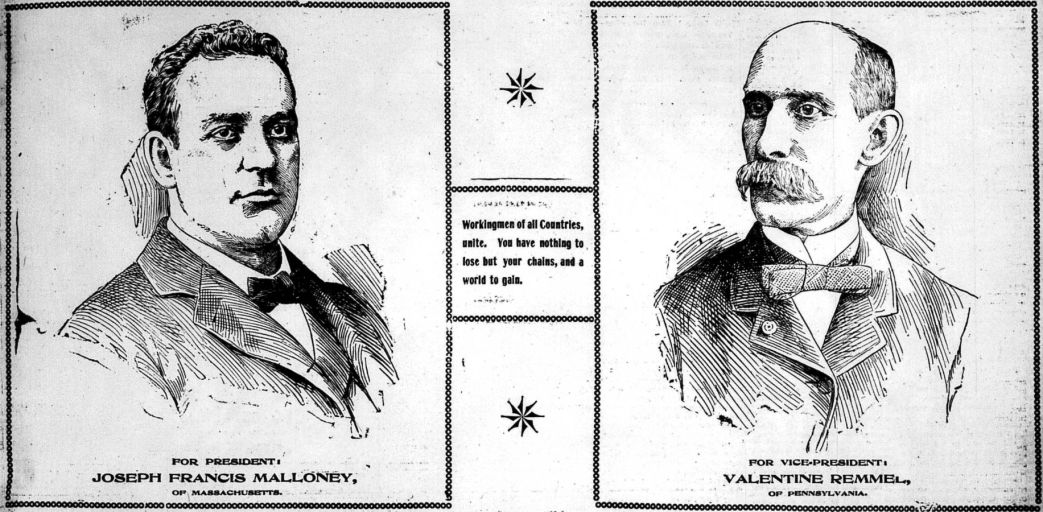
Standard-bearers of the Socialist Labor Party, Joseph F. Malloney and Valentine Remmel, in 1900.
‘The Socialist Candidates and Their Biographies’ from The People. Vol. 10 No. 17. July 21, 1900.
Joseph F. Malloney, the Socialist Labor Party candidate for President, was born in Providence, R.I., October 16th, 1865. This brings him just within the required age of thirty-five years. He is the youngest of nine children. When he was nine years old, the poverty into which his parents had fallen, made it necessary for him to go to work. He obtained a job in a cotton factory, and worked at various tasks, each succeeding one harder than the former, for about six years. Then he was apprenticed to the Machinist’s trade, and bound in the sum of $150 to the Rhode Island Locomotive Works. This was a guarantee that he would stay there for three years.
It happened at that time that the demand for locomotives made it possible, by working overtime, to end his apprenticeship in two years and five months. From that time until 1892 he worked regularly at his trade in Providence and vicinity.
When Malloney went to Massachusetts in that year he was absolutely unacquainted with Socialism. His first employer was George R. Peare, of Lynn, who had been and yet is one of the staunchest Socialists in the country. The Party could not but become known to Malloney, and so well did Peare teach him that in 1893 he joined the Party, and has been a valuable member of it since. Shortly afterwards he went on the platform as a speaker, and his services have been from that time until now in constant demand.
There was in Lynn at that time a small organization of machinists, and Malloney at once became a member and remained with it until its dissolution. Another organization was started and he entered with activity into its work, and soon became president. He was delegate to the convention of the International Machinists held in 1897 at Kansas City, and after a hard fight there became convinced that the policy of “boring from within” is not only folly, but that it is worse than folly.
Massachusetts has had few important conventions or meetings at which Malloney was not present. He has also frequently been nominated for office, and in 1888 ran for Congress in the Seventh District of Massachusetts. His Democratic opponent was Walter Ramsdall, the notorious “labor” mayor of Lynn. So sturdy and true were the blows that Malloney struck that Ramsdall, after refusing to meet him in debate, found his campaign broken. Malloney addressed every town and city in the district, and the present vigorous growth of the Party there is traceable to the fight which Malloney conducted in 1898.
It is largely due to his work that the Canadian Rev. Herbert Casson, a peculiarly fishy character, who tried to ride the American Labor Movement, was shown up in true colors. At first it seemed that misplaced sympathy for Casson would tear asunder not only the section at Lynn, but also the Party throughout the state. The question was fought out on the ground of whether or not Casson should be allowed to place himself above the Party and use it for his own ends. The skill with which Malloney presented the Party’s side won the day. Casson was driven from the ranks, and has since been a rolling stone. At once the Lynn section of the Socialist Labor Party felt the good effects of his absence.
The demand for Malloney as a speaker and his great force and readiness on the stump led the section members to elect him State Organizer in 1899. He proceeded to work, and at the time of the Kangaroo episode had several sections and locals of the S.T. & L.A. under way. The trouble forced him to withdraw temporarily from the work of organizing, and for the next few months he devoted his energy to drawing the sections into shape. This he was successful in doing, and when it was accomplished he returned to the work of new organizations.
The early age at which he went to work left him with but little education. When he commenced to work for the Party, he recognized the necessity for training, and with characteristic thoroughness he engaged a teacher, and spent his evenings in the hardest kind of study. He hewed his whole way through the solid rock, and it has told upon his whole character. No obstacle hinders him; no amount of hard work tires him; no difficulty discourages him.
As a candidate Malloney possesses all the strongest points of the Party which made him its candidate. As a man he possesses the best intelligence of the working class. Malloney is an indication of the new life and the new blood of the S.L.P. There is no doubt but that he will, as he has done in the minor campaigns in which he has figured, surprise and dismay the old parties by the vigor and force of the fight he will conduct.
Valentine Remmel was born in the City of Pittsburg, Pa., on the 10th of March, 1853, of German parents, who emigrated to this country in 1845.
His father at once went to work in coal mine, and mined coal in the Pittsburg coal district until 1863 when, being injured in the mines, he had to quit work, as he was disabled for life.
This incident forced young Valentine to leave school and go to work to help support the family, he being the only son out of four children.
At the age of eleven he went to work in Atterbury’s glass factory as a carrying-in boy. At the age of eighteen he had finished his trade as glass blower and has been working at it ever since.
In the year 1876 Remmel, along with his fellow craftsmen, organized the glassworkers into the Knights of Labor: It was soon found that this form of trades union did not suit the glassworkers’ ideas of trades union, on account of the affiliation with so many unskilled workers. In 1879 they organized the A.F.G.W.U.
In November of 1881 when the American Federation of Trades had its first convention in Pittsburg and were first organized, Remmel was elected a delegate from his local union, and took an active part in having his trade connect itself with the Federation. That organization has since changed its name to the A.F. of L.
Remmel was always active in the trades union movement, and has served it in every capacity from outer guard to president, as well as delegate to various conventions of his organisation and delegate to trade councils, etc. where he had considerable experience in the “boring from within” process and has profited by it.
Remmel became a member of the Socialist Labor Party in 1895, and once was active in bringing about the American section of the Party in Pittsburg. He has been actively engaged with the movement ever since. In June 1898 he was elected secretary of Pennsylvania State Committee, and been its secretary ever since.
Remmel, bowing to the will Party, never shrank from standing as the Party’s candidate during the campaigns. Thus he has run for Congress in his district, has been candidate for Mayor of Pittsburg, and last year was placed on the ticket for judge of the Superior Court. Remmel became member of Local Alliance 189 S.T. & L.A. in the fall of 1896.
Prior to becoming a Socialist Remmel called himself an independent in politics.
New York Labor News Company was the publishing house of the Socialist Labor Party and their paper The People. The People was the official paper of the Socialist Labor Party of America (SLP), established in New York City in 1891 as a weekly. The New York SLP, and The People, were dominated Daniel De Leon and his supporters, the dominant ideological leader of the SLP from the 1890s until the time of his death. The People became a daily in 1900. It’s first editor was the French socialist Lucien Sanial who was quickly replaced by De Leon who held the position until his death in 1914. Morris Hillquit and Henry Slobodin, future leaders of the Socialist Party of America were writers before their split from the SLP in 1899. For a while there were two SLPs and two Peoples, requiring a legal case to determine ownership. Eventual the anti-De Leonist produced what would become the New York Call and became the Social Democratic, later Socialist, Party. The De Leonist The People continued publishing until 2008.
PDF of full issue: https://www.marxists.org/history/usa/pubs/the-people-slp/000721-weeklypeople-v10n17.pdf
 Revolution's Newsstand