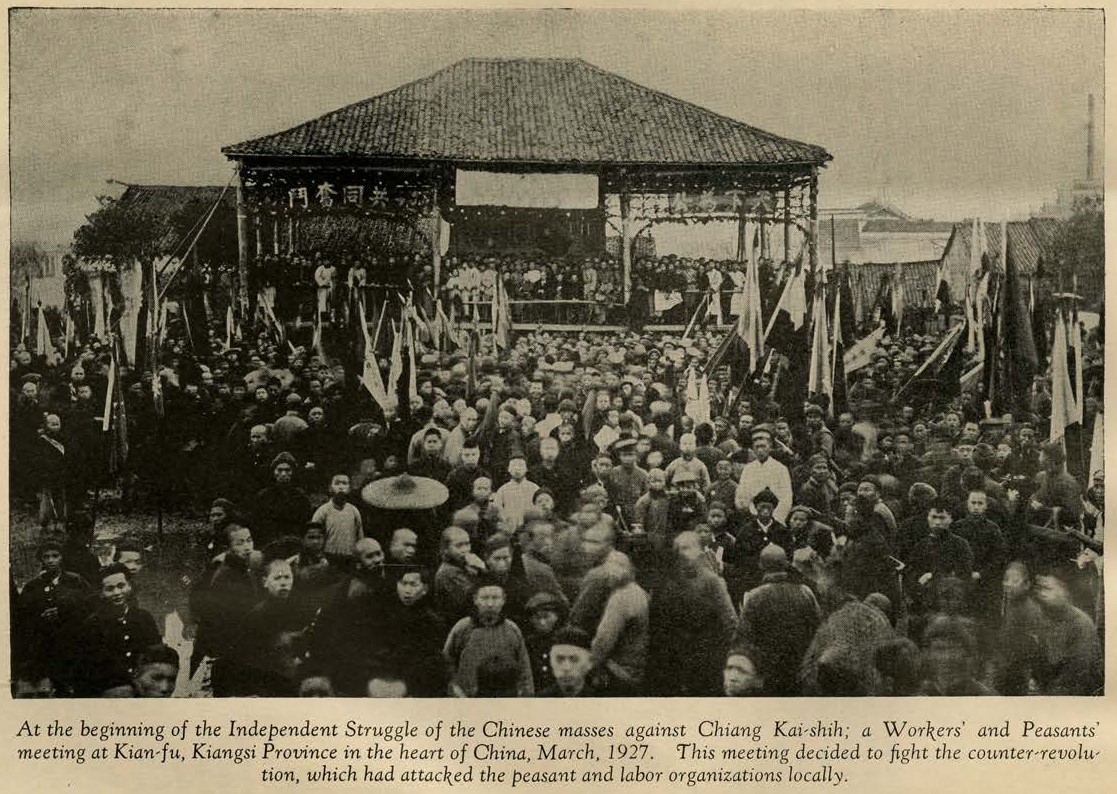
This perspectives and tasks document from the Fourth R.I.L.U. Congress came at a momentous time for the Chinese Revolution as the center of gravity shifted from the urban working class to the rural peasantry in the aftermath of break with the Koumintang and the bloody suppressions of 1927.
‘The Trade Union Movement in China’ from Report of the Fourth Congress of the Red International of Labor Unions, 1928.
PROGRAMME OF ACTION FOR THE TRADE UNION MOVEMENT IN CHINA.
The Chinese trade union movement, which took up the course of the revolutionary class struggle from the very outset, constitutes, both by its numbers and fighting qualities, one of the best detachments of the R.I.L.U. At the same time, none of the sections of the R.I.L.U. have had to experience such cruel persecution as the Chinese. The ruling classes of China, in league with imperialist capital, have taken up the course of the PHYSICAL DESTRUCTION of the vanguard of the working class. Under such circumstances it is the fundamental task of the revolutionary trade unions in China to MOBILISE THE PROLETARIAT around its class organisations, without which the relentless struggle against the Kuomintang and the other reactionary groups in China, the overthrow of the counter-revolutionary régime, and the emancipation of China from the yoke of imperialism cannot be achieved. To this fundamental task are subordinated the organisational and practical tasks of to-day: the organisation of the everyday struggle of the proletariat, the fight against the reactionary unions, and the organisational building up of the revolutionary trade unions.
PROGRAMME OF ACTION FOR THE REVOLUTIONARY TRADE UNIONS.
(1) After a number of defeats, under the conditions of wild terror, the labour movement is passing through a period of certain depression, and in some working-class quarters there has become manifested a spirit of disappointment and fatigue, coupled with an improper conception of the fighting methods under the new circumstances. In order to overcome these moods, a persistent work of agitation, propaganda and organisation must be conducted by the revolutionary trade unions in the factories, directly among the workers. Under these circumstances it is necessary to endeavour to obtain the maximum organisation in all the actions of the working class; it is necessary to attract into the trade union organisations all, even the most backward, elements of the working class, since only by a high state of organisation and by the participation of the widest masses will it be possible to secure the successful course of the struggle of the working class. Upon the questions which stir the workers day by day, the revolutionaries should arouse the class-consciousness of the workers, demonstrating that the Red trade unions are the only organisations which defend the interests of the proletariat. It is essential to make it widely clear to the workers that the Red trade unions do not at all constitute purely political organisations, but that, IN THE FIRST PLACE, they are organs of the economic struggle of the workers, which stand at the same time upon the revolutionary standpoint of the class struggle.
(2) The revolutionary unions should PLACE THEMSELVES AT THE HEAD OF THE ECONOMIC STRUGGLE. The demands made in time of strikes should be thoroughly discussed by all the workers. Only when the bulk of the workers will clearly understand the sense and content of the struggle will it be possible to attain success. Any compulsion in regard to the masses of the workers hesitating to join the struggle is not only inexpedient, but also harmful. It undermines their confidence in the labour organisation, and facilitates the work of the REACTIONARY UNIONS AND THE EMPLOYERS IN THE DESTRUCTION OF THE REVOLUTIONARY TRADE UNIONS.
(3) The fundamental economic platform around which the revolutionary unions ought to mobilise the masses should be the decisions of the Fourth All-China Trade Union Congress: the eight-hour day, the shorter day for miners and for workers in unhealthy trades, the weekly day of rest with pay, the abolition of the periodical turnover of workers, the annual holiday, the minimum wage, the increase of wages, discharge benefits, the prohibition of the employment of children under fourteen, the six-hour day for youths, the prohibition of night work for women and minors, paid rest periods for pregnant women, equal pay for equal work; the organisation of sanitary inspection in the factories, benefits to sick and injured workers at the expense of the employers; relief for the unemployed at the expense of the State and the employers under the control of committees elected by the workers; the abolition of the system of unpaid apprenticeship, the abolition of fines and black lists, the prohibition of corporal punishment of workers, the abolition of the system of foremen, and so forth. This economic platform should be modified, itemised and adapted to the peculiar features of each separate district and of each separate industrial group of workers.
(4) In the case of a strike, there should be only such demands raised which can be obtained by the workers under a given economic and political situation, and AT A GIVEN DEGREE OF FIGHTING ABILITY on the part of the workers. It is necessary to limit the number of the workers’ demands, not raising them by the score, but concentrating the whole struggle around two or three BASIC demands. In South China, under the circumstances of the severe reaction, the most vital and popular demands among the workers are: The retention of the conditions previously won with the aid of the revolutionary unions, the struggle against lengthening the working day, against reducing the wages, against the intensification of labour, against discharges and curtailment of staffs of employees, against compulsory arbitration, against the payment of wages in depreciated currency, and so forth.
(5) The protests against execution and arrests of workers, the demands for the liberation of arrested comrades, the recognition of the right to strike, and the freedom of assembly and combination should be launched as part of wide mass movements involving tens of thousands of workers.
(6) Whilst laying stress upon the defence of the economic interests of the working class the revolutionary trade unions should wage a fight against any open or covert forms and tendencies of class collaboration; against the deceptive ideas of participation by the workers’ organisations in raising the productivity of labour, against company unions, profit-sharing schemes for the workers, the system of labour shares, the formation of labour banks, insurance companies, co-operative factories and workshops, etc., which are so diligently preached both by the foreign and Chinese capitalists, as well as by the Kuomintang and the reactionary trade unions.
(7) The Chinese bourgeoisie, the Kuomintang, and the reactionary trade unions, are telling the workers in one voice that the conditions of labour in Chinese factories are better than in those owned by foreigners, endeavouring in this manner to paralyse the revolutionary struggle of the workers. The red trade unions should expose this deception, explaining to the workers that all capitalists, whether Chinese or foreign, are exploiting the workers with equal cruelty, and are to an equal extent the class enemies against whom the most relentless struggle ought to be fought.
(8) If, on the one hand, there is danger of being isolated from the working masses, in the refusal to lead their economic strikes; the present conditions, on the other hand, may bring about a deviation towards excessive interest in minor matters, towards a fear of political action, towards a policy of crumb-picking. The objective circumstances at present are such that among certain elements of the workers there may temporarily arise the sentiments of narrow guild interests. Such sentiments should be overcome by linking up every economic struggle with the general class tasks of the proletariat. Step by step, the revolutionary trade unions should demonstrate to the workers, upon real examples, the inevitability of the transformation of the economic struggle into a political one, and in the long run into the struggle for power.
THE FIGHT AGAINST THE REACTIONARY TRADE UNIONS.
(9) The reactionary trade unions in China, except the Kwangtung Federation of Labour and the Mechanics’ Union were created after the counter-revolutionary feats executed by the Chinese bourgeoisie in 1927 (the Kuntunhwei and the Kuntsunhwei in Shanghai, the Trade Union Reorganisation Committees in Hunan and Hupeh, etc.). Therefore, they rely above all upon the military and police machine, and upon the foremen, contractors, lumpen-proletarians, and strike-breakers, and therein is their chief source of power just now. The reactionary unions have managed somehow to rally a portion of the workers and to keep them in their ranks by resorting NOT ONLY TO COMPULSION, BUT ALSO TO REFORMIST METHODS, securing some petty concessions from the employers for separate categories of workers, whilst at the same time refusing to fight against the general worsening of the living and working conditions of the workers. Therefore, the struggle against the reactionary unions is a profoundly political one, since the revolutionaries will have to overcome not only the resistance of the apparatus of the military and the police, but also the backwardness of a certain section of the workers, and the remnants of their faith in the Kuomintang.
(10) For the struggle against the reactionary unions the organisation and class education of the wide masses are essential, and for this reason the methods of individual terror against reactionary trade union leaders are extremely harmful. Terror cannot serve as a means of CONVINCING the workers. Individual terror can only divert the attention of the revolutionaries from their fundamental task-the emancipation of the masses from the influence of the reactionaries. Such terror can only scare the workers without convincing them that the revolutionary trade unions are right.
(11) Many workers in the Chinese trade union movement in the past considered it necessary either to limit or to discontinue sending comrades into the reactionary unions, because they would become demoralised there; this may be interpreted as a REFUSAL TO WORK WITHIN THESE UNIONS in order to break them up and to win away the masses from them. Without taking any part in the leading organs of the reactionary unions set up by the military authorities, our comrades should work among the masses who are organised in these unions. Whilst refusing to send workers into the reactionary unions, they would thereby leave the whole strata of workers under the influence of the reactionaries. Whilst relentlessly exposing the corruption of the reactionary trade union bureaucrats, whilst showing up their real fascist face before the masses, the revolutionary unions should at the same time win the members of these unions and utterly destroy the reactionary unions.
ORGANISATIONAL STRUCTURE OF REVOLUTIONARY TRADE UNIONS.
(12) The illegal conditions of activity create the danger of
replacing the revolutionary trade unions by political party organisations. THE ORGANISATIONAL INDEPENDENCE OF THE TRADE UNIONS MUST BE ASSURED. The complete fusion of the illegal apparatus of the Communist Party with the apparatus of the trade unions, the fusion of the Party nuclei with those of the trade unions in the factories, result in the fact that the trade unions cease to be wide mass organisations which can be joined by any worker irrespective of political or religious convictions, who observes the class solidarity and subscribes to the trade union rules.
(13) The revolutionary trade unions of China should at all costs embrace, in the first place, the categories of the INDUSTRIAL workers: the textile workers, the railwaymen, the miners, the metal workers, the seamen, the tobacco workers, etc. This should be particularly emphasised, since at the present time, owing to the tremendous difficulty for the revolutionary unions to be active in the large factories, there arises a tendency of FOLLOWING THE LINE OF LEAST RESISTANCE, transposing the centre of gravity to the small enterprises of the artisan and trading type, and to the scattered groups of common labourers. The revolutionary unions should not fail to develop vigorous activity among the WHOLE of the Chinese proletariat, but the activity among the industrial workers should constitute the basis, particularly in those places where they are under reactionary leadership, e.g., at Canton (the mechanics, the electricians). A relaxation in the activity among the skilled workers may lead to the strengthening of the reactionary unions.
(14) There should be a systematic distribution of the forces of the revolutionary trade unions to serve all the important industrial districts of China. In the North, until very lately, the work was suffering greatly on account of severe repression, as well as owing to the insufficient activity of the revolutionary trade unions. There are still unorganised the seamen of the North, the workers of Dairen, Tientsieng, Tsintao, and nearly all the large industrial centres of Manchuria, whilst the Tan-shung workers and the railwaymen are feebly organised. And yet this activity acquires exceptional importance in view of the revival of the labour movement in Manchuria. In Shanghai, the revolutionary trade unions will have to wage a fight against the ostensibly reformist Labour Federation for the influence over some section of the industrial workers. Exceedingly important is the work among the proletariat in the districts adjacent to Shanghai–in the towns of Hanchow, Wusi, Suchow, Nanking, Nantunchow, Chekiang, etc., where there are hundreds of thousands of industrial workers and trade union organisations which can be joined by any worker irrespective whose members can be easily won over to the side of the revolutionary class struggle. In Hunan and Hupeh, particular attention should be devoted to the organisation of the railway-men of the Peking-Hankow and Canton-Hankow lines, the metal workers, the textile workers, the Wuhan municipal employees and porters, and the miners of the four principal mining districts: Pingsian, Taye, Suikowshan and Sikuanshan. In Hong-kong a fresh revival of the labour movement is emerging and the revolutionary unions are confronted with the task or restoring the organisations of the seamen, metal workers, shipbuilders, port labourers, and other detachments of the industrial proletariat. In Canton the situation is a most difficult one, but even here there is a favourable ground for intensive activity among the proletariat as a whole, and even among the members of the Mechanics’ Union and those categories of workers which hitherto served as the mainstay of the counter-revolutionary organisations.
(15) The revolutionary trade unions should have their basis. in the factories, in the workshops, in the enterprises. Under the present circumstances of illegal activity, the lower organs of the red trade unions are no longer the factory committees, but the factory nuclei of the trade unions, which should be organised in the first place.
(16) It is essential to wage an energetic struggle for the open existence of the revolutionary trade unions.
(17) The question of preparing a cadre of capable union leaders constitutes one of the sorest questions in the Chinese trade union movement. Hitherto the trade unions have quite inadequately attracted the rank and file members to the leadership of the unions. Among the leading organs the percentage of rank and file workers was very small. This defect should be remedied at all costs. Otherwise the trade unions will remain top organisations isolated from the working masses. Workers from the factories should be attracted to all the leading trade union organs, as people who are intimately connected with the masses and know their moods, customs, traditions, etc. On the other hand, it is essential that each trade union official, even if he is not directly employed in production (it is essential that some portion of the trade union officials should be engaged in production), should constantly come into direct contact with the workers. Wherever the circumstances do not permit the opening of trade union courses, it is necessary to publish special literature for the training of the old and the preparation of the new trade union officials. To all leading organs of the trade unions, from the bottom to the top, including the Executive of the All-China Federation, the representatives of the youth and the women workers should be attracted.
(18) When organising the workers employed in ARTISAN WORKSHOPS and PETTY TRADES, it is essential to pay the utmost attention to the old-established organisational traditions (countrymen’s groups, etc.), endeavouring to utilise them as PROVISIONAL, transitional forms of organisation. At the same time it is necessary to wage a campaign against PROVINCIALISM and the group prejudices of the workers, endeavouring in every case to expose and eliminate the causes of friction among different groups of workers (the differences in skill, the intrigues of the employers, etc.).
(19) The WORKING YOUTH has always played, and always will play, a tremendous role in the revolutionary movement. The revolutionary trade unions, besides protecting the working conditions of the working youth, should carry on educational activity among that section of the adult workers which is opposed to the amelioration of the conditions of the young people. The youth should be attracted into the trade unions on the same rights as the adults. The trade unions should also assist in every way in the development of the pioneers’ organisations, which, under Chinese conditions, consist almost entirely of young workers.
(20) The WORKING WOMEN constitute a very high percentage among the Chinese industrial workers. They experience with particular poignancy the yoke of exploitation, and are more oppressed and degraded than all the other workers. The revolutionary trade unions, as in the past, should firmly protect the working conditions of the women and attract the largest possible numbers into their ranks.
(21) One of the most essential tasks of the revolutionary trade union movement is the ORGANISATION OF THE UNEMPLOYED. If hundreds of thousands of the unemployed will not be embraced by the influence of the Red trade unions, the unemployment may be turned into a great danger to the revolutionary labour movement; the unemployed may be utilised by the capitalists and by fascism for their fight against the revolutionary organisations, in the capacity of hooligans, strike-breakers, etc. The struggle against the scattering and declassing of the Chinese proletariat will be possible only in the event that the revolutionary trade unions will maintain the contact with the workers who have been thrown out of the factories, creating special organisations for this purpose, and Unemployed Committees working under the leadership of the trade unions.
(22) The trade unions in China should establish even closer contact with the peasantry, organising the backing of the workers’ actions by the peasants, and vice versa. The trades councils in the districts have been in the past, and should be in the future, the organising centres for the peasantry of the whole district. It is necessary that the district trades councils should proceed to the organisation of the agricultural labourers, the transport workers, the building workers, the artisans, and other working people in the villages, whilst these newly-formed organisations should work in close contact with the peasant unions. The concrete methods of organising these workers should be worked out in the immediate future by the Executive Bureau of the R.I.L.U. jointly with representatives of the All-China Federation.
(24) The All-China Federation of Trade Unions constitutes the only supreme organ of the Chinese trade union movement; yet in view of the civil war and the lack of roads, the intercourse among the different districts has been rendered extremely difficult, and the whole burden of the leadership in the local movements falls upon the local trades councils, the strengthening of which is a task of the utmost importance. It is therefore necessary to form at the Executive of the All-China Federation a staff of travelling instructors who should pay regular visits to the districts.
(25) It is essential to do everything possible to transform the unions of the RAILWAYMEN AND OF THE SEAMEN into genuine All-China organisations. It is also necessary to restore the union of post and telegraph workers, and to prepare for the amalgamation of the unions of miners and textile workers upon an All-China scale.
(26) The All-China Federation of Trade Unions should keep in fraternal contact with the Pan Pacific Trade Union Secretariat and collaborate with the latter. It is also necessary to establish regular contact between the revolutionary trade unions of China and other countries, especially with the Minority Movement of Great Britain.
(27) The IV. World Congress instructs the incoming Executive Bureau to work out a detailed programme of assistance to the Chinese movement by all sections of the international, and instructs also the holding of a “Week of Help to the Chinese Workers” in the very near future.
Report of the Fourth Congress of the Red International of Labor Unions, 1928.
PDF of original book: https://books.google.com/books/download/Report.pdf?id=pfBaAAAAYAAJ&output=pdf&sig=ACfU3U2IOegkwdTMugHLQx-AB1bggAacmg
 Revolution's Newsstand