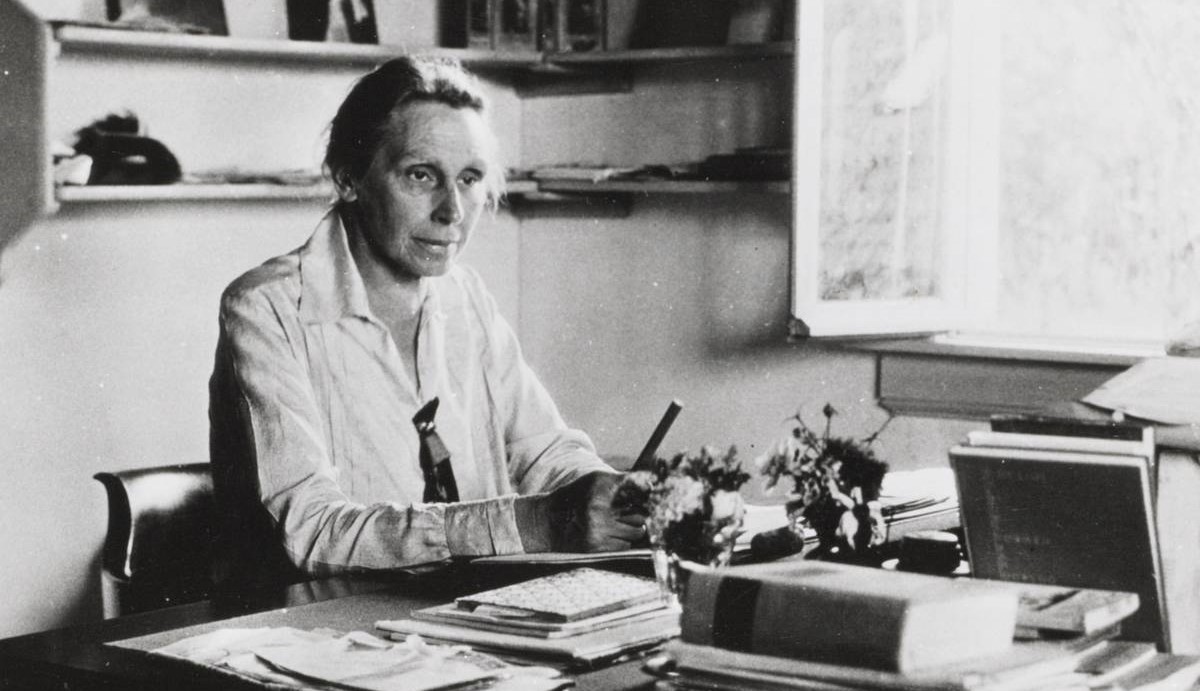
Roland-Holst with an essay on the emancipation of art and the art of emancipation.
‘Communism and the Stage’ by Henriette Roland-Holst from Communist International. Vol. 1 No. 11-12. June-July, 1920.
AS little as capitalist society could be reshaped into a society where generous, universally developed individuals would live in common a life of brotherly harmony, so little, under capitalism, could the age be made a consecrated place, where each one separately would refine the noblest part as the common soul unified in the ideal form of art. The characteristics of the stage reflect each period the characteristics of society, and whoever wants to purify and elevate the modern stage without renewing the soil which nourishes. It–society–proceeds like a physician who would try to give blooming locks, glossy hair and sparkling eyes to a man with impure blood, without beforehand renewing the juices of his body. He would have to use all sorts of artificial means to achieve his foolish ends, and they would at best produce ab If by magic a short delusive appearance of health but not the real thing.
And just so all reforms of the stage in capitalist society are doomed to be purely delusive. The reformed stage seeks to express live values which society does not possess, and–speaking objectively–it must necessarily be more of a lie than the unreformed stage, which manifests quite openly its aim of exciting sensuality, and deadening the feeling of the emptiness of life.
All who, in the last fifty years, moved by idealistic aspirations and a praiseworthy ambition, have tried to renovate the stage and make it a temple where men coming out of the bustle and the incessant activities of life would be born anew to a life of deep and noble alertness–all these became without exception victims of their illusions. A long unbroken line of gifted, energetic personalities with the highest aspirations–beginning with Wagner and up to the stage reformers of our days–have seen the gold of their ideals turn to tinsel between their fingers, just because they did not sufficiently grasp the substance of capitalism and were and were not aware of the inner connection between spiritual life and social conditions. Success brought them more disappointment than failure, considering that to achieve success meant to give up all they had dreamed of as the highest achievement. Their halls were filled, not because the audiences wanted to be newborn in the high serenitude of a work of art, but because it was the fashion to go there. And instead of being sanctified by an elevated spirituality the artists were hoping for, the atmosphere was sullied by the disgusting rotten breath of snobbishness penetrating everywhere and soiling everything.
People say money can do anything. It brings those who possess it all the treasures of the earth and all power over men.
This is quite true, but it is true as well that money can do nothing and has no power whatever. Money cannot light the tiniest spark of love, and not the smallest star of beauty shines through it. It cannot produce a single true emotion, a single noble action. The wonderful creative forces which support and enrich the world manifest themselves outside the barren sphere where money reigns. Money can only buy substitutes of these forces, not the forces themselves–only false love, false devotion, false beauty, false pathos.
The stage is a part, a fixed institution of capitalist society, just as the banks and the stock exchange, church and school, stores and brothels. Whoever wants to work for the reform of the stage must enter the sphere of capitalism and the more he is supported by capitalism the more he can do within the bounds where money is powerful. He will have the means to build spacious, richly decorated halls. He will have at his disposal the industry, the talent, the taste and the intellectual force of all those who work for capitalism: the composer and the poet, the singer and the comedian, the musicians, the dancers, the producers and the stage painters. All this can be bought for money. But the purified and still emotion which assembles the elements of words and music, of dance and gestures, mimic and plastic, and transforms it all into a picture expressing the highest and the noblest in the human spirit all this money cannot buy. Nor can money buy money buy the deep intensity of an audience feeling its soul become one with the highest revelations of the common soul, and shuddering at the sensation of it.
All the money in the world cannot inspire one single line of poetry. How could capitalism find the force to create tragedy, the highest form of art, born only at a moment when the human community feels its unity so deeply, and the individual becomes so proudly and yet so humbly aware of his strength and of the limits of the community, that the creative genius finds all elements of tragedy already linked and disposed in inner harmony before he begins to shape this understanding and this recognition into a transfigured picture of life!
The remoulding of the stage could come only from within, as the working of social ideal forces. No money, talent or energy could resuscitate tragedy from death—a new feeling must arise to do the miracle, a new feeling of unity among mankind, a new recognition of the earnestness and the sanctity of life. Such a feeling and such a recognition come now over the whole world in the social religious ideals of the proletariat struggling for united humanity on the basis of Communism.
Socialism already for several decades has been a luminous flame above the heads of the workers, clearing their minds and warming their hearts. But only just now has come the time when this ideal, expressed in Communism, begins to determine the actions of the proletariat. And the more it determines these actions, the more it will fill the workers’ consciousness. It is only what we do that fills our minds. Under the rule of capitalism the working class absolutely depends on its masters, not only economically and socially, but also spiritually; and to shake off this dependency the proletariat must proceed by means of a revolutionary struggle to create new social surroundings. And as to the creation of really new values of life, the working class can do that only in the time of Social Revolution.
Up to a short time ago the proletariat was more imprisoned within the walls of the bourgeois world in the domain of art than in any other. The proletariat had no art of its own, it had not found its own way of expressing its own life. It did not possess a taste of its own but lived in regard to art from odds and ends of the bourgeoisie. It looked with the eyes of the bourgeois class, listened with its ears and heard usually only the most obvious of what was to be heard, saw only the crudest of what was to be seen.
The Labour movement was trying before then to educate the organized workers in art, as it educated them in politics and economics. As a result there were People’s Theatres started in several countries. They did not create proletarian art, but they taught the more advanced workers to appreciate the better sort of bourgeois art, in preference to the less valuable substitutes which constituted for so long the only spiritual food–just as the consumers’ cooperatives substituted better unadulterated food stuffs for the horribly falsified goods the proletariat had been living upon. But just as the costumers’ cooperatives were not an effective means of substituting Communist for private housekeeping, so no proletarian Communist art arose from the People’s Theatres. The proletariat passively took up some elements of bourgeois spiritual culture, in preference naturally those echoing the great struggle of the bourgeoisie against autocracy. These elements attracted the proletariat more than anything else. The general tendency of the People’s Theatres, as of most proletarian educational institutions having any other object than to instruct the proletariat in Marxist economics and in historic determinism, was actually to increase the spiritual dependence of the working class on the bourgeoisie. They were unable to do anything else. The struggle for Communism did rapidly and definitely away with this dependency, and is now affording at last the necessary conditions for the birth of a proletarian art and the renewal of the drama.
Communism is a general humanitarian ideal, the ideal of the union of all the human kind. As such an ideal Communism is the base of a cult of humankind, the symbol of a general striving for joy and happiness, the acknowledgment of love as a force humanity lives by. But Communism is also a struggle, a hard relentless struggle against the powers adverse to the uniting of men: against the bourgeoisie, and all those whose eyes are still blinded by bourgeois ideology. Before the union of all humanity is realized, hate blazes up once more in all its bitterness. Hate dividing man from man, class from class, like the frost, which is bitterest just before the rising sun warms the ground.
The proletariat cannot get away from this contrast between object and means, between the substance of Communism as an Ideal and its form, being that of struggle between its character as ecclesia triumphans and as ecclesia milltans. This contrast is inherent in the working class. It was there from the beginning, but the breaking out of the Revolution kindled it to a burning flame, and it will not be quenched until the Revolution has accomplished its triumphal round all through the world. Does this mean that the suffering and struggling masses have to wait for the beauty ardently longed for until the whole long way is ended? Does it mean that the proletariat must remain dumb all the while, and be deprived of the joy to shape its mighty aspirations into an ideal harmony?
Not at all. It only means that the art of struggling Communism will shape into ideal forms not the universal still-unborn harmony, but this inner, genuinely tragic contrast, and the grandeur of the image will raise the masses over all the disgrace and torment, the pain and the humiliation of their daily experience. The revolutionary struggle purifies the proletariat from cowardice and egoism, from petty bourgeois narrowness and all inconsistency, by the limit less sacrifices it requires the endless aspirations. It awakens, by the high flood of love and hate. It makes overflow the world; and this struggle will also awaken in the proletariat a desire for a purification of pain and passion by beauty. The maker of the new day on earth will long to be carried away and above the deeds he achieves. He will long to quiet his heart, burning with love and hate, to calm the pain tearing and tormenting him, by the transfigured representation of his force and his achievements. He will long to feel anew the fantastic wild grandeurs of these torments, clarified by the breathing of beauty, and to participate through his emotion in the noblest manifestation of the common soul, to melt into one with the image, the idea of World Proletariat. The social tension and the spiritual rising, the conscience of unllmited force in men, and of the sanctity of life, the longing for purification through beauty, such are the forces which will renew the stage in the epoch of the Proletarian Revolution.
The development of these forces requires as an absolute necessity the victory of the Revolution. This alone can guarantee independence of the mind and leisure; this alone can put at the disposal of the working class the material means necessary for revival of the stage. That is why such a renewal begins where Communism has won its first victories. The burning enthusiasm for the theatre on the part of the workers in Soviet Russia, their active work as authors, artists and producers, announces the coming revival. It will be achieved by the collaboration of the masses with the superior minds, with the great architects, the dramatic and the creative minds, as well as by the Communistic union which originates in the joint creation of the masses and the’ artists.
The ECCI published the magazine ‘Communist International’ edited by Zinoviev and Karl Radek from 1919 until 1926 irregularly in German, French, Russian, and English. Restarting in 1927 until 1934. Unlike, Inprecorr, CI contained long-form articles by the leading figures of the International as well as proceedings, statements, and notices of the Comintern. No complete run of Communist International is available in English. Both were largely published outside of Soviet territory, with Communist International printed in London, to facilitate distribution and both were major contributors to the Communist press in the U.S. Communist International and Inprecorr are an invaluable English-language source on the history of the Communist International and its sections.
PDF of full issue: https://www.marxists.org/history/international/comintern/ci/old_series/v01-n11-n12-1920-CI-grn-goog-r3.pdf
 Revolution's Newsstand