
A fine look at working conditions and class organizing at the New Haven weapons manufacturer from the General Secretary of Brotherhood of Machinists.
‘How the Winchester Repeating Arms Company Rifles the Workers’ by Robert M. Lackey from International Socialist Review. Vol. 13 No. 5. November, 1912.
THE Winchester Repeating Arms Company is the largest manufacturer of fire arms and ammunition in the world. Its plant covers over 59 acres of land in the heart of New Haven, Connecticut, and its rifle ranges and storage grounds embrace 489 acres on the outskirts of the city. From 5,900 to 6,400 workers are on the pay roll. As far as possible, the company has established a monopoly by buying out competitors, dismantling their factories and junking the machinery. Its products are shipped to every corner of the globe. Winchester Rods are in great demand for sporting purposes, but wars are a very important source of revenue. Frequently, mysterious shipments are made to unknown destinations. They may be for a revolution in China, South America or Mexico.
The Winchester works is interesting, chiefly because of the tremendous dividends paid the stockholders, the poor pay, long hours and tyrannical treatment given the employes. A million dollars is all that the stockholders even pretended to invest when the company was incorporated and no more has been added since by them; but according to the company’s own sworn statement to the tax assessors, its city property alone, including land, buildings, machinery and other equipment is valued a $3,684,292.00. Moody’s Manual, which is an authority on such matters, says that the plant is worth several times the capital stock of the company. It is doubtful whether the owners would sell for less than $15,000,000.00. The difference between the original investment and the present worth has been accumulated entirely from the unpaid labor of the workers. The dividends run from 60 to 100% each year, but after the Spanish American war, a dividend considerably over 100% was declared. The stock being gilt-edged is very closely held. Transfers are rarely made. The latest quotations were in the neighborhood of $1,200.00 for a hundred dollar share.
Winchester’s is a big company with small ways, as its relations with its employes will show. Ten hours constitute a day’s work. Overtime is paid for as straight time. A worker who is two minutes late is docked 1-3/10 hours on the week’s pay. A system of espionage worthy of Russia is practiced throughout the works. Every employe is watched like a prisoner and quickly fired if he is suspected of the least leaning towards unionism. The piece-work system has probably been carried on to a greater extreme than in any other American factory. Clockers have timed every operation down to the second and set the prices accordingly. Truck drivers are paid according to the weight of their load; sweepers by the square foot and the men who gather the cuspidors and clean the windows are paid by the piece. Frequent cuts are made but never all over the factory at one time. The company is too wise for that. A reduction is made in one department at a time, but every department is due for at least one cut in about every two years.
A concrete example of the bad faith of the management and the method of cutting prices is shown by the experiences of the loaders in the cartridge department. A loading machine run by a gang consisting of a man with a boy and four girls, assembles every part of a cartridge and turns out a product ready for the market. Several years ago 200,000 cartridges was a day’s work for which the man, called the loader, received about $2.80, and the girls and boy somewhat over half of the man’s rate. One day the foreman wanted more cartridges in order to fill the many orders on hand. He promised that there would be no cut in prices provided more work was produced. The gang succeeded in turning out 250,000 per day, for which the loader received $3.50 and his helpers a corresponding increase. This rate was continued for a few years when the prices were cut, so the same amount of work would only bring the old rate of wages. The attention of the foreman was called to the promise made not to cut prices, by no heed was paid to it by the management. Advantage was taken of the panic of 1907, to make further reductions. The workers had the alternative of accepting lower wages or speeding up to make up the difference. Then another cut followed. No improvements have been made on the machinery, but the increased output is entirely due to the breakneck speed of the workers.
During the last ten years the amount of work turned out has been doubled while the wages are actually lower. If the old piece prices still prevailed, loaders would now receive $3.00 a day more than the present wages. The company is therefore saving about $900.00 a year on each loader and a corresponding amount on each of the rest of the gang, according to their rate. An entire loading gang receives less than 5 cents a thousand for a certain kind of cartridge, while the lowest price quoted in the Winchester catalogue for the smallest kind of cartridges is $5.00 per 1,000. Accordingly, 400,000 cartridges, which is now a day’s work for a gang receiving about $11.00 in wages, retail for $2,000.00. The raw material of which cartridges are made consisting of lead, powder and copper is not expensive, therefore, the margin of profit must be exceedingly great.
Loading cartridges is dangerous, as an explosion is apt to occur any hour. Seven people lost their lives at one time on this work and the loss of a finger or an eye is not unfrequent as the consequences of the killing gait at which the workers must go.
Fuminate is a high explosive, a small quantity of which is placed in every cartridge at the point struck by the firing pin so as to cause the explosion of the powder. The department where it is manufactured is the most dangerous in the factory. Everyone employed there takes their lives in their hands; but recently even this department was placed on the piece work basis. As a result of the speeding up which is bound to follow, loss of life is sure to increase.
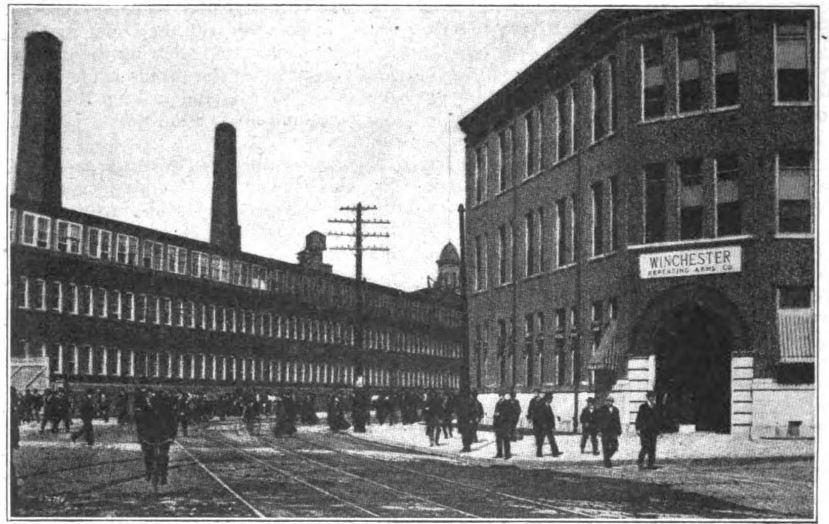
Several spasmodic efforts had been made to organize the Winchester workers, but the union has always been thwarted by the company, immediately discharging those who joined. A few years ago, about thirty men were initiated in a union. The secretary of this union left his satchel down unguarded for a moment. Someone stole it by substituting a similar satchel. The names of the union men were obtained and they were all fired.
The Brotherhood of Machinists tackled the job of organizing all the Winchester workers into one big union with a full knowledge of the handicaps against which it would have to contend. It was realized that in order to be successful the organization must be conducted in such a way as to protect those who identify themselves with it. Hall meetings were out of the question, as no one would dare to attend. The campaign was commenced by holding open air meetings at noon at the shop door. Organizer Walter Eggeman, who started this work, has spoken to large gatherings three and four times a week for several weeks. The crowds listening to him have increased in number, and attentiveness, in spite of the foremen and other stool pigeons of the company mingling in the crowd with note books and pretending to take the names of those in the audience. On several occasions the writer has assisted Bro. Eggeman in addressing meetings at noon and again at night on the Green, which is a large park in the center of New Haven, in the shadow of Yale University.
Thousands of Machinists Bulletins, with special articles dealing with Winchester questions and strongly appealing to the workers to organize, have been circulated. It has not always been easy to give these out as the police sometimes interfered. Then it was necessary to sell them. This was done occasionally by passing pennies out to the workers who then purchased bulletins with them.
A large two-sided banner bearing a target on each side has played a conspicuous part in the agitation. Every morning, noon and night the targets are paraded in front of the shops. The banner is really a work of art and the sentiments it bears always receives a cordial reception from the Winchester wage slaves.
Personal appeals through circular letters and visits from organizers have also been features of the campaign. In fact, every medium by which men can be reached has been utilized. Secrecy is maintained in regard to the identity of the applicants by having them mail their applications to headquarters. This method is to continue until a sufficient number have joined to assure protection to all.
The Winchester Company has been alarmed by the progress made, but its old methods of firing union men will not be successful this time and it is at a loss to discover new tactics by which to hamper the movement.
A New Haven paper published a report of a fake meeting which was supposed to be held by the Brotherhood. Four hundred men were said to have signed their names and pledged themselves to strike if the union was not recognized. Neither the Brotherhood, organizers, proprietor of the hall or anyone else knows anything about this meeting. Organizers Eggeman and Cassile were addressing an open air meeting at the time the fake meeting was reported to have been held. The purpose of the report was undoubtedly to create confusion and distrust. Other equally untrue yarns have appeared in the newspapers by which the company alone could benefit; but as usual it is very difficult to get a word in such papers in regard to the progress made by the union.
The company has much reason to be alarmed because of the headway made in furthering the ideas and principles of industrial unionism. It is a new force with which it must contend. “One Big Union of all Winchester workers,” “a shorter day” “better pay” and “industrial freedom” don’t sound pleasant to those who have become millionaires on the profits of labor. But these words are the inspiration, the hope and the battle cry of freedom for the Winchester wage workers.
The International Socialist Review (ISR) was published monthly in Chicago from 1900 until 1918 by Charles H. Kerr and critically loyal to the Socialist Party of America. It is one of the essential publications in U.S. left history. During the editorship of A.M. Simons it was largely theoretical and moderate. In 1908, Charles H. Kerr took over as editor with strong influence from Mary E Marcy. The magazine became the foremost proponent of the SP’s left wing growing to tens of thousands of subscribers. It remained revolutionary in outlook and anti-militarist during World War One. It liberally used photographs and images, with news, theory, arts and organizing in its pages. It articles, reports and essays are an invaluable record of the U.S. class struggle and the development of Marxism in the decades before the Soviet experience. It was closed down in government repression in 1918.
PDF of full issue: https://www.marxists.org/history/usa/pubs/isr/v13n05-nov-1912-ISR-gog-ocr.pdf
 Revolution's Newsstand