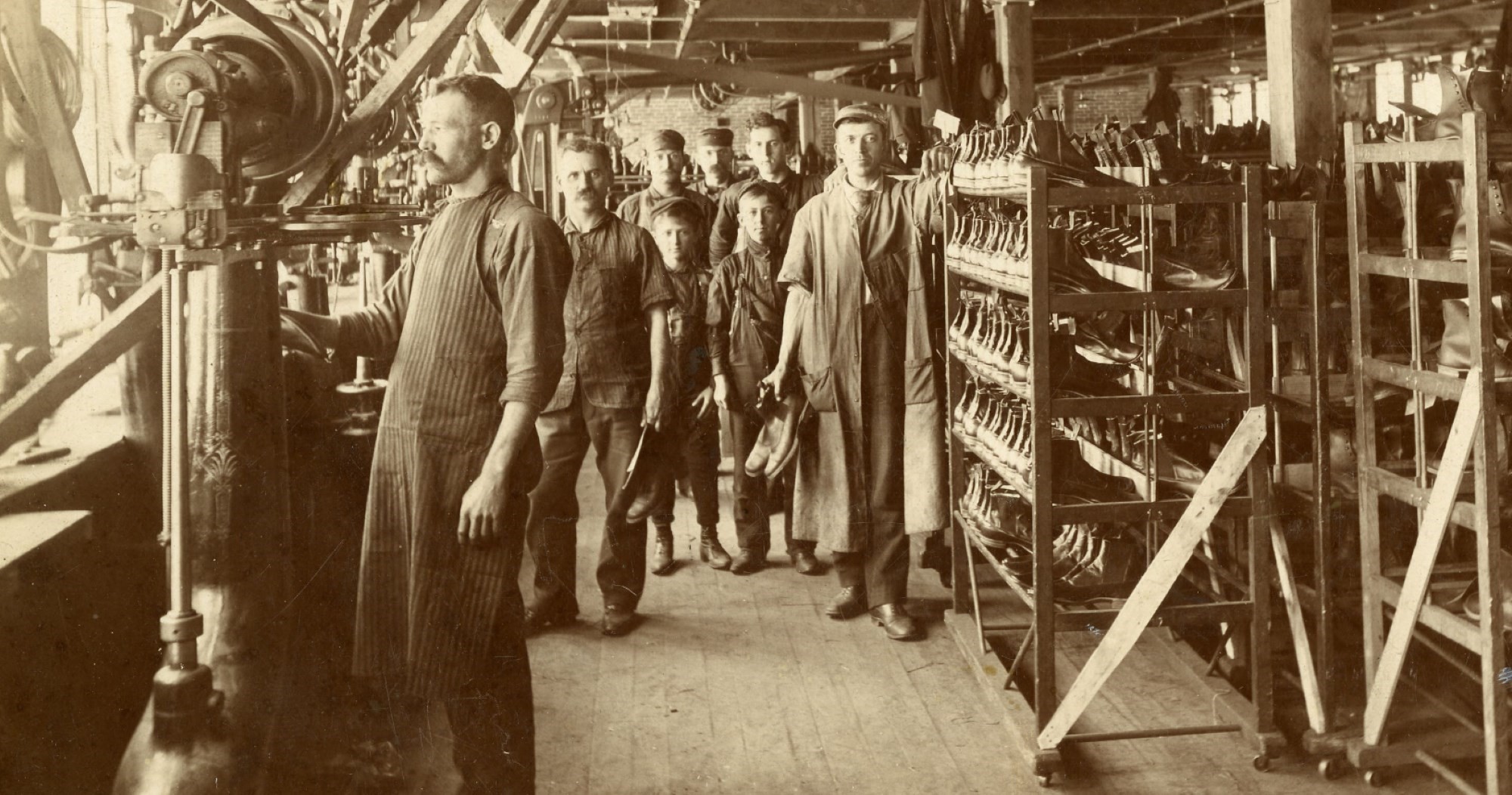
A fascinating look at the industry going back to the 1850s as it changed from handicraft to mass production, along with a detailed history of its unions by a Lynne, Massachusetts worker. Centered in New England, over 250,000 people were employed in the industry when this was written.
‘The Boot and Shoe Worker’ by Shoeworker from The Weekly People. Vol. 13 No. 20. August 15, 1903.
The story of the boot and shoe industry is an interesting one when told in detail, but lack of space forbids such a lengthy narrative at this time. The story here told will be told as briefly as truth will permit, and has to do with the men, methods and organization of the boot and shoe trade, which at this time numbers approximately 250,000 wage slaves engaged in the production of boots and shoes.
For nearly half a century the New England States and New York controlled the boot and shoe industry, but little by little the West has made inroads in that control, until now there are but few States that have not got their “shoe town,” with its accompaniment of shoe workers–tramp and otherwise.
Prior to the ’50s the making of boots and shoes was “hand work” and was a leading occupation in Massachusetts and parts of New Hampshire and in certain cities in New York State. In those days the shoemaker worked at home, or in the old “ten-footer” of that period, where he hired “seat room.” Not only did the shoemaker work at the trade, but in many instances the entire family as well. The women assisted in the fitting of the upper, which was then done by hand, and the boys did odd jobs around the shop: But that day is no more. The hand worker, with his few crude tools and “ten-footer,” has passed away forever. His place has been taken by the modern shoe worker, the appendage of a highly developed tool, working in a mammoth factory, where hundreds, and in many instances thousands of “hands” are employed.
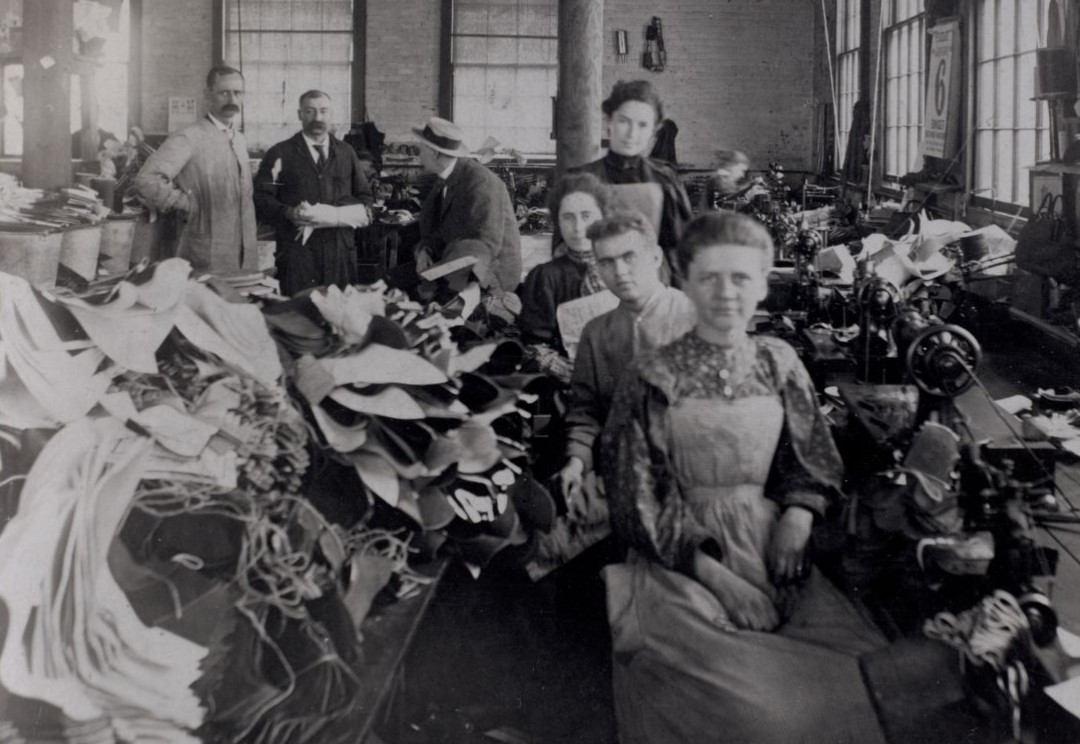
The first machine of importance which was brought into the trade was the sewing machine, the invention of Elias Howe, which was used in the fitting of the upper. Then, in the latter part of the 50s, came the McKay machine for fastening the bottoms on boots and shoes. The advent of these machines was the beginning of the revolution.
The McKay machine was the invention of a North Brookfield, Mass., shoemaker; but, like all other inventions under the capitalist system, which respects (1) private property, it was gobbled up by Gordon McKay, then a “clever,” “pushing,” “industrious” capitalist in embryo, who got control of this invention for a few dollars and became, as result, a multi-millionaire.
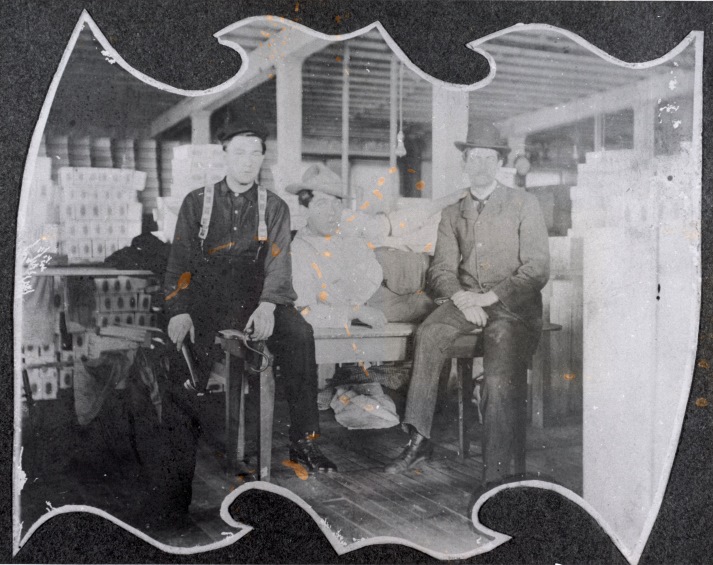
Then came the pegging machine, which was used to peg the soles of boots and shoes. For a long time after its invention, the McKay system of fastening the soles of boots and shoes was the leading method for making “sewed work,” as it was called in those days.
Next came the Goodyear turn and welt system, which put the McKay machine in the shade. With these and the standard screw machine, which was another invention gobbled up by McKay, who had by this time became wealthy, the sole-fastening department will be dropped.
The invention of the Bussiel trimmer, and the heel trimmer, the Union and other edge-setting machines, the McKay and, later, the National nailer, the power buffer and power machinery for finishing bottoms, with an endless chain of machinery for stitching the uppers, completed the revolution from the hand to the machine method, until today there is scarcely an operation that a boot or shoe goes through but what the work is done by the machine; which, needless to say, has eliminated most of the skill required of the hand workman, who did all these parts alone.
The Civil War and the impetus which machinery gave it caused the boot and shoe industry to move to the front ranks at a rapid rate, until today it is the means whereby nearly 250,000 persons earn their bread and the bread of those dependent upon them; and that portion of the capitalist class who own the tools by which boots and shoes are produced wax fat and export to other lands thousands of pairs of boots and shoes, while those who produce them go about on their “uppers,” constantly on the edge of poverty.
So much for the development of the industry itself. Now a few words on organization of this army of workers, past and present.
During the ’50s, especially during the panic of ’57, the despotism of the “shoe bosses,” as they were then called, caused the founding of the first trade organization amongst the shoemakers of any importance. In 1858, following a great trike of the journeymen in Lynn, the strikers held a mass meeting in Central Square, that city, which resulted in the founding of the Journeymen Cordwainers’ Association.
The cordwainers was a short-lived affair, and in the early ’60s Newton Daniels, a Milford, Mass., boot treer, founded the Knights of St. Crispin, which was in its day a powerful organization for good; but, being built on the pure and simple, or British idea, while it for a time did organize those who worked at the trade, it also organized the forces of its own destruction. Dissention finally crept into its ranks, and it went out with the “crime of 73,” or shortly afterward. While the “Crispins” lived it was the strongest organization the shoemakers had had, and, for that matter, there has not been such a complete organization of the trade since. It pulled the scattered forces together and held them there for some years, raised wages and brought order out of chaos. Those were the days that the “old-timer” loves to dream about and fondly hopes to see again. But he hopes in vain. Never again will the men of the pinchers and awl see these times under capitalism. They will only come when the shoemakers, organized in the Socialist Trade and Labor Alliance and the Socialist Labor Party, marching shoulder to shoulder with all the other toilers of the land, overthrow the robber system of capitalism, with its horde of ignorant, stupid and corrupt labor fakirs, who uphold the present system of robbery of the shoemakers, along with all other workers.
Then will come the glad day that the old Crispin hopes for more than he can hope for, because it is more than he has been taught to ask for; the full product of his labor, not the “living wage” of pure and simple trade unionism, or, worse still, the scabby job that Tobin teaches him to regard as the alpha and the omega of the worker to-day.
After the Knights of St. Crispin went down the shoeworkers remained unorganized for several years, and during those years the “bosses” paid them back with compound interest for all that the Crispins had done. Wages were mercilessly cut and conditions were forced in the shops that made the life of the shoeworker a little hell. Finally, in 1879, the lasters of the City of Lynn met in that city and organized the Lasters’ Protective Union of New England, which later became a national organization.
About this time the Knights of Labor came along, and between the two, the L.P.U. and the K. of L., the shoeworkers were again pulled together, but not so thoroughly as in the days of the Crispins. The lasting of boots and shoes at this time was hard work, and the L.P.U. worked with might and main and built a powerful union throughout New England and raised the wages of the lasters, which had been horribly slaughtered between. ’73 and 79, and last, but not lease, made Edward L. Daley, now one of Tobin’s lieutenants and a former appointee of Grover Cleveland, its general secretary. The L.P.U. was also the training school of another labor lieutenant, Edward F. McSweeney, who was at one time its national president.
The way the L.P.U. went about things angered the bosses, and many a stubborn strike was fought with the union usually the winner, as it controlled about all the lasters who worked at the trade, and there was no machine to do the work. This latter element, the machine, or the absence of it, to speak properly, caused the head of many a laster to swell to abnormal proportions. “You cannot get a machine to last shoes,” the old-time laster would say.
But the machine came, and as a result the L.P.U. went on the rocks. It tried the impossible–it tried to prevent the introduction of one kind and all kinds of machines by keeping the members of the L.P.U. from working on them, with the inevitable result. Finally the machine companies made some sort of a compromise agreement, which had the effect of splitting the union. One set, those who had got jobs on the machines, stood for the company; the other element, who were left out, usually the fighters, were against it. This move completed the wreck of the once powerful L.P.U.
During these years the K. of L. was arriving at the end of its tether by different methods. While it once held out to the shoeworkers a hope for the future, when it was making some attempt to follow the teachings of its founder, Uriah S. Stephens, this hope soon faded, and in its place came a horde of labor skates, such as the “Father of the Labor Movement,” George E. McNeil; the “Globe Trotter,” Albert E. Carlton, now holding a fat political job for his treachery to the workers; Frank K. Foster, slicker fakir than whom never existed; Charles H. Litchman, who landed a political job on the strength of his position, and many others whom the writer does not call to mind at this time.
This bunch of grafters put the K. of L. on the ways, and it soon slid down and out. While it lasted it was used by every buckeye grocer and cockroach capitalist who wanted to feather his nest, plus the politicians who used it politically, until to-day all that is left hereabouts of that once powerful organization among the shoeworkers is the Cutters’ Assembly, No. 3662, which is now, fighting the Lynn strike against Tobin and his Boot & Shoe Workers’ Union. In 1889, Harry J. Skiffington, who had faked the K. of L. until it was no longer workable, broke away from it and started the International Boot & Shoe Workers’ Union, which was a scab-furnishing agency with Skiffington as benefactor-in-chief.
There were now three national warring organizations of pure and simplers in the field–the L.P.U., which controlled the lasters, the K. of L., and the International. Each of them had a hatred for the other, and all of them “did” the others whenever the chance was offered. Their conduct was so bad, and the rank and file of each of them suffered so much, that finally there was elected out of the three bodies a joint label committee to take charge of the three stamps then in vogue, and to make some arrangement for one label to be indorsed by them all. In short, they had fought so long that they were looking for “harmony,” and the committee had it, as its business, to see that they did not get it.
Then came the great Haverhill strike of ‘95, which lasted for over three months, and which affected about 4,000 shoe workers, and tied up eight of the largest shops in the city. Haverhill was the first to fall into the maw of Skifington’s International. For a long time he and his local lieutenants ruled the roost, in the land of the “armory builder.”
The International was organized in Dover, N.H., in February, 1889, and shortly after, owing to a lockout in that city, Skiffington organized Haverhill and held it until 1892, or early in 1803, when he landed a job in the Immigration Office, with headquarters in Boston. It might be well to add that it was, about the same time that the same, Grover Cleveland who appointed this labor fakir to this sinecure, and who also sent the federal troops to murder the Pullman strikers, appointed two others from the Lasters’ Protective Union, viz., Edward F. McSweeny and Edward L. Daley, to similar positions.
But to get back on the rail again: The shoeworkers of Haverhill deserted the International shortly after “Skiff” got his job from the capitalist class. John D. Dullea, who succeeded Skiffington, was not the oleagineous blatherskite of his predecessor, and while he would have faked them as bad and as long as any of this gang had, he lacked the blarney to hold them in line, especially in the panicky year of ’93. The result was that one after another the locals fell behind in their per capita tax. Dullea missed his meal tickets, because Haverhill was about all there was left of the International, the unions stood suspended, the bosses cut wages right and left, until the workers were reduced to a mere lot of coolies.
Contract systems were introduced in some of the shops to bind them. The present secretary of the Navy, Moody, who is a Haverhillian, was counsel for the firm of Chick Bros., who first introduced the contract system, and Moody was the legal light employed to turn the trick. To pay him for the suffering which he caused them, the workers after the strike of ’95 rewarded him by electing him to Congress.
This was the condition of affairs when the strike took place in ’95. For nearly four months of winter weather the shoeworkers battled for better conditions, only to have their strike run into the ground by an ignorant labor skate and muddlehead named Pomeroy, who was their leader. While the strike was on, Dullea, who was filled with a spirit of hate for the Haverhill shoeworkers, because of their having failed to furnish him with a living, did what he could to prevent the remaining locals of the International in Brockton and elsewhere from sending any money to Haverhill, and that put the International on the rocks forever.
The joint label committee of the International, K. of L. and the L.P.U., learning that a call was soon to come from Haverhill for a convention to “organize” the shoeworkers of the United States and Canada, took the bull by the horns and headed the, move off by issuing a call themselves to the K. of L., the L.P.U. and the International, and such local bodies as desired to send delegates to a convention, to be held in Boston in April, ’95, to form a national trade union of the shoeworkers of the land. One hundred and thirty-five delegates responded, and the result was the formation of the Boot Shoe Workers’ Union. This move put the International, the L.P.U. and the K. of L., except I.A. 3662 (Cutters’ Assembly of Lynn), out of business.
When the Boot & Shoe Workers’ Union was organized it was an honest attempt on the part of the workers to better their conditions. But honest attempts minus knowledge of class interests availeth nothing but more trouble.
The shoeworkers were tired of the gang of sharks who had lived on them so long, and they refused to place them in control again. There were present as delegates a large number of S.L.P. men who were then going through the muddleheaded period of “boring from within.” They wanted a Socialist at the head of the new union.

James F. Carey, then a member of the S.L.P., now, an armory building kangaroo, was the man slated to wear the mantle, but he refused and told the writer that he would have none of it, that it was a pure and simple body and was bound to go on the rocks, and when that day came the Socialists would be blamed for whatever happened. The second choice was John F. Tobin, who was elected. Tobin was then a member of Section Rochester, N.Y., and at that time was an honest, clear-headed, hard-working Socialist, away head of most of the delegates in point of knowledge of the economic and political movement. Great things were expected of him. What he did we shall see later. Tobin had for a side partner Horace M. Eaton, who was elected general secretary. Eaton was a cunning knave, a mixture of freak and fraud, with the fraud as his long suite. He was a Democrat and a populist as Eaton was best served by it, and always insisted when talking to an S.L.P. man that he was “coming our way.” We saw him first and he never arrived. He is in transit yet, so far as we know.
The boot and shoe workers under Tobin and Eaton started in to organize the shoe workers, and succeeded in setting up a fairly strong movement in Brockton, Marlboro, Haverhill, and some other places. While it attempted to be at all honest the Boot and Shoe Workers’ Union’s growth was slow, hard luck was its lot. In 1898 came the big strikes of Brockton and Marlboro, which were complete failures, so much so, that Marlboro has remained from that day until now totally unorganized. The Marlboro workers fought hard and lost, and throughout were treated contemptuously. The general office gave. them $150 strike benefit for an all winter’s fight, while Tobin and Eaton took nearly $4,000 salary and expenses for that year.
The cunning eye of Eaton perceived in these failures the death of the B. & S. W.’s U., and together with Tobin he began to scheme to save their jobs, and, as a result, the present constitution drafted by them was snapped on the Rochester, N.Y., convention of 1899. The convention stood for the administration and as the new constitution was forced down the throats of the members. Then began the rascality of this pair of labor fakirs in good shape. The old constitution demanded ten cents a week dues, the new one twenty-five tents, and section No. 52 makes it unconstitutional for any future convention “to seek to lower the amount charged for dues in this section.”
This was only one of the many fakes. which the new constitution contained. A contract was made to govern the use. of the union stamp, which plainly makes the B. & S. W.’s U. a scab furnishing agency, and places the workers in the hands of the fakirs, as Tobin can, under its provisions, cause the discharge of any one who is objectionable to him for any cause.
What the stamp means to the workers can be best understood when I quote from a circular letter sent out by Tobin to the bosses August 30, 1902. In this circular appears this paragraph:
“We stand ready to take your fac tory at the existing scale of wages, issue the union stamp under an arbitration contract which absolutely protects you against a labor dispute, or a stoppage of work, and protects you from being required to pay above the market rate of wages.”
With this as their slogan, Tobin and Eaton started in, aided by the capitalist class, or, at least, that portion of it which is engaged in fleecing the shoe workers, to blackmail the men, women and children who make shoes, and they have met with extraordinary success. In Haverhill and Brockton they have been assisted by the kangaroo socialist party, who attempted to do the same in Lynn, but a strong S.T. & L.A. local and S.L.P. section put the kangs on the run.
In order to round-up the dupes, Tobin drew around him some of the most notorious labor skates, and all-round crooks imaginable. Here are some of them: Fred. G.R. Gordon, the U.S. mail robber; Jerry Donavan, of Haverhill, a double for Pat Dolan, of the miners, with all of Pat’s vices and none of his virtues; in short a low down, ignorant, stupid fakir and brow-beater of the rank and file; Frank A. Sieverman, of Rochester, N.Y., the “hot-air” kangaroo who “nobly wages the class struggle” under the alias of “Pull Down No. 19” for $90 per month and expenses, which is more than his salary, according to the report blanks of the B. & S. W.’s U; then there is “Christian Socialist” Gad Martindale, of Rochester, N.Y., and many others, to say nothing about the retinue of horse thieves and prison graduates used to break strikes here and elsewhere.
After the Rochester convention in 1899 the Haverhill shoeworkers broke away from Tohin and formed an independent union, which in turn was driven or sold back to Tobin by Jerry Donavan, who was its walking delegate. Donavan had been the walking delegate of the shoemakers of Haverhill since Pomeroy was turned down after the collapse of the strike of 1895. He had held the job when the workers were in the B. & S. W.’s U., and when the Haverhillians kicked Tobinism into a cocked hat, when Eaton, and his, at this time, kangaroo superior, Tobin, saw where they were at they used Donavan, who is thoroughly unscrupulous, to turn the trick, and the trick was for Donavan to go with the workers, and later steer them back again, which he did when several manufacturers applied for the stamp. Tobin refused the stamp unless the men became members of the B. & S. W.’s U. The Independents relented, permitted its members to go. over to Tobin, with the result that in a few short months the camp of the Independent was split into halves.
When the Independents found out where they were at it was too late. Then the B. & S. W.’s U. granted wage reductions to the bosses in shops which had taken the stamp, thus violating bills of wages which had been posted by the Independents.
The same was true of Lynn and many other places, but not to such a degree. as in Haverhill.
Finally the time came when, thanks to the agitation carried on in both Haverhill and Lynn by the Socialist Trade and Labor Alliance, and the Socialist Labor Party, many of the workers in both cities went on strike against Tobinism and that strike is still on, and it looks as though the genial John, to use a forcible, though somewhat in elegant expression, was “all in” so far as these cities are concerned. The Brockton bosses, so rumor says, will get rid of him ere long owing to the fact that the men have in some instances in that city refused to be cut down via the union.
What is true of the East is true all over the land, so far as the shoemakers are concerned. Everywhere pure and simple trade unionism has brought the same sad luck and instead of learning from experience the poor dupes have gone from one pure and simple body to another, each one worse than its predecessor, until the shoe workers who were once amongst the most intelligent of the working class, are now, down to the bottom, the spirit of resistance to oppression has been broken, and the height of the ambition of the average shoeworker to-day is to get a job no matter how.
The wage which they once received has dwindled down to a mere shadow of what it once was. A large army of shoeworkers now help to make up the unemployed of the nation, the tramp shoeworker is the rule now rather than the exception.
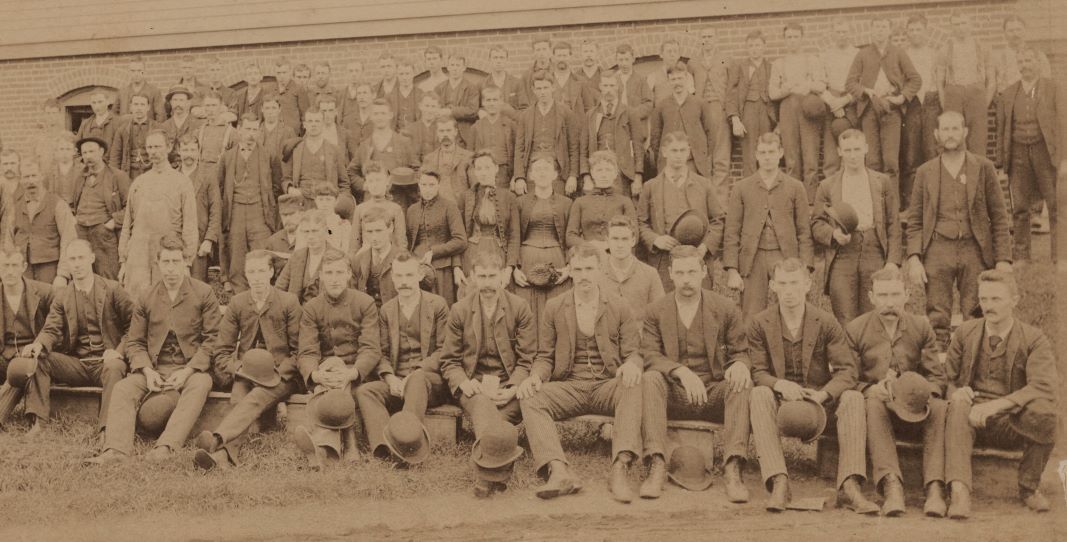
The only hope of shoeworkers is in the Socialist Trade and Labor Alliance, and the Socialist Labor Party. There, and there alone can they find a cure for their ills. Only when the men and women of the shoe trade say to the labor fakirs, and the capitalist class, that employs them, “Thus far have you gone but no farther, stand and deliver,” will the end come to their wanderings. Little by little the light is breaking, the Socialist Trade and Labor Alliance and the Socialist Labor Party teaching is being brought home to them; which with the antics of the fakirs in the past and the great army of unemployed workers, together with the steady concentration of the industry, must soon open their eyes.
If it don’t the fakirs will continue. to open their pockets, and in the end the capitalist class will open their skulls for the shoeworkers will revolt, they must, or go down to the level of Chinese coolies, or Sicilian brimstone miners.
If they make them revolt along the intelligent lines of the S.L.P. then all is well, and the hopes cherished by the old-timer, who hopes to see the men of the craft back again on easy street, will be realized. But if they do not theirs is the loss, and they will suffer in slavery for their ignorance, and the crimes of their fakir leaders against the working class.
This is the story of the shoe trade told by a wage slave, who has spent nearly a quarter of a century in the harness, who has come down through from the pure and simple union, and who now asks of his fellow craftsmen that they heed the writing on the wall and stand from under.
Fellow craftsmen put an end to the robbing practiced upon you by the labor, fakirs and capitalists alike, by standing like men with the rest of your down-trodden, disinherited class, in the ranks of the Socialist Trade and Labor Alliance, and the Socialist Labor Party. Fight the boss in the shop, and vote him out of power on election day. Stop scabbing it on yourselves.
Lynn, Mass.
A Shoeworker.
New York Labor News Company was the publishing house of the Socialist Labor Party and their paper The People. The People was the official paper of the Socialist Labor Party of America (SLP), established in New York City in 1891 as a weekly. The New York SLP, and The People, were dominated Daniel De Leon and his supporters, the dominant ideological leader of the SLP from the 1890s until the time of his death. The People became a daily in 1900. It’s first editor was the French socialist Lucien Sanial who was quickly replaced by De Leon who held the position until his death in 1914. Morris Hillquit and Henry Slobodin, future leaders of the Socialist Party of America were writers before their split from the SLP in 1899. For a while there were two SLPs and two Peoples, requiring a legal case to determine ownership. Eventual the anti-De Leonist produced what would become the New York Call and became the Social Democratic, later Socialist, Party. The De Leonist The People continued publishing until 2008.
PDF of full issue: https://www.marxists.org/history/usa/pubs/the-people-slp/030815-weeklypeople-v13n20.pdf
 Revolution's Newsstand