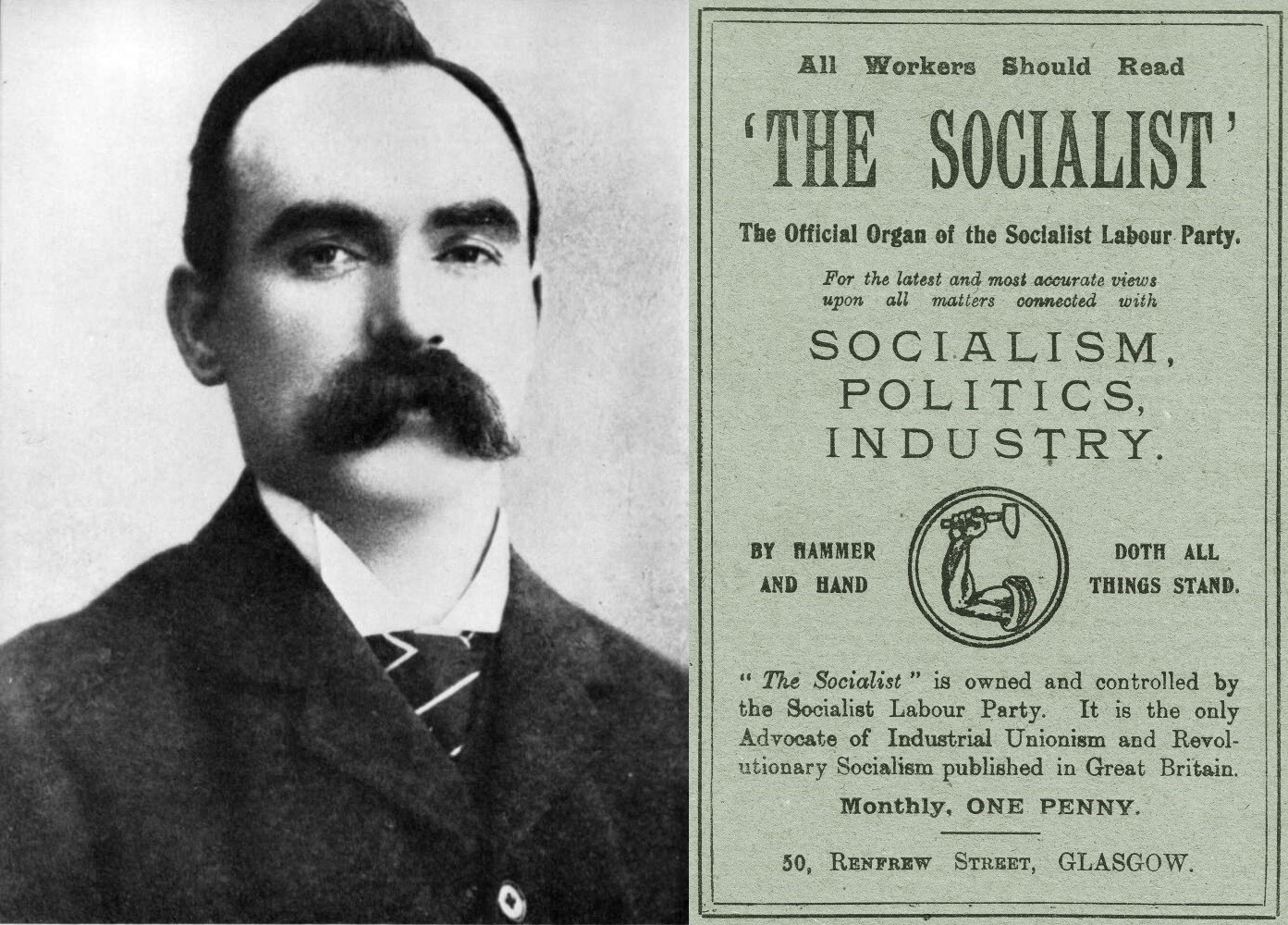
After his resignation from the Irish Socialist Republican Party in February, 1903 Connolly went on a speaking tour of Scotland for the Social Democratic Federation, where a left split soon created the British Socialist Labour Party. Immediately on arriving in the United States, this time to live, in October, 1903 he gave this interview with the S.L.P.’s Weekly People on the origins and prospects of the new party.
‘The British Socialist Labor Party’ by James Connolly from The Weekly People. Vol. 13 No. 29. October 17, 1903.
The organization of a class conscious Socialist movement in Great Britain having excited considerable interest among Socialists here, a Daily People reporter interviewed James Connolly upon the future prospects of the new movement. Comrade Connolly, as our readers know, is just over from the old country, where he was in close touch with the upheaval in the S.D.F. that resulted in the organization of the British S.L.P.
“What is your opinion upon the present position and future prospects of the S.L.P. of Great Britain? Do you not think that it will have an uphill fight, owing to the field having been so long pre-empted by the trades unions?” was the first question asked.
“On the first point there is no doubt that the S.L.P. will have a hard fight. But not a fight to maintain its position as a Socialist party. Owing to the fact that all its branches had formerly been branches of the S.D.F., and that when they resolved to leave that decaying organization they were able in every instance to hold the club rooms and party premises in their respective districts, the new party starts with at least a local status everywhere.
“On the second point there is no doubt but that the British S.L.P. will have a stiff struggle with those parties already in the field and which claim to represent labor. Since the new interpretation given to the Conspiracy Laws by the famous, or rather infamous, Taff Vale Railway ease in England, and the case of Quinn versus Leatham in Belfast, Ireland, the trades unions are in danger of being crushed by the heavy penalties awarded against them in the law courts. The law declares now that the union has a right to call its members out on strike, but it also declares that if by so doing it inflicts any pecuniary damage upon the employer het has a right to sue the union for the loss his business sustained by the strike. If he wins, which is of course almost a foregone conclusion, all the trade union’s funds can be seized to recompense, the employer. As a consequence of this nearly all the important trade unions are now voting large sums to pay the expenses of Parliamentary candidates from their own trades. Their plan is to elect men for the sole purpose of repealing this obnoxious law, and thus place the unions on a more satisfactory footing?”
“Are these candidates Socialists?”
“No! And as a rule they don’t even claim to be. They are for the most part Liberals. Some are Socialists of the stripe of George Barnes of the Amalgamated Society of Engineers, who on May 16 of this year declared in an electioneering speech at Glasgow that he did not mean ‘to set class against class,’ or people against employers of labor.”
“What attitude does the S.L.P. take toward this movement?”
“An attitude of criticism and exposure. It criticises the action of the movement in limiting its scope to the alteration of a single law, and it exposes the sophistries and crooked actions of the leaders and spokesmen which a wrongly founded movement naturally produces.”
“Will the S.L.P. run candidates against those of the trades unions you have just mentioned?”
“It would, if it had money enough to put up candidates. It will run candidates in the municipal elections where the official election expenses are paid out of the rates, but, I am afraid, that for sometime yet it cannot do so in a parliamentary election, the official expenses of which must be paid by the candidate. These expenses are very heavy, varying in proportion to the size of the constituency. Thus in a recent election in Lanarkshire, Scotland, the expense of the labor candidate amounted in all to $4,000. Thus you will see it is not possible to be a candidate for parliament unless backed by a very wealthy party, or unless the candidate is a wealthy man.
“This makes election there prohibitive to a working class organization whose members are poor, although nominally every adult is entitled to stand as a candidate. That is one of the reasons for the proneness of the S.D.F. and the I.L.P. to wobble. They know the more they wobble the easier it will be to get money from rich and sentimental friends of the working class.”
“That brings us to another question: What do you think the S.D.F. is likely to do in the future!”
“Well the chief desire of its leaders is to unite with the I.L.P. They have been frightened by the big vote of the latter party and can think of nothing but running into its arms. On the other hand, the chiefs of the I.L.P. do not want to unite, and lose no opportunity of insulting and kicking the S.D.F. Keir Hardie wants no mouthers of revolutionary phrases in his show; that would spoil his game and alienate the support of his wealthy sympathizers. Besides Hardie has a healthy contempt for Hyndman and his pets, and doesn’t propose to help them cover their failure with the S.D.F. by merging themselves in his ranks.”
“By the way, you mentioned that the S.L.P. would likely run candidates at municipal elections. Is it possible to accomplish much for Socialism in such elections in Great Britain, even if successful at the polls!”
“In my opinion a great deal cannot be accomplished in a municipal direction anywhere. We require primarily to capture the powers of National Government. In Great Britain the municipalities are nothing more than administrative bodies. They have no power to grant franchises or to tax, except when permission is specially obtained by express Act of Parliament for each object.”
“Then little can be done in a municipal election except in the way of propaganda!”
“That is true, and the Socialist Labor Party of Great Britain is quite clear upon that point.”
Comrade Connolly said that the literature and the tactics of the S.L.P. of the United States and Canada are an inspiration and guide to the S.L.P. of Great Britain.
He explained the recent increase in emigration from Ireland as due to the bad crops. Those who could scrape up money to pay their fare here, or who could get assistance from relatives here, were leaving the county. Connolly described as heart-rending the scenes attendant on the departure of the emigrant trains to the seaports. Aged parents have to be torn from sons and daughters whom they are likely never to see again. He predicts that famine conditions will afflict Ireland this winter.
Industrial conditions in England and Scotland are in bad shape, and many are leaving their native land. Canadian promoters have been taking advantage of this state of affairs to push colony schemes. Thousands of Scottish people have been induced, by their glowing ne counts, to emigrate to Canada, only to find themselves turned loose in a veritable wilderness.
The business of securing strike breakers has become an international affair. Connolly told the reporter of an agent who gathered up two hundred moulders in Scotland, on the promise that good jobs at big wages awaited them in Canada where men were scarce. The men were told that they were to go to Winnipeg, but they were whisked into Tor onto where a strike was on. When these men learned the purpose for which they were brought over, though they were penniless and strangers in the land, not a man of them would take a striker’s job. The heart of the working class is all right. The trouble is, that capitalist tool–the labor fakir has control of its mind. Speed the day, when class conscious Socialists the world over will have destroyed the power of the labor fakir, whose mission it is to keep the workers in superstition and ignorance.
New York Labor News Company was the publishing house of the Socialist Labor Party and their paper The People. The People was the official paper of the Socialist Labor Party of America (SLP), established in New York City in 1891 as a weekly. The New York SLP, and The People, were dominated Daniel De Leon and his supporters, the dominant ideological leader of the SLP from the 1890s until the time of his death. The People became a daily in 1900. It’s first editor was the French socialist Lucien Sanial who was quickly replaced by De Leon who held the position until his death in 1914. Morris Hillquit and Henry Slobodin, future leaders of the Socialist Party of America were writers before their split from the SLP in 1899. For a while there were two SLPs and two Peoples, requiring a legal case to determine ownership. Eventual the anti-De Leonist produced what would become the New York Call and became the Social Democratic, later Socialist, Party. The De Leonist The People continued publishing until 2008.
PDF of full issue: https://www.marxists.org/history/usa/pubs/the-people-slp/031017-weeklypeople-v13n29.pdf
 Revolution's Newsstand