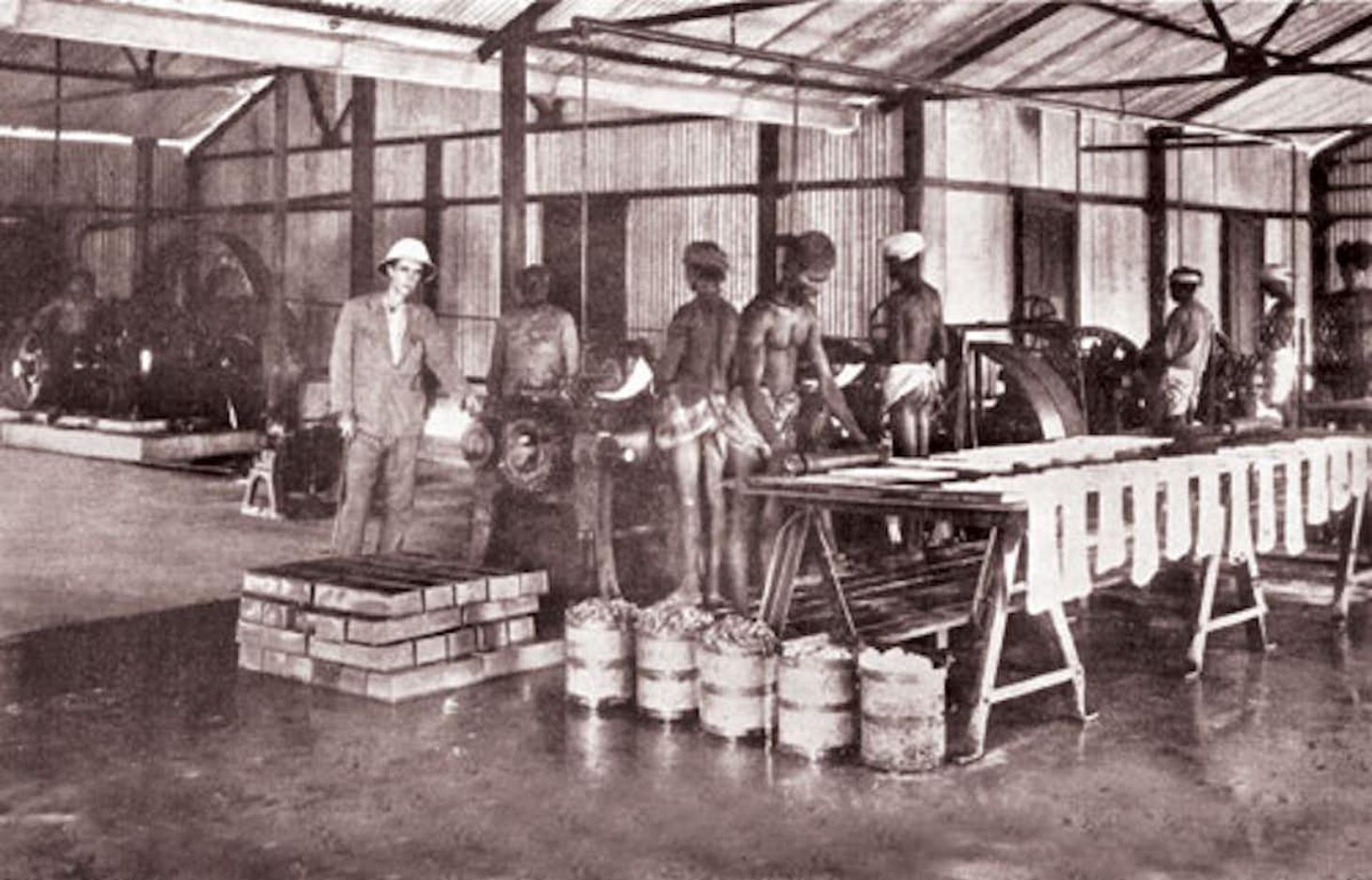
From a report to a conference of the Profintern’s Pan-Pacific section.
‘Malay Labor Steps Onto the World Arena’ from Pan-Pacific Monthly (San Francisco). No. 33. January, 1930.
(Extracts from the Reports of Delegates from Sumatra, Java, and from the Nanyang Federation of Labor of the Malay Peninsula, at the “Second Section” of the P.P.T.U. Conference, Shanghai, given in the First Day of the Conference, following the Report of the Secretariat).
IN the course of the reports, the delegates, by their discussion of the changed economic situation since the World War, proved how closely they study world capitalism, and thus refute the slander of imperialism as to the alleged “backward” nature of the Malayan toilers. Both the delegates from Sumatra and Java related how:
“British and Dutch imperialists are co-operating very closely in their efforts to maintain their exploiting positions in Malay, for not only do these two powers invade Java, Sumatra, etc., but Japan, America and France are also attempting to increase their exploitation in these Islands and the Malay Peninsular.
“The hostility between the groups contending for powers in our countries becomes greater, but everyone suppresses the masses and their trade unions and proletarian parties. They have deported the militant leaders of the workers’ organizations to unpopulated Islands since the rebellion in Indonesia in 1926, and, anyone who may attempt a visit to their deported friends are never allowed to return.
“In Sumatra the Anti-Imperialist League plays a big role among the peasantry, but the suppression of the trade unions makes it difficult to struggle even for better conditions.
“Dutch imperialists are sending reformists to our countries to fight against militant trade unionism, and while they are doing some damage to the trade union movement, they cannot succeed because the masses are still under the influence of the Proletarian Party.”
A most interesting contribution came from a delegate of the Nanyang Federation of Labor from Malay Peninsula. We give his statement verbatim:
“The terrible conditions inflicted by the British imperialists are almost beyond description. The economic depression which has hit the mining and rubber industries only intensifies the horrible conditions which have always existed in the Peninsula. It was these awful conditions and the influence of the Chinese Revolution that caused the workers to organize the Nanyang Federation of Labor in 1926.
“We have only been able to hold our annual congresses in 1926 and 1927. The British oppression was too great in 1928 and now they have forced us into an illegal existence by their terroristic tactics.
“The British have imported many reformist trade unionists who hold positions constructing the new naval base. They are using them to undermine our membership in Singapore by doing reformist propaganda among the workers. But the conditions are too bad. for their reformist ideology to have any effect.
BRITISH WORKERS! TAKE NOTE!
“We must do propaganda among the workers in imperialist countries. They must be told that British imperialism desperately tries to hold its position of world dominance, as all other imperialists do, by intensifying the exploitation of the colonial peoples. The larger the volume of wealth extracted by cheap labor in the colonies the more easy it is for British imperialists to pay their debts and cover their trade deficits.
“Without this exploitation British imperialism would be ended quickly. The masses of Britain must be brought into close cooperation with colonial workers, so they can jointly deliver themselves from imperialist exploitation. We will do our share in face of great oppression. What we need is a united front of all nationalities, for we are ill-treated not only by one group of exploiters, but by all their allies both native and foreign.
“The Chinese employers at Singapore have formed a branch of the Canton Mechanics Union (a fascist organization) which uses threats of violence if the workers strike, but we have struck and increased wages in some instances in spite of our illegal position. The P.P.T.U.S. must assist us to make our Federation the leading mass organization in Nanyang (Malaya); we must extend our organization among the seamen, miners, rubber, railway and dock workers. We realize the importance of the mining and rubber industries which are Government (British) owned. Therefore a strike in these industries is a strike against the Government (imperialism). In this way we shall fight imperialism and its reformist allies. We made propaganda against both on May 1 and protested against the imperialists sending reformists to Nanyang.
THE P.P.T.U.S. MUST HELP
“But there are many nationalities among the workers of Nanyang. We have already drafted a program of demands, but the P.P. T.U.S. must help us to perfect this program. The time has arrived to form committees of action, to call united front conferences, including all nationalities.
“Our difficulty is to find efficient organizers; therefore the P.P.T.U.S. must arrange to send workers from imperialist countries to help us. We must send workers from India to work among the indentured Indian labor, who are most difficult to organize, and who only receive 40 Malay cents a day. This is the only way to fight imperialism.”
Comment is unnecessary regarding the above. It is clearly shown how imperialism works to deepen its exploitation and the statement proves this worker knows how to deal with it. Another Singapore delegate stated that he thought every worker knew that British imperialism in Malay Peninsula was the real enemy and the class consciousness of the masses was rising. “We must realize,” he said, “that without the overthrow of imperialism, colonial peoples cannot become free, so this should be our objective.”
The Pan-Pacific Monthly was the official organ of the Pan-Pacific Trade Union Secretariat (PPTUS), a subdivision of the Red International of Labor Unions, or Profitern. Established first in China in May 1927, the PPTUS had to move its offices, and the production of the Monthly to San Francisco after the fall of the Shanghai Commune in 1927. Earl Browder was an early Secretary of tge PPTUS, having been in China during its establishment. Harrison George was the editor of the Monthly. Constituents of the PPTUC included the Australian Council of Trade Unions, the All-China Federation of Trade Unions, the Indonesian Labor Federation, the Japanese Trade Union Council, the National Minority Movement (UK Colonies), the Confédération Générale du Travail Unitaire (French Colonies), the Korean Workers and Peasants Federation, the Philippine Labor Congress, the National Confederation of Farm Laborers and Tenants of the Philippines, the All-Union Central Council of Trade Unions of the Soviet Union, and the Trade Union Educational League of the U.S. With only two international conferences, the second in 1929, the PPTUS never took off as a force capable of coordinating trade union activity in the Pacific Basis, as was its charge. However, despite its short run, the Monthly is an invaluable English-language resource on a crucial period in the Communist movement in the Pacific, the beginnings of the ‘Third Period.’
PDF of full issue: http://fau.digital.flvc.org/islandora/object/fau%3A32145/datastream/OBJ/download/The_Pan-Pacific_Monthly_No__33.pdf
 Revolution's Newsstand