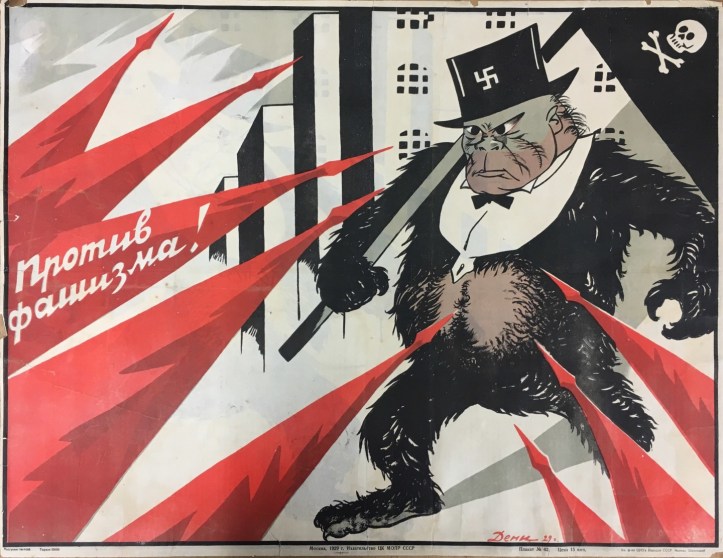
A discussion of which needs to be back on the agenda today. Resolution from the Proftinern’s 4th World Congress in 1928.
‘Measures for Fighting Fascism in the Trade Union Movement’ from Report of the Fourth Congress of the Red International of Labor Unions, 1928.
(Thesis Adopted on the Reports of Comrades Mounnrousseau, Redens, Dmitrow).
I. Roots and Character of Fascism.
1. Fascism represents a special system of the class domination of the bourgeoisie in the epoch of imperialism and Social Revolution. After the imperialist war, after the victorious October Revolution, and after the consolidation of the Soviet Union, and with the tremendous revolutionising influence of all these factors on the proletariat, on the peasant masses, and on the oppressed nationalities and colonial peoples, the bourgeoisie is finding it more and more difficult to hold the masses of the people under its class hegemony, and is not in a position to solve the problem of the stabilisation of capitalist economy with the help of the old forms and methods of parliamentary democracy.
These conditions determine the peculiar character of Fascism in various countries. In some countries (Italy, Poland), the Fascist dictatorship is being established by means of the direct utilisation of the movement of the dissatisfied: the petty bourgeoisie and certain strata of the peasantry; whilst in other countries (Bulgaria, Spain, Portugal, Lithuania), it is being established by revolts of the bourgeoisie and against the resistance of the masses, the bourgeoisie being supported by the armed force of the country and receiving the financial support of banking capital. On the other hand, in some countries, Fascism is being applied as a means of struggle for the prevention of the revolutionisation of the labour movement (Britian, France, Belgium, America). It is being organised, armed, and is gathering its forces for a determined attack, under the patronage and with the fullest assistance of the government authorities (Austria, Czecho-Slovakia, Yugoslavia, Rumania). In other countries, it is being applied as an open weapon of counter-revolution in the period of the extreme sharpening of the revolutionary struggle (Germany in 1923, China), or as a means of consolidating the tottering positions of the bourgeoisie after the temporary victory of the proletarian revolution (Hungary), and so on.
2. For the class movement of the proletariat of all countries, Fascism is a constant and growing danger. To underestimate the forces of the Fascist dictatorship and deny the possibility of the establishment of Fascism in the big capitalist countries is likely to weaken the vigilance and resistance of the proletariat towards Fascism, and to further the temporary strengthening of the Fascist dictatorship wherever it already exists, and permit its establishment where it is not yet the State form of authority.
II. Fascism in the Trade Union Movement.
3. For Fascism, the possession of the trade unions, the destruction of the class Trade Union movement, is a vital necessity.
Just as the dictatorship of the proletariat is unthinkable without a class trade union, so, too, the Fascist dictatorship of the bourgeoisie is impossible without the break-up of the class trade union movement. Fascism terror is directed against any genuine working class movement, and against any economic struggle.
4. In regard to ideology, Fascism mainly makes use of nationalism and chauvinism. It tries to divert the attention of the masses from internal problems to external problems, by holding out the prospects of a betterment in the position of the working class through the conquest of neighbouring regions, territories, by obtaining colonies, etc. Fascism advocates the theory of co-operation between the capitalists and the workers for the stabilisation of capitalism and the rationalisation of production, the theory of class harmony, the “unity of interests” of the various classes, the liquidation of all class struggle, the substitution of compulsory arbitration for strikes, and the transformation of the trade unions into organs of the capitalist State, etc.
5. Fascism is directing its main efforts towards the subjection to its tutelage of the movement of transport workers through police repressions, miners and workers in other key industries, as well as the movement of the employees in the direct employment of the government apparatus. Fascism is also making big efforts to strengthen its influence on the agricultural workers, taking advantage of their cultural backwardness. It is also trying to make every use of the starving unemployed masses, recruiting adherents from their ranks. No less attention is being given by Fascism to the youth, whom it is attracting into its net by means of various sport, military, and other “cultural” organisations.
Trade schools are being utilised by Fascism to train new skilled staffs under Fascist influence, who could be used to replace the main part of the revolutionary proletarian skilled labour in transport and the key industries.
In many countries, in every big undertaking, Fascist reserve officers, Russian white guards, and all sorts of thugs and blackleg elements are being appointed as overseers, watchmen, etc., usually forming armed groups, terrorising the workers and office employees, endeavouring to disorganise and demoralise them, whilst at the same time these undertakings are purged of the best revolutionary proletarian elements; leaving the masses at the point of production without leaders.
6. Whilst doing everything to destroy the existence and hinder the strengthening of the class organisations of the railwaymen, postal and telegraph employees, and other State employees, and miners, and so on, Fascism is also trying to take hold of the leadership of the reformist and yellow organisations in these important fields with the assistance of the reformist and yellow leaders themselves. At the same time, Fascism is putting forth every effort to create its own trade unions, and to subordinate the entire Trade Union movement to its tutelage. Combining the instrument of political and economic terror with the instrument of demagogy, and corruption of the masses, Fascism very frequently shows great ability to manoeuvre and to adapt itself to the specific conditions of each country, each branch of industry, and each category of the proletariat, broadcasting popular slogans and demands for the workers social insurance, State and workers’ control over industry, etc.), and making use of the discontent of the masses with their reformist leaders, it hides behind the slogan of ” no party politics,” and sometimes even heads workers’ strikes; of course, not for the object of carrying them to a successful issue, but for the purpose of bringing about a compromise with the employers through its agency and thus extend its influence over the working masses.
III. Reformism in the Service of Fascism.
7. By their anti-working class policy the reformist Amsterdam bureaucracy is clearing the way for Fascism in the Trade Union movement. By trying to liquidate the last remnants of the ideas and methods of the class struggle in the reformist trade unions, by proclaiming and pursuing the policy of “peace in industry,” and of compulsory arbitration, by helping their capitalist bourgeoisie on the national scale (by means of various “national economic councils”) and on the international scale (League of Nations, the International Labour Office, etc.), in the work of stabilising capitalism and rationalising production, and by sabotaging in every way the struggle of the workers for their everyday interests, this reformist bureaucracy is actually taking up the same stand as Fascists. The line of demarcation between its ideology and the ideology of Fascism is tending to disappear more and more, and the reformist bureaucracy is being transformed into the instrument of Fascism in the Trade Union movement. In destroying trade union democracy, in breaking up the real mass Trade Union organisations by splitting them and expelling militants, in endeavouring to cause a break between the revolutionary elements and the masses inside the trade unions, and by their shameless persecution of Left revolutionary tendencies in the Trade Union movement—in doing all this, the reformist bureaucracy is working on the united front with Fascism.
8. Part of the leaders of the reformist trade unions are already in open and full ideological and political unison with Fascism (Italy, Bulgaria, Hungary, etc.). The other part is on the way to Fascism (Jouhaux, Thomas, Grossman, etc.). The more the masses in the reformist trade unions move to the left and become revolutionised, and the more they resist the treacherous policy of the reformist bureaucracy, the more–in the process of the sharpening of the class struggle–will the leadership of the reformist trade unions move to the right towards Fascism.
By breeding disappointment and distrust in the backward sections of the reformist trade unions, and by corrupting the upper strata of the trade union membership, the reformist leadership in the Trade Union movement is creating a certain foundation for Fascism in the movement.
IV. Struggle with Fascism in the Trade Union Movement.
Against Fascism in the Trade Union movement, and especially against the Fascist unions, a systematic, stubborn, merciless and continuous struggle must be fought everywhere, and in every way. Wherever Fascism has reared its head–in the factories, in offices, in organisations, among the unemployed, etc.–it must be struck at in concrete and business-like fashion. This must be done from the point of view of the workers’ class struggle for liberation, and in accordance with the immediate interests of the workers and office employees, and with the special task of the Trade Union organisations themselves.
An ideological, political and organisational struggle must be conducted simultaneously within the Trade Union movement on the following basic lines:
Firstly, the Fascist ideology must be determinedly opposed by the class revolutionary ideology of the proletariat. We must expose and fight nationalism and chauvinism, the ideas of “international peace” and class harmony, of the theory of the liquidation of the class struggle, and all such manifestations of reformism. We must expose Fascism as the splitter and grave-digger of the trade union movement, the slogan of no party affiliation for the trade unions, which serves as a cover for the Fascists. Exposure of Fascism as the bearer of the seeds of war, and more especially of war against the first proletarian State in the world. Broadest and most constant popularisation among the masses of the programme and tactics of the R.I.L.U.–The International of the class Trade Union movement.
Secondly, organisational consolidation of the class trade unions and the enrolment of the masses of the unorganised workers in their ranks; transference of their organisational basis and the centre of gravity of their activities to the factory and workshop. Creation of illegal Trade Union organisations maintaining connections with the broad working masses and guiding their struggle wherever the existence of the legal class unions is impossible. Strengthening of the class-conscious wing in the reformist, nationalist, autonomous and other unions, while linking it up with the class trade unions for joint work and struggle. Extension and strengthening of the network of general workers’ committees at the point of production, and in offices (shop committees) as the organs of the masses right at the place of their employment, while linking up their work with the class Trade Union movement. Organisation of the unemployed movement, and its co-ordination with the campaigns of the class Trade Union organisations. Organisation of the agricultural proletariat. Extension of work among the civil servants and State employees who are the most liable to yield to Fascist agitation and influence. Enrolment in the ranks of the class trade unions of the vast mass of the working youth and women workers.
Thirdly, mass campaigns and strikes, against the consequences of capitalist rationalisation, for the freedom of the class trade unions, freedom to strike, etc. In this manner we must set the masses against Fascism (and its agent, reformism) in the process of the struggle itself for the workers’ immediate interests and demands, and expose their treacherous bourgeois nature. In this way we can isolate Fascism and the Fascist unions from the proletarian masses.
Fourthly, in the struggle of the workers (during strikes, etc.) the active moral and material support of the rest of the town, and peasant working masses, must be obtained. The united front between the workers and the toiling peasants in the general struggle against the capitalists must be established, thus isolating Fascism from these toiling masses on the basis of the struggle.
Fifthly, organisation of mass self-defence against the Fascist oppressors in the factories (protection of organisations, meetings, strikes, Trade Union officials, etc.). Campaign for hounding Fascist agents, overseers, spies, provocateurs, etc., under the slogan of “clear the factories of the Fascists!”
Sixthly, strengthening of the campaign against the splitting policy of Fascism (and of reformism) from below among the masses in the process of their practical struggle for the class unity of the Trade Union movement, no concessions whatever being allowed to the Amsterdam International or the Fascist unions.
10. Inasmuch as the Fascist unions have succeeded in some countries in grouping workers within their ranks either as the result of repressions and legislative measures of the Fascist dictatorship or in consequence of the lack of class-consciousness, lack of courage, or demoralisation of these workers, the adherents of the R.Í.L.U. must work inside these unions, doing everything to oppose the treacherous Fascist leadership by the struggle for the workers’ daily interests, and to oppose the terror and violence practised by the Fascist leadership by the Trade Union democracy. In this way the internal struggle in the Fascist unions will be rendered more acute, and connections between the Fascists and the masses undermined. But this work must not be undertaken with the object of winning the Fascist unions from inside—a thing utterly nonsensical–but for the purpose of destroying them and liberating the workers in their ranks for enrolment in the class unions (legal or illegal).
11. It is essential to devote particularly serious attention to questions concerned with the unemployed. The employers make use of the dismissal of part of the workers in the factories to create antagonism between different sections of the workers. Constant work must be carried out to overcome this antagonism by establishing and maintaining close connections and developing a closely-cemented solidarity between unemployed and those working short time, and the other workers.
Further, in countries where there are masses of foreign workers, the most energetic work must be carried out against the attempts of the Fascists to foster antagonism between the native and foreign workers, and against the deportation of foreign workers on account of their sympathy with the revolutionary labour movement, this work taking the form of bringing the foreign workers into the class Trade Union movement, strengthening the solidarity between them and the local workers, and by fighting most determinedly in defence of foreign workers, against deportations and various methods of persecution, and exclusive measures.
V. Fascism and the Trade Union Movement in Italy.
12. In Italy the Fascist unions are defined by the law as “State organs of class collaboration.” This definition in itself is quite enough to characterize the Fascist unions as organs of the overlordship of the capitalists over the workers, organs excluding any class struggle, the real and traditional task of every working class trade union.
Owing to the very essence of their bourgeois class character, as well as their forcible methods of organisation, the Fascist unions have not, and cannot have, any deep roots in the working class, and cannot be regarded as proletarian organisations. If the Fascists speak of hundreds of thousands of members in their unions when issuing their official reports, it is, of course, only a matter mainly of simple bureaucratic registration, and by no means of the active participation of the masses in the life of these organisations. The hundreds of thousands of Fascist Trade Union members is for the most part the result of coercion carried out by means of: (a) compulsory membership dues deducted by the employers from the workers’ wages for the membership cards of the Fascist unions; and (b) various direct forms of coercion on the part of the Fascists against the workers (no worker may take up employment if not registered in the Fascist union; arrests, bludgeonings, etc.).
The Fascist unions in Italy display no real trade union life; the vast bulk of their members, or rather booked members, take no part at all in the life of these unions.
The workers do not participate, or do so to a very limited extent, in the meetings called by the Fascist unions. At these meetings, the workers are afforded no opportunity whatever of discussing the problems they are interested in; and, general speaking, these Fascist Trade Union meetings are more in the nature of a show, and of Fascist political demonstrations.
The members of the Fascist unions have no right to elect leaders for the unions, these being appointed directly by the State organs. The minister of the Fascist corporations appoints the secretaries of the confederations; these latter appoint the secretaries of the national federations, who in turn appoint provincial secretaries; and so the appointments go on, from the top, right down.
Owing to this bourgeois class character of the Fascist unions, and their internal coercive system of organisation, all possibility of conquering the Fascist unions and reorganising them on the basis of the class struggle is out of the question. The general slogan of the adherents of the R.I.L.U. must therefore be the slogan already adopted in Italy: “Leave the Fascist corporations! Join the General Confederation of Labour!” This does not mean, of course, that the adherents of the R.I.L.U. must give up working to win the workers belonging to the Fascist unions or to disintegrate these unions. At the present time, the Fascist unions represent the only legal organisation in existence in Italy; the mass of the workers are organised in them forcibly, and it is the task of the adherents of the R.I.L.U. to develop special work in these unions, suited and adapted to the special character of the Fascist unions.
All this work to disintegrate the Fascist unions must be carried on concurrently with work for strengthening the General Confederation of Labour, the sole class Trade Union centre mobilising the masses and leading them to the struggle for economic demands against capitalism and its Fascist dictatorship.
13. The fundamental tasks of the R.I.L.U. adherents in Italy must be: (a) Wholehearted support and consolidation of the General Confederation of Labour as the sole Trade Union organisation of the Italian working class, which continues successfully to develop and guide its struggle, in spite of the fact that it is entirely illegal, and despite the most outrageous repressions.
(b) Transference of the base of organisation of the illegal trade unions to the factories and workshops.
(c) Livening up and extension of the practical work of the illegal trade unions of the G.C.L. on the basis of a clear- cut programme of partial demands for mobilising the working masses for the struggle against Fascism.
14. All work in the Fascist unions must be directed towards exposing to the workers the system and role of the Fascist unions as an instrument of capital and of the Fascist dictatorship of the bourgeoisie, towards rousing the forcibly organised workers to press their demands and fight for the defence of their immediate interests, and thus develop the internal struggle inside the Fascist unions, render their internal contradictions more acute, widen the gulf between the masses and the Fascist leadership, steadily strengthen the process of disintegrating and destroying the Fascist unions.
15. The struggle against the Fascist Trade Union movement in Italy is at the same time a struggle for the obtaining of freedom for the class Trade Union movement, the right to strike, and against the Fascist regime generally. It must be linked up with the struggle against the militant policy of Fascism as well as with the common task of the proletariat and the toiling masses–the overthrow of the Fascist dictatorship of the Italian bourgeoisie.
VI. International Character of the Struggle with Fascism in the Trade Unions.
16. The struggle against Fascism in the Trade Union movement, against the Fascist unions, and against the Fascist dictatorship, must be fought internationally by the joint efforts of the class-conscious proletariat of all countries. It is particularly necessary to organise international campaigns in defence of the class trade unions of countries in which the Fascist dictatorship has already been established (Italy, Bulgaria, Poland, Spain, Lithuania, etc.). The weakening of the position of Fascism in countries where it holds the dominating position will undoubtedly facilitate the struggle against the onslaught of Fascism in the trade union movement in those countries where the Fascist dictatorship is not yet established.
17. Any success in the struggle against Fascism in the Trade Union movement will depend primarily on the activity and good work of the adherents of the R.I.L.Ú., on the correct revolutionary policy they follow in their practical work, on their placing themselves at the head of the struggle of the masses against the offensive of the capitalists along the whole line, and against the growing danger of war, on their winning the confidence of the broadest masses by their practical work for the defence of the daily demands of the workers.
Only in this way will it be possible to preserve the class trade union movement wherever it still exists openly, and to obtain its re-establishment wherever it has been suppressed or is subjected to repressions–only in this way will final victory over Fascism be achieved.
Report of the Fourth Congress of the Red International of Labor Unions, 1928.
PDF of original book: https://books.google.com/books/download/Report.pdf?id=pfBaAAAAYAAJ&output=pdf&sig=ACfU3U2IOegkwdTMugHLQx-AB1bggAacmg
 Revolution's Newsstand