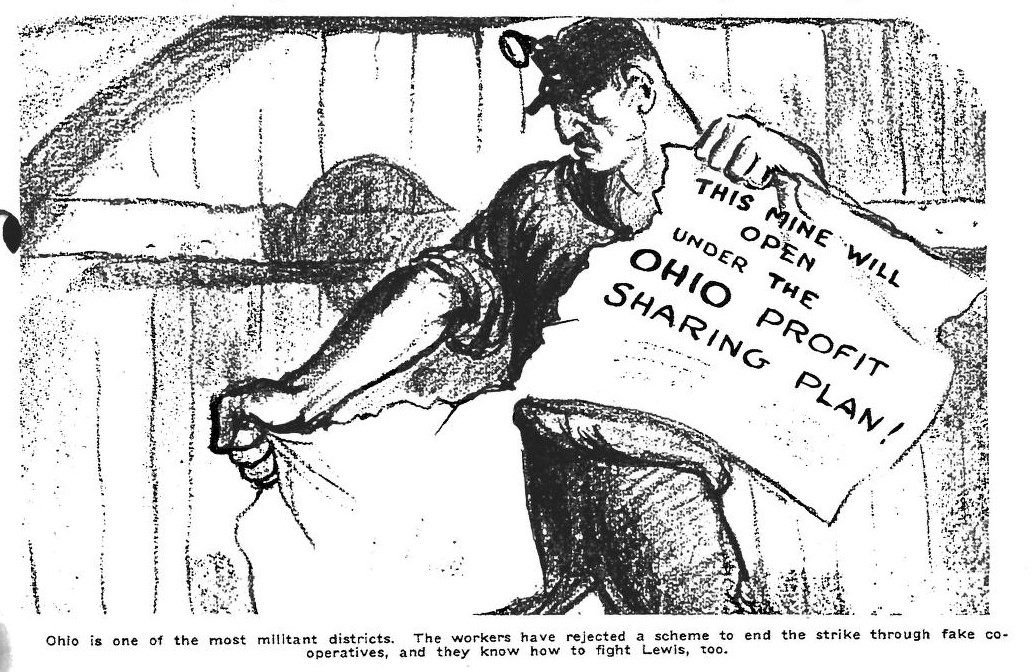
One of the hardest fought battles in U.S. working class history was the fight for life of many mining communities at the expiration of the ‘Jacksonville Agreement’ with the U.M.W.A. in 1927; with the Lewis leadership eager to see many of the mines, and their militant locals, closed. T.J. O’Flaherty reports on the struggle in the Ohio town of St. Clairsville.
‘St. Clairsville, Ohio; A Mining Town on Bail’ by Thomas J. O’Flaherty from the Daily worker. Vol. 5 No. 112. May 12, 1928.
When the war to make democracy safe for Harry Sinclair, A.B. Fall and the coal operators was in bloom and the stool-pigeon was looked upon as the highest type of American citizen in official quarters, a customary salutation in circles that regarded the entry of the United States into the war as a crime against the American masses was, “Where is your indictment?”
Today in the mining town of Lansing, Belmont county, Ohio, a man or woman not under bond on charges of anything from disorderly conduct to “riotous and unlawful assembly” in connection with the strike is almost as scarce as a bank account in a striking miner’s family.
in Belmont county the constitutional rights which the citizens enjoy when they don’t need them are now safely tucked away in Sheriff Haresty’s jail in Saint Clairsville.
Miners’ Wives March to Jail.
Saint Clairsville, the county seat is a typical American community of 1,900 inhabitants. Its leading restaurant caters to “the Caucasian race only.” No doubt it was a lively spot in the heyday of the Ku Klux Klan and inhospitable territory for those who did not do their hating in accord with the K.K.K. constitution or “honor” American womanhood in approved klan fashion.
It was a lively spot on Saturday April 21st, when 51 women, the wives and daughters of the striking miners of Lansing marched on the county jail to protest against the rearrest of their strike leaders, only to find themselves tricked into jail by Colonel Don Caldwell, of the Ohio National Guard, official observer for Governor Donahey in the strike area.
Many of the women had to sleep on the bull pen floor because of overcrowding in the jail. Several of them were nursing babies. The sheriff finally relented and permitted their babies to be brought in to the nursing mothers, and taken away again.
The 51 women were released on their own recognizances with the exception of a few of the leaders who were held in bonds of $500 each. They went away smiling and more determined than ever to carry on the struggle for victory in the strike.
A Typical Militant.
Thirty-eight miners are sitting in the Saint Clairsville court house. Six of them are in the chairs usually occupied by the “gentlemen of the jury.” They are the “ringleaders” as the prosecution likes to brand those who have more than the average qualification for leadership.
John Barto, of the Lansing local of the U.M.W. of A., militant and cool, is called to the stand. He rented the union hall in Lansing to the miners’ women who wanted to organize themselves into a Ladies’ Auxiliary. The women had received permission from the sheriff to hold their meeting. But, so it is said, there was a telephone call to the sheriff from the Lewis officials in Bellaire and the meeting was broken up and six of the men present arrested.
John Barto opened a window to let in the fresh air. He looked out on the road, and was noticed by Sheriff Hardesty. The sheriff asked John to come out. He did and was placed under arrest.
“Why were you arrested?” asked W.L. Bradshaw of Wheeling, attorney for the defense.
“For looking out on the street, I guess,” replied Big John in his quiet way with a merry twinkle in his eyes. John Barto is a big fellow. He is a leader. He could not help being a leader even in the court house. His blue shirt was frayed at the collar. His clothes never saw the inside of a Hart, Schaffner & Marx factory. But sitting down there in the witness chair, flanked on the left by a puny coal baron’s squire and a shallow-pated operator’s attorney, John stood out like a tower on a prairie. When the Sheriff Was “Ill.” John testified on direct examination by W.L. Bradshaw, defense attorney, that he gave the use of the union hall to the women to organize into a Ladies’ Auxiliary, the sheriff having given permission to hold the meeting. A deputy sheriff denied that permission was given for this purpose. So Bradshaw suggested that the presence of the sheriff would be desirable to clear up the matter. Paul V. Waddell, the coal men’s Good Man Friday informed the court that the sheriff was ill and in bed. At this moment it was learned that the sheriff was standing in the court room corridor.
An hour later a deputy stated that the sheriff had gone down to the river, not to jump in, but on some business.
Paul V. Waddell started in to question Barto. The little shiny-trousered, fellow snarled at John and wanted to know what he was doing at the Mutton Hollow mine when the mass picketing took place.
John is not the kind of a fellow to tell more than the traffic can bear. Wherever he was he had a perfect right to be. The prosecutor barked to show his importance. John smiled to show that he didn’t give a damn. The defense rested. The squire was resting on the bench. The defendants were resting in their seats in the court room. Attorneys for both sides sauntered over to the window with an air of importance as is the way with lawyers. They looked out the window, flicked the ashes from cigars and assumed a bored look. Wrapped in deep thot they gave the impression of being engaged in the business of solving weighty problems. Two little law students who were assisting the prosecutor horned in on the conference, hands in hip pockets.
They also were having their day in the sun.
Reporters and all those not directly concerned in the hearings were ordered out of the room. Then both lawyers lectured the defendants on the advisability of observing the law. Mass picketing is illegal. The lawyers did not say that it is effective. That is why it is illegal. The lawyers said that the miners must obey the law. The prosecutor said that if they did not make any more trouble for the county officials, the cases would never be called. The miner said nothing but went away more determined than ever to win the strike.
Arrest Strike Leaders.
A few hours later three mine strike, leaders were brought by a deputy sheriff into the office of Squire Brady Bradfield. Joe Webber, of Bridgeport, John Spiech of Neffs and Andy Plechaty of Dillonvale. Sepich was arrested while addressing a mass meeting in a hall at Crescent. Webber and Plecahty were arrested on the street outside the hall.
Deputy Sheriff J.C. Baker, takes the witnesschair. He is questioned by an assistant prosecutor who develops the fact that John Sepich addressed the mass meeting at Crescent on April 23. Sepich is alleged to have stated that there are several miners in jail now and that there would be several more in jail. This was inciting to riot! The prosecution rested.
Defense attorney Bradshaw questioned the witness. Did Sepich attack the government? No. Did he attack the county officials? No. Then why the devil was he arrested? The deputy felt ill at ease. His was not to reason why. His was to do as he was told. So he had Sepich arrested.
Bradshaw flashed an affidavit on the witness bearing his signature. Among other things it said, “That they did riotously agree with each other to commit an unlawful act” and that “they then and there made riotous movements.”
What did Mr. Baker mean by unlawful acts? No answer. What did he mean by riotously agreeing to commit an unlawful act? No answer. The prosecutor came to the assistance of the harried witness. Baker did not have to know anything except that Sepich said more miners would be arrested before the strike was over.
A Frame-up.
The extent of Sepich’s wrongdoing was, according to Baker, that he talked about winning the strike in a loud voice and that all those present appeared to agree with what he said. Baker admitted that he did not read the affidavit he signed. As attorney Bradshaw pointed out it was copied from a form book in the court house and he signed it with his eyes looking upwards.
The assistant prosecutor stood up grabbed hold of the back of a chair and stumbled thru a little speech which said in substance, “May it please the court, the people believe that those men violated the law and should be held for the grand jury.” “May it please the court,” started Bradshaw, “but the defense believes that those men were entirely within their rights in what they did and the charges should be dismissed.”
But it pleased the court to hold them for the grand jury, which course he took with the unction of a Jesuit putting a heretic to the rack for doubting the truth of the fable where Jonah is supposed to have gone down the whale’s gullet only to emerge as fresh as if he had just taken a cold bath.
The Daily Worker began in 1924 and was published in New York City by the Communist Party US and its predecessor organizations. Among the most long-lasting and important left publications in US history, it had a circulation of 35,000 at its peak. The Daily Worker came from The Ohio Socialist, published by the Left Wing-dominated Socialist Party of Ohio in Cleveland from 1917 to November 1919, when it became became The Toiler, paper of the Communist Labor Party. In December 1921 the above-ground Workers Party of America merged the Toiler with the paper Workers Council to found The Worker, which became The Daily Worker beginning January 13, 1924. National and City (New York and environs) editions exist.
PDF of full issue: https://www.marxists.org/history/usa/pubs/dailyworker/1928/1928-ny/v05-n112-NY-may-12-1928-DW-LOC.pdf
 Revolution's Newsstand