
An extremely useful summary by Foster of what can be hard to understand from this distance, but which was among the most important internal union battle in U.S. working class history. The U.M.W.A. would be shattered in the strikes at the time, with many mines closing, and the union violently split.
‘Background of the Coal Miners’ Struggle’ by William Z. Foster from The Daily Worker. Vol. 5 No. 78. April 2, 1928.
(Since this article was written the Save the Union Committee has called, subject to approval by the Pittsburgh conference, a strike for April 16 of the 100,000 unorganized miners in Fayette, Somerset, Westmoreland, Green and other western Pennsylvania counties. The District 12 Save the Union Committee calls Illinois miners to strike April 1.)
THE coal industry, both bituminous and anthracite, finds itself in a deep-going crisis. The principal factors contributing to this are: over development during the war period, installation of machinery and speed-up systems, the introduction of oil, water-power and other substitutes for coal, the reduced demand for coal caused by the general industrial depression, etc. The crisis in the American coal industry is part of the international crisis in the coal industry.
The general result of the working of these factors is a falling off of demand for and a decline in total production, also a rise in production per man.
The principal harvest the workers reap from this situation is an unparalleled unemployment, the breaking of their union, wage cuts, etc. The slogan of the operators and the reactionary trade union leaders is “There are 250,000 miners too many.” The crisis in the industry reflects itself by a deep-going crisis in the union. Gradually the organization is being crushed. During the past several years it has been wiped out entirely in West Virginia, Tennessee, Maryland, and many other districts. It is now being attacked most desperately in the three key districts, in West Pennsylvania and Ohio. The crisis in the union is graphically indicated in the fact that four years ago 70 per cent of all bituminous coal dug was produced by union coal miners, but on April 1, 1927, at the beginning of the present strike, the amount of bituminous coal produced by union miners had been reduced to 30 per cent.
The Lewis administration tries to throw the responsibility for the crisis in the union upon the difficult situation in the industry as a whole. Naturally the conditions in the industry have contributed to make the position of the union more difficult, but with proper policies the organization could have overcome these obstacles, and not only maintained but strengthened itself.
Criminal Misleadership.
The Lewis administration has wantonly permitted the destruction of the union in various districts, and it has absolutely refused to carry on any organizational work to re-establish the union. It is saturated with corruption and inertia. It has systematically crushed every manifestation of militancy in the organization, expelling militant fighters wholesale. It has divided the coal miners against themselves, splitting off the anthracite miners from the bituminous miners, and in the present strike, signing separate district and individual agreements. This destroys solidarity among the miners.
Ever since Lewis came into power his general policy has been one fatal to the union. His betrayal of the 1922 strike, one of the most shameful features of which was his abandonment of the Fayette miners, is typical. The signing of a separate five-year agreement for the anthracite was a crime against the miners; likewise his failure to strike the bituminous miners jointly with the anthracite miners in 1925 and thus put a stop to the violation of the Jacksonville scale. He made no preparation for the present strike; carried on no preliminary organizational work; and made no stimulation of the union for the struggle; and when the strike took place he did nothing to draw the unorganized into the fight. For six months after the strike began no organized relief was given the miners; militancy was systematically suppressed; no mass picketing; no mass violation of injunctions was engaged in. While the miners starved, he and his cronies drew their fat salaries. They directed the miners to place their hopes not in an aggressive fight but in futile appeals to Coolidge, empty senate investigations, etc.
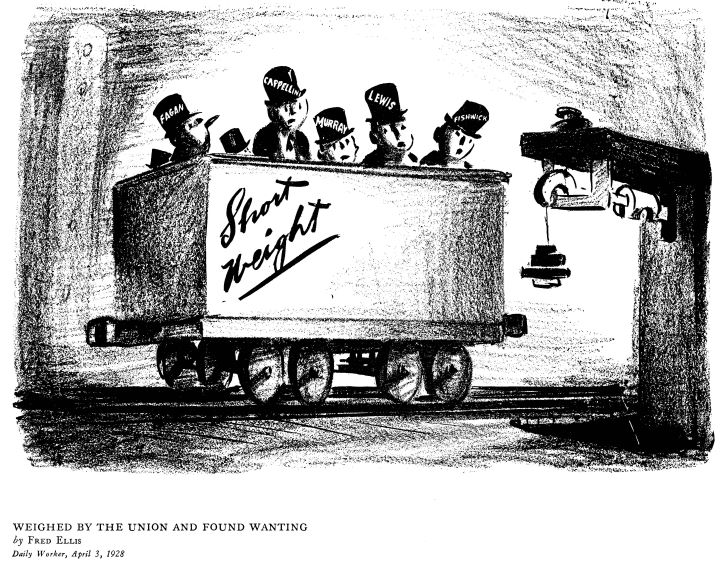
While Lewis was thus weakening the miners’ union with his criminally wrong policies, the employers were constantly growing more powerful. The spread of non-union territory, the consolidations of the coal operators themselves, the general strength of other great industrial corporations with coal-mining departments, the increase in the open-shop militancy among employers generally: all contributed towards increasing the power of the employers, while the strength of the union diminished.
The general result has been to bring the United Mine Workers of America to the greatest crisis in its history. The organization is now in very real danger of being destroyed altogether.
First Strategy of the Opposition.
Two years ago the left wing, perceiving the increasingly dangerous position of the miners’ organization, raised the slogan of “Save the Union.” Forming a united front with the progressives on the basis of a minimum program including the Organization of the Unorganized, the Formation of a Labor Party, a National Agreement, 6 Hour Day and 5 Day Week for all Coal Miners, Nationalizing of the Mines, etc., the left wing embarked upon an intensive struggle against Lewis. This struggle first took the forms of an election campaign with the progressives putting up a ticket against the Lewis machine, a campaign for delegates to the national convention and for the organization of the unorganized miners in preparation for the approaching bituminous strike.
These movements brought forth afresh the corruption and ruthlessness of the Lewis administration. Lewis brazenly stole the election, packed the convention, and resisted every proposal for the launching of a campaign to organize the unorganized districts. The defeat of the opposition resulted in a spread of pessimism and dual-union spirit among the miners, A conclusion quite generally reached, full of great importance for the future, was that it was hopeless to try to revive the U.M.W.A. through the democratic channels of the union.
The Second Stage.
The second general stage of the opposition strategy began about three months ago by the holding of an open conference of the opposition in Pittsburgh and the definite formation of the National Save the Union Committee, of which John Brophy is chairman and Pat Toohey is secretary. This is based upon an open struggle against the Lewis machine to force it out of control of the union and thus bring about, through the instrumentality of the left wing and progressives, the adoption of the policy necessary to save the organization. The typical opposition slogans of this period are: “Lewis Must Go” and “Miners, Take Control of Your Union.”
The present policy of open struggle is based upon four general considerations:
(a) The union is in the most critical danger of being destroyed. Drastic measures must be ‘adopted to save it.
(b) The Lewis machine, hopelessly reactionary, is wrecking the organization and there is no hope of it voluntarily adopting policies that will preserve the union.
(c) Only the policies advocated by the opposition can save the organization and relieve the pressure on the miners.
(d) Democracy being completely wiped out in the union by the Lewis autocracy, it is futile to try to function through elections and conventions corrupted and dominated by the Lewis machine. The only means left to put into effect the fundamentally necessary policies of the opposition is by an open clash and contest with the Lewis administration for the leadership of the miners.
Strike Strengthened.
The immediate general objective of the opposition in the struggle against the coal operators who are determined to smash the union and of whom the Lewis bureaucrats are the agents, is the mobilization of all possible forces to win the Pennsylvania-Ohio strike, it being manifest that if this great struggle is lost a tremendous obstacle will be placed in the way of unionism generally in the coal industry. This strike, the most important in the history of the American working class, can and must be won with correct policies. The miners involved are making the most desperate struggle in the face of unprecedented difficulties, and they can win the victory provided they are given real support.

Incredible though it may sound, the strike has been considerably strengthened in the past three months, due principally to the swift development of the opposition movement which gives the miners the first real ray of hope.
To win the strike the opposition is working on the following general strategy:
(a) The strengthening of the strike itself through mass picketing, violation of injunctions; the extension of strike relief and invigorating propaganda to stimulate the spirit of the strikers.
(b) Drawing of Illinois, Kansas and Indiana into the strike on April 1st. These districts were signed up separately by the Lewis machine several months ago. The effect was simply to betray the Pennsylvania- Ohio strikers and to give the operators in these districts a chance to exploit the winter market. With temporary agreements expiring on the 1st of April, these districts are confronting demands of the operators for the liquidation of the Jacksonville scale. The Lewis machine pulled these districts out of the strike; the left wing proposes to pull them in again. The effect of their coming into the strike afresh will give tremendous impetus to it and do enormous injury to the prestige of the Lewis machine.
(c) Drawing in the unorganized miners. Fundamentally necessary to winning the strike in Pennsylvania and Ohio is to draw in the vast armies of unorganized miners of Pennsylvania and West Virginia. Lewis make’s no effort in this direction. The unorganized have no confidence in the Lewis machine; the “Save the Union Committee” has the confidence of these strikers and is now making strenuous efforts to mobilize them for the struggle. Thus, the very heart of the problem of the union, namely, the organization of the unorganized, is being systematically at- tacked.
(d) Drawing in the anthracite miners. Reversing the wrong policy of the Lewis machine in separating the anthracite from the bituminous miners, the Save the Union Committee is now working to join them up with the bituminous miners.
The anthracite miners confronted with heavy unemployment, speed-up system, and betrayed by their officials, face the destruction of their organization unless they, too, join forces with the bituminous miners.
These four points in brief: (a) Immediate strengthening of the Pittsburgh-Ohio strike; (b) Drawing in the signed up districts; (c) Drawing in the unorganized; (d) Drawing in anthracite miners constitute the main factors of the strike strategy of the opposition.

To mobilize the full forces of the organized and unorganized miners to put this general strategy into effect, the National Save the Union Committee has called an open conference of miners, official representatives of their locals, to be held in Pittsburgh on April 1st, as Labor Unity comes from the press. This conference has been preceded by the holding of rank and file conferences in all the principal districts of Pennsylvania, Ohio, West Virginia, Illinois, Indiana, Kansas, etc.
Bituminous Miners.
Especially marked is the upheaval amongst the bituminous miners. In the anthracite districts where there has been no strike and where the union crisis is not so evident to the miners, the upheaval is also developing, but the tempo at present is not quite so fast as in the bituminous sections. The mass district conferences, with the representative delegations of 150 to 300 each, were veritable outpourings of the rank and file in revolt against the Lewis machine. They were held openly notwithstanding threats from the misleaders of the union. They indicate, especially in the bituminous sections, a tremendous upheaval of the rank and file miners against the men who have, under the guise of union leaders, systematically betrayed them for years into the hands of the operators.
Everywhere district Save-the- Union Committees have been created. These have behind them a vast network of Save-the-Union Committees in innumerable local unions. The organ of the movement is the Coal Digger with a rapidly growing mass circulation. It is this whole machine mechanism which will send forth a large delegation to the Pittsburgh Conference.
The effect of this great mass movement has been to stimulate the fighting spirit of the miners in Pennsylvania and Ohio. A weakness of the progressives was that almost unanimously for several months they held the position that it was wrong to criticize the Lewis machine during the strike. The result of this was to give Lewis a free hand to destroy the strike.
Mass Attack Strengthens Strike.
The left wing, however, firmly maintained that especially during the strike Lewis and his policies had to be attacked. Now progressives and all are agreed that the mass attack on Lewis has vastly strengthened the strike and gained it its first real prospect of success. Should the strike be successful Lewis will, of course, try to claim the credit. But the opposition must know how to instruct the rank and file in the real truth.
The evident determination of the Lewis machine is to hang on at all cost in the face of the opposition of the majority of the union, securing the support of the operators and the government in order to retain control of the union.
The Importance of the Struggle.
The importance of the struggle now going on in the coal industry can hardly be overestimated. The coal operators are aggressively attempting with the active assistance of the government and the treacherous misleadership of the Lewis machine, to break up the United Mine Workers and to put through their wage-cutting policies. The loss of the United Mine Workers of America would deal a most destructive blow to the trade union movement as a whole, and give an enormous impulse to the open-shop movement in every industry. The saving, rebuilding of the United Mine Workers and the driving out of its corrupt leadership is of fundamental importance to the whole labor movement.
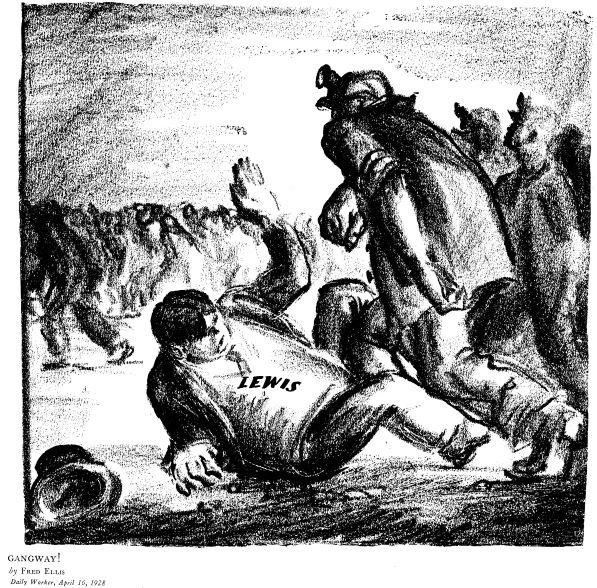
The situation turns around the struggle between the Lewis machine and the opposition. The defeat of the Lewis machine by the opposition would have far-reaching consequences not only in the miners, but in the labor movement generally. It would put the present strike on the road to victory and would lay the basis for real unionism amongst the miners. But more than that, it would give a shattering blow to the corrupt bureaucracy of the A.F. of L. in all its ramifications. On the other hand, a defeat of this movement would plunge the trade unions deeper into the mire of reaction. The strike against the coal operators and the struggle in the union against the Lewis machine mark a turning point in the history of the American labor movement.
*Active campaigns of relief should be initiated everywhere and money should be sent to Penn.-Ohio Miners’ Relief, 611 Penn. Ave. Room 307, Pittsburgh, Pa.
The Daily Worker began in 1924 and was published in New York City by the Communist Party US and its predecessor organizations. Among the most long-lasting and important left publications in US history, it had a circulation of 35,000 at its peak. The Daily Worker came from The Ohio Socialist, published by the Left Wing-dominated Socialist Party of Ohio in Cleveland from 1917 to November 1919, when it became became The Toiler, paper of the Communist Labor Party. In December 1921 the above-ground Workers Party of America merged the Toiler with the paper Workers Council to found The Worker, which became The Daily Worker beginning January 13, 1924. National and City (New York and environs) editions exist.
PDF of full issue: https://www.marxists.org/history/usa/pubs/dailyworker/1929/1929-ny/v06-n023-NY-apr-02-1929-DW-LOC.pdf
 Revolution's Newsstand