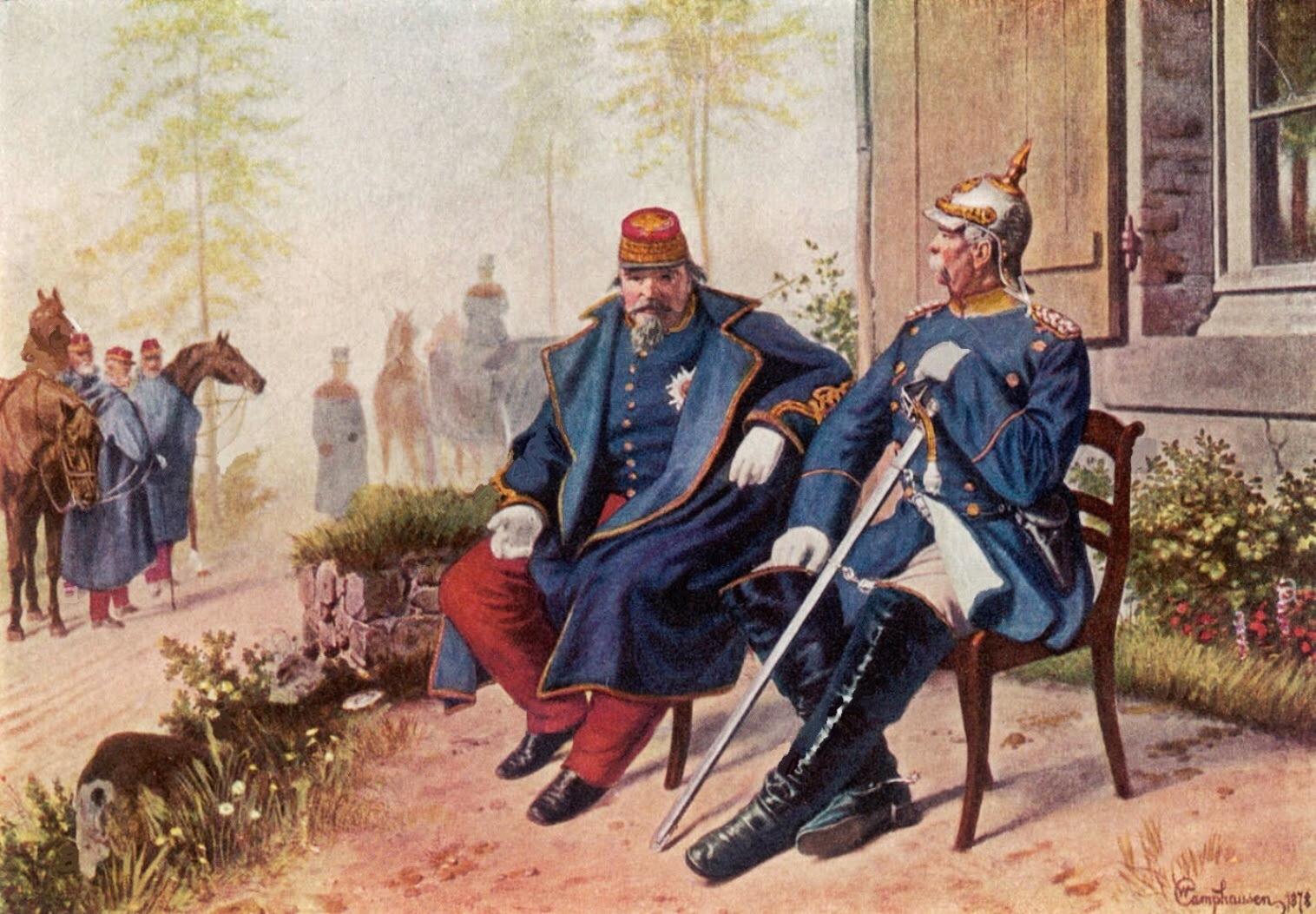
In this, the sixth letter to the U.S. during the Franco-Prussian War, Liebknecht looks at the relations of Napoleon III and Otto von Bismark after Sedan
‘Letter from Leipzig, VI’ by Wilhelm Liebknecht from Workingman’s Advocate (Chicago). Vol. 7 Nos. 26 & 27. February 25 & March 4, 1871.
Leipzig, January 22, 1871
To the Editor of the WORKINGMAN’S ADVOCATE:
Paris bombarded! Not the forts around Paris, but the town itself! Bombs and shells thrown, but on the women sitting in their rooms, on the babies sleeping in their cradles. “We make war only on the soldiers, not on the people,” proclaimed King William, when he entered France. I dare say you think he has a strange way of keeping his word. Maybe; but keep his word he does. A Hohenzoller always does, it is in their nature, they cannot break their word, not with the best will. It is true that often it has looked uncommonly like it, but it only looked so. And whoever presumes to doubt the inviolability of a royal word is guilty of crimen laesae majistatis (crimes against majesty)–off to prison with him! Now, too, the case is not as it appears to the profane eye. Appearances are proverbially deceptive. Words must not be taken literally, but according to their meaning. If King William pledged himself not to make war on the French people, he did so as must be evident to all well regulated minds, on the supposition that the French people would not make war upon him. This supposition has proved erroneous, the French people have notoriously rushed headlong into the outrageous, suicidal folly of making war upon the invader of France. The soldiers on whom King William made war when he gave his word, are not in arms any more; the people on whom he would not make war, are in arms against him the people have taken the place of the soldiers–ergo, he must make war upon the people in place of the soldiers. There is no flaw in the argument, and since the French people are composed of thirty-eight millions of men, women and children, the King of Prussia, even if he was to bombard one million out of life, would still generously spare thirty-seven millions, and display a humanity almost superhuman.
Apropos, I have always been speaking of a King of Prussia. The title is so familiar that custom becomes second nature. Emperor, I ought to have written. I must teach my pen, in future, to follow better the rapid course of events. Emperor, Emperor, Emperor! So, I hope, I shall keep it in memory. How did it happen? Well the finest model bombardment becomes tedious at last; they wanted a little change at Versailles, a new crown was ordered and a new purple robe; the King put it on, looked very stately, the courtiers saluted him as Emperor, he acknowledged the salute, and to commemorate the intervening performance a manifesto apprized the public of what had happened. In this manifesto the German people are not mentioned, which does honor to the chief actor’s sincerity, and we are informed that the Hohenzollern Empire will be peaceful throughout. As the whole Empire is a translation from the French, we can expect to see a new version of Bonapart’s celebrated l’Empire c’est la Paix. The German Empire, too, is peace. The German Emperor has said so, and to give an augury of happy fulfillment while he spoke, his mortars and cannons hurled their iron messengers of death on the devoted city, and preached with their thundering mouths the civilization of the nineteenth century.
Hail to the Emperor of Germany! And now I must tell you the date. Let me quickly look in a newspaper; there it is: the 17th of January, 1871. Mark the day! But I hear you ask, why did he not wait till the war is over? Why does he present this bill before it is due? Well, when the war is over, perhaps no stuff for an Empire is left and who would discount the bill, then? I am afraid it will soon be forgotten, and a time may come when it will interest you to verify the only unmixedly comic episode of this tragic war.
To serious matters again. Although the opinion still predominates in my country that Prussia will succeed in bringing France on her knees and wresting the Alsace and part of Lorraine from her, yet it is a noteworthy fact that in circles which rather incline on the Prussian side, the conviction begins to spread that Count Bismarck had committed a great blunder in not concluding peace after the catastrophe (or tragic-comedy) of Sedan.
Well, Bismarck did conclude a peace at Sedan. What the two men of Biarritz talked together on that day of the dupes, we do not know, and shall never know exactly, for both have the most powerful reasons to cover it with an eternal veil; but during the last four months things have come to light partly through accident, partly through the indiscretion–more or less calculated–of the Bonapartistic agents, which enables us to discern clearly the outlines of the intrigue spun there. Before proceeding to point them out, we must recall to mind, that the war, which began in the middle of last year, was an untoward event for Bonaparte as well as for Bismarck. That it was so to the former is irrefutably proved by the absolute want of military preparation on the part of the French Empire. That it was so to Bismarck is irrefutably proved by the difficulties into which he has been thrown by the downfall of the Empire; difficulties which he could not but foresee, and which he foresaw, and which are the necessary offspring of the Prussian victories. The miserable sycophants, who tell us Bismarck, in his wonderful statesmanship, had entrapped Bonaparte in this war, pay a very poor compliment to the genius of their hero; for they accuse him of having with full deliberation entered upon an undertaking, which, if unsuccessful, must ruin him at once, and if successful must ruin him after some time, unless he contrived to undo his own success, to neutralize the natural effects of his own victory. And what else is the war since Sedan, but a desperate attempt of undoing the results of the war up to Sedan; that is, of restoring the Empire? Certainly before the last crisis arose in July Bismarck had made himself familiar with the idea of a war between France and Prussia, but he thought of it as a terrible misfortune to be avoided by all means, and not as a desirable event to be brought about by crafty artifices. When the war had already broken out in consequence of a strange fatality, Count Bismarck could not help uttering his fears, and when the superiority of the Prussian army had been established, and officious people congratulated him, he replied: “The real difficulties begin only after our victories.” These words, at the time reported in many newspapers, passed unnoticed in the deafening noise of the battlefields. They were wrung from him by his embarrassing position. There are cogent reasons to believe that during the war Bismarck and Bonaparte were in constant correspondence. I will only remind my readers of the mysterious letter which Marshall Bazaine wrote to Paris after his first defeat, and before the affair of Sedan took place. In this letter he hints at dishonorable proposals made to him by the Emperor. It is now established beyond doubt that Bonaparte harbored the intention of flying into the Prussian camp even as far back as the middle, if not the first half of August, and that the dishonorable proposals made to Bazaine consisted of nothing more or less than the plan, since circumstantially disclosed in Bazaine’s memorial for this defence, viz: to use the army under his command, not against the Prussians, but against the Frenchmen, for the pacification of the country, as the shooting down of unarmed citizens is diplomatically called. Bazaine, who had already begun to play that double game in which he caught himself at last so cleverly, declared his consent and hastened to betray the plan to those just in power in Prussia, in order to be safe in any case. Sedan came. Bonaparte delivered the last French army to the Prussians and sat down with grateful Bismarck to arrange matters and to put a term to the disastrous misunderstanding of the preceding weeks. A treaty was concluded. Prussia could not go home empty handed after her wonderful victories. What was France to Bonaparte, except a domain to be plundered? The domain was large, a part of it might be sold, and yet there would remain enough for him and his kindred and his creatures (male and female) to continue the old life of Sardanapolian orgies. He did not hesitate long. A piece of Alsace and of Lorraine–how large we do not know accurately was bartered away. And the price? Restoration of his throne, if need be, with the help of the Prussian bayonets. Dear brother William had of course no objections. To carry out the treaty did not seem difficult. France was disarmed how could she think of resisting? Thanks to the well organized system of imperial lying, by telegrams and bulletins, she was wholly in the dark about her position. If the news of the final coup d’état and coup de grace was properly communicated, she would be dumbfounded, stunned, and allow anything to be rammed down her throat. Only those marplots, the Republicans, might try to spoil the games, but it was easy to dispose of them. In all towns the police has lists of the obnoxious citizens, and against the most dangerous of them mandates of arrest had been carefully filled out beforehand, and the telegraph flashed everywhere the order at once to execute these mandates.
II.
The two confederates separated in the comforting consciousness of having got out of a very low scrape; Bonaparte travelled to his gorgeous villégiature on Wilhelmshöhe, with inward chuckles waiting for the denouement, and Bismarck caused King William to give the Prussian army a week’s repose, and was for the next two nights cured of his habitual sleeplessness. Not for more. The “strange fatality” which had created one untoward event, created a second one, and worse than the first, the fulfillment of the darkest fears. Whether the telegrams containing the ominous orders were intercepted or delayed on the road, or whether the police-authorities were struck with indecision by the awful news from the seat of the war–enough, the orders were not executed,1 an electric shock went through France, simultaneously the people rose, the Republic was proclaimed, and with unanimous enthusiasm accepted. The evil tidings fell on Bismarck like a thunderbolt; it was some time before he could recover his sangfroid.2
He stood before two roads, leading in opposite directions–the one to an honorable peace, the other to a war of extermination. Which was he to choose? If he chose as a statesman, there could not be a moment’s hesitation. Prussia had been fighting in what must appear to everybody a righteous cause; she had in four weeks’ time annihilated the army till then considered the first in the world; the criminal author of the war a prisoner in her hands, the sympathies of Europe, of all of civilized mankind, were with her; the German people, dazzled by the brilliancy of the military achievement, had forgotten their past sins, and were ready to fly into her arms; one word, and the rocks of the Kyffhauser opened, and old Barbarossa stepped forth to put his crown on the head of King William, who would then be the mightiest monarch of this planet. One word–Peace.
But Bismarck is a Junker. What the statesman imposed, the Junker forbade. Peace with the Republic, peace with Revolution–impossible. The interests of Germany, the commands of humanity–fiddlesticks. There stood before him that one fact: France is a Republic. This fact must be suppressed, got rid of, somehow, anyhow, by all means, at any price! At the side of a French Republic, Bismarckian Prussia cannot exist; either the one must perish or the other. Do not talk of the risk! Peace with the Republic is certain ruin; war offers at least a chance of safety; the French people is still the same which fought the whole of Europe for a quarter of a century, all the gain of the past victories may be lost in a turn of fortune, a butchery on a scale never known before will be initiated. A cataract of blood will pour over France. Never mind–the Republic must be destroyed–WAR.
And war there was. The tired army, that had just begun to enjoy the promised repose, received counter orders and had at once to march on Paris.
Nobody will deny that Bismarck, the Junker, acted logically; but for Bismarck, the Statesman, it would have been better if Junker Bismarck had been a little less logical. The sorry farce played at Versailles last week would not have been necessary, and Count Bismarck would not be obliged to crawl before his mortal enemy Beust, in Vienna, because he is well aware that 100,000 Austrians could march unopposed from one end of Prussia to the other, and by delivering the 300,000 French prisoners of war, furnish France with an army sufficient in four weeks time to reduce the new German Emperor to an even humbler state than that of a Marquis de Brandebourg.
By the by, the plan of restoring Bonaparte, or his son Lulu (which is the newest idea) has never been given up at Berlin and Versailles, and it is now more in favor than ever. An infamous paper, edited by the infamous Granier (nicknaming himself, “de Cassagnac”) Le Drapeau–the Standard–is most zealously propagated among the French prisoners of war, while the Independence Belge, which does not write in the Bismarckian or Napoleonic sense, has been forbidden to them. In some places, for instance, at Darmstadt, the captive soldiers were admonished from the pulpit to remain faithful to their monarch, chosen by the people and during 20 years government visibly blessed by God; and in the darkest colors was painted to them the fearful sin of rebellion. However, all this is “love’s labor lost.” The captive French soldiers are perverse enough to consider the traitor of Sedan as a coward and criminal deserving a halter instead of a crown; and they are sinful enough to think that the French nation in ridding itself of such a pest, has only done what honor and interest commanded. On New Year’s Day, which in France is a more popular feast than Christmas, the Emperor–for so, and not ex-Emperor, he is officially styled in Germany–sent large money presents to his soldiers in their different places of confinement. If ever men have been in a position inducing them to accept charity, these poor French prisoners have been. Badly lodged, badly nourished, scantily dressed, exposed–they the children of a sunnier climate–to the horrors of a winter of phenomenal fierceness even for our more northern latitudes–what could have been more tempting to them than the offer of money sufficient to buy woolen blankets and clothes, and to have for once after such long parting a good, plentiful dinner? But the man who held out these treasures to them was the man who had brought them into this ignominious captivity, it was the man to whom they owed their physical sufferings, it was the man to whom they owed the infinitely more tormenting moral anguish to see their fellow citizens, men not accustomed to wear arms, engaged in a deadly struggle against an immense invading army, while they, the drilled and disciplined soldiers, chosen and trained to defend their country, had to stand aside idle, and had in the enemy’s land to eat the enemy’s bread. No, what this man offered they could not accept. It would be adding infamy to misfortune. A small minority did not think so, but the immense majority did; they preferred starvation to the gifts of the Imperial Tempter, and commissioned his messengers to tell him he should not insult them further. Honor to these brave men! Recently I hear the Prussian Government has given orders to treat the French prisoners better; but after what has passed we must regard this attempt at indirect bribery as completely hopeless too. The French soldiers will not help Prussia to subdue their own country.
NOTES
1. At Lyons, where the Republic was proclaimed sooner than in Paris, the filled out mandates of arrest were still found in the Prefecture, scattered about and partly destroyed. The same discovery was made in other places.
2. Communicated to me by a man in a position to be well informed.
The Chicago Workingman’s Advocate in 1864 by the Chicago Typographical Union during a strike against the Chicago Times. An essential publication in the history of the U.S. workers’ movement, the Advocate though editor Andrew Cameron became the voice National Labor Union after the Civil War. It’s pages were often the first place the work of Marx, Engels, and the International were printed in English in the U.S. It lasted through 1874 with the demise of the N.L.U.
Access to PDF of issue: https://chroniclingamerica.loc.gov/lccn/sn89077510/1871-03-04/ed-1/seq-2/
 Revolution's Newsstand