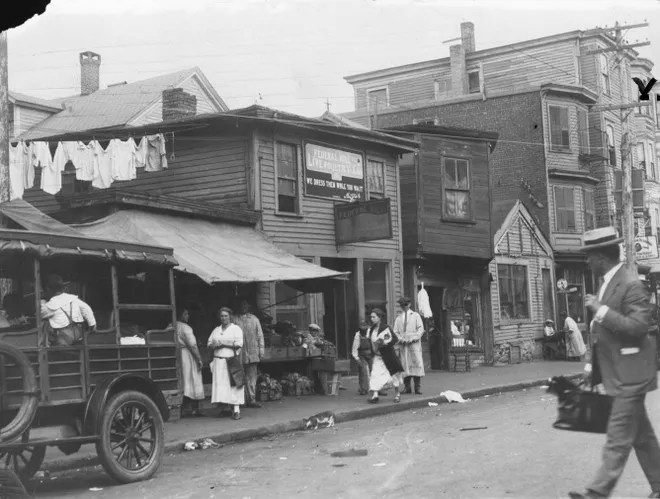
The working class Italian immigrant neighborhood of Federal Hill in Providence, Rhode Island explodes over war-time price-gouging in local grocery stores, and racialized police brutality.
‘Many Wounded by Police Bullets on Federal Hill’ from Labor Advocate (Providence). Vol. 3 No. 2. September 5, 1914.
Inability of Authorities to Fix Blame for High Prices Causes Resentment Among Italian Workers–Wholesale Stores Wrecked and Contents Thrown Into Street–CONSTABLE’S BAD BLUNDER CAUSES RIOT–Foolhardy Attempt to Arrest Youth on Trivial Charge Arouses Crowd to Frenzy of Excitement–Young Italian Boy Dangerously Wounded by Policeman’s Bullet and Scores of Others Injured.
Inordinate greed on the part of a number of wholesale and retail dealers in foodstuffs, resentment by the Italian workers at this imposition and the inexcusably bad judgment of a police constable caused the probably fatal injury of one Italian boy and the shooting down of a score or more of older persons last Sunday afternoon on Federal Hill.
In common with the residents of all sections of the city the Italian people have been aroused to a high pitch of indignation at the evident determination of certain food merchants to take advantage of the European war and boost prices to the highest possible point regardless of the cost to the dealers. This indignation on the part of the Italian people was intensified by the results of the “investigation” conducted by Mayor Gainor, who announced that the dealers of Providence were not at all to blame and that the situation was caused by circumstances beyond their control. This decision was far from pleasing to the Italian people, who had inconvertible evidence that certain dealers had boosted the price on articles of which they had an immense stock on hand, and these facts were presented to the mayor, This evidence could not be ignored by the mayor, but he declared that nothing could be done about it, that the dealers had the right to charge whatever price they chose. He pointed out that the laws of the United States were different from those of Italy, and that the municipality had no power to fix prices on foodstuffs, no matter to what extent the working class families were robbed by dealers in this merchandise.
These facts were pointed out to the people of Federal Hill at a mass meeting held on Saturday evening and al- though the speakers advised the assemblage to perform no rash acts the indignation of the more hot-tempered ones were shown in no uncertain terms. “If there is no law to protect us,” said one of them, “we must protect ourselves. There seems to be plenty of protection for those who rob and cheat and exploit the people, but none for those who are robbed.”
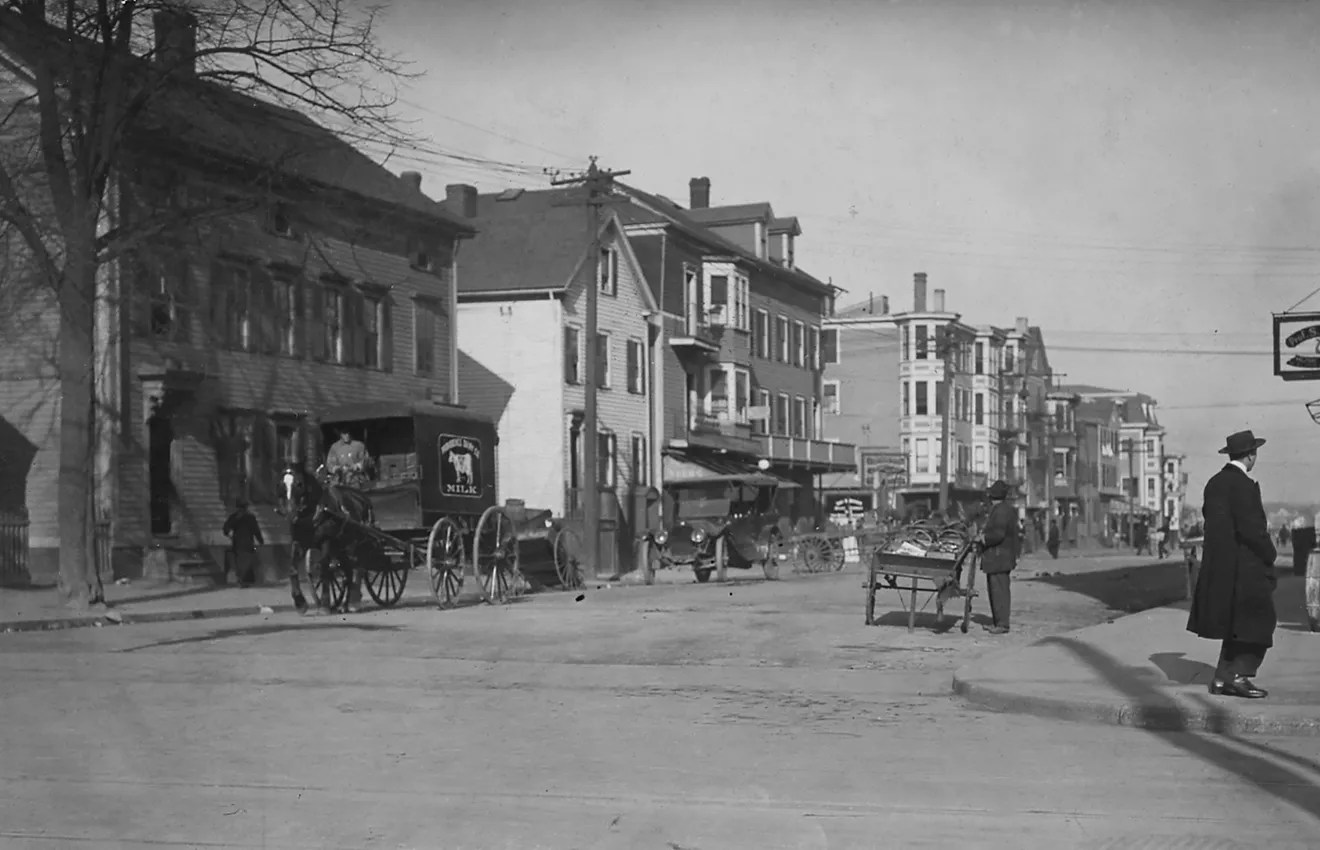
Led on by a few impetuous spirits, the crowd made a rush for the establishment of Frank P. Ventrone, who is regarded as the leader in the conspiracy to raise the price of foodstuffs. Someone threw a stone through a window, and soon the air was filled with the flying missiles. In a short time the place was a wreck, nearly everything in the store being thrown out on the streets. The police reserves, who had been summoned by the few police on duty on the hill, arrived soon after the disturbance started and charged the crowd with revolvers and night sticks, arrested a half-dozen or more, principally those who had nothing to do with the demonstration and the place was soon comparatively quiet.
The demonstration of Saturday evening, however, was as nothing to the scene which occurred the next day, and it was all caused by the idiotic act of a deplorably incompetent police constable. Just at the time when Atwells avenue was thronged with the residents of the district, with the occurrences of the previous evening still fresh in their minds, and the whole crowd tense with excitement, Constable Samuel Brown determined to inject himself into the limelight. It was like throwing a match into a keg of gunpowder to start anything with the crowd in such a tense state as it was at that time, but this fool constable did the trick. Seeing a youth who had been wanted for some time on a non-support charge, Brown approached him and placed him under arrest. The youth, wiser than the officer, warned him that it was dangerous to attempt to make an arrest at that time and told the officer he would follow him to the station if he would walk quietly away. Brown, however, was determined to adopt a more spectacular method and started to pull the prisoner toward the patrol box. The crowd, seeing the arrest and supposing that it had something to do with the affair of the night before, immediately started to rescue the prisoner, and the street was soon filled with a mass of wildly excited people. The police reserves were again called, and charging the crowd with drawn revolvers, fired point blank into the struggling mass. At the first shot Quinnio Oddi, 15 years old, sank to the ground with a bullet in his chest. Blood gushed from his mouth and it was seen that the child was mortally wounded. The sight of the dying child aroused the crowd to a perfect frenzy and men, women and girls charged upon the officers. Volley after volley was fired by the policemen and a score or more fell victims to the officer’s bullets. None of the patrolmen were shot, their injuries consisting merely of stone bruises. This shows that no demonstration had been planned against the police but had been brought about by the foolhardy work of one plain clothes police constable. As it is now, the feeling of resentment against the storekeepers has given way to a desire for revenge against the police
Another policeman with no more sense than Brown may follow his example at any time and start another riot with the inevitable bloodshed. It is a time when cool heads and common sense are sorely needed, and nowhere is there more necessity for it than in the Providence police department. One thing has been shown by this affair, and that is that there is one class of workers who will not forever remain quiet and submissive under all sorts of oppression. It would be well for certain individuals to take note of these occurrences and profit by the lesson contained therein.
PDF of full issue: https://chroniclingamerica.loc.gov/lccn/sn92063933/1914-09-05/ed-1/seq-1/
 Revolution's Newsstand