
Though facing an all-consuming need to defend its fragile power, and in conditions of unbelievable hardship, Soviet Latvia attempted to reconstruct society on a new basis in the short time of its existence. Proclaimed on December 17, 1918 and headed by the author, Pēteris Stučka, the Latvian Socialist Soviet Republic lasted until Riga was captured by German Freikorps troops. Acting under the ‘Social-Democratic’ government of Ebert-Scheidemann, workers and Communists were massacred six months after the murder of Rosa Luxemburg and Karl Liebknect. The story below.
‘Five Months of Soviet Latvia’ by P. Stuchka from Communist International. Vol. 1 No. 3. July 1919.
Regarded from the comic standpoint tiny Latvia presented before the war the aspect of the most developed part of Russia. Not only such important industrial centres as Riga and Libau, but also the villages showed of the highly capitalist development of the country. In the villages, the percentage of purely hired labourers or landless population considerably exceeded the number of landed peasants. In another respect Latvia presented an exceptional picture, even in comparison with the West. The war brought great changes in the life of the country. Not only was it materially ravaged, not less than Belgium or Poland, but also depopulated, and to a much higher degree than the rest of Russia. In Riga the inhabitants before the war numbered 325,000 and the census taken in January, 1919, showed the number reduced to 212,000, of whom the aged formed 25%. For every hundred men there are now 180 women: before, as in all industrial centres, it was the young masculine generation that predominated. A hundred thousand industrial proletarians together with their families were removed, in the year 1915, at the time of the evacuation of factories and mills, and dispersed in different towns of Russia, where they remain until the present day. Things have also changed in the villages. The village proletarian is either in his soldier uniform on the field of battle, or has become a small farmer, or half-partner, or day-labourer, or some other dissimulated form of hired slavery.
Under such conditions November, 1918, when the idea of Soviet Latvia arose, the question of Kautzky clearly stood before us: is it possible on these ruins of the war, where nothing is left to socialize, to create a socialistic order of things? In our Manifesto on the construction of the Socialist Soviet Lettish Republic we unhesitatingly answered in the affirmative. Instead of helping the capitalist class to reconstruct on these ruins the fortress of capitalist bondage–the proletariat of Latvia, will set to work, without delay to erect its own temple of Labour. The Soviet Government of Latvia, formed by order the central Committee of the Social Democracy (at present the Communist Party) of Latvia which existed illegally in Riga, published their Manifesto in December 17th, 1918, regarding the abolition of the scenic Bourgeois Provisional Government. In virtue of the occupational régime of that time, this Manifesto could only begin to circulate in Riga on December 25th, when the Soviet Government had already entered the territory of Latvia and had taken the town of Valk. Simultaneously, with the signing of the Manifesto the Presidium of the Soviet Government of Latvia, whose members we at the moment in Moscow (Stouchka, Danishevsky, Lenzman and Peterson) fixed the day and place, January 13th at noon in the House of the Knights in Riga, for the convocation of the Assembly of the Workers’, Peasants’ (landless) and Soldiers Deputies of united Latvia. When on December 13th I handed over, simultaneously with the communication on the construction of the Soviet Government of Latvia, an invitation to our Assembly, to the late I.M. Sverdloff, President of the All Russian Central Executive Committee, he smiled and said: “Are you not fixing your Assembly too soon, Comrade Stouchka, when you have not yet got a span of land? But I shall certainly attend the Assembly.” I replied that we should try to keep our word. And, in effect, on January 4th we were able to telegraph to Comrade Sverdloff from Riga that the appointment of January 13th for the meeting of the Assembly remained in full force and that we expected him. Comrade Sverdloff, on his part, was true to his word, and arrived.
On what did we base our assurance when with such confidence we fixed the day for the Assembly? First of all, on our faith in the proletariat of Riga, in spite of its occupation. Secondly, on our confidence in the Lettish proletariat, in the Lettish rifleman, who had fought in the ranks of the Red Army of the Russian Soviet Federative Socialist Republic, and who, when sent into the rear of the Army for rest, instead of resting, hurried joyfully home in order to liberate their proletarian native country. For, we invariably, in our Manifesto, as well as afterwards, confidently said that there can exist in Latvia only a proletarian, that is, a Soviet power–or the feudalist-Junker régime of the barons. And only the malicious calumny of the German social traitors could confound the returning home of the Lettish riflemen with the so-called Imperialist intentions of the R.S.F.S.R.
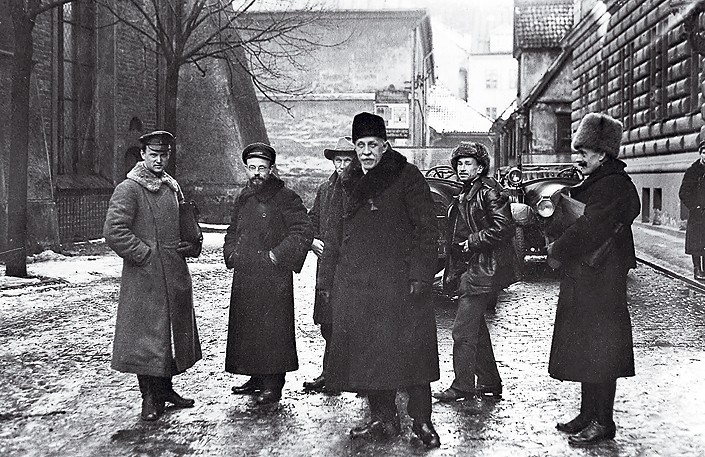
The victorious march of the Proletarian Revolution was amazing. Those of the Kaiser’s troops which had remained, the decomposed parts as well as the iron divisions, yielded directly to the attack of the not yet numerous, but fearless detachments of the Lettish Red Army regiments, which had already been often under fire. Everywhere, on the approach of our soldiers, the local proletariat rose and inevitably conquered. So it was in Valk, in Wolmar, in Wenden, on Jan. 3rd in Riga, then in Mitau and Tukkum. And only in Windau a second effort was made in order to bring success. But quite without precedent was the rising of the Riga proletariat, who in spite of the part played by German troops in the street-fighting and of the presence of English cruisers in the Dwina, conquered in one day, without any external help, although the Lettish regiments were yet at a distance of 10 to 20 versts and were not in time to fire one helping shot. At 3 a.m. on Jan. 3rd I and my comrades entered the town in a German armoured train, which had been captured by the workmen, whilst the retiring German troops set fire to the theatre and elevator. Another week or two, and Libau would also have been in our hands, after which Germany (by the order of the Allies), or the Allies themselves, would have been obliged to make us an open declaration of war–that is, if the mood of the labouring masses of the West would have allowed such a thing. But at this moment appeared bourgeois Finland, which attacked Lithuania with its forces from the side of Esthonia; and the Germany of Scheidemann sent against us fresh, newly formed regiments of Socialist Germany, with Hindenburg at their head. Of all the shameful pages of the régime of Scheidemann (and they are not few!) one of the most scandalous, is the upholding of the forces of the brutal and antiquated feudalistic régime of the Baltic baron-land-owners by the troops of the German Socialist-Republic.
Noske is frank and he openly refutes all the reports that it was the Allies who forced Germany to leave her troops in Latvia. “We are not engaged to do this by the Treaty, but Courland is German ground.” And yet on this “German” ground, according to the statistics of the Germans themselves, there are only 4% of Germans, including the population of the towns. What must one say, then, of Dantzig?
Our task in Latvia was an exceedingly difficult one. We had to struggle against the external enemy on three fronts: on the Northern Front, where The Red Esthonian Army was not in a state to resist the attack of bourgeois Esthonia together with her auxiliary forces; on the South-Western Front, where in Courland the not numerous forces of the Lettish bourgeoisie, but the numerous regular German troops and volunteers, attracted by ten marks a day and by copious nourishment (at the Entente’s cost) from Germany, Denmark, Sweden and so on, and under the daring leadership of experienced captains from amongst Baltic barons, formed an enemy of superior strength, technique and enterprising spirit. At last, after the fall of Vilna, on the Polish-Lithuanian Front, where we had to send consecutively five of our regiments, we had not one man left in our reserve. Thanks to a mobilization which reached its maximum our troops increased in number, but certainly did not present the same former homogeneous Red Army, which we possessed in December.
We saw ahead a threatening picture of imminent collapse of the Army, but were helpless to prevent it. At the same time at the base, we had to perform important structural work. It is absurd and childish to say that all this work should have been postponed. We could not, for one day, dispense with the solving of the food question, in the first place for the Army. It was also absolutely necessary to have factories working (if even of the smallest dimension) in order to supply the Army, because there was not a sufficient supply of boots, equipment, etc., in the centre. If only u had been able to recall to Riga even a small part of the evacuated unemployed proletariat, and a supply, of factory appurtenances, which since 1915 lay useless in wagons er storehouses, we should have obtained more help for our front from a thousand or two conscientious proletarians, returned to Riga, than from an additional thousand mobilized soldiers or a dozen communists sent out for agitation. It is the good fortune of the Hungarian Soviet Republic that 60% of her Red Army consists of workmen.
The food shortage was awful. In April, an average of nineteen people died from hunger in one day. Under pretext of the Armistice, the German Commanding Staff tried to carry off all that had been plundered in this country under pretense of contribution or war-spoils (remember that even Kautzky looks upon war-booty as upon legal property). In that way many trains and ships left Riga laden with bread and other food stuffs before we occupied it, thus leaving the population at the mercy of fate. Our Western Front, to which our Army was attached, was not in a state to supply and did not supply our Army with victuals in a sufficient quantity, and all that should have been distributed amongst the civil population went to the Army. For months the workmen of Riga did not receive one single pound of bread. We cannot but admire the self-denial of the Riga proletariat who, without the slightest murmur, suffered so bravely the torments of hunger. The only thing the Soviet Government could do for them, was to give them scanty dinners, consisting of soup. At the time of the German occupation 80,000 such portions were distributed; our government increased the quantity of caloric contained in each portion, and distributed 180,000 portions dally amongst a population of 212,000 people. The ingredients of such a portion gave 1/118 of the food necessary for a healthy person; but at the time of the German occupation the people received only 1/117. By the month of May the supply apparatus was put in right working order. Thanks to the Ukraina, we could at last begin the distribution of bread to the civil population also, in the following categories.
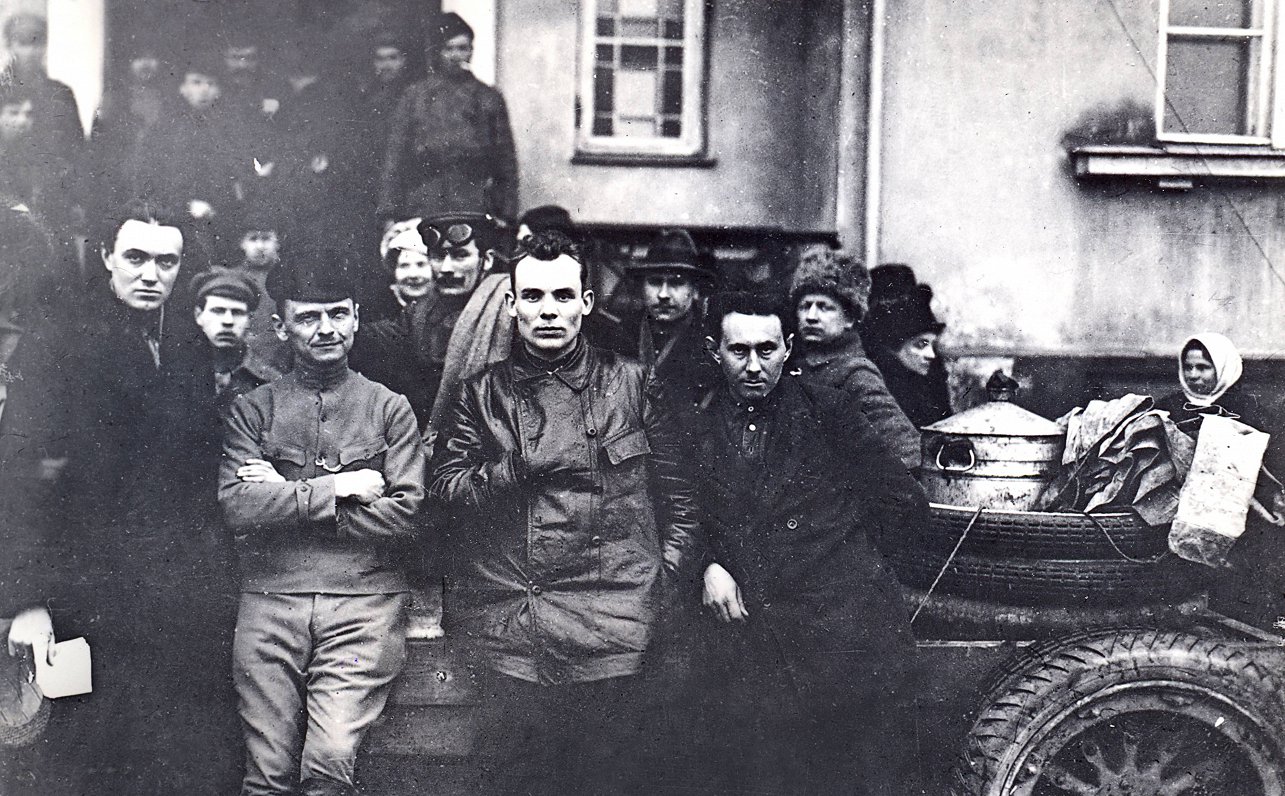
First category—3/4 of a pound; second category—1/2 a pound, and third category ¼ of a pound. The distribution was even provided for 14 days ahead. This insignificant store of provisions fell into the hands of the German troops who (according to received information) sold them off to speculators.
We had yet to arrange the means of distributing the food stuffs. The communists in Riga had at their disposal well-developed workmen’s co-operatives. We transformed them into Government organs of distribution, and introduced into them as obligatory; members all the electors of the Soviets, that is, all the labourers; at the same time we abolished all share-holders dues. A month after the introduction of categoric food cards we intended to realize the registration of a labourers at the corresponding local centres of distribution. But the taking of Riga by the Germans interrupted this work, which was but half finished.
Latvia is, principally, an agricultural country; but the rural economy had already in the sixties of the last century taken a purely monetary form. The number of landless peasants exceeded the landowning ones by four times. Such was the picture before the war. During the war the number of farmers who were employing day labourers considerably diminished, and part of the hired labour sold another unrecognizable, natural form. But the substance of capitalist economy remained. We at once nationalized without indemnification all the large estates (of over a 100 desiatines), but could begin cultivating them at the costs of the Republic only in proportion to the inventory that was at our disposal. We initiated 230 Soviet farms, well stocked and satisfactorily cultivated. It was more difficult to dispose of the other rural properties. It is not an easy thing to unite the interests of the “grey barons,”–the farmers–with those of the landless day labourers. In consequence of a sometimes inexpert realization of our policy in this sphere, that is to say in the rural districts, our agricultural policy led to many misunderstandings. But all these dissensions, which had accentuated themselves at the beginning of the summer season, were of short duration, and when we were forced, by the military strength of Germany, to retire from Latvia we were followed by thousands of day-labourer fugitives and the same discontented elements who did not wish to remain in the Latvia of the barons. Because of the default of inventory and of the deficiency of a sufficiently important apparatus of agriculturists, we were obliged, in order to avoid famine, to leave in force the leasing of land which did not constitute Soviet farms and to give license to the peasant farmers to employ hired labour, insisting only on the observation of all the laws of labour-protection. The working day in the rural districts was to average in the year eight hours a day. Temporarily we were forced to make this concession. We decidedly opposed the distribution of land amongst the landless peasants.
The Soviet Republic is, in a considerable degree, a Republic of propaganda, but of propaganda principally by action, and not by words. We were obliged to pursue our agitation by decrees and by actual renovation of the economic life of the country. We were forced to reopen, one after the other, the industrial establishments, whose work had been suspended or had been destroyed. We did this regardless of the enemy, who stood at 20 to 30 versts from Riga. The organization, of production was realized on a purely Soviet standard. The management belonged to a delegate, chosen by the Soviet or by the Soviet government, but with the participation and under the control of deputies of industrial (formerly trade unions). The trade unions, having lost their significance as organs of class-struggle, transformed themselves into organs of power, with the abolition of all re-imbursements of members and with the obligatory participation in them of all workers. According to the information gathered by an investigation held in Riga in the month of April, the average productivity of labour had but slightly diminished; but there were also cases of increase of productivity of labour. As a reason for the decrease of productivity, famine and deficiency of materials has already been indicated. Our proletarian discipline was strict and gave good results. Everywhere minimum output of work was introduced; a transference into a higher or lower category of payment was admitted, in dependence upon the actual finished work. Our communistic fraction of the trade unions opposes payment, according to agreement. The Soviet Government of Latvia was purely communistic. We did not conceal from anyone that we were the government of one Party, but the only Party, who had the right to the name of a veritable Soviet Party. All our endeavours tended towards making the administrative apparatus simple, not overcrowded and cheap, and that the same piece of work should not be duplicated. That is why we accepted as law that the Central Committee of the Communist Party and its local committee must correspond in personnel to the Government and the board of the local Executive Committees. The government, on the other hand is at the same time the Presidium of the Central Executive Committee. Instead of arranging fictitious voting for the passing of obligatory regulations of the Central Committee of the Party, we decided all questions simultaneously in the Central Committee and in the Government. Accordingly, we had not simultaneously a Soviet propaganda with a propaganda of the Party, or an organ of the Party with an organ of the Central Executive Committee; agitation, written and verbal, was entirely the function of the Party. The editor of our Party publications was, in virtue of his position in the Party, a member of the Government. But this did not mean in any way that we had given up party agitation, but rather that we had reinforced it. (The organ of our Party appeared in six languages: Lettish, Russian, German, Jewish, Lithuanian and Esthonian).
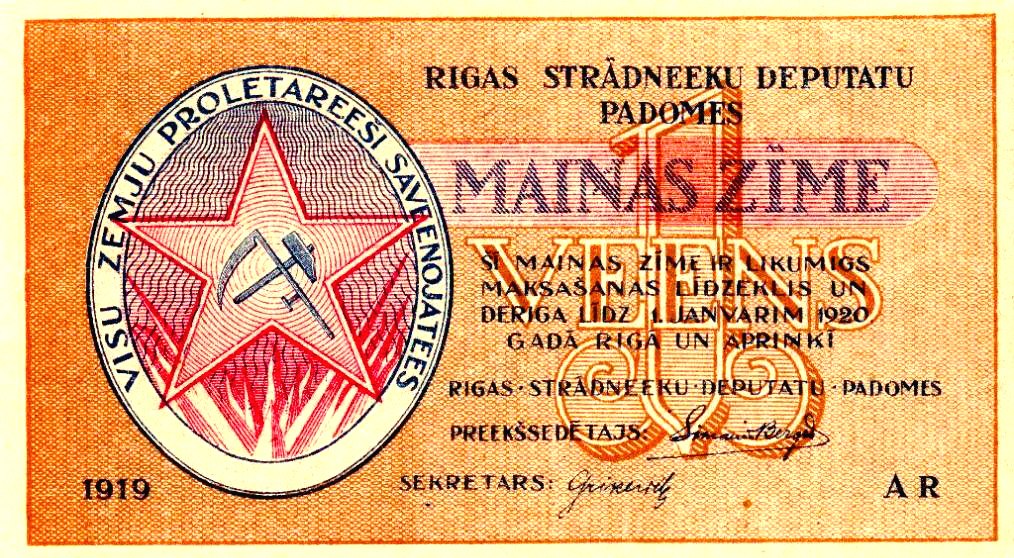
Our government had the full right to call itself a workers’ government: for not only more than half its constituents were really workmen, but also all the standards of payment for all categories of labour were equal–from 400 to 800 roubles (from May 1st 600 to 900 roubles). As a general rule we accepted that the specialists were attached to the commissaries and not the commissaries to the specialist (Excepting only the military department where, according to the general law of the R.S.F.S.R. there exists the opposite regulation).
All the economic departments, for the purpose of simplification called commissariats, were looked upon as sections of a unique Council of Public Economy, which by us was differently organized from that of the R.S.F.S.R. Our Council of Public Economy, under the presidency of the President of the Soviet Government, decided finally all questions of an economic character which had not evoked dissonance. This Council broke up into two (production and exchange or distribution) and eight sections or commissariats (industry, agriculture, labour, public building, ways and means of communication, food, finance and foreign exchange). In such a way we hoped to prevent the disunion of the different departments and mutual friction and parallelism, inevitable under another system.
The central material administration and central bookkeeping, instituted in the Council of Public Economy, were to serve as the principal means of unification of all the economic life of the country, and where in future, the budget of production and consumption of the country, was to be worked out. The Council of Public Economy and Its material administration and central bookkeeping were formed as sections or subsections of a future single complete body, of a more or less extensive International, with the object of attaining a real and rational centralisation.
On the question of our International situation we took from the very first, a firm position, declaring ourselves foreigners only as regards the non-Soviet states. With all the Soviet states we are the most natural and close allies. In the first place, of course, with the R.S.F.S.R., with whose proletariat we are welded together by many years of common struggle. All attempts to infuse dissension amongst our comrades in this respect were fruitless. We always emphasised only a true union and not a union on paper. And we stood up in defence of the natural independency of any Soviet assimilation, especially so under our economic conditions, which differ from those of other parts of Russia. This question–of uniting centralisation with local Soviet–independence is doubtless the most difficult question to solve. But experience has shown that in practice this problem was nearing its solution. From January 3rd until May 22nd, that is for less than five months, our power existed in Riga. It was too much to expect great result in such a short lapse of time. But yet, if in January the representative of the social democrats, Vinning, the German ambassador in Riga assured me that “order was visible in our midst,” and that it was clear to him, that only we, and not the bourgeois democrats had the right to have the power in Latvia, all the more incomprehensible is the calumny about the horrors we were perpetrating in Riga, which this same Vinning and his partisans said about later on. We were obliged to be merciless, having to deal with an unheard of régime of medieval Junkers who ruled here before, and in the first, not yet completed, quarter of the XX century, undertook two punitive expeditions in this country (In 1906 in Russian, and In 1918 in German attire). In answer to the third invasion of these avenging Junkers, this time under the firm of the social democrats Scheidemann and Noske, who brutally destroyed everything that reminded them of the odious communists, not spring even women and children, we were obliged to take recourse to severe measures, even to the shooting of the hostages, consisting of barons and bourgeois, principally the former. We had to punish the avengers of 1906 and 1917 themselves. But whoever knows the local conditions of Latvia will agree that we limited ourselves in this respect to the smallest minimum possible. At the present moment, thanks to Scheidemann, Riga is under the temporary rule of General von der Holz, the commander of Hindenburg’s. troops. And if the rest of the Kaiser’s troops, when leaving Riga in January, set fire to the theatre and to the food stores, the troops of Scheidemann have immortalised their coming by destroying the monument of Marx, by destroying the tombs of the communists and by shooting hundreds of communists and other workmen in Riga and the rest of Latvia.
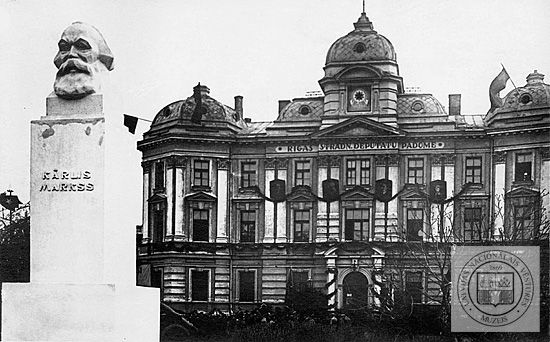
But the German troops will go together with Scheidemann, the truth will be once more confirmed that in Lettland can rule only the feudal barons, or the Soviet power. P. Stoutchka.
The ECCI published the magazine ‘Communist International’ edited by Zinoviev and Karl Radek from 1919 until 1926 irregularly in German, French, Russian, and English. Restarting in 1927 until 1934. Unlike, Inprecorr, CI contained long-form articles by the leading figures of the International as well as proceedings, statements, and notices of the Comintern. No complete run of Communist International is available in English. Both were largely published outside of Soviet territory, with Communist International printed in London, to facilitate distribution and both were major contributors to the Communist press in the U.S. Communist International and Inprecorr are an invaluable English-language source on the history of the Communist International and its sections.
PDF of full issue: https://www.marxists.org/history/international/comintern/ci/old_series/v01-n03-jul-1919-CI-grn-goog-r2.pdf
 Revolution's Newsstand