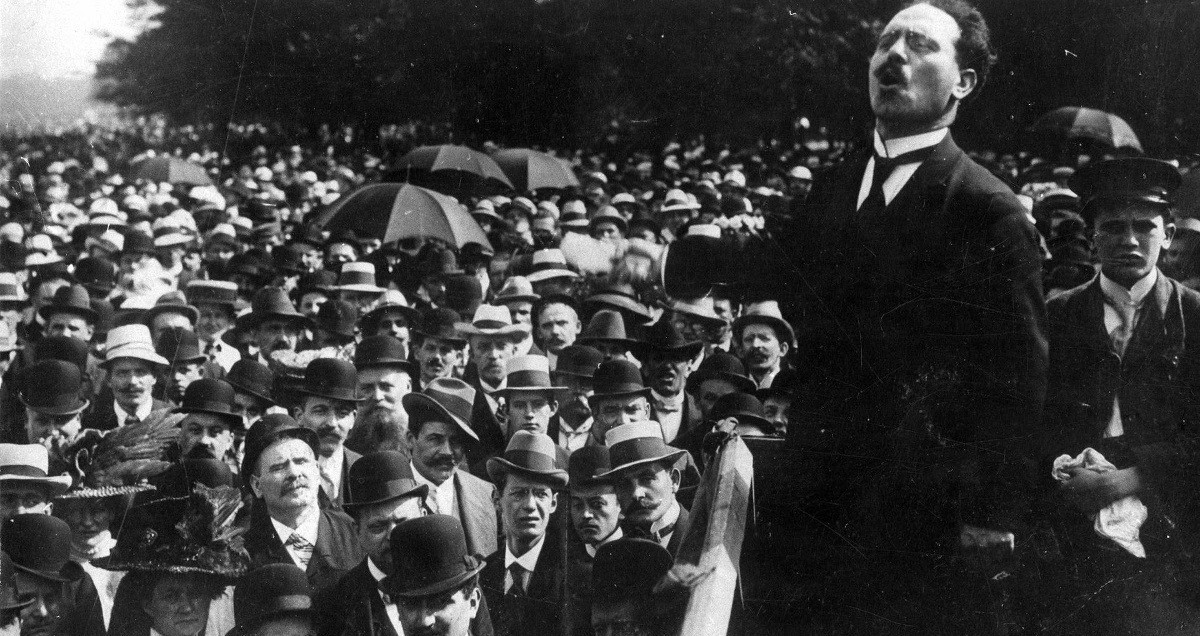
A witness’ account of Liebknecht’s arrest at Berlin’s 1916 May Day rally.
‘Liebknecht’s Defiance’ from International Socialist Review. Vol. 17 No. 3. September, 1916.
LIEBKNECHT’S final offense, which caused his arrest and consequent imprisonment, was delivered before a great Labor Day demonstration in the Potsdamerplatz, in Berlin, on May 1st, of which the following vivid account is given by a Spectator:
“It was two o’clock in the afternoon. Tens of thousands of people in the streets and crowds are coming from everywhere. The strange thing about the gathering is its complete silence. Not a sound is to be heard — only the noise of countless feet. Women and children predominate. The men, for the most part, are of advanced age. Liebknecht is to deliver a speech.” He said:
“Comrades, some time ago a witty Social Democrat observed: ‘We Prussians are a privileged people. We have the right to serve as soldiers, we are entitled to bear upon our shoulders the entire burden of taxation, and we are expected to hold our tongues. So it is. The authorities never cease to call upon us to keep silent. Quite a simple thing — hold your tongue, that’s all. Don’t talk! If you are hungry, don’t talk! If your children starve, don’t talk! They ask for milk — hold your tongue! They ask for bread — don’t say a word!
“Comrades, we are starving, but no one must know it — least of all the soldiers. Such news would weaken the warlike spirit of the fighters, therefore, don’t complain. Women, hide away the truth from your own men! Lie; don’t tell the truth, lest the soldiers in the trenches learn how things stand. Prussian censorship takes good care that this does not happen. Poor German soldier, he really deserves pity. Under the compulsion of a warlike Government he has invaded a foreign country, and is doing his bloody work, suffering untold horrors. Death reigns on the battle-field and his children at home are succumbing to hunger and want. The poor mother is in distress and cannot share her grief with her husband.
“The workers of Germany have to bleed because such is the will of the capitalists, of the superpatriots, of the cannon-makers. The people have to make bloody sacrifices without a murmur in order that these robbers may mint gold out of their valuable lives. The war was ushered in with a lie, so that the workers would rush to the battlefields, and now the lie still presides over the continuance of this awful carnage.”
“Liebknecht had scarcely finished the last sentence when the ranks became disturbed. Something happened. I looked round — endless waves of human heads. Liebknecht is being dropt down from the platform; his comrades follow him. The children are alarmed, the air is full of cries. Then — a movement never to be forgotten. I am lifted off my feet by a human wave and carried aside. The police break into the crowd, they trample many underfoot and throw others to the ground.
“We gather in the evening to discuss the situation. We number between 25 and 30 persons. Almost everybody is a soldier. Some are officers in uniform. Where is Liebknecht? No one knows — not even his wife.”
At his trial and condemnation, which followed in July, the public prosecutor asked that the public be excluded. Liebknecht exclaimed:
“Gentlemen, you are powerful, but you are afraid. You tremble at the effect my poor words might have on the public and on the prudently chosen journalists. You who have at your disposal a force of police, an army, cannon, everything! It is cowardice on your part, gentlemen. Yes, I repeat that you are cowards if you close the doors. You should be ashamed of yourselves.”
Nevertheless, the court decided to exclude the public. Then Liebknecht shouted to his wife and Rosa Luxemburg in the audience: “Leave this comedy, where everything, including even the judgment, has been prepared beforehand! Go away!”
When the crowd waiting outside heard the verdict shouts arose: “Our Liebknecht has been condemned to imprisonment for two and a half years. Long live Liebknecht!” The next day between 50,000 and 60,000 workers in the munitions factories, and especially in the plant of the General Electric company, struck. The manager of the latter concern asked to see a delegation from the strikers. He told them that no political strike would be tolerated and that strikers would be tried by court-martial, but he added that if they desired an increase in wages the company would consider it. The men did not ask for an increase, but after a few days the strike ceased owing to opposition by socialists and syndicalist leaders.
Still there remains great discontent among the masses and some agitators have even been advocating a general strike.
The Berlin newspapers have been forbidden to publish the fact of the arrest of Rosa Luxemburg. She was arrested in the military zone and can thus legally be kept in prison without trial until the end of the state of siege. The news of her arrest, however, was spread by word of mouth throughout Germany.
The International Socialist Review (ISR) was published monthly in Chicago from 1900 until 1918 by Charles H. Kerr and critically loyal to the Socialist Party of America. It is one of the essential publications in U.S. left history. During the editorship of A.M. Simons it was largely theoretical and moderate. In 1908, Charles H. Kerr took over as editor with strong influence from Mary E Marcy. The magazine became the foremost proponent of the SP’s left wing growing to tens of thousands of subscribers. It remained revolutionary in outlook and anti-militarist during World War One. It liberally used photographs and images, with news, theory, arts and organizing in its pages. It articles, reports and essays are an invaluable record of the U.S. class struggle and the development of Marxism in the decades before the Soviet experience. It was closed down in government repression in 1918.
PDF of full issue: https://www.marxists.org/history/usa/pubs/isr/v17n03-sep-1916-ISR-riaz-ocr.pdf
 Revolution's Newsstand