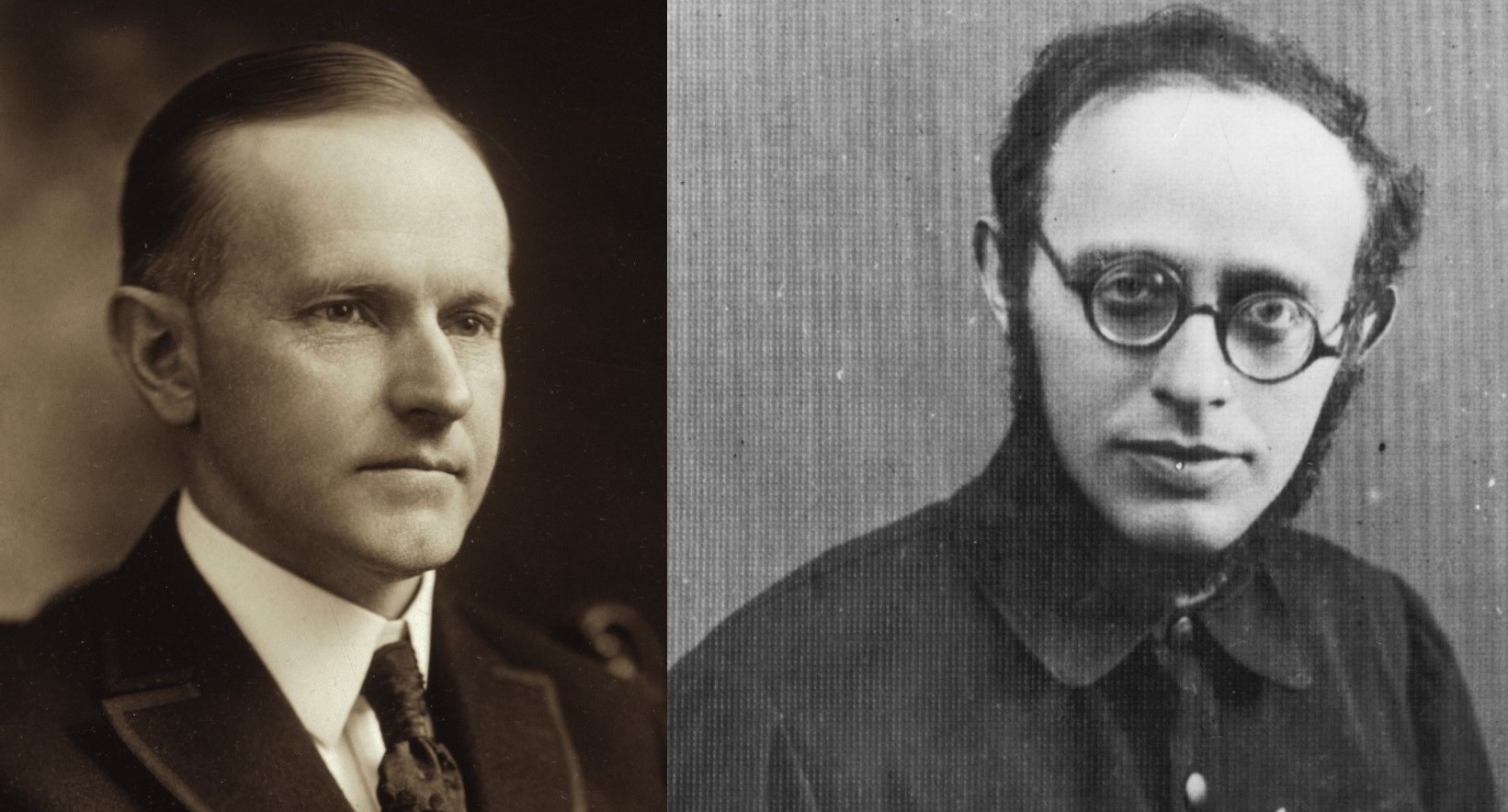
Radek on the Republican victory in the 1924 elections, the post-war export of U.S. capital, and its rivalry with British imperialism.
‘The World Situation at the Opening of the New Year’ by Karl Radek from International Press Correspondence. Vol. 5 No. 2. January 8, 1925.
The election victory of the Republican Party in America was the result of the improvement in the economic situation which took place in summer and autumn last. This victory in turn caused a further improvement in the economic situation. An American journalist who belongs to the Democratic, that is to the defeated Party, wrote: “Our generation knows no other President in whom the financial circles had such great confidence as they have in Coolidge.”
The capitalist world is assured of a government which will be its blind tool.
In order to gain an idea as to the industrial situation in America, we will quote the most important statistical figures. About 2 million shares of 555 industrial and commercial concerns change hands every day on the stock-exchange. These are the highest figures since 1896. The Clearing-house figures in October reached 40 milliard dollars. This again is the highest sum since March 1920. We see along the whole line a reduction in the number of bankruptcies and an increased trade turn-over. The steel industry, which on the 1st of July was working 46% under its normal capacity, has reduced this difference to 14%. The price of steel is rising.
The cause for this revival is to be seen in the high price of corn, which in turn is due to the bad harvest in Canada and in Russia. The price of wheat has reached 1.62 dollars.
The question has even been discussed in some newspapers, whether we are here confronted with a temporary overcoming of economic depression or with the commencement of a great industrial boom.
A great quantity of the capital accumulated in America is not only seeking for new markets for the products of American industry, but also for markets for the direct export of capital. In the year 1923 London issued securities to the value of 2 milliard Gold roubles; 38% English, 41% colonial and 21% foreign. During the year 1923 the United States exported capital to the value of 1200 million gold roubles. In the first ten months of 1924 London issued securities to the value of 1400 million gold roubles; of these, 300 million went abroad. During the same period New York issued securities to the value of 5 milliard roubles, of which more than 2 milliard went abroad. In the search for markets for the export of capital American finance capital has already left English capital behind.
Another very important fact is that this exported capital is not only in the hands of a few bankers or financiers, but that the loans find subscribers among the ranks of the petty and middle bourgeoisie. The Austrian loan, amounting to 50 million gold roubles, found 9000 subscribers; the Japanese loan, amounting to 300 million gold roubles, 44,000 subscribers. The low rate of discount of the American banks has overcome the “fear of the unknown” existing among the middle and petty bourgeoisie; the latter are investing larger sums of money abroad every year.
It is interesting to cast even a fleeting glance at the places to where American capital is being exported. During the first ten months of 1924 the United States lent (reckoned in Gold roubles): 80 millions to Argentina, 300 millions to Japan, 60 millions to Switzerland, 80 millions to Holland, to Czechoslovakia about 20 millions, to Hungary 18 millions, to Norway 50 millions, to Belgium 60 millions, to Canada 280 millions, to Germany 220 millions, to France 200 millions, besides a whole number of municipal and private loans. It is not surprising, therefore, that Coolidge, after his re-election, declared: We cannot hope that we shall always remain an island of the blest which will live apart from the rest of humanity. If we were unable to avoid participation in the war, with the causes of which we had nothing to do (!) how could we think of avoiding responsibility for other world questions which are to be solved in the atmosphere of peace and goodwill?”
We will leave the “peace and goodwill” of Mr. Coolidge aside. The president of America, who was returned to power with the aid of a Party which in the year 1920 defeated Wilson under the slogan of isolation from the rest of the world, expresses in these words the fact that American capital has already penetrated into all countries of the world to such an extent, that to-day it has become one of the most important factors in world politics. The American newspapers are full of articles dealing with the trade of America with the whole world, with the question of the export of capital and with all the conflicting questions of world politics. This is a complete change of front which only becomes intelligible when one has studied the attitude of America to world questions in the period from 1919 to 1922. The United States, after having protected her industries by enormously high tariff walls, is now competing to an ever greater extent with all the other countries of the world, and for this purpose is employing her enormous accumulated capital, the export of which constitutes nothing else than the powerful weapon of long term credits, which America had very unwillingly granted hitherto.
If the question of capital export at present occupies the forefront position in America, in England it is the question of the export of goods which is engaging the greatest attention. The statistician Edgar Crammond, calculates in his recent work that, as a result of the war, the national income of England has become considerably reduced and that from 1914 to the present day if we take into consideration the reduced purchasing power of money it has fallen from 24 to 21 milliards (reckoned in roubles). The present national income is about equal to that of 1907. It is upon this reduced national income that there lies the heavy burden of the enormously increased national debt, with the result that the budget has to be increased fourfold. In consequence of this England, who in the year 1907 was able to devote about 24% of her national income for the extension of the influence of her capital at home and abroad, is now only able to employ about 10% for this purpose.
As English capital is not in a position to compete with America as regards the export of capital for the purpose of capturing markets, and as it does not possess such a big home market as America as would permit it to reduce the cost of production, and in addition is suffering from the industrialising of its own colonies, English capitalism is faced with far more serious difficulties than is American capitalism. The above mentioned Mr. Crammond calculates that the share of England in the trade of the world increased in the period from 1912 to 1922 from 13.8 to 17.3 percent. This increase in the share of England in the world’s trade (in the first place at the cost of Germany) does not, however, correspond to the increase in the total sum of English trade. In 1922 it was 25% lower than in 1912. The necessity for creating the pre-conditions for normal trade was the driving force which caused England to participate in the attempts to solve the reparations question. It is this also which is causing England to strive to restore a firm regime at all costs in her colonies, to “pacify” China and to open the Russian markets. And as the consolidation of the capitalist order in the whole world is equally necessary for the export of capital as for the export of goods, the whole of the year 1924 was characterised by the co-operation of England and America.
“The relative weakness of England in the sphere of capital-export, her close relations with the European markets, is causing
great uneasiness among the English capitalists with regard to the difficulties which English capitalism will encounter in the event of the strengthening of German industry. Hence a number of vital questions regarding the reconstruction of capitalism assume another form to the United States than to England. These differences show the varying degree of interest which England and America have in the colonial questions. The Anglo-American co-operation, in spite of all the compliments of the English statesmen to the United States, has not led to the disappearance of the profound antagonisms between these two powers. One must, however, for the time being reckon that the efforts arising from the greater strength of American capital and from the deep crisis of English capitalism to create favourable conditions in shattered Europe, in the colonies and in the semi-colonial countries for the absorption of goods and for the investment of capital, will not only lead for the time being to the solidarity of these powers against the Soviet Union, as well as against the colonial and semi-colonial peoples, but also to the attempt to create favourable pre-conditions as quickly as possible for the penetration of English and American capital into these countries.
American imperialism is striving to conquer the world; English imperialism is striving to maintain its conquests. A collision between these two will take place in the future. Today, however, they both require at all costs an extension of the world market. These efforts of the two imperialist powers constitute the most characteristic feature of the international situation at the opening of the new year.
International Press Correspondence, widely known as”Inprecorr” was published by the Executive Committee of the Communist International (ECCI) regularly in German and English, occasionally in many other languages, beginning in 1921 and lasting in English until 1938. Inprecorr’s role was to supply translated articles to the English-speaking press of the International from the Comintern’s different sections, as well as news and statements from the ECCI. Many ‘Daily Worker’ and ‘Communist’ articles originated in Inprecorr, and it also published articles by American comrades for use in other countries. It was published at least weekly, and often thrice weekly.
PDF of full issue: https://www.marxists.org/history/international/comintern/inprecor/1925/v05n02-jan-08-1925-inprecor.pdf
 Revolution's Newsstand