Continuing to explore the far-reaching struggle within the United Mine Workers during the late 1920s, consequences of which our class lives with with today. In the recently posted William Z. Foster review of the background to the crisis, he left off anticipating the April 1, 1928 ‘Save-The-Union’ conference. There 1000 militants and anti-Lewis miners declared an all-or-nothing battle against the Lewis regime. Two weeks later and Lewis declared ‘Save-The-Union’ a ‘dual union’ and instructed the national U.M.W.A. to expel all supporters and decertify its locals. Many other critics outside of the Communist sphere were also eliminated. In a few short months, the most committed, energetic builders of the largest, and only national industrial union, were discarded. In September of that year, the Communists and their supporters picked up the pieces to launch the National Miners Union, which, unlike Save-The-Union, was a dual union.
‘The Save-the-Union Conference’ by Jack Lee from Labor Unity. Vol. 2 No. 5. May, 1928.
WHEN for two intense and glorious days, starting at eleven o’clock Sunday morning, April 1, over eleven hundred delegates from local unions of the United Mine Workers of America, and from the unorganized fields, met in the National Save the Miners Union Conference and voted to take the union from its misleaders, to fight and win the year old strike, to call out hundreds of thousands of non-union miners who would follow it but would not follow Lewis into battle, they did something that resulted in such immediate and dramatic events, of such colossal importance that the conference itself seems about to be hidden beneath the spectacle of its deeds.
Yet in more senses than this already mentioned, the Pittsburgh conference was a historic thing. Nothing like it has ever before been attempted in America.
The U.M.W.A. has been the solid base of the American organized labor movement. But nowhere has the destruction of democracy, control by the rank and file, been so apparent and so complete. The conference was held without the participation of a single one of the higher officialdom of the union, all bought up by the Lewis machine. It met in the face of the published threat of Lewis and the larger district officials that everybody attending would be expelled. Local unions endorsed it in the teeth of Lewis’ declaration that their strike relief would be cut off if they did so. It was called after the Senate of the United States had sent an investigation committee to issue a proclamation against the Save-the-Union movement, and to beg the operators to save Mr. Lewis in order that the progressives might not be able to take over the struggle.
The economic difficulties were enormous. Delegates had to come thousands of miles, in some cases, and by auto, for there was no money for railroad fares. Storm and rain and the fact that the miners have not been able to keep their ears in repair kept many away. It is safe to say that the widespread poverty of the coal fields, on strike for a year, kept away at least four times as many as would have come otherwise.
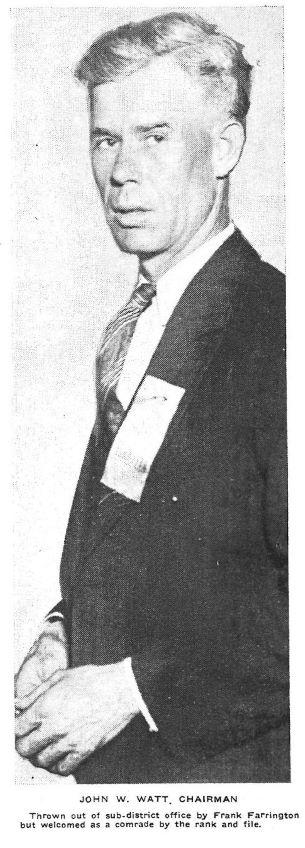
But after Senate, and operators, and Mr. Lewis and Mr. Fagan, president of District 5 (Pittsburgh) had denounced the Save-the-Union movement as everything from “only an April Fool joke” (Fagan) to ”foreign Red propaganda” (Lewis and the Senate) 1125 delegates that John W. Watt called to order Sunday morning met in a real council of war.
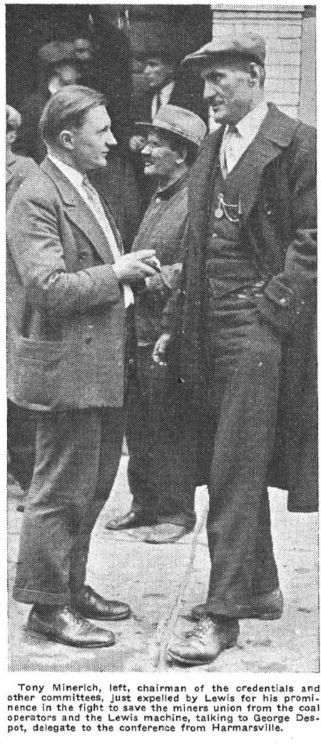
Tony Mlnerich, chairman of the credentials and. other committees, just expelled by Lewis for his prominence in the fight to save the miners union from the coal operators and the Lewis machine, talking to George Despot, delegate to the conference from Harmarsville.
which lasted to the motion to adjourn late Monday night.
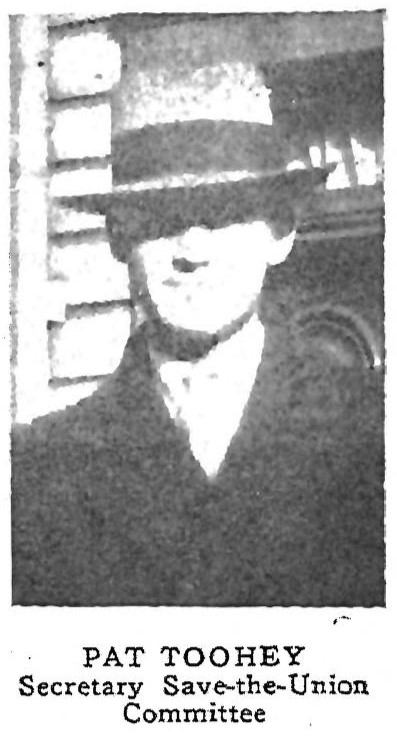
Watt, himself, gray and gaunt with the struggle, but strong and fighting fit, stood on the platform and looked with a smile over grim miners’ faces, miners packing the floor of the largest hall that could be obtained in Pittsburgh, packing the galleries where visitors would have been if there were any room for visitors, and thronging steadily in to stand in the aisles and round the walls. On the second day the committee sent in huge painted banners, “Lewis Must Go!” “Organize the Unorganized,” “Spread the Strike.” “Save the Union.” The banners echoed the keynote struck in every speech on the first day. The conference organized with a minimum of confusion and effort: Watt, chairman; Pat Toohey, secretary; David Jones, assistant sec’y; a rules committee, credentials committee, program and resolutions committee; committee on strike situation, committee on organization of unorganized, committee on organization, finance and press.
Business started at once. In fact, it had already started the night before when the delegations had met by districts, elected five representatives from each district on a provisional National Save-the-Union Committee, (the conference re-elected them all), and read and adopted the program drawn up by the Save-the-Union Committee calling the meeting.
“Take Over The Union”
After a long and keen analysis of the situation, this program contained three decisive paragraphs, fighting paragraphs, open declaration of war against the operators and their hirelings, the misleaders of the union, as follows:
“To put the U.M.W.A. into honest hands we propose the following procedure: The Save the Union movement in the various districts shall at once through the local unions insist upon the calling of special emergency district conventions, carefully guarding against any packing methods by the Lewis machine. In the event of refusal or delay by the present district officials in calling such conventions, the respective Save the Union movements shall themselves call the conventions. At these emergency district conventions the offices of Lewis machine supporters shall be declared vacant and new officers, representative of the membership, shall be elected. In the local unions new officers shall be elected in place of the proved Lewis supporters. After the district conventions the national convention of the U.M.W.A. shall be organized on the same principles.”
Then a call for mass picketing and mass violation of injunctions both of which policies the Lewis machine has sabotaged, and for strike on April 1 of Illinois, Indiana and Kansas, the districts forced to make a separate, strikebreaking peace with the operators by Lewis, and after that the call to the unorganized to join the strike:
“The Save the Union movement is carrying on extensive organization work in the unorganized districts. This is already far advanced in Somerset, Fayette, Greene, and Westmoreland counties in Pennsylvania. The National Conference endorses the call issued by the National Save the Union Committee for a strike of these miners on April 16th. This strike must be a mass turn out. It will go far to win the whole battle of the miners. The unorganized miners of West Virginia, Kentucky, and other unorganized districts are urged to unite under the leadership of the Save the Union Committee and to prepare to defend your interests and to help win the present decisive strike The Save the Union movement pledges you its most loyal support.”
On the second day, after a long debate, the conference decided to also call the anthracite on strike just as soon as the necessary preparatory work could be done.
The conference adopted the entire program with cheers, many with a sigh of relief. Not a single dissenting vote. Old men, worn with the struggle against the treason of the Lewis machine, weary of expulsions and suppression at conventions and union meetings, sick of Lewis’ crude vote stealing and packing of conventions, breathed cleaner air at once, whispered their renewed zeal to their neighbors.
Young miners, the first leaders in this campaign, felt their early ardor justified. This is a fight to the finish, and everybody present knew what he was undertaking.
Brophy Analyses
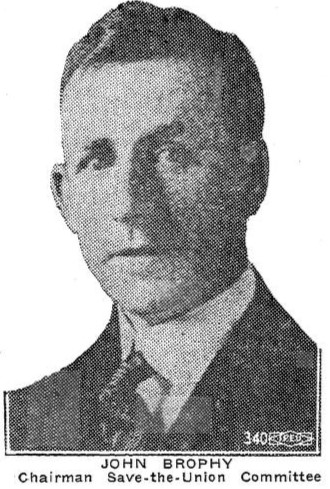
Brophy spoke, as chairman of the National Save-the-Union Committee. Brophy is the man Lewis counted out in the 1926 elections for international president.
“In its whole life,” said Brophy, “the union never faced such a crisis as today, and the fault lies with the Lewis policies.”
He recounted the story of the 1922 strike, when the union at the peak of its power was led into a humiliating “arbitration” by President Harding, and President Lewis, an arbitration which couldn’t be forced on the miners after all.
Lewis’ position in this strike, Brophy proved by many instances, was the same he has openly held since, namely, to split the union up into as many fragments as possible. He wanted to settle with any company that would settle and let the more difficult districts, wait, and starve, and lose to the operators. Brophy told how Lewis finally had his way at the Cleveland convention, dragooning the other districts into abandoning the coke fields, and even to such plain treason as allowing a company to sign up part of its mines and use them to scab on the mines which it did not sign up. The Consolidation Coal Company (Rockefeller’s company) had mines in Northern West Virginia which it signed. Its mines in Maryland and Pennsylvania were kept scab. The Bethlehem Mines Corporation was privileged to sign up some of its mines only. The Weaver interests mines in Pennsylvania and West Virginia signed up in one state and scabbed in the other. The Hillman Coal Company, broke the strike of its coke coal miners but signed its bituminous miners. The U.S. Fuel Company of Illinois owned by the U.S. Steel Company, signed 3,000 men, and the H.G. Frick Coal and Coke Company, also owned by the U.S. Steel Company, scabbed on 18,000 men in Pennsylvania, etc.
“We meet today,” said Brophy, in “defiance to the officialdom to end this sort of thing. Voices call us dual unionists and agents of the employers, but the presence of these delegates showing the feeling of the rank-and-file shows that we are only saving our union and the officials are wrong. Two hundred thousand men have already expressed lack of confidence in the Lewis methods by leaving the union.”
He spoke for a labor party, for violation of injunctions.
Lewis’ plan to starve 250,000 men out of the mining industry, at a time too, when all other industries were cutting down their forces, came in for most sarcastic treatment.
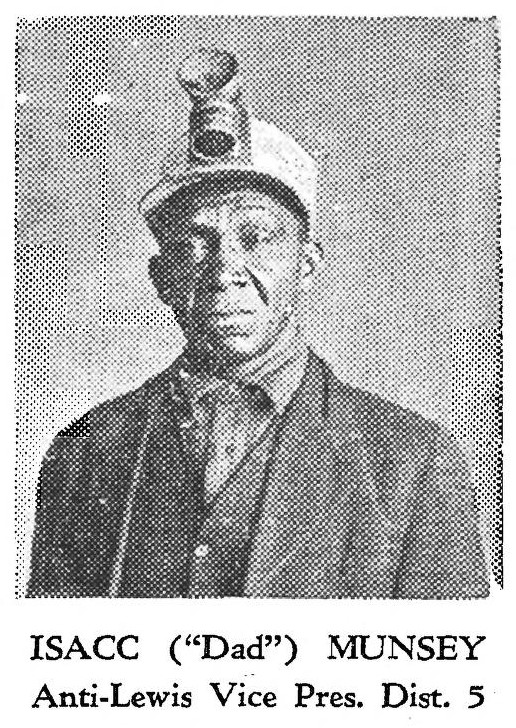
‘If our union is to be saved,” declared Brophy, “it will not be done by Senate investigations. The Senate will never organize the unorganized, and that is our key problem.”
“The strike must be won. April 1 gives us the best chance. The progressives have the leadership more and more. Their program will be accepted by the miners. New hopes and illusions will not do. But carrying the fight into the non union fields will win and we welcome Illinois and the other signed up territories back into the struggle.”
Pat Toohey, Secretary of the National Save-the-Union Committee also reporting for the committee struck responsive chords when he said: “We are here for only one purpose: to save the Miner’s union, to win and spread the strike and to oust the gang of reactionaries who are leading it to destruction.
“The reactionaries,” continued Toohey, “are the agents in our union of the coal operators like Schwab, Rockefeller, Warden and Mellon. The union faces the most serious crisis in its history, and we meet with the determination that these 1,100 miners, representatives gathered from all parts of America and Canada to discuss among themselves, in the absence of their $11,000 a year labor fakers who are betraying the miners, who have lost the union, who are wrecking the union, to meet today to plan ways and means of saving this union, the remnants of it, of building it, of saving their conditions and getting better conditions, and bringing our union back to itself where it was before these reactionary thieves took control of it.
“John L. Lewis was never elected to the presidency of the Union,” said Toohey as the conference roared “No!” in agreement, “for he stole the election from Alex Howatt in 1922, he stole the election from Voyzey in 1924, and he stole the election from John Brophy in 1926. He has instituted a Mussolini regime in the unions, a regime of sluggings, of evictions and of beating down and terrorising the rank and file.
Toohey turned to the story of the courageous fight of the Pennsylvania and Ohio miners, and spoke of how they were holding out against the terrific odds of the coal and iron police, the clubbings, the jails, the injunctions, and the courts, the hunger and cold of the barracks and the miserable relief of $1 a week given them by their highly paid officials. Their conditions have led them to thinking more and more that they must do something to prevent the complete smashing of the union by the operators ana their union tools.
Toohey spoke of the unorganized fields, where, as in Westmoreland, Pa., county, there is no tonnage and no check-weighman, and where, as the miners say, ‘We load coal by the acre’. The miners are being paid as low as 85 and 95 cents per car, which is described as a “streetcar”, and there is no pay for deadweight. “The non-union fields,” he said “are our central problem.”
“Miners, take control of your union! We propose that on the return of the delegations they begin organizing the forces of the rank and file and demand the union “If there is any split, it will not be we but the reactionaries who will bear the responsibility for it by their policy of discrimination, expulsions and victimization. It is true that we vote, but it is they who count the votes. The rank and file/’ he concluded, “are we the Save-the-Union movement and that is our assurance of victory in the fight to win the strike, to oust the Lewis machine. Save-the-Union and reestablish it as a powerful force in the mining industry.”
After Toohey’s statement and during his entire speech tremendous applause rocked the hall.
The details of the speeches that followed were different, but the sense was the same. Each speaker related new instances of Lewis treachery, of its evil results for the union, but all were united on the main point–“The Union Must Be Saved From The Coal Operators and From Lewis.”
The Pittston Murders
Stanley Dziengliewski from Pittston told of the Lewis-Cappellini program of murder and frame up there: when progressives win control of a union, gunmen kill three of them, wound another, and frame up three on murder charges, Tom Parry, of Illinois, expelled by Fishwick and Farrington; George Voyzey, counted out by Lewis when he ran for international president in 1924, Wakefield of Kansas, where Lewis expelled the officials for fighting the antistrike law; and many others of the rank and fife added their voice to the indictment of Lewis and his clique. Anthony Minerich, reporting as chairman of some of the most important committees, spoke again and again, militant, direct, common sense, he had just been expelled, Lewis’ first victim, for attending the conference.
Joe Angelo of Springfield introduced a resolution; he was carrying the marks of a slugging by the machine thugs. Powers Hapgood was chairman of a committee; he was out on bail arrested for activity in defense of Bonito, Menciola and Moleski.
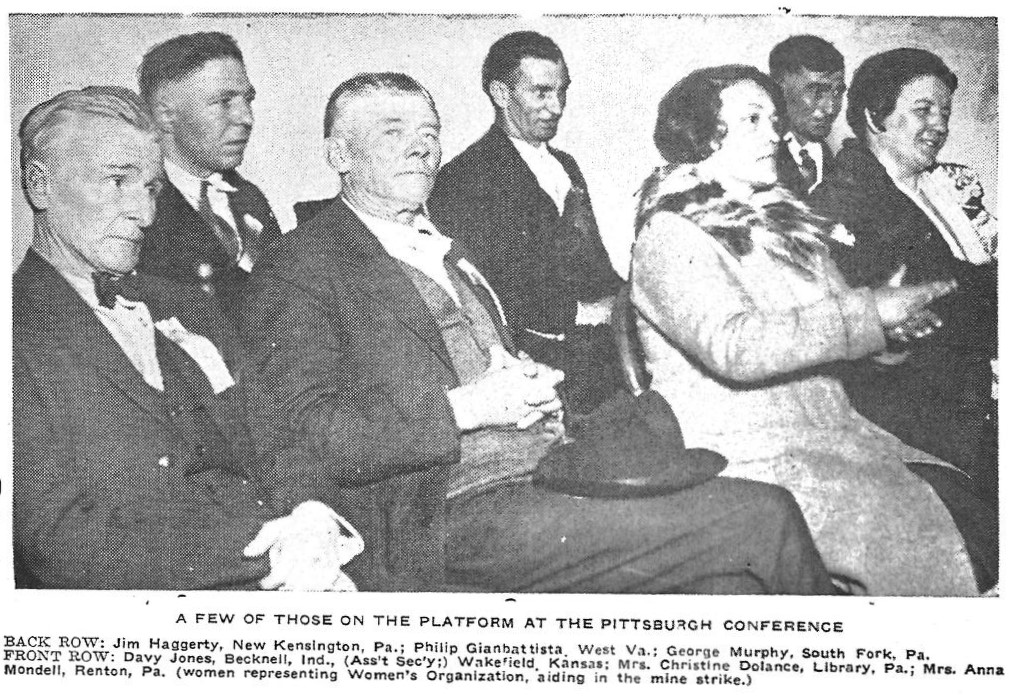
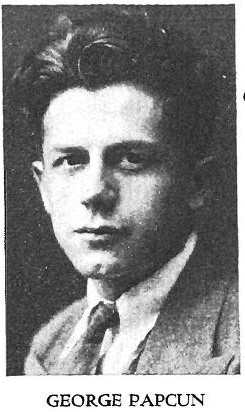
Two days of this, and meanwhile speeches on the young miners, by George Papcun; on the miners’ children; by 12-year-old John Foley, representing Mollenauer strikers’ children’s clubs, on women by Mrs. Dolence and Mrs. Mondell of the Women’s Progressive Committee, on Negro miners, by Wm. Boyce. The conference adopted resolutions and amendments t o the program co-ordinating all this activity, recognizing the need of the negro miners for equal work for equal pay, and equal rights in the union, which Lewis has deprived them of, drawing the youth organizations and the women’s organizations into the strike activity.
The attitude of the entire conference towards the Negro miners was cordial and fraternal in the extreme, and Negro delegates representing both white and negro miners took a prominent part in proceedings.
Coal Digger Endorsed
The Coal Digger, militant organ of the Save-the-Union Committee, published at 526 Federal St., Pittsburgh, was endorsed, and many in the conference gave their last dollar for a subscription. Money was showered upon the stage.

A skeleton organization for the unorganized was provided as follows:
“…a complete network of mine, local, subdistrict, and district committees among ththe unorganized. Secretaries shall be elected by these committees who shall be properly connected with e National Save the Union Committee. These committees shall carry on intensive work to unite the unorganized miners around them.
“The next step shall be the organization of district and local conventions for the purpose of definitely organizing these miners into unions. These newly formed unions shall be under the general direction of the National Save the Union Committee until they can be brought into the U.M.W.A. under honest and reliable leadership. Under no circumstances shall they be turned over to Lewis’ henchmen.”
And that is that. Let Lewis call it a dual union if he wants to; when he is eliminated, it will be part of the United Mine Workers of America.
Lewis has cut loose from the safety of Washington with a fierce and incoherent denunciation of the National Save-the-Miners” Union Conference. He calls it Communistic, he pretends also it intends to hurt the strike — as if anything had been left undone by Lewis to injure the strike.
The miners will know very well how little credence to give Lewis.
The General Attitude
The attitude of the capitalists and the machine was one of great bewilderment. The hard-boiled New York press hardly mentioned the conference. The Chicago Tribune, closer at hand gave it columns of space. The local Pittsburgh papers gave it their main headlines. The farther away you got from it, the easier it was to follow Lewis’ lead, that the Conference amounted to nothing. In the coal states it could not be disregarded.
The Workers Party papers supported the Conference completely. The Socialists split on it, the New Leader recognizing it as a bona fide struggle of the miners, but deploring its “Red leadership”, the Forwards condemning it outright. The I.W.W. which scoffed and jeered at it throughout its making, was forced into some grudging admiration at its success, the Wobbly attitude is almost that of the New Leader. The liberal Nation published special, and accurate articles on the Conference.
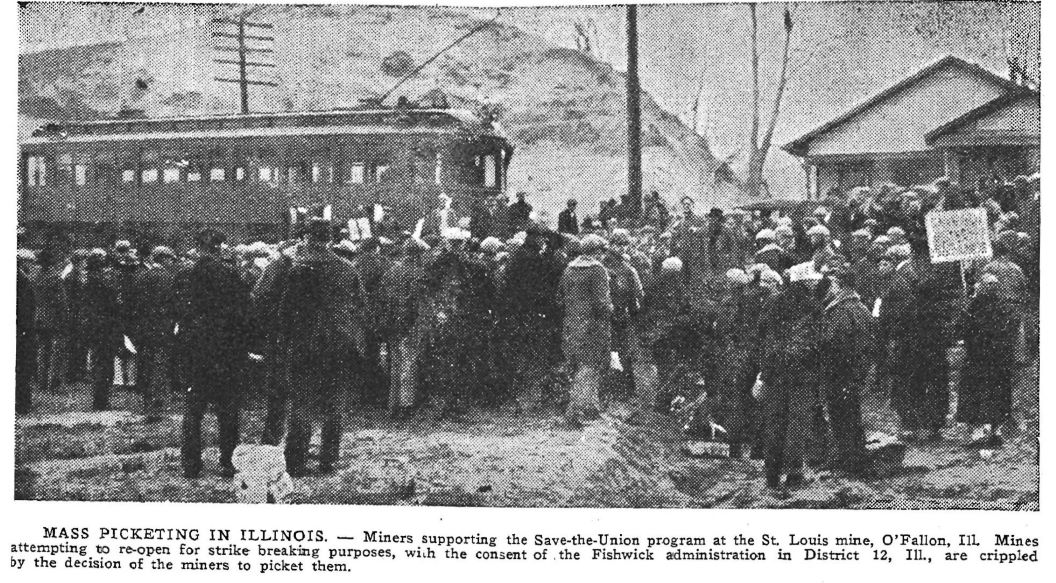
The miners need publicity because they need relief, and the solidarity of labor to win this strike. One of the things they spent most time on was the discussion of relief. Lewis is going to cut off relief right and left, to evict miners from union barracks, to try to starve his rebellious union members into submission. The Conference moved to appeal to the whole labor movement for relief and solidarity. If they get it they will win in spite of Lewis, the operators and the injunctions.
Labor Unity was the monthly journal of the Trade Union Educational League (TUEL), which sought to radically transform existing unions, and from 1929, the Trade Union Unity League which sought to challenge them with new “red unions.” The Leagues were industrial union organizations of the Communist Party of the United States (CPUSA) and the American affiliate to the Red International of Labor Unions. The TUUL was wound up with the Third Period and the beginning of the Popular Front era in 1935.
PDF of full issue: https://www.marxists.org/history/usa/pubs/labor-unity/v2n04-w23-may-1928-TUUL-labor-unity.pdf
 Revolution's Newsstand