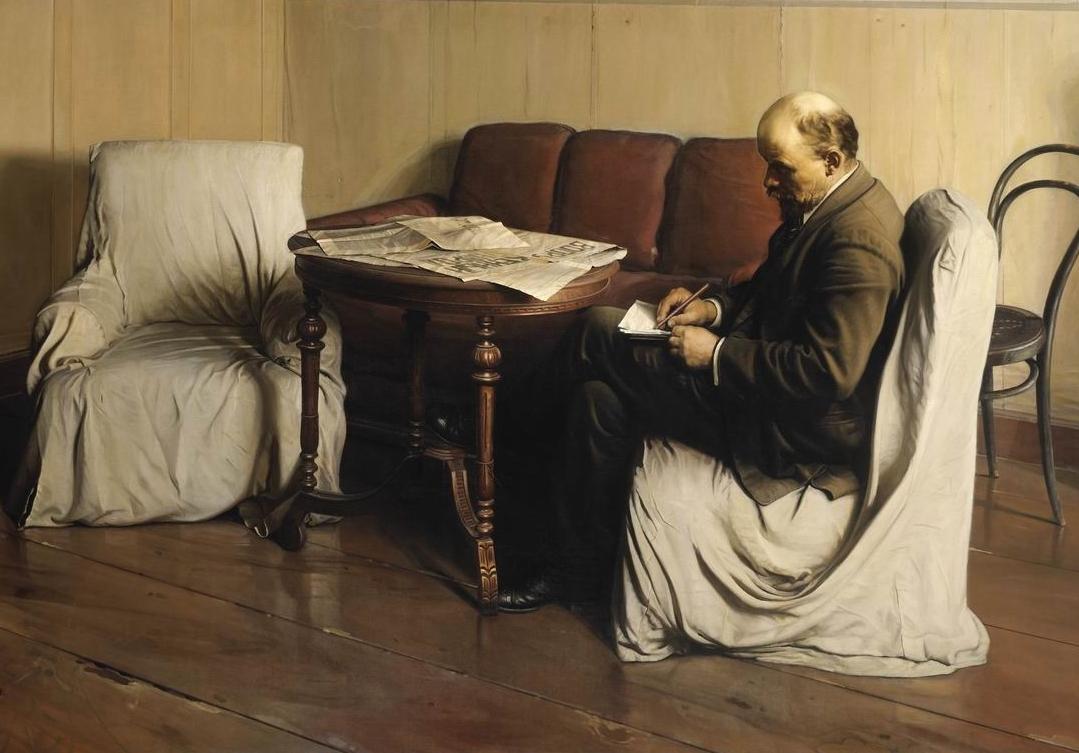
While certainly no ‘New Atheist,’ neither was Lenin a proponent of religious agnosticism in Soviet education and propaganda. Such views could not be reconciled with Marxism’s militant, dialectical materialism, as ‘millions…who have been condemned by all modern society to darkness, ignorance and prejudice, can emancipate themselves from this darkness only along the straight line of a purely Marxist education…’
‘The Significance of Militant Materialism’ (1922) by V.I. Lenin from Selected Works, Vol. 11. International Publishers, 1937.
ALL that is essential about the general tasks of the magazine Under the Banner of Marxism has already been said by Comrade Trotsky in No. 1-2, and said very aptly. I should like to dwell on certain questions that more closely define the content and programme of the work set forth by the editors of the magazine in the introductory announcement to No. 1-2.
This announcement states that not all those gathered around the magazine Under the Banner of Marxism are Communists, but that they are all consistent materialists. I think that this alliance of Communists and non-Communists is absolutely essential and correctly defines the tasks of the magazine. One of the biggest and most dangerous mistakes of Communists (as generally of revolutionaries who have successfully accomplished the beginning of a great revolution) is the idea that a revolution can be made by revolutionaries alone, On the contrary, to be successful every serious revolutionary work requires the understanding and translation into action of the idea that revolutionaries are capable of playing the part only of the vanguard of the truly virile and advanced class. A vanguard performs its task as vanguard only when it is able to avoid becoming divorced from the masses it leads and is able really to lead the whole mass forward. Without an alliance with non-Communists in the most varied spheres of activity there can be no question of any successful Communist constructive work.
This likewise refers to the work of defending materialism and Marxism which has been undertaken by the magazine Under the Banner of Marxism, Fortunately, the main trends of advanced social thought in Russia have a solid materialist tradition. To say nothing of G.V. Plekhanov, it is enough to mention Chernyshevsky, from whom the modern Narodniks (the Populist Socialists, Socialist-Revolutionaries, etc.) have retreated frequently in a quest for fashionable reactionary philosophical doctrines, captivated by the tinsel of the so-called “last word” in European science and unable to discern beneath this tinsel one or another variety of servility to the bourgeoisie, bourgeois prejudice and bourgeois reaction.
At any rate, in Russia we still have—and shall undoubtedly have for a fairly long time to come—materialists from the non-Communist camp, and it is our absolute duty to enlist all adherents of consistent and militant materialism in the joint work of combating philosophical reaction and the philosophical prejudices of so-called “educated society.” Dietzgen senior—not to be confused with his writer son, who was as pretentious as he was unsuccessful—correctly, aptly and clearly expressed the fundamental Marxist view of the philosophical trends which prevail in bourgeois countries and which enjoy the attention of their scientists and publicists, when he said that in effect the professors of philosophy in modern society are in the majority of cases nothing but the “graduated flunkeys of clericalism.”
Our Russian intellectuals. who are fond of thinking themselves advanced, as indeed their brethren in all other countries, are very much averse to shifting the question to the plane of the opinion expressed in Dietzgen’s words. But they are averse to it because they cannot look the truth in the face. One has only to reflect ever so little on the governmental, general economic, social and every other kind of dependence of modern educated people on the ruling bourgeoisie to realise that Dietzgen’s mordant description was absolutely true. One has only to recall the vast majority of the fashionable philosophical trends that arise so frequently in European countries, beginning for example with those connected with the discovery of radium and ending with those which seek to clutch hold of Einstein, to gain an idea of the connection between the class interests and the class position of the bourgeoisie and its support of all forms of religion on the one hand, and the ideological content of the fashionable philosophical trends on the other.
It will be seen from what has been said that a magazine that sets out to be an organ of militant materialism must be a fighting organ in the first place, in the sense of unflinchingly exposing and indicting all modern “graduated flunkeys of clericalism,” irrespective of whether they appear as the representatives of official science or as freelances calling themselves “democratic Left or ideologically Socialist” publicists.
In the second place, such a magazine must be an organ of militant atheism. We have departments, or at least state institutions, which are in charge of this work. But this work is being carried on extremely apathetically and extremely unsatisfactorily, and is apparently suffering from the general conditions of our truly Russian (even though Soviet) bureaucracy. It is therefore highly essential that in addition to the work of these state institutions, and in order to improve and infuse life into this work, a magazine which sects out to he an organ of militant materialism should carry on untiring atheist propaganda and an untiring atheist fight. The literature on the subject in all languages should be carefully followed and everything at all valuable in this sphere should be translated, or at least reviewed.
Engels long ago advised the leaders of the modern proletariat to translate for mass distribution among the people the militant atheist literature of the end of the eighteenth century. To our shame be it said, we have not done this up to the present (one of the numerous proofs that it is easier to win power in a revolutionary epoch than to know how to use this power properly), Our empathy, inactivity and incapacity are sometimes excused on all sorts of “lofty” grounds. as, for example, that the old atheist literature of the eighteenth century is antiquated, unscientific, naive, etc. There is nothing worse than such pseudo-scientific sophistries, which serve to conceal either pedantry or a complete misunderstanding of Marxism. There is, of course, much that is unscientific and naive in the atheist writings of the revolutionaries of the eighteenth century. But nobody prevents the publishers of these writings from abridging them and providing them with brief postscripts pointing out the progress made by mankind since the end of the eighteenth century in the scientific criticism of religions, mentioning the latest writings on the subject, and so forth. It would be the biggest and most grievous mistake a Marxist could make to think that the millions (especially the peasants and artisans}, who have been condemned by all modern society to darkness, ignorance and prejudice, can emancipate themselves from this darkness only along the straight line of a purely Marxist education. These millions should be supplied with the most varied atheist propaganda material, they should be made acquainted with facts from the most varied spheres of life, they should be approached in this way and in that way, so as to interest them, rouse them from their religious torpor, stir them from the most varied angles and by the most varied methods, and so forth.
The keen, vivacious and talented writings of the old atheists of the eighteenth century, which wittily and openly attacked the prevailing clericalism, will very often prove to he a thousand times more suitable for arousing people from their religious torpor than the dull and dry paraphrases of Marxism, almost completely unillustrated by skillfully selected facts, which predominate in our literature and which (it is no use hiding the fact) frequently distort Marxism. We have translations of all the bigger works of Marx and Engels. There are absolutely no grounds for fearing that the old atheism and old materialism may remain unsupplemented by the corrections introduced by Marx and Engels. The most important thing—and this is most frequently overlooked by our would-be Marxian Communists, who in fact mutilate Marxism— is to know how to awaken in the still quite undeveloped masses a conscious interest in religious questions and a conscious criticism of religion.
On the other hand, take a glance at the representatives of the modern scientific criticism of religion. These representatives of the educated bourgeoisie almost invariably “supplement” their own refutations of religious prejudices by arguments which immediately expose them as ideological slaves of the bourgeoisie, as “graduated flunkeys of clericalism.”
Two examples. Professor R.Y. Vipper published in 1918 a little book entitled The Origin of Christianity (Pharos Publishing House, Moscow). While giving an account of the principal results of modern science, the author not only refrains from combating the prejudices and deception which are the weapons of the church as a political organisation, not only evades these questions, but announces the simply ridiculous and most reactionary claim that he rises superior to both “extremes”—the idealist and the materialist. This is toadying to the ruling bourgeoisie, which all over the world devotes hundreds of millions of rubles from the profits squeezed out of the toilers to the support of religion.
The well-known German scientist, Arthur Drews, while refuting the religious prejudices and fables in his book, The Christ Myth, and while proving that Christ never existed, at the end of the book declares in favour of religion. albeit a renovated, purified and more subtle religion, one that would be capable of withstanding “the daily growing naturalistic torrent” (fourth German edition, 1910, p. 238). Here we have an outspoken and deliberate reactionary who is openly helping the exploiters to replace the old and decayed religious prejudices by new, more odious and vile prejudices.
This does not mean that Drews should not be translated. It means that while in a certain measure effecting their alliance with the progressive section of the bourgeoisie, Communists, and all consistent materialists, should unflinchingly expose it when it is guilty of reaction. It means that to shun an alliance with the representatives of the bourgeoisie of the eighteenth century, i.e., ‘the period when it was revolutionary, would be to betray Marxism and materialism; for an “alliance” with the Drewses, in one form or another and in one degree or another, is essential for our struggle against the ruling religious obscurantists.
The magazine Under the Banner of Marxism, which sets out to be an organ of militant materialism, must devote a lot of space to atheist propaganda, to reviews of the literature on the subject and to correcting the immense shortcomings of our governmental work in this field. It is particularly important to utilise books and pamphlets which contain many concrete facts and comparisons showing how the class interests and class organisations of the modern bourgeoisie are connected with the organisations of religious institutions and religious propaganda.
Extremely important is all material relating to the United States of America, where the official, state connection between religion and capital is less manifest. But on the other hand, it makes it clearer to us that so-called “modern democracy” (which the Mensheviks, the Socialist-Revolutionaries, partly also the anarchists, etc., so unreasonably worship) is nothing but the freedom to preach what it is to the advantage of the bourgeoisie to preach, namely, the most reactionary ideas, religion, obscurantism, de fence of the exploiters, etc.
One would like to hope that a magazine which sets out to be an organ of militant materialism will provide our reading public with reviews of atheist literature, showing for which circle of readers any particular writing might be suitable and in what respect, and mentioning what literature has been published in our country (only decent translations should be noticed. and they are not so many) and what should still be published.
In addition to the alliance with consistent materialists who do not belong to the Communist Party, of no less’ and perhaps even of more importance for the work which militant materialism should perform is an alliance with those representatives of modern natural science who incline towards materialism and are not afraid to defend and preach it as against the modish philosophical wanderings into idealism and skepticism which are prevalent in so-called “educated society.”
The article by A. Timiryazev on Einstein’s theory of relativity published in Under the Banner of Marxism, No. 1-2, permits us to hope that the magazine will succeed in effecting this second alliance too, Greater attention should be paid to it. It should be remembered that it is precisely the abrupt change which modern natural science is undergoing that very often gives rise to reactionary philosophical schools and minor schools, trends and minor trends. Therefore, unless the problems raised by the recent revolution in natural science are followed, and unless natural scientists are enlisted in this work of a philosophical magazine, militant materialism can be neither militant nor materialism. While Timiryazev was obliged to observe in the first number of the magazine that the theory of Einstein, who, according to Timiryazev, is himself not making any active attack on the foundations of materialism has already been seized upon by a vast number of representatives of the bourgeois intelligentsia of all countries, it should be noted that this applies not only to Einstein, but to a number, if not to the majority, of the great reformers of natural science since the end of the nineteenth century.
And in order that our attitude towards this phenomenon may not be an uninformed one, it must he realised that unless it stands on a solid philosophical ground no natural science and no materialism can hold its own in the struggle against the onslaught of bourgeois ideas and the restoration of the bourgeois world outlook. In order to hold its own in this struggle and to carry it to a victorious finish, the natural scientist must be a modern materialist, a conscious adherent of the materialism which is represented by Marx. i.e., he must be a dialectical materialist. In order to attain this aim, the contributors to the magazine Under the Banner of Marxism must arrange for the systematic study of Hegelian dialectics from a materialist standpoint, i.e., the dialectics which Marx applied practically in his Capital and in his historical and political works, and applied so successfully that now every day of the awakening to life and struggle of new classes in the East (Japan, India and China)—i.e., the hundreds of millions of human beings who form the greater part of the population of the world and whose historical passivity and historical torpor have hitherto been conditions responsible for stagnation and decay in many advanced European countries—every day of the awakening to life of new peoples and new classes serves as a fresh confirmation of Marxism.
Of course, this study, this interpretation, this propaganda of Hegelian dialectics is extremely difficult, and the first experiments in this direction will undoubtedly be accompanied by errors. But only he who never does anything never commits errors. Taking as our basis Marx’s method of applying the Hegelian dialectics materialistically conceived, we can and should treat this dialectics from all sides, print excerpts from Hegel’s principal works in the magazine. interpret them materialistically and comment on them with the help of examples of the way Marx applied dialectics, as well as of examples of dialectics in the sphere of economic and political relations, which recent history, especially modern imperialist war and revolution, is providing in unusual abundance. The group of editors and contributors of the magazine Under the Banner of Marxism should, in my opinion, be a kind of “Society of Materialist Friends of Hegelian Dialectics.” Modern natural scientists will find (if they know how to seek, and if we learn to help them) in the Hegelian dialectics materialistically interpreted a series of answers to the philosophical problems which are being raised by the revolution in natural science and which make the intellectual admirers of bourgeois fashion “stumble” into reaction.
Unless it sets itself such a task, and systematically fulfils it, materialism cannot be militant materialism. It will be not so much the combatant as the combated, to use an expression of Shchedrin’s. Without this, great natural scientists will as often as hitherto be helpless in making their philosophical deductions and generalisations. For natural science is progressing so fast and is undergoing such a profound revolutionary change in all spheres that it cannot possibly dispense with philosophical deductions.
In conclusion, I will cite an example which, while not related to the domain of philosophy, is at any rate related to the domain of social questions, to which the magazine Under the Banner of Marxism also desires to devote attention.
It is an example of the way in which modern pseudo-science serves in effect as a vehicle for the grossest and most infamous reactionary views.
I was recently sent a copy of the Economist, No. 1 (1922), published by the Eleventh Department of the Russian Technical Society. The young Communist who sent me this journal (he probably had no time to acquaint himself with its contents) rashly expressed an exceedingly sympathetic opinion of it. In reality the journal is—I do not know how deliberately—an organ of the modern feudalists, disguised of course under a cloak of science, democracy and. so forth.
A certain Mr. P.A. Sorokin publishes in this journal an extensive so-called “sociological” enquiry into “The Influence of the War.” This scientific article abounds in scientific references to the “sociological” works of the author and his numerous teachers and colleagues abroad. Here is an example of his science. On page 83 I read:
“For every 10,000 marriages in Petrograd there are now 92.2 divorces— a fantastic figure. Of every 100 annulled marriages, 51.1 had lasted less than one year, 11 per cent less than one month, 22 per cent less than two months, 41 per cent less than three to six months and only 26 per cent over six months, These figures show that modern legal marriage is a form which conceals what is in effect extra-conjugal sexual intercourse, enabling lovers of ‘strawberries’ to satisfy their ‘appetites’ in a ‘legal’ way” (Economist, No. 1, page 83).
Both this gentleman and the Russian Technical Society which publishes this journal and gives space to this kind of argument no doubt regard themselves as adherents of democracy and would consider it a great insult to be called what they are in fact, namely, feudalists, reactionaries and “graduated flunkeys of clericalism.”
Even the slightest acquaintance with the legislation of bourgeois countries on marriage, divorce and children born out of wedlock, and with the actual state of affairs in this respect, is enough to show anyone interested in the subject that modern bourgeois democracy, even in the most democratic bourgeois republics, exhibits a truly feudal attitude in this respect towards women and towards children born out of wedlock.
This of course does not prevent the Mensheviks, the Socialist Revolutionaries, a part of the anarchists and the corresponding parties in the West from shouting about democracy and how it is being violated by the Bolsheviks. But as a matter of fact the Bolshevik revolution is the only consistently democratic revolution in respect to such questions as marriage, divorce and the position of children born out of wedlock. And this is a question which in a most direct manner affects the interests of more than half the population of any country. The Bolshevik revolution, in spite of the vast number of bourgeois revolutions which preceded it and which call themselves democratic, was the first and only revolution to wage a resolute struggle in this respect both against reaction and feudalism and against the usual hypocrisy of the ruling and propertied classes.
If 92 divorces for every 10.000 marriages seems to Mr. Sorokin a fantastic figure. one can only suppose either that the author lived and was brought up in a monastery so entirely walled-off from life that hardly anyone will believe that such a monastery ever existed, or that the author is distorting the truth in the interests of reaction and the bourgeoisie. Anybody in the least acquainted with social conditions in bourgeois countries knows that the actual number of actual divorces (of course, not sanctioned by church and law) is everywhere immeasurably greater. The only difference between Russia and other countries in this respect is that our laws do not sanctify hypocrisy and the unfranchised position of woman and her child, but openly and in the name of the government declare systematic war on all hypocrisy and on all unfranchisement.
The Marxist magazine will have to wage war also on these modern “educated” feudalists. Many of them, very likely, are in receipt of government money and are engaged in government employment in educating the youth, although they are no more fitted for this than notorious seducers are fitted for the post of superintendents of educational establishments for the young.
The working class of Russia has succeeded in winning power; but it has not yet learnt to utilise it, for otherwise it long ago would have very politely dispatched such teachers and members of learned societies to countries with a bourgeois “democracy.” That is the proper place for such feudalists.
But it will learn, if it only wants to learn.
March 12, 1922.
International Publishers was formed in 1923 for the purpose of translating and disseminating international Marxist texts and headed by Alexander Trachtenberg. It quickly outgrew that mission to be the main book publisher, while Workers Library continued to be the pamphlet publisher of the Communist Party.
PDF of full book: https://archive.org/download/selected-works-vol.-11/Selected%20Works%20-%20Vol.%2011.pdf
 Revolution's Newsstand