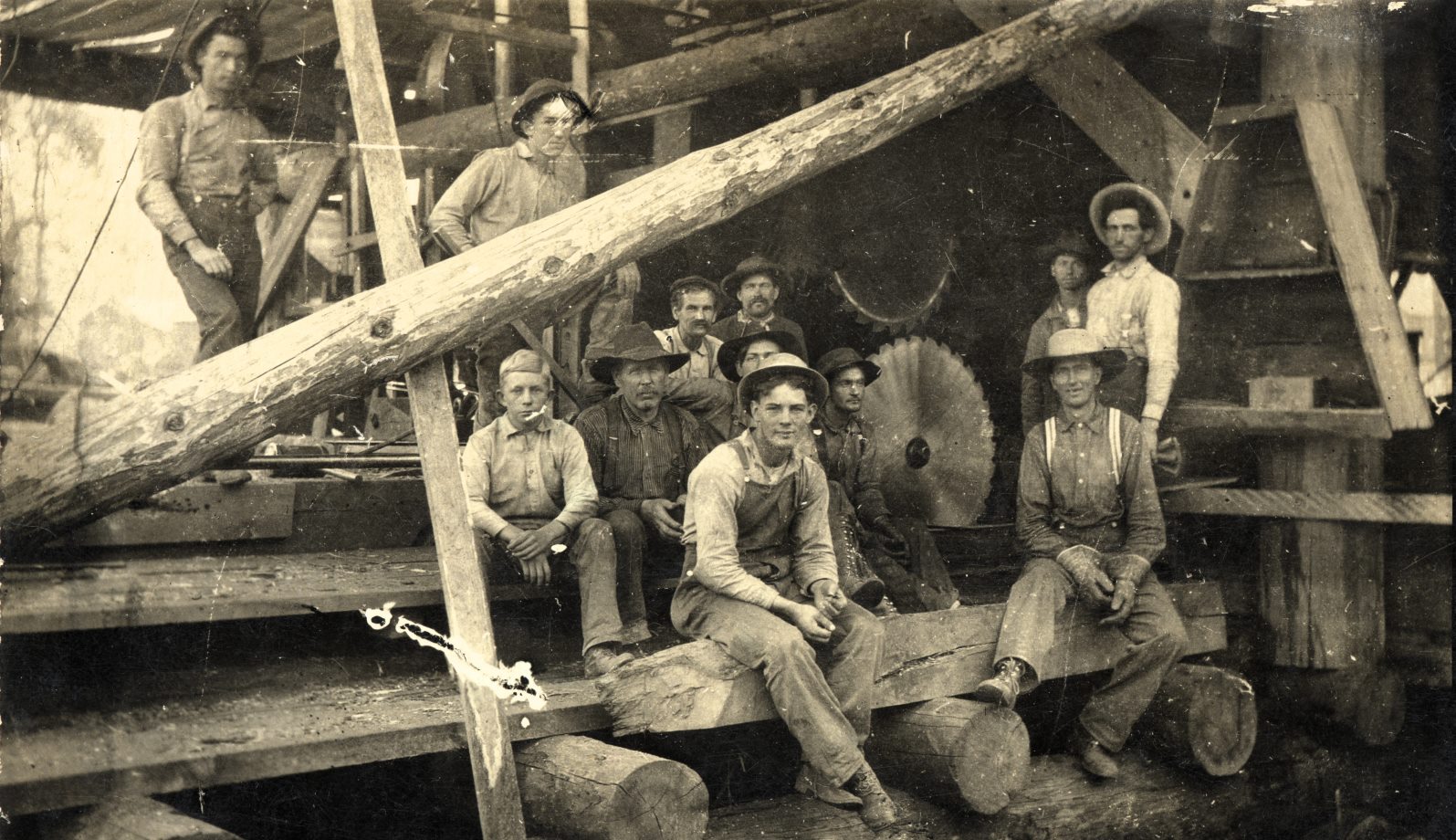
Industrialization of the lumber industry required a new approach to workers’ organizing. Earl Osborne investigates those changes.
‘One Big Union of Lumber Workers’ by Earl Osborne from Solidarity. Vol. 5 No. 250. October 24, 1914.
The lumber industry is one of the basic industries of the United States and Canada; especially is this so in the western part of these countries. It is with the latter that this paper will deal.
It is not so many years ago that the industry was practically a hand industry. But in recent years the machine has come into being and the old mode of production has gone to make way for the more up-to-date form of production. The old bull and horse teams, which would put in from ten to twenty thousand feet of logs a day, have given way to the donkey engine, which will put in from seventy-five to one hundred thousand feet per day. But even the donkey engine is now giving way to the steam skidder, better known as the “Flying Machine,” which will double the output of the donkey.
The old-fashioned sawmill, with its rotary or circular saw, dead rollers and out-of-date way of handling lumber, has practically gone out of existence, being replaced by the modern mill, with its band saw, shotgun feed, steam nigger, live rollers and resaw. The sawmill of a few years ago put out nothing but rough lumber, making it necessary for the carpenter to have a host of tools to build a house; today, a man to be a carpenter needs square, saw and hand-axe. When the lumber leaves the mill today, it is all ready to be nailed up–windows, sashes, doors, siding, etc., being finished by the machine.
Now, Mister Lumber Worker, what benefit are you getting from this improved production? Are your conditions as good as they were? Is your standard of living as high as it was ten years ago? The answer is not far to seek. Go into any of the employment offices in the coast cities, ask the thousands of lumber workers you meet on the road and the street; you need not even ask any questions–look, and if you have only one eye, you can easily see. In the city of Bellingham, Wash., in the winter of 1913, there were millmen walking the streets from morning till night looking for work, yes, begging for work, which was not to be had. The beach from Bellingham to Everett was lined with loggers and shingle weavers who were out of work. They practically dug the Bellingham water tunnel, because there was no work to be had in the mills or camps. They only received from $2.50 to $3.00 per day for this underground work.
Did you see these things a few years before? Is the lumber industry on the bum, as many people would have us think? Let us look closely, who was it that built the White, the Hoge, the Cobb, and the Banker’s Trust Co.’s buildings in the coast cities? Were these people poor, who financed the building of these structures? Of course not. Why is it, then, that the producer of lumber is hard up? The answer is plain: The producers of lumber have made the machine, and in using it have perceived its faults, and have eliminated them, until the machine has reached its present high state of development, arriving at a stage where the cost of production of lumber has been cut in half, yes, less than half.
After a careful investigation of the facts, there can be only one) conclusion–improvement of the machinery will produce more lumber at less cost; and what of the producer? How is it that we don’t have some of the benefits of these improvements, in the shape of a shorter work day, and a bigger pay? Why have the wages in this industry gone down, and the hours of the workday increased? Have YOU any answer to these questions? Can you give any causes why so many lumber workers are out of work? Being found in the employment offices, asking for work, yes, begging for work, in actions if not in speech? There is a solution to this problem, Mister Lumber Worker; you have the remedy in your hands if you have the courage to use it. Moses died long ago, so it is of no use for you to wait for him to come and lead you out of the darkness of industrial slavery.
ORGANIZATION
Organization only, will ever benefit the workers of the mills and camps, in their many struggles for more of the necessities. of life. BUT, this organization must be formed in such a way that the members can use it as they desire, and at any time they please. The A.F. of L. has two or three organizations in the Humber industry, but they are of absolutely no use to the lumberjacks. It is unnecessary for us to go into detail, on the formation of these craft unions, for craft unions they really are, although some of their spell-binders would have you believe that theirs is an industrial union. Their statements fall flat without FACTS to back them up. Let us look at some of the strikes they have pulled off. We’ll take for instance the strike at the Blodel & Donovan mill in Bellingham. The shingle weavers went on strike, while the sawmill men and loggers remained at work; and the peculiar thing, they never asked for support from the sawmill men and loggers. Do you call that an industrial union? In Big Lake, in the spring of 1913 the sawmill men went out, and the shingle weavers presented a grievance on the following Monday; they were members of the A.F. of L. and were invited to make common cause with the mill men. But Stuart of the Timber Workers said, “No, we have already sent for Brown.” Brown is president of their union. What do you think of that for an industrial union? One union in one industry does not mean that one part shall pull the chestnuts out of the fire for the rest to enjoy. One union in one industry means, if it means anything, that all branches of that industry shall aid one another in the common cause. One Big Union of all workers means more than that, it means that the workers in one industry shall help their fellow workers in another industry, and, formed in such a way that it correctly represents the working class and its aims. First, it must combine the wage workers in such a way that they can most successfully fight their battles, and protect their interests in the fight for shorter hours and bigger wages, with better conditions. Second, it must offer a final solution to the labor problem–an emancipation from strikes, injunctions, bull pens and the scabbing of one against another. Such an organization is outlined in the great Preamble of the I.W.W.
THE NEW UNIONISM
The form of unionism and principles advocated by the I.W.W., must take the place of the old craft unions, as represented by the American Federation of Labor. The I.W.W. claims that all workers in the lumber industry are necessary to operate that industry, and that their interests are the same. They have one common enemy, the boss. The I.W.W. claims that the engineer, fireman, logger, mill man, etc., while working in the same industry, must belong to the same union, together with every other worker in that industry. If any of them change their job to any other industry, they would be given a transfer free of charge. For instance, a shingle weaver changes his job to the marine transport industry–he will be transferred to the transport workers’ union, and then become a member in the transport union. All workers in one industry must come together to discuss affairs relative to that industry no matter what position they hold on the job; they should take part in these meetings. Each mill or camp must have a local committee, representing as near as possible all the various departments. This committee acts as a representative of the workers in their respective mill or camp. Any worker who has a grievance reports to the committee; if the committee fails to get justice they report to the local; the worker in local meeting decide what shall be done and if a strike is called all the workers strike together, making it almost impossible for the boss to get scabs.
All the workers must meet together, discuss their grievances together, think together, and in this way bring about a unity of mind which is necessary for the unity of action.
NATIONAL AND INTERNATIONAL AFFILIATIONS
The work of organization must go farther than a locality, however, because the lumber barons have organized themselves together and own mills and camps in various parts of the country. If the workers in a locality strike, the employers transfer their orders to another one of their mills or camps, until the workers are compelled to return to work through starvation. The workers must be in touch with their fellows in all parts of the country in order to close down all the mills or camps of an employer in any part of a country in case of a strike if found necessary. This can be done by combining all the local unions in the lumber industry into a National Industrial Union of Forest and Lumber Workers, and in turn affiliate with other national unions in other countries, thus establishing local, national, and international solidarity. The aim of the lumber workers must not be merely a fair day’s wage for a fair day’s work. Who is to determine what constitutes a fair day’s work? The mill and camp owners consider that anything is fair that they can get the workers to work for.
CONTROL OF INDUSTRY BY THE WORKERS
The aim must be the control of industry, and the slogan, “To the workers all they produce.” The battle cry must be: “An injury to one is an injury to all.”
The whole matter is merely a question of power. The workers will never get more than they have the power to make the bosses give. The power of the workers is their power to control. industry, to start or stop it at their will. This can be done through a strong organization, embracing all the workers. In a mill where there is no organization the boss is absolute master. Whatever he says, will be the law of that mill or camp. He will determine the wages the workers shall receive, the amount of work they shall do, what conditions they shall have on the job, how the work shall be distributed, and who shall be employed or discharged. When the workers organize, they will have something to say as to what the wages shall be, how the work shall done, what the sanitary conditions of the camps or mills shall be, whether or not a worker shall be discharged or kept on, what the hours of labor shall be, and so on. The stronger the workers organize the more power they will assume. Whatever power the workers assume is taken away from the bosses and makes them so much weaker. This holds good in all industries. Through close compact organization the workers can gain any demand by using direct action. For instance, the lumber workers can gain the eight hour day by organizing in the I.W.W. When they get a good percentage organized, take a vote in the organization and set the date when they want the eight hour day. When that date comes let every lumber worker walk out of the camps and mills after doing eight hours work. If this is done. all over the country at the same time there is no power on earth can make the workers work longer than eight hours. United action will get them anything they want. Organization, as advocated by the I.W.W., makes this possible. Craft unionism, as advocated by the Timber Workers, in the A.F. of L., never.
TACTICS ON THE JOB.
The employers will dispute every inch of ground. They will fight hard to maintain control of industry. The weapons used by the workers in their fight for control of try may vary greatly. Any weapons which will give the workers the desired results, the workers are justified in using. If the boss refuses to deal with a committee elected by the workers, a good move is to stop all work but stay in the mill or camp and constitute themselves as one big committee of all the workers. Wherever this has been tried it has been found very effective. The boss has always called for a committee, because he is very sensitive about having his whole place stopped. Even if the boss is willing to receive a committee, it is a good idea to stop the) whole mill or camp; this helps the boss to make up his mind quickly. To strike in the mill or camp without leaving it is often better than leaving. Make your demand, stop the mill for a few hours and if the boss does not give in to your demands, go back to work again and try the same thing next day. Keep this up until the boss gets tired of it, and gives in to your demands. To strike often, and never for a very long time, is better than these, long drawn out hunger strikes. When the workers act directly for themselves, they can be relied upon to use the right methods in order to gain their point. They will learn by acting, and will gradually gain more and more control over industry, until finally they have full control.
A NEW SOCIETY
When all the more important industries have reached this point, the working class will be the dominant class and refuse to be slaves any longer. They will run the industries for the benefit of the workers and establish a new society where there are no masters and no slaves. We often hear the question asked, “How shall this new society be constructed?” While the details must depend upon the future development of industry, we are safe in saying that it will be constructed along industrial lines instead of geographical or political lines. This means that the means of production, distribution, transportation and the land must be owned jointly by the workers. The political state with its geographical demarcations will disappear, and the industrial. state will take its place. The workers working in an industry will make the rules, or laws, if you wish to call it that, for that industry. These are the only ones qualified to do so, being the only ones who have any intricate knowledge of that industry. Their representatives will be workers who are thoroughly familiar with that industry and are elected by the workers working in that particular industry. For instance, the lumber workers will elect their representatives from among their own ranks and. these will be the representative body for the lumber industry, taking the place of the state representatives as we know them now in the political state. All the other industries will do the same and, combined, will constitute the new nation, thus establishing a new society, an industrial democracy.
The most widely read of I.W.W. newspapers, Solidarity was published by the Industrial Workers of the World from 1909 until 1917. First produced in New Castle, Pennsylvania, and born during the McKees Rocks strike, Solidarity later moved to Cleveland, Ohio until 1917 then spent its last months in Chicago. With a circulation of around 12,000 and a readership many times that, Solidarity was instrumental in defining the Wobbly world-view at the height of their influence in the working class. It was edited over its life by A.M. Stirton, H.A. Goff, Ben H. Williams, Ralph Chaplin who also provided much of the paper’s color, and others. Like nearly all the left press it fell victim to federal repression in 1917.
PDF of full issue: https://www.marxists.org/history/usa/pubs/solidarity-iww/1914/v05-w250-oct-24-1914-solidarity.pdf
 Revolution's Newsstand