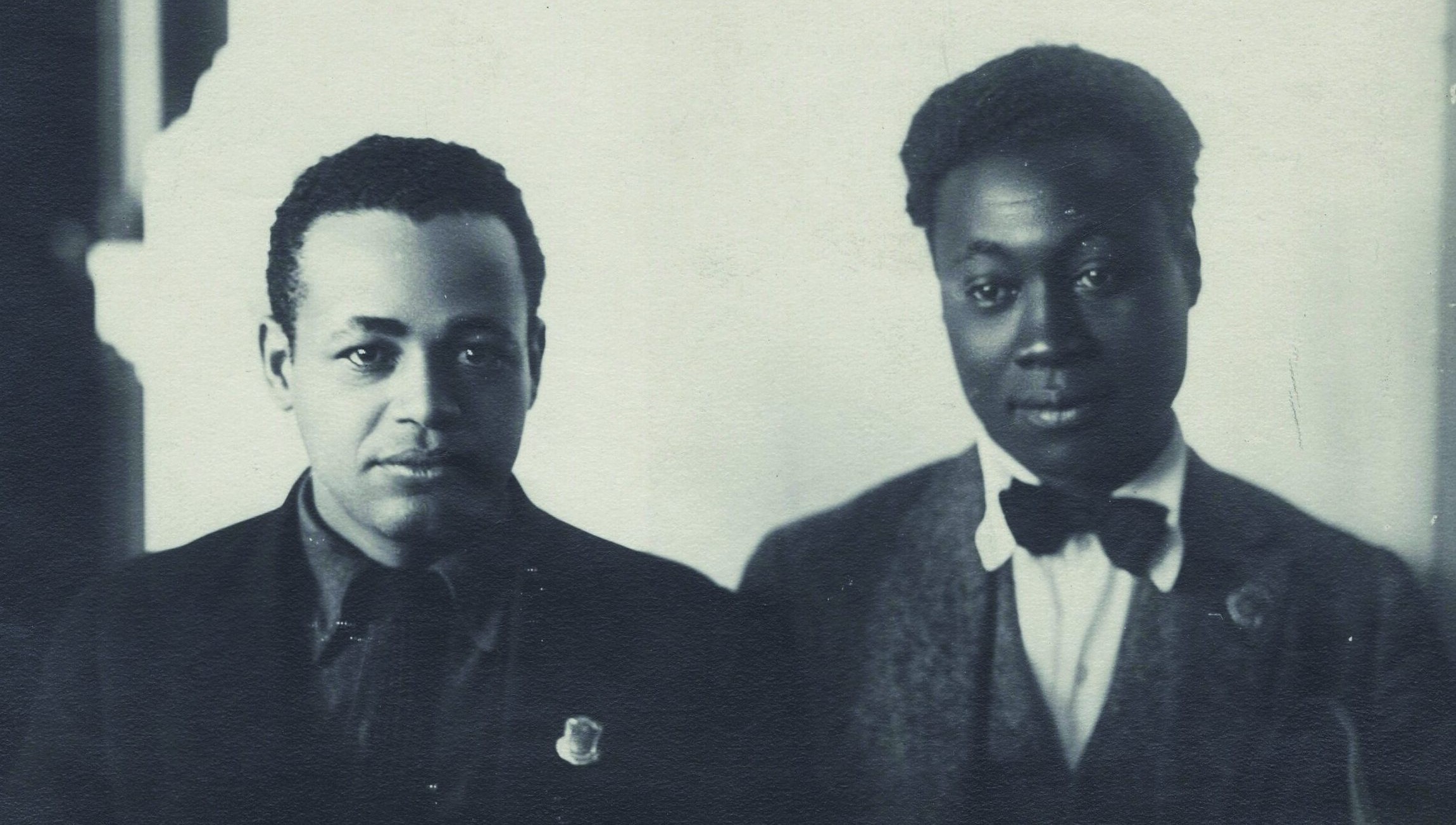
Rose Pastor Stokes, a delegate to the 4th Comintern Congress, relates the role of her fellow participants Otto Huiswoud and Claude McKay in crafting that body’s first theses on the liberation of Black workers. Includes the full text of the resolution.
‘The Communist International and the Negro’ by Rose Pastor Stokes from The Worker. Vol. 4 No. 265. March 10, 1923.
One of the most significant decisions in the Fourth Congress of the Communist International was the establishment of a Negro Commission and the adoption of the Commission’s Theses on the Negro Question which concludes with the declaration that “the Fourth Congress recognizes the necessity of supporting every form of Negro movement which tends to undermine or weaken capitalism and imperialism or to impede its further penetration,” pledges the Communist International to fight “for the equality of the Negro with the white people as well as for equal wages and political and social rights,” “to exert every effort to admit Negroes into Trade Unions” and to “take immediate steps to hold a general Negro Conference or Congress in Moscow.”
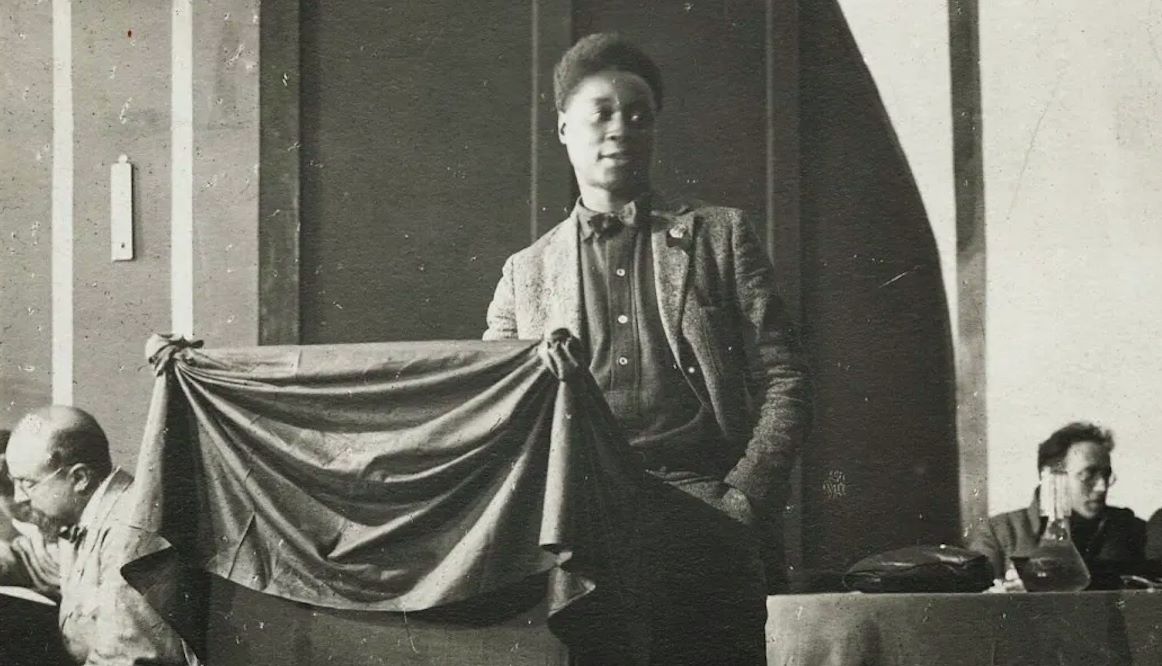
Two American Negroes were guests of the Congress. One, a poet, the other a speaker and organizer, both young and energetic, devoted to the cause of Negro liberation and responsive to the ideals of the revolutionary proletariat. They charmed the delegates with their fine personalities. Both addressed the Congress and won prolonged applause, while Comrade Radek threw his arms about one of them, as he came from the platform, delighted to find such a clear and able comrade representing the oppressed Negro workers.
Among the countries represented on the Negro Commission were America (two; with an additional member later), Belgium, France, England, Java, British South Africa, Japan, Holland, Russia (one each). The two Negro Comrades were in the Commission; one as guest of the Commission invited to address its members and attend its sittings, the other as member who was elected in the first meeting permanent Chairman of the Commission.
The original draft of the Theses (presented by the Chairman to the Congress) was returned upon a motion by Comrade Radek, for “clarification and amplification,” his criticism being that the document was “too Marxian in its phraseology.” This pleased the American members of the Commission and the member from British South Africa, who were no sticklers for the “Marxian phrase” and who wanted particularly to make it a simple statement that any man reading a newspaper could read and understand. A small subcommittee elected by the Negro Commission produced the Theses in its final form, the full text of which, purported to be taken from the Minutes, follows:
“Chairman, I call on Comrade Sasha to report on the decisions of the Negro Question.
Africa Next Imperialist Prize.
“Sasha (America). Comrades, the theses on the Negro Question which was returned for clarification and amplification I will now read to you and trust that it will be unanimously adopted by the Conference.
“1. During and after the war there developed among the colonial and semi-colonial peoples a movement of revolt, which is still making successful progress against the power of world capital. The penetration and intensive colonization of regions inhabited by Black races is becoming the last great problem on the solution of which the further development of capitalism itself depends.
“French capitalism clearly recognizes that the power of French post-war imperialism will be able to maintain itself only through the creation of a French-African Empire, linked up by a Trans-Sahara Railway. America’s financial magnates (who are exploiting 12,000,000 Negroes at home) are now entering on a peaceful penetration of Africa.
“How Britain for her part dreads the menace to her position in Africa is shown by the extreme measures taken to crush the Rand Strike.
“Just as in the Pacific the danger of another world war has become acute owing to the competition of the imperialist powers there, so Africa looms ominously as the object of their rival ambitions.
Negro Workers Aroused
“Moreover, the war, the Russian Revolution and the great movements of revolt against Imperialism on the part of the Asiatic and Mussulman nationalities, have roused the consciousness of millions of the Negro race whom capitalism has oppressed and degraded beyond all others for hundreds of years not only in Africa but, perhaps even more, in America.
American Negro Has Important Role
“2. The history of the Negro in America fits him for an important role in the liberation struggle of the entire African race. Three hundred years ago the American Negro was torn from his native African soil, brought in slave ships under the most cruel and indescribable conditions, and sold into slavery.
“For two hundred and fifty years he toiled a chattel slave under the lash of the American overseer. His labor cleared the forest, built the roads, raised the cotton, laid the railroad tracks and supported the Southern aristocracy. His reward was poverty, illiteracy, degradation and misery. The Negro was no docile slave. He rebelled. His history is rich in rebellion, insurrection, underground methods of securing liberty, but his struggles were barbarously crushed. He was tortured into submission and the bourgeois press and religion justified his slavery.
“When chattel slavery became an obstacle to the full and free development of America on the basis of capitalism; when chattel slavery clashed with wage slavery, chattel slavery had to go.
“The Civil War, which was not a war to free the Negro, but a war to maintain the industrial supremacy of the North, left the Negro the choice of peonage in the South or wage slavery in the North.
Equality to Kill and be Killed
“The sinews, blood and tears of the “freed” Negroes helped build American capitalism, and when, having become a world power, America was inevitably dragged into the war, the American Negro was declared the equal of the white man to kill and be killed for “democracy.”
“Four hundred thousand colored workers were drafted into the American army and segregated into “Jim Crow” regiments. Fresh from the terrible sacrifices of war the returned Negro soldier was met with race persecutions, lynchings, murders, disfranchisement, discrimination and segregation. He fought back, but for asserting his manhood he paid dearly.
“Persecution of the Negro became more widespread and intense than before the war, until he had learned to “keep his place.” The post-war industrialization of the Negro in the North and the spirit of revolt engendered by post-war persecutions and brutalities (a spirit of revolt which flames into action when a Tulsa or other inhuman outrage cries aloud for protest) places the American Negro, especially of the North, in the vanguard of the African struggle against oppression.
Communists Hail New Negro Spirit
“3. It is with intense pride that the Communist International sees the exploited Negro workers resist the attacks of the exploiters, for the enemy of his race and the enemy of the white workers is one and the same–Capitalism and Imperialism. The international struggle of the Negro race is a struggle against Capitalism and Imperialism.
“It is on the basis of this struggle that the world Negro movement must be organized: in America, as the center of Negro culture and the crystalization of Negro protest; in Africa, the resevoir of human labor for the further development of Capitalism; in Central America (Costa Rica, Guatemala, Colombia, Nicaragua, and other “Independent” Republics), where American Imperialism dominates; in Puerto Rico, Haiti, Santa Domingo and other islands washed by the waters of the Caribbean, where the brutal treatment of our Black fellow-men by the American occupation has aroused the protests of the conscious Negro and revolutionary white workers everywhere; in South Africa and the Congo, where the growing industrialization of the Negro population has resulted in various forms of uprisings; in East Africa, where the recent penetration of world capital is stirring the native populations into an active opposition to imperialism, in all these centers the Negro movement must be organized.
Struggle Against Imperialism World Wide
“4. It is the task of the Communist International to point out to the Negro people that they are not the only people suffering from the oppression of Capitalism and Imperialism, that the workers and peasants of Europe and Asia and of the Americas are also the victims of Imperialism; that the struggle against Imperialism is not the struggle of any one people, but of all the peoples of the world; that in China and India, in Persia and Turkey, in Egypt and Morocco the oppressed colored colonial peoples are rising against the same evils that the Negroes are rising against–racial suppression and discrimination, and intensified industrial exploitation; that these peoples are striving for the same ends that the Negroes are striving for–political, industrial and social liberation and equality.
Comintern Will Support Negro
“The Communist International, which represents the revolutionary workers and peasants of the whole world in the struggle to break the power of Imperialism; the Communist International, which is not simply the organization of the enslaved white workers of Europe and America, but equally the organization of the oppressed colored peoples of the world, feels its duty to encourage and support the international organizations of the Negro people in their struggle against the common enemy.
Special Duty of Communists
“5. The Negro problem has become a vital question of the world revolution; and the Third International, which has already recognized what valuable aid can be rendered to the Proletarian Revolution by colored Asiatic peoples in semi-capitalist countries, likewise regards the cooperation of our Black fellow men as essential to the Proletarian Revolution and the destruction of capitalist power: The Fourth Congress accordingly declares it to be a special duty of Communists to apply the “Theses on the Colonial Question” to the Negro problem.

“6. (1) The Fourth Congress recognizes the necessity of supporting every form of Negro movement which tends to undermine or weaken Capitalism or Imperialism or to impede its further penetration.
“(2) The Communist International will fight for race equality of the Negro with the white people as well as for equal wages and political and social rights.
“(3) The Communist International will use every instrument within its control to compel the trade unions to admit Negro workers to membership or, where the nominal right to join exists, to agitate for a special campaign to draw them into the unions. Failing in this, it will organize the Negroes into unions of their own and especially apply the United Front tactic to compel admission to the unions of the white man.
“(4) The Communist International will take immediate steps to hold a general Negro Conference or Congress in Moscow. The Worker, March 10, 1923.”
United Front of All Labor
“Comrades, I want to add a word on the Negro Question. On the clause dealing with the Negro and the trade unions: In the American Federation of Labor Negroes are nominally admitted to membership in most unions, but there is absolutely no effort made save in extremely few cases to draw the Negro into the unions.
“In the United States we can bring pressure to bear upon the American Federation of Labor to admit the Negro workers. There we must enter into a definite campaign to accomplish the thing. Campaigns should be carried on in every country concerned, clearly, definitely, painfully, and if we fail, it will be our duty to organize the Negroes into separate unions, bring together the white and colored workers who are willing to form a united front and carry on anew a campaign to compel inclusion.
“In the industrial field, where the Black and white workers toil side by side and suffer together through the industrial oppression of capitalism–chiefly we can hope to create a unity, that understanding, that binding tie, that will bring them through common organization into the struggle.
“The Congress is taking a wonderful first step in moving to hold a general Negro Conference or Congress in Moscow. But our chief work (as Sections) lies in getting the industrialized Negroes into the unions where they can fight together with the white workers for their equal emancipation…We must not allow this Theses to become a dead letter, but we must carry it into life, and make the Negro worker a vital part of the Communist International.”
The Resolution was unanimously adopted.
Credit is due America for introducing the question of a Negro Commission. I understand there was no opposition to the motion in the Presidium where it was offered, and the creation of the Commission was voted unanimously and immediately named.
The Negro Question is not one that was suddenly precipitated at the Fourth Congress. Jack Reed had reported on the American Negro at the Second Congress. Last year a comprehensive report had been received by the C.I. Executive. The question was being considered. Nor is the idea of calling a general Negro Conference or Congress in Moscow some time in the near future, an inspiration of the Commission. In Asia, in Turkey, in Egypt it is the Communist International that inspires the revolutionary struggle of the oppressed colored peoples, and it is the logic of the struggle that fast dictated the tactic.
Beside presenting the above Theses to the Congress for action, the Negro Commission made a report also for the Presidium, more private in its nature, which called for action by the C.I. Executive. This report was detailed and said to contain the following: (1) recommendations for the creation of a Negro Bureau in Moscow; (2) certain recommendations with respect to specific Negro Organization; (3) a draft of instructions (as coming from the C.I. to the Sections concerned), detailing the specific tasks of the Sections in their relations to the Negro Question. One indication of the significance the C.I. attaches to the Negro Question, lies in the fact that immediately upon the receipt of these recommendations, a member of the Presidium was selected to head the proposed Negro Bureau.

The C.I. desires action in the matter. It is taking action. One of the living tasks of the American Comrades is to carry on in behalf not alone of the foreign-born workers who are oppressed and discriminated against, but also on behalf of that American worker whose black skin is a greater bar to Trade Union membership and the general fellowship of American Labor than the lack of an American birth certificate.
White “whisperers” warn against the “rising tide of the darker races” that will overwhelm and dominate the white race. Communists have no ear for such Ku Klucks! Communists have nothing to fear from the liberation of oppressed peoples. Communists know no race or color differences, as they know no national boundary lines. Common oppression ultimately places all workers in one camp for the struggle against the oppressors. And the Proletarian Revolution will make them one in Communism as we are all biologically one.
Long live the revolutionary workers and peasants of every color and every race! Long live their power in union!
The Daily Worker began in 1924 and was published in New York City by the Communist Party US and its predecessor organizations. Among the most long-lasting and important left publications in US history, it had a circulation of 35,000 at its peak. The Daily Worker came from The Ohio Socialist, published by the Left Wing-dominated Socialist Party of Ohio in Cleveland from 1917 to November 1919, when it became became The Toiler, paper of the Communist Labor Party. In December 1921 the above-ground Workers Party of America merged the Toiler with the paper Workers Council to found The Worker, which became The Daily Worker beginning January 13, 1924.
Access to PDF of full issue: https://www.marxists.org/history/usa/pubs/theworker/v4n265-mar-10-1923-Worker.pdf
 Revolution's Newsstand