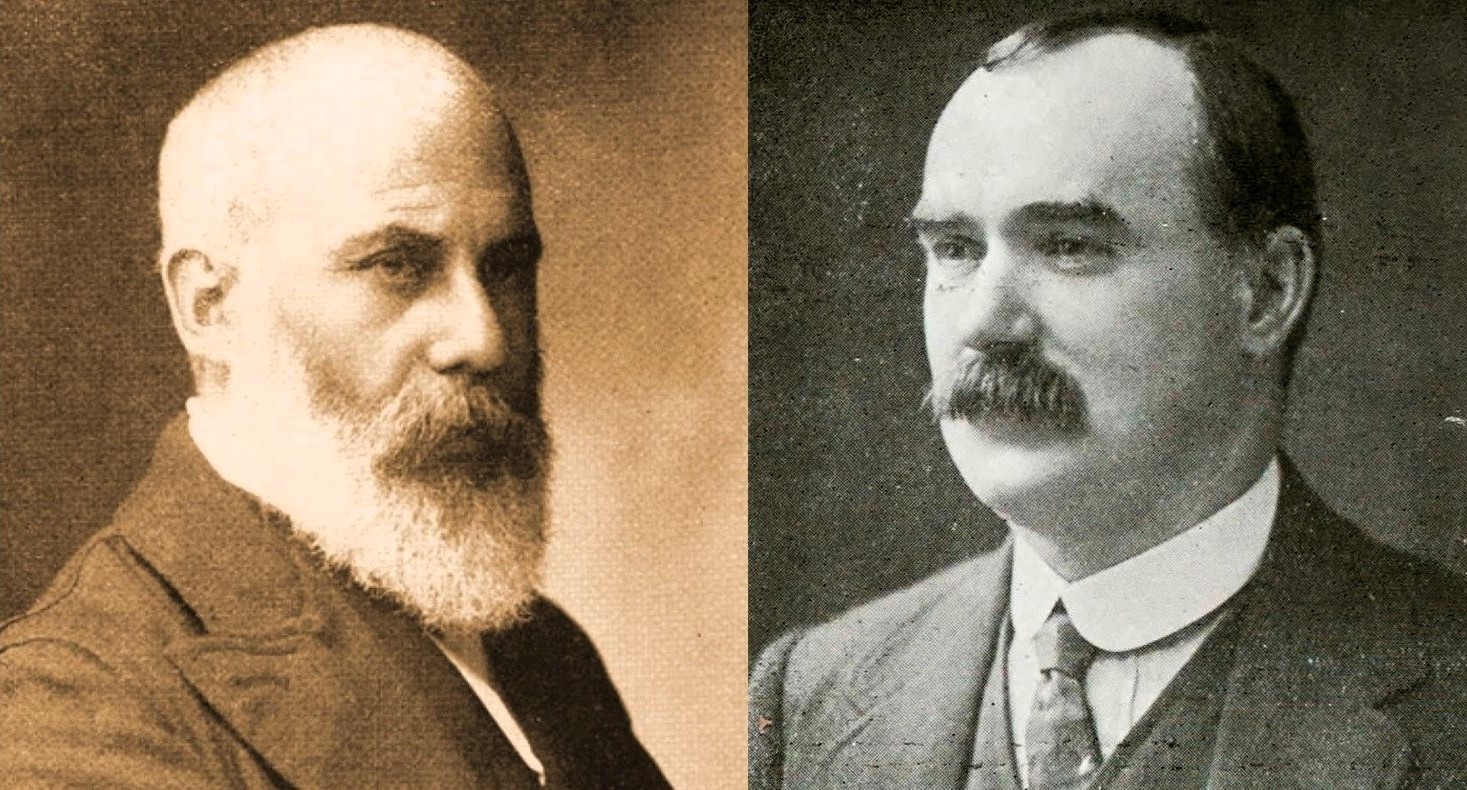
Continuing the dramatic December, 1907 meeting of the I.W.W.’s leading General Executive Board in New York City where James Connolly, then a paid I.W.W. organizer, was accused by Daniel De Leon of being a police agent. The G.E.B. then consisted of General Secretary-Treasurer William. E. Trautmann, William Yates, T..J. Cole, B.H. Williams, with Vincent St. John and Fred Heslewood absent, and Daniel De Leon’s lone loyalist Rudolph Katz. In the context of his larger fight to retain control of the S.L.P., De Leon’s accusations against Connolly were aimed also at his rival in the I.W.W. William Trautmann and B.H. Williams, like Connolly a former leading members of the S.L.P. Shot down on all attempts, De Leon’s accusations further, and fatally, isolated his faction with many of the best and most talented former S.L.P. members chose to stay and build the I.W.W. in the split that followed, including Connolly who took an increasing role in the New York-Jersey, and nationally, with regular articles appearing in the I.U.B. Connolly would join the Socialist Party, energized by Debs’ presidential campaign, the following year.
‘Daniel De Leon vs. James Connolly at the I.W.W. General Executive Board’ from Industrial Union Bulletin. Vol. 1 No. 49. February 1, 1908.
December 23rd, Afternoon Session
At this juncture Fellow Worker Katz suggested that the board go into executive session to allow Fellow Worker DeLeon the floor for the presentation of important matters.
Fellow Worker DeLeon, before starting to present the matter, asked the board whether that was considered an executive session. Thereupon the doorkeeper left the room.
Fellow Worker DeLeon then started to explain what prompted him to ask for a hearing. He stated that he had the intention to proceed to Chicago directly when he heard that negotiations were being conducted with the Harbor Workers of New York City; as he deemed his knowledge of things important enough to entertain the fear that injury may result from misdirected moves; but that he felt relieved when he heard that the general executive board would meet in New York City.
DeLeon intimated that there was a “police spy” at work in I.W.W. affairs, and proceeded with the outline of his theory; until he had established sufficient grounds to bring out open charges against James Connolly, the organizer of the Industrial District Council of New York City.
Executive Board Member Cole asked for an interruption of a few minutes, as he wanted to withdraw from the room. On his return Fellow Worker DeLeon started to resume.
At this juncture T.J. Cole rose for the purpose of entering his protest against any further continuation of the meeting behind closed doors. Cole asserted that from personal observation he is convinced that any tolerance of star-chamber proceedings will wreck and destroy the Industrial District Council of New York and all unions in the adjacent towns. Cole contended that he did not know that the suggestion of “going into executive session” meant a meeting behind closed doors.
Yates wanted to know where Cole got his information that the District Council would be wrecked. Cole rose to answer, but being interrupted by DeLeon, Cole stated that he would immediately start for home, if the executive board would stand for such mode of procedure.
Secretary Trautmann stated that he, although not having a vote, would insist on having his protest, conjointly with that of Cole, entered on the minutes, on the ground that a continuation of star-chamber proceedings at which the most serious and grave charges are presented against another member of the I.W.W. without the accused having a chance to hear the charges, or to defend himself, would inevitably bring in its consequences ruin and disastrous results to the I.W.W. all over the country. Justified as were those who condemned Sherman, Moyer and their associates for their actions in the star-chamber sessions of the majority of the first executive board of the I.W.W., still more would they brand those who joined in the cries of condemnation and yet would tolerate a repetition on this occasion. When the first executive board of the I.W.W. disfranchised in star-chamber sessions some of the best and most progressive railroad workers to please a coterie of fakirs, without giving these victimized proletarians a chance to voice their side of the case, it nearly rent the I.W.W. asunder, and such would be the case if any body, no matter who he be, thinks exceptions should be granted and a repetition countenanced.
Chairman Williams also immediately joined in the protest and wanted to be recorded accordingly; he also ordered that the doors be thrown open and the proceedings be continued in the open.
Fellow Worker DeLeon then proceeded with the presentation of his charges. He asserted that it was his desire to keep any political party wranglings out of the I.W.W.; and nobody could accuse him of being insincere in this attitude; but he claimed that there was an evident connection between parties that were trying to drag a controversy between the S.L.P. and Connolly into the I.W.W. in New York City and Chicago, and as substantiation for this allegation Fellow Worker DeLeon produced a private letter sent to him by an employe in the I.W.W. office by the name of Otto Justh, in which reference was made to this controversy.
DeLeon claimed that the letter of said Otto Justh had been mailed first to the national secretary of the Socialist Labor party, and was delivered to him open; and as the many corrections in that letter were made in two handwritings, it was evident that that letter was not the product of one individual; and the affair thus assumes a suspicious aspect; that consequently Justh, an office employe of the I.W.W., must have been working in connection with somebody to drag the Connolly affair into the I.W.W. Objection was again raised against further continuation of the case until Connolly would be present himself. T.J. Cole moved that the matter of presentation of charges by DeLeon be postponed until the Industrial District Council of New York City be given a chance to have defendants and witnesses summoned to be able to present their side of the case. Motion carried.
As none of the witnesses nor the defendant in the case were present, a motion was made by Katz, seconded by Cole, that the DeLeon-Connolly matter be taken up at 9 o’clock a.m. next morning, so that the board may dispose of all other matters before them. Mation carried.
The letter written by Otto Justh to DeLeon was the next subject for discussion. The letter could in no way be considered as emanating from the general office, typewritten on plain paper, the reference therein about certain remarks which DeLeon was supposed to have made at the last convention of the I.W.W. about Connolly, was based on general information undoubtedly gained from hearing a general discussion of delegates in the general office, when inquiries were made by them as to the personality of the ‘walking delegate’ mentioned in the arguments of DeLeon on the floor of the convention.” This was the explanation of General Secretary-Treasurer Trautmann.
However, as the two handwritings in the many corrections made in the letter indicated a collusion, in some way, a motion was made by Katz, seconded by Cole, that it is the sense of the general executive board that Otto Justh be requested to reveal the name of the party, or parties, who helped him make the corrections in that letter. Trautmann asserted that such “personal letter” information-bureaus have done lots of injury to the organization already; too much of such “personal letter” transactions have transpired, to his knowledge, in the I.W.W., and if assistants in the office should be guilty of such breach of confidence, and be a party to “wire-pulling tactics” they should be treated accordingly.
The following motion was adopted: “That knowledge of affairs transpiring within the organization gained by reason of employment in the office of the I.W.W., if interjected in their correspondence in I.W.W. matters, be cause for immediate dismissal.”
TUESDAY, DECEMBER 24TH, 1907.
Meeting was called to order at 10 o’clock A. M. by Chairman Williams. Charges of Delcon against Connolly were taken up. Connolly was present, as were many others.
Fellow Worker DeLeon began to sum up his statements. He started out with explaining the situation of a man who is with one foot in the S.L.P. and with the other in the I.W.W.; that the injury done to one foot must certainly also affect the other, that consequently the mischievous acts of one man in the S.L.P. must cast their reflex in the doings of the I.W.W.
We went at length into discussion of the destructive effect of an article appearing in the Industrial Union Bulletin of October 26th, No. 35, contributed by James Connolly, entitled “Wages and Prices,” in which “Connolly uses The Bulletin to assail the record of the Socialist Trades and Labor Alliance, by asserting that said Alliance had taught false economics, whilst in reality the claim of Connolly that prices go up first before wages are increased is absurd and a false doctrine to propound. That James Connolly had used I.W.W. stationery to communicate with others, interjecting therein Socialist Labor party disputes into the I.W.W.; and one of such letters was introduced as evidence, but not read, that James Connolly and his followers in the District Council of New York had started a movement against the “Daily People” plant in trying to enforce the rule that I.W.W. printers he employed in the plant, which would have surely resulted in a strike of A.F. of L. printers employed in the plant: and no I.W.W. English printers available to operate the plant; that that was a premeditated plan to wreck and destroy “Daily People”: that the letter of Justh to him (DeLeon) was another connecting link to prove an organized effort to throw a fight into the I.W.W.; that the statement of the general secretary-treasurer in his report to the G.E.B. anent the Markley affair contained a paragraph in which it is stated that the “Daily People is used against the I.W.W.” gave rise to the suspicion that that was a part of a plan to discredit the loyalty of the People to the I.W W. movement: that he had written to Trautmann letters asking for explanations on this as well as on the Connolly matter, that the latter replied on the “Markley affair.” but failed to give satisfaction on the Connolly matter. That he, DeLeon, would certainly stand for the most rigid enforcement of discipline against men who would conduct themselves as Markley did.
At this point a member of the organizing committee of the District Council asked whether the District Council of New York would have a chance to be heard for the rebuttal of statements made by DeLeon.
Williams ruled that as long as the executive board allowed Fellow Worker DeLeon to present charges, the defendant, Connolly, had a right to summon all the witnesses he wants; including committees of the Industrial District Council.
Trautmann here interrupted the complainant and stated that the Markley affair was a closed incident, all members of the G.E.B. approved the course taken in the matter; he denied that the reference in the report anent the “Daily People” was a premeditated attempt to injure that paper, as the clause referred to reads: “He (Markley) even used the columns of the ‘Daily People’ to misrepresent the I.W.W.,” which was proven to be true; but if there should be any anxiety about the reference he would gladly make the statement that the “Daily People” never consciously attempted to do injury to the I.W.W. DeLeon then continued to depict the career of James Connolly in Ireland, how the record of the man proves him to be a destroyer and wrecker of any movement he had been connected with; that from Katz he had heard about Connolly’s interference in Lancaster strike matters and the disastrous results thereof: that he (Connolly) had ruined the Socialist Labor Party in Ireland.
At this point T.J. Cole rose to ask a point of order. He wanted to know whether the chair would permit the injection of matters with which the I.W.W. had nothing to do; as for instance, the reference to Connolly’s record in the Socialist Labor Party of Ireland.
The chair ruled that the point is well taken, and that such matters should not be injected because irrelevant. Wm. Yates asked whether the parties of the controversy had exhausted all previous resources of launching complaints before bringing the matter up before the General Executive Board and he asked for a ruling whether this matter comes within the province of the G.E.B.
The chair ruled that the parties to the controversy would have to go through the regular channels and the matter can only be presented to the general executive board after all other resources have been exhausted.
Katz appealed against the ruling of the chair. Katz stated the reasons for his appeal; he held that the matter should be decided and investigated on the ground that a constitutional clause provides that an organizer is subject to supervision by the general executive board, and that Connolly by injecting in the article referred to political party differences, as for instance his criticism of the Socialist Trades and Labor Alliance, was violating one of the established rules, and that therefore the G.E.B. had jurisdiction in the case and could investigate the matter and enforce the law as regards the conduct of organizers.
Williams in explaining his ruling stated that the attitude of Connolly as organizer is not involved; if there is proof of an organizer’s objectionable conduct, especially when such an organizer is maintained by an Industrial District Council, the general executive board may ask of a council to discipline such organizer, and failure of such council or a local union to comply may eventually cause the revocation of their charter; but as a local union is the smallest unit of the I.W.W. the general executive board must recognize the right of such unions to dispose of such matters first, and then if in the proper course such matters reach the genera! executive board, the same will know that all previous recourses have been exhausted; nor can the article of Connolly in The Bulletin be construed as an attempt to inject S.L.P. matters into the I.W.W.; inasmuch as the Socialist Trades and Labor Alliance was considered an economic organization.
Vote on the appeal was taken by roll-call: Katz voted not to sustain the chair; Cole, Yates and Williams voted to sustain the decision. The chair was sustained.
Fellow Worker DeLeon asked the chair what course to pursue so that the matter may eventually reach the general executive board.
The chair stated that charges of such nature must first be submitted to the local union of which the defendant is a member; an appeal may be taken to the Industrial District Council by either side to a controversy, and the last appeal can be taken to the general executive board if all other means are exhausted. He gave that as his ruling.
Fellow Worker DeLeon asked whether there was nothing that could change the ruling of the general executive board. Chairman Williams stated that he could see nothing that would prompt them to reverse that decision.
This disposed of the matter, and other questions were immediately taken up.
Katz asked whether he as member of the G.E.B. has a right to prefer charges on account of the conduct of an organizer of the I.W.W. He was asked to proceed with presentation of his charges upon which he would claim that Connolly is disqualified to act as organizer. Katz repeated his charges relating to the Lancaster strike; stated the cause of the strike, the gallant conduct of the men and girls. He told about the return of these two men who had gone to New York and returned to Lancaster spreading the report of the statement alleged to have been made by Organizer Connolly; that McRoe was one of the young men who made these statements in the meeting, and as a result thereof many got discouraged and precipitated a stampede back to their places. Connolly stated in reply that the two men who had come to New York were at the headquarters of the I.W.W., where they stated in presence of witnesses that they had a letter from Lancaster in which it was stated that most of the men who had joined the union first had already returned to work and they were disheartened on account of that. His statement was: “It’s hard to understand that the workers so soon after being organized, went on strike,” and that the statement was overheard by Fellow Worker Campbell. Campbell corroborated the statement of Connolly.
Chairman Williams ruled that not sufficient evidence had been submitted by Katz to substantiate the charges against Fellow Worker Connolly. Katz asked a question relative to statements made regarding the organizing of New York harbor workers. Connolly stated in reply that he had given a full report of what had transpired to ask from the general executive hoard specific points of instructions. He could only repeat what the official committee of the Longshore Workers had told him and the organizing committee. If that committee had given him false information on any point, of which Connolly, however, was not aware, it was not his fault, and he should not be held responsible.
Secretary Trautmann suggested that the organizers matter be taken up…
The Industrial Union Bulletin, and the Industrial Worker were newspapers published by the Industrial Workers of the World (IWW) from 1907 until 1913. First printed in Joliet, Illinois, IUB incorporated The Voice of Labor, the newspaper of the American Labor Union which had joined the IWW, and another IWW affiliate, International Metal Worker.The Trautmann-DeLeon faction issued its weekly from March 1907. Soon after, De Leon would be expelled and Trautmann would continue IUB until March 1909. It was edited by A. S. Edwards. 1909, production moved to Spokane, Washington and became The Industrial Worker, “the voice of revolutionary industrial unionism.”
PDF of full issue: https://www.marxists.org/history/usa/pubs/industrialworker/iub/v1n49-feb-01-1908-iub.pdf
 Revolution's Newsstand