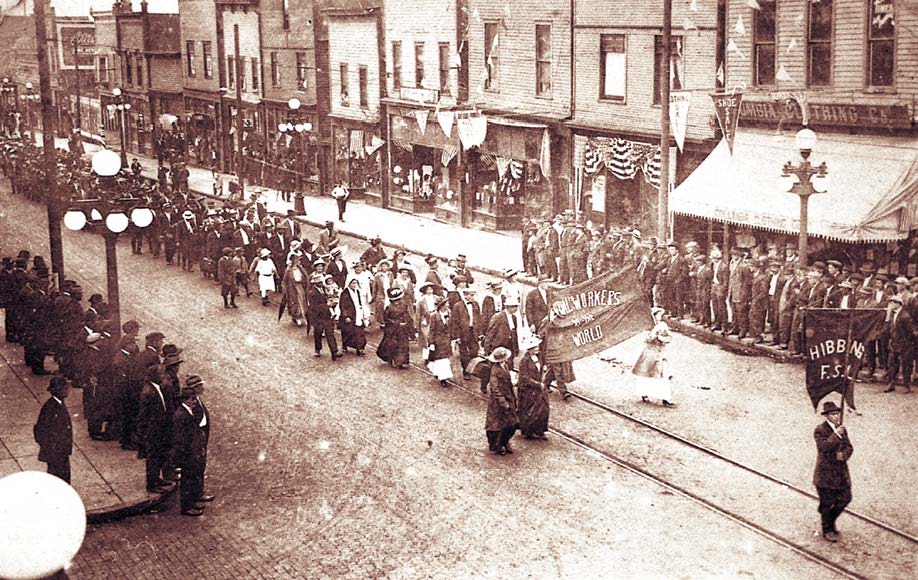
A report on Flynn’s speech to 1500 Mesaba Range iron miners at Virginia, Minnesota’s Opera House in defense of Carlo Tresca and others facing trial for their role in the recent strike there.
‘Gurley Flynn on Mesaba Range’ by Harrison George from Solidarity. Vol. 7 No. 362. December 16, 1916.
Arouses Miners to Great Enthusiasm as She Lays Bare the Terrible Conflict Between the Workers and the Steel Trust.
With a shout of assent that raised the roof and made the stool-pigeons of the Steel Trust tremble in their skins, E.G. Flynn, the “incomparable,” brought an audience of 1500 miners to their feet when she put the question: “If one of the boys in jail is convicted, how many of you, I wonder, will throw down your tools?” “ALL OF US,” was the ringing reply of faith and loyalty.
The large and beautifully furnished opera house in Virginia was packed both floor and balconies last Sunday, when James P. Thompson, who acted as chairman, arose to introduce “Our Gurley” back home to the miners from her eastern tour.
She told of the enthusiasm and interest manifested in the cities of the east about the miners’ rebellion, “But more than the admiration for you, you should be proud that you have forced the U.S. Steel Corporation to respect you,” she said. “Do you suppose that the hearts of the Trust’s directors are more filled with sympathy for you than they were a year ago, that they should now grant an increase in your pay? Do you think they have lost their grasp of cold-blooded calculation and have become with sentimental concern for your distress? Oh, no! It was not love-but fear, that made them announce this advance. They have found that you are not dumb, driven beasts–but men; with the full stature and the living heights of men.
“They know but do not care, that the steel they sell is mixed with the sweat and blood and tears of the toiling army of industry. On the range a hill may slip and you miners are buried alive and unearthed only when a steam-shovel lifts your bones commingled with ore into the cars bound for the docks. On those docks a misstep means death, all crushed and mangled by the fall–perhaps a grave in the cold waters of Lake Superior. In Pittsburg at night the sky is lurid with the glare of furnace fires. On a greasy runway above these infernos men walk to and fro watching the steel in process of production. A slip–a scream–there is a little blue spouting flame for just a second and another worker’s body joins the miner’s and both are sold as rails and nails and needles in the markets of the world.
“Now you have forced a raise, the trust is trying to wreak its vengeance on the men that are in jail. But the destinies of their intended victims are not the only things to be affected by these trials. When they are tried, capitalism is tried. Nick Dillon is on trial. The whole system by which you toil and sweat to eat the bread of slaves is on trial. Gunmen rule, responsible for the murder of John Allar on the streets of Virginia, is on trial.

“What crime did these three organizers commit? Did they kill anyone? No! They only challenged the economic power of the ruling class. They are guilty of the heinous and unspeakable crime of making speeches. The trust may send thousands of guns and millions of shells to the slaughter house of Europe that is business. But make a speech in free America and you are charged with murder!
“Your determined solidarity will furnish an ominous background when these cases go to trial. Let the great jury of public opinion know that you are standing by those who stood by you. There are more ways than one in which you can assist: You can wear the button that bears their picture and shows your colors You can give to their defense a part of the wage increase their sacrifice has brought to you; last but not least, you can-if the fight in the courts fail–down tools in protest!! How many of you will say, “We will close the mines till the doors swing out for Scarlett, Schmidt and Tresca?” It was at this point the miners started from their seats and shouted, “ALL OF US! ALL OF US!”
The meeting, which was addressed by various language speakers, closed with a silver-toned benediction as the hats went round for contributions for the defense. A great deal of literature was sold.
The miners will hold big protest meetings in every town on December 17th, the day before the trials open. Everyone do the same and send all proceeds to James Gilday, Sec’y-Treas. Defense Committee, Box 372, Virginia, Minn.
The most widely read of I.W.W. newspapers, Solidarity was published by the Industrial Workers of the World from 1909 until 1917. First produced in New Castle, Pennsylvania, and born during the McKees Rocks strike, Solidarity later moved to Cleveland, Ohio until 1917 then spent its last months in Chicago. With a circulation of around 12,000 and a readership many times that, Solidarity was instrumental in defining the Wobbly world-view at the height of their influence in the working class. It was edited over its life by A.M. Stirton, H.A. Goff, Ben H. Williams, Ralph Chaplin who also provided much of the paper’s color, and others. Like nearly all the left press it fell victim to federal repression in 1917.
PDF of full issue: https://www.marxists.org/history/usa/pubs/solidarity-iww/1916/v7-w362-dec-16-1916-solidarity.pdf
 Revolution's Newsstand