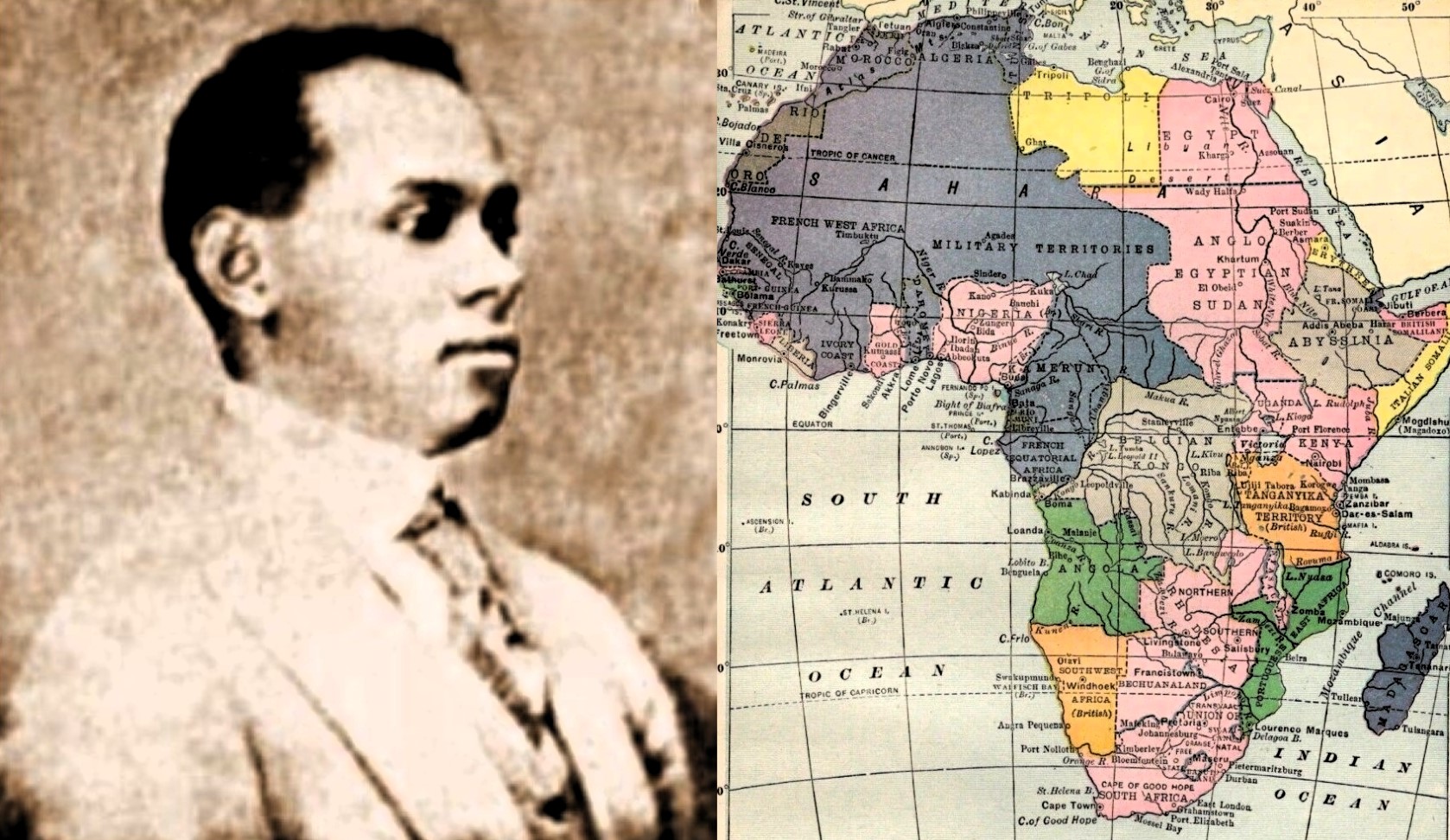
An international problem requires an international response. African Blood Brotherhood leader and Crusader editor, Cyril V. Briggs on self-determination and sate-building.
‘The American Negro’s Duty to the Negro Race’ by Cyril V. Briggs from The Crusader. Vol. 2 No. 3. November, 1919.
Fitness or unfitness for self-government is usually advanced by the white man to demonstrate race superiority or inferiority as the need might be. Those races that are of recognized fitness to govern themselves are deemed to be superior to the races claimed (but not demonstrated) to be lacking in this fitness for self-government. Thus, the European races which have had the opportunity to demonstrate by exercise and experience in self-government their fitness for autonomy are deemed to be in the superior race class, while the Negro, the Hindu and other suppressed races are placed in the inferior race class because, not having had the opportunity (in modern times) they have, quite plainly, not been in a position to demonstrate their fitness or unfitness for autonomy. This, in a nutshell, was the case until the appearance upon the world-stage of the two struggling Negro nations, Liberia and Haiti. This, in fact (rank hypocrisy and nonsense as it is) is still the case today, since the dominant white world refuses to admit that in either Haiti or Liberia the Negro has as yet demonstrated his fitness for self-government.
Now, the importance of fully and emphatically demonstrating to the world and to ourselves our fitness for self-government must be evident even to the dullest mind when it is recognized that such a demonstration is absolutely necessary to lift us out of the inferior race class, as well as to insure us impartial protection and equal rights under the only form of government under which they can be obtained by any people; government of the people by that people and for that people. For, admittedly, if we are really incapable of self-government, we are certainly inferior to those races which are capable of self-government. Furthermore, not fit to govern ourselves, what right have we to ask a share in the government of others—in the United States or elsewhere? Unfit for self-government we are deservedly disfranchised from participation in the government of others.
Of course, the Negro’s fitness for autonomy was amply proved thousands of years ago in ancient Egypt and Ethiopia, and only a few hundred years ago in the Songhai, Nube, Yorubba and other African states. But those states are gone, the records they have left behind are few, and even these through malice and envy, the white man persists in interpreting to our disadvantage. Thus it is imperative that we prove again, and in this day of caucasian control of education and public opinion, the Negro’s fitness for self-government. Until that fitness is proven to the satisfaction of ourselves and the white man, the latter will have much to support him in his claim that we are an inferior race.
This is the joint duty of all branches of the Negro race to that race. This is the duty, especially of the American and West Indian groups. And it is because of this imperative duty to the race that the call to Africa and the profitable and glorious work of State-building cannot be lightly gainsaid or denied. This duty, together with the invitation to enjoy with the African Negro the Negro’s heritage, should be irresistible even to a people existing in a paradise on earth. Existing, as we are, in a Hell on Earth, where mob murder, court injustice, inequality and rank, widespread prejudice, are the rule, it should be a comparatively easy matter for the American Negro, in particular (though God knows the West Indian Negro is not much better off, except in the freedom from lynching which his numbers maintain), it should be a comparatively easy matter to pull up stakes from out of the hellish soil of American Mobocracy and answer the call to duty–the call to duty that is also the call to unhampered enjoyment of the right to “life, Liberty and the pursuit of happiness.”
The Crusader was published in New York City between 1918 and 1922, becoming the paper of the The African Blood Brotherhood for African Liberation and Redemption and the earliest Black Communist publication in the US. Founded by Cyril V Briggs, who had arrived to the city from the Caribbean in 1905, at first it was the journal of the Hamitic League of the World, a Pan-African group led by George Well Parker. Increasingly in sympathy with the Russian Revolution and new Communist International, in October 1919 the paper announced the African Blood Brotherhood and its adherence to Marxism. In June 1921, The Crusader officially became the journal of the ABB and the Black publication of the US Communist movement. Antipathy with Marcus Garvey’s movement led the Communist Party, at the insistence of Claude McKay, to withdraw support and Its last issue was in January, 1922. The African Blood Brotherhood with dissolve into the Workers Party of America with many activists joining the American Negro Labor Congress in 1925.
PDF of full Issue: https://www.marxists.org/history/usa/pubs/crusader/v2n03-nov-1919-crusader-r.pdf
 Revolution's Newsstand