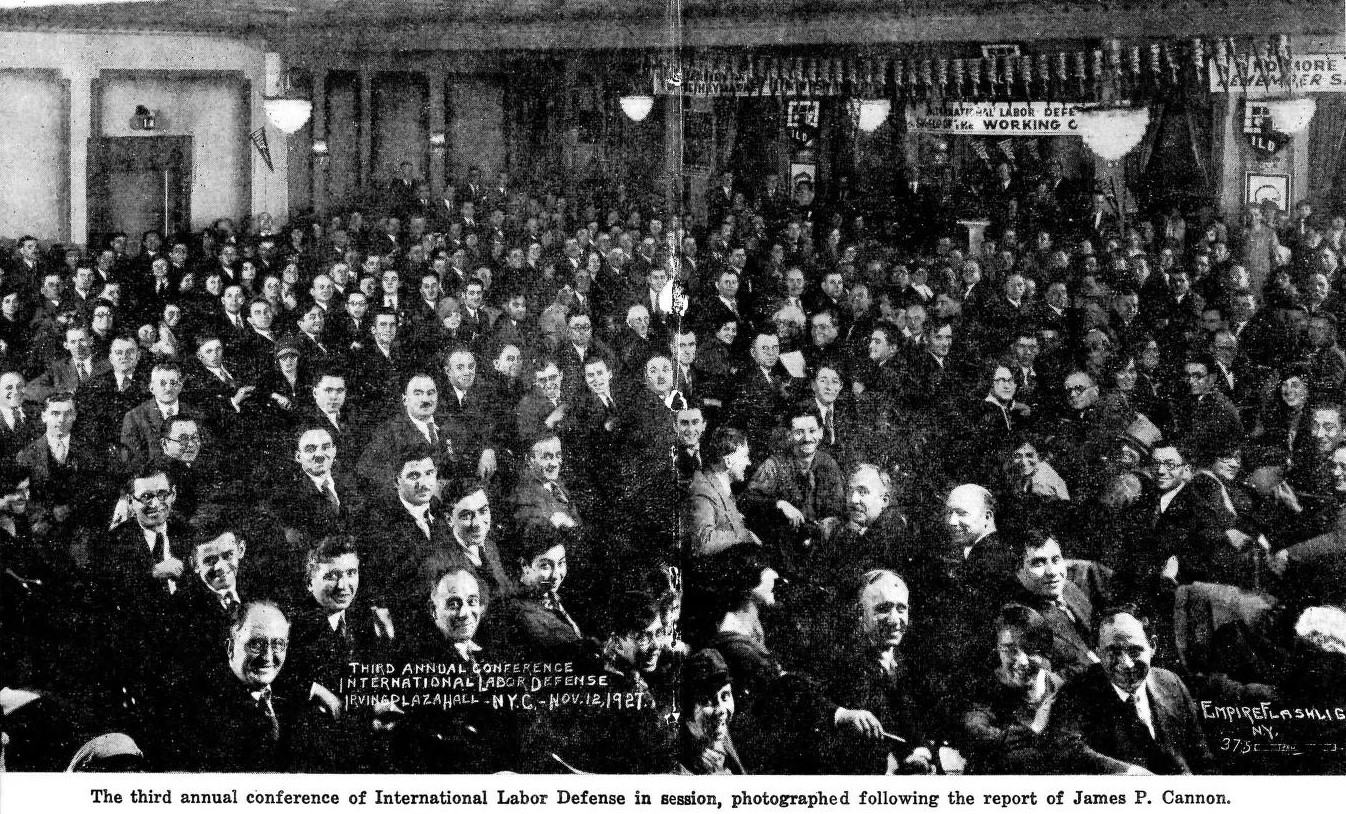
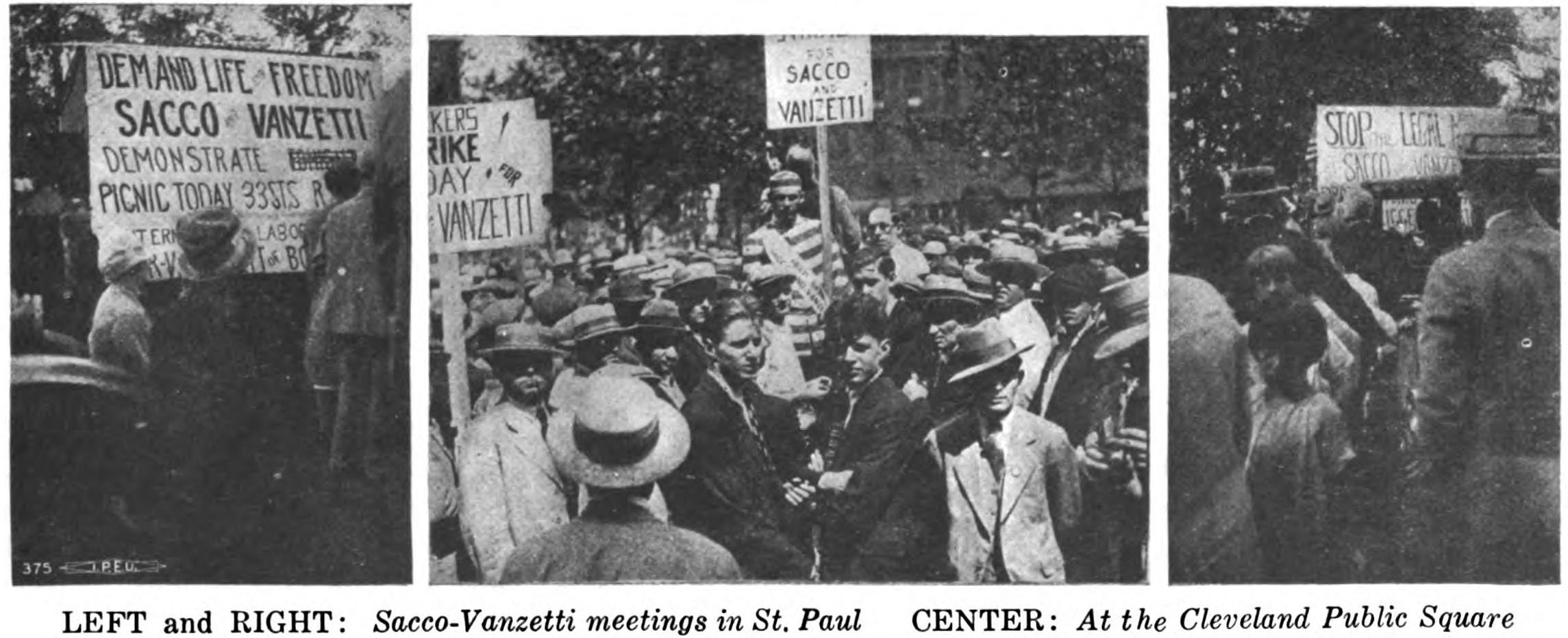
The 3rd I.L.D. Conference was held shortly after the judicial murder of Sacco and Vanzetti, the campaign around which was the major force in building the I.L.D. since its inauguration.
‘The Third Annual Conference of the International Labor Defense’ by James P. Cannon from Labor Defender. Vol. 2 No. 12. December, 1927.
THE delegates who gathered in New York for the third annual conference of International Labor Defense were a tribute to the fact that the movement of class solidarity with the victims of capitalist persecution has become a living part of the labor’s struggle in the United States. There were 306 delegates present from 30 cities. They came from all parts of the country, and from all sections of the labor movement; but they were of one mind in their united support to the cause of labor defense.
It was a serious working body which reviewed and discussed the past year of the work of the I.L.D., the report on which was given by James P. Cannon. The outstanding work of the period since the last conference was undoubtedly the campaign for Sacco and Vanzetti. It dominated all of the activities of the organization. It tested the class character of the I.L.D. and found that it was unyielding and dependable. It taxed the capacities of the movement to the fullest and enabled it to head the huge and unprecedented wave of the protest movement that swept the entire country. It drew the circle with which the workers surrounded the futile lawyers’ and liberals’ movement to show all the more sharply the contrast between it and the surging life of the class movement in behalf of the two martyrs.
The third conference found that the I.L.D. was a timely force not only in the big and dominating issues but that it was a source of strength and dependability in the smallest case of capitalist persecution. It could be proudly stated in the report of the executive committee that not a single worker had appealed in vain, to the I.L.D. for support. An arrest of no matter how humble a worker for his labor activities or opinions found the I.L.D. at its unremitting task of defense and support.

In the year since the last conference, the I.L.D. had broadened and made more systematic its work of relief to the class war prisoners and their dependents. Perhaps only the men behind the bars and walls of capitalism, and their families who feel the bitter knife of destitution can completely estimated the value of this material aid. The I.L.D. worked incessantly to teach the entire working class the vital importance of this work of solidarity.
The conference was an answer to the critics and opponents of the organization, those experts at sabotage who cover their own infamy and do-nothingness by throwing the mud of slander and calumny at the militant fighters.
The endorsement given to the line followed by the executive committee was the reply the conference gave to the Felicanis of Boston, the Oneals and Cahans of reactionary socialism, and the treasonable labor bureaucrats in other parts of the country. As in the past, the I.L.D. will go forward with its work, refusing to engage in futile controversies, and allowing its deeds to reply to its attackers.
The delegates occupied themselves not only with the review of the past work, but took up those issues which are pressing for solution immediately. The Greco J. Carrillo case, which already has all the earmarks of another Sacco-Vanzetti frame-up, was considered after the report of Carlo Tresca. And it is indicative of the work of the International Labor Defense that the protest movement is already being begun, and meetings held, in various parts of the country so that the American workers may be mobilized and ready at the first sign from the legal tools of Mussolini in this country that they intend to judicially assassinate these two innocent workers.
The cause of the Cheswick miners who have been framed-up for their loyal adherence to the Sacco-Vanzetti movement was also taken up by the conference in the report of William J. White. His graphic description of the iron heel in Pennsylvania which is trampling over the labor movement and persecuting its best fighters, stirred the delegates to the determination that the Cheswick defendants shall not be railroaded to prison for their activities.
Earl R. Browder, who had just returned from Colorado, reported on the fight that the miners are carrying on there against the despotism and misery of Rockefeller rule. The conference pledged its support to a victorious conclusion to the strike and expressed its vigorous condemnation of the terrorism of the armed and uniformed thugs who have just murdered five peaceful pickets, and injured a score or more of others.
The conference, continuing the policy of fraternal solidarity with the victims of the white terror in other countries, reaffirmed its opposition to the persecution of labor and revolutionary workers in all capitalist lands and pledged its support to the international struggle for the imprisoned and tortured fighters everywhere. The report on international persecutions was given by Comrade Ben Gitlow, himself one of the best-known class war prisoners in this country.
The delegates sent their warmest greetings to the class war fighters imprisoned in various parts of the country, and they stood in respectful tribute to the martyrs of labor, Sacco and Vanzetti, and to two other courageous fighters, both active workers in the International Labor Defense who had died in the past year, Eugene Victor Debs and Charles Emil Ruthenberg. The conference paid its warmest respects to the widow of the great Haymarket martyr, Albert R. Parsons, who spoke at the conference. Lucy Parsons symbolized for them the link between the militant labor movement of yesterday, which was not silenced on the scaffold of Cook County forty years ago, and the militant labor movement of today which continues in the noble and heroic traditions of the four who were hanged by the instruments of murderous capitalism.
Two of the most important phases of the conference were its decisions to organize a national movement against the infamous frameup system, and to carry on a systematic campaign to eradicate from the I.L.D. the last evil remnants of the old traditions of labor defense movements. These movements were formerly composed of small committees, chiefly money-collecting agencies, with no broad basis in the living movement of the masses, with narrow and temporary aims and programs. Such conditions are still reflected in the I.L.D. to a certain extent. Every effort will be made to build the I.L.D. upon a different basis: upon the basis of unity of all elements, of the defense of all class-war cases, of the drawing in of thousands and hundreds of thousands of workers into the movement of solidarity.
There are new struggles visible on the horizon. The rumblings of revolts in various parts of the country can already be heard. The apathy that has dominated the labor movement for the last few years is being shaken off. We know that every new struggle brings with it new victims of the bestial terror of the capitalist class. International Labor Defense has already sunk its roots deep in the soil of the struggle. There are no longer any skeptics who dare question its right to existence and its important place in the movement.
The past has shown that the I.L.D. can be a strong force on the side of those workers who have been caught in the frame-up machine that kills and imprisons the rebels against capitalism. The future must see the development of the I.L.D. into a powerful arm of the labor movement,—a shield for the whole working class.
Labor Defender was published monthly from 1926 until 1937 by the International Labor Defense (ILD), a Workers Party of America, and later Communist Party-led, non-partisan defense organization founded by James Cannon and William Haywood while in Moscow, 1925 to support prisoners of the class war, victims of racism and imperialism, and the struggle against fascism. It included, poetry, letters from prisoners, and was heavily illustrated with photos, images, and cartoons. Labor Defender was the central organ of the Scottsboro and Sacco and Vanzetti defense campaigns. Editors included T. J. O’ Flaherty, Max Shactman, Karl Reeve, J. Louis Engdahl, William L. Patterson, Sasha Small, and Sender Garlin.
PDF of full issue: https://www.marxists.org/history/usa/pubs/labordefender/1927/v02n12-dec-1927-LD.pdf
 Revolution's Newsstand