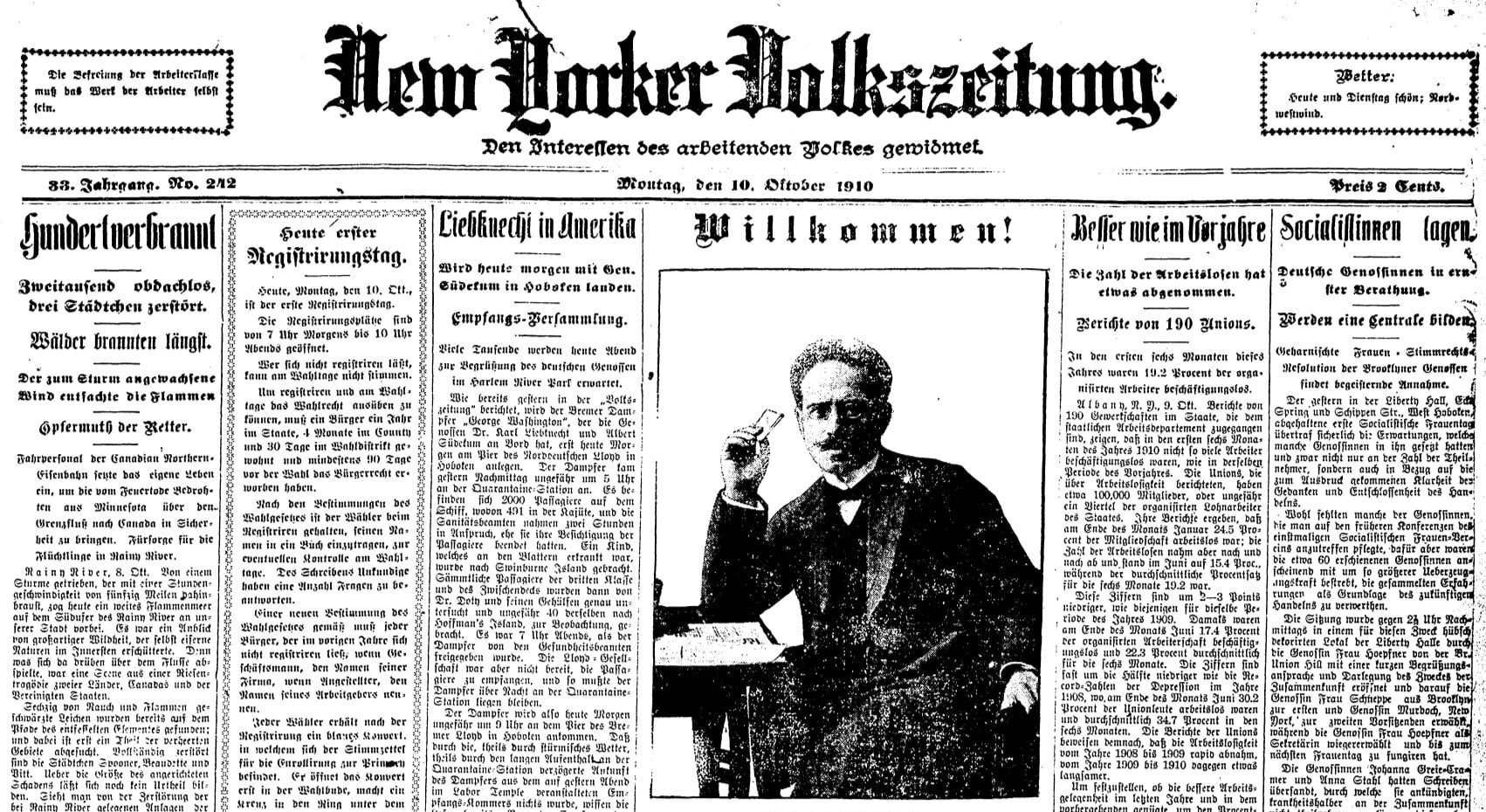
Karl Liebknecht began his tour of the United States with October, 1910 with optimism about possibilities in the ‘Great Republic.’ On his return to the East Coast after two months coast-to-coast travel, his view on the possibilities here had darkened considerably. A report from on of his final talks before returning to Europe.
‘Liebknecht in Baltimore’ by Cary Fink Angulo from The Weekly People. Vol. 20 No. 37. December 10, 1910.
IN ADDRESS TRIES TO AROUSE LABOR TO SENSE OF DUTY.
Baltimore, November 29. If anything can stir the enthusiasm of Baltimore Socialists, it must surely have been awakened last Saturday night by Karl Liebknecht’s brilliant address. One is usually well satisfied with a speaker if he but present his subject in a passably interesting way: those men who influence their hearers through some indescribable force of personality, being few and far between. But Liebknecht is one of these His response to the hearty greeting he received from the audience was to say that their friendliness was not for him personally, nor because he was the son of his father, but because he came as a Socialist, a representative of an idea so tremendous as to wipe out of consideration the individualities of the men working for it.
Throughout his speech he remained true to the impression of frankness and solidity of position outlined in this remark: “Here at last,” one could say, “is a man who has got an intellectual grasp on the subject of Socialism, a man who sees in it something big enough to make him willing to sink in it his own personality, and not one who intends exploiting it for his special interests, I which is the spectacle too often before our eyes today.”
The idea uppermost in Liebknecht’s mind Saturday night seemed to be the desire to stir the American workingman out of the lethargy into which he has sung himself by the oft-repeated lies as to the conditions which exist here. The German Socialist party, he said, began to make progress from the time when the proletariat first realized that it must brush aside the dogmas handed down to it from the “upper classes,” and do its own thinking. Today, he said, German Socialists can no longer be fooled, so seriously have they taken in hand the business of understanding conditions as they really are. The obstructions in their path, such as the remnants of feudal institutions, a hereditary aristocracy, a government run in the interests of the capitalist class, supported by police and army, and a church which is also antagonistic to the Interests of the people, all of these obstacles lose half their menacing aspect from the fact that each and all have been examined critically by the Social Democrat and understood by him. Anyone putting forth that threadbare principle of the unity of interests of capital and labor, for instance, receives only a derisive laugh for his pains. In other words, the German workingman is getting experience with his eyes open.
In this country, on the other hand, Liebknecht said he received everywhere the impression of a people who believed themselves to be in a “dreamland,” each man holding the secret hope that he may one day become a capitalist, hence unwilling to spoil those chances by joining a movement for the overthrowal of the whole system. In this state of mind it becomes an easy matter for those to whom a united working class is a menace to keep them divided and hence weak. Liebknecht brought forward innumerable instances taken from every part of this country, to show the tremendous power of the capitalist class, and the corresponding degradation of labor. In the face of this though, he said, more than one Socialist here had said to him, “Yes, I believe in Socialism, but I am going to vote the Republican or the Democratic ticket so that my vote is not lost altogether.” In this stupid way the American proletarian becomes the dupe of his own superficial thinking, he will actually vote for his enemy rather than not have his vote “count” at all. It was not in this way that the victories of the German Social Democrats were won. They are in their present position of strength, Liebknecht said, because they dared at one time to be weak in numbers and to vote doggedly for the principles they knew to be true, regardless of their minority at the polls. So his final appeal was for the Socialists of this country to organize into a genuinely class-conscious body, capable of thinking and acting in a clear and relentlessly logical manner and capable above all, of carrying on an incorruptible campaign for the improvement of the conditions of life for their class.
New York Labor News Company was the publishing house of the Socialist Labor Party and their paper The People. The People was the official paper of the Socialist Labor Party of America (SLP), established in New York City in 1891 as a weekly. The New York SLP, and The People, were dominated Daniel De Leon and his supporters, the dominant ideological leader of the SLP from the 1890s until the time of his death. The People became a daily in 1900. It’s first editor was the French socialist Lucien Sanial who was quickly replaced by De Leon who held the position until his death in 1914. Morris Hillquit and Henry Slobodin, future leaders of the Socialist Party of America were writers before their split from the SLP in 1899. For a while there were two SLPs and two Peoples, requiring a legal case to determine ownership. Eventual the anti-De Leonist produced what would become the New York Call and became the Social Democratic, later Socialist, Party. The De Leonist The People continued publishing until 2008.
PDF of full issue: https://www.marxists.org/history/usa/pubs/the-people-slp/101210-weeklypeople-v20n37-DAMAGED.pdf
 Revolution's Newsstand