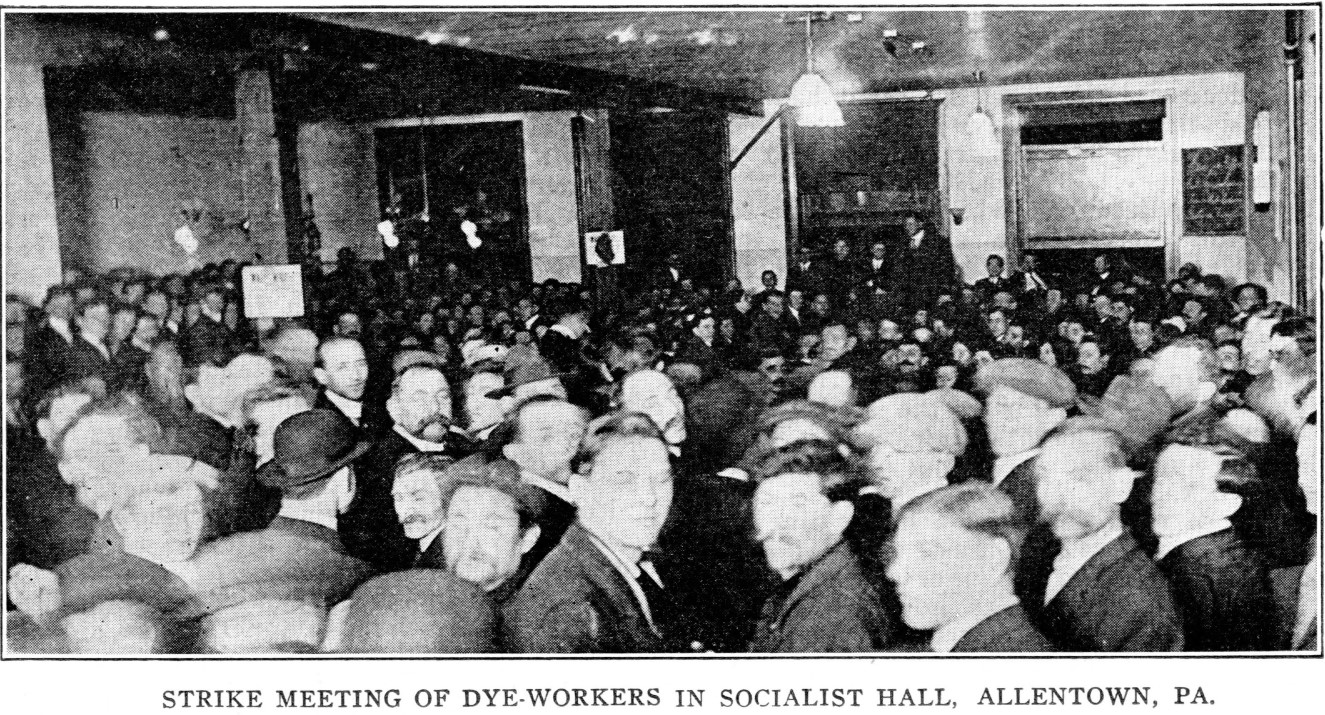
Socialist Party member of Allentown city council reports on the I.W.W. led silk strike, and the visit of Carlo Tresca and Bill Haywood, inspired by the fight at Paterson.
‘The Allentown Silk Dyers’ Strike’ by Robert J. Wheeler from the International Socialist Review. Vol. 13 No. 11. May, 1913.
THE great Paterson strike aroused the silk-workers of the entire east. Allentown, Pa., is the center of the industry outside of Paterson. Around about this city, within a radius of 30 miles, there must be 50,000 silk workers. They are poorly paid and overworked, even worse than in Paterson. This was cause enough for a strike, but until the great outbreak in Paterson, the spirit of revolt has not burned very bright up country.
Allentown is the ideal spot for the silk exploiter. We have a working class which has been taught to be content with its lot here on earth.
But the dye workers are mostly Italians; bold, spirited rebels whose spirit neither church nor state has ever been able to break. The Italians struck in an endeavor to support the Paterson strike.
Of course, they had the same grievances. Conditions are even worse here. But the strike was precipitated by the stupid use of the police who were placed on guard over the mill March 11th. The exploiters were afraid some Paterson men might get in and explode things. Monday morning, six men were arrested by the police pickets and held while one policeman ran to a phone and asked the manager of the Dye Works what he wanted done with the suspects. You see, in Allentown, the capitalists make no pretenses. They give the orders direct to the police, the Mayor is only a political salary-drawer.
In the evening of the same day the Mayor, Chief of Police and the First Sergeant, walked through the Dye Works. The game was to intimidate the workers. It had the opposite effect. The men were furious at being guarded like convicts. Strike talk filled the air. The next morning the whole force walked out. I.W.W. organizer Charles Plunkett had arrived the night before and the work of organization was carried on rapidly. Five hundred joined the I.W.W. in a few days.
The Socialist Party placed their hall at the disposal of the strikers and party members were very active in helping organize.
The police force was used against the strikers with the utmost vigor. When they had a parade, police drove them from the rear, rode alongside, and the Mayor, Chief and Specials went ahead in an auto. The parade was entirely orderly, but the police tried to start trouble. Every auto or team passing was invited by the police to ride through the damn fools. The chief ordered the cops to break their heads if one of the strikers left the ranks.
Finally the parade turned toward the Socialist Hall. The police drew up in front and would not let the strikers in, while a squad forced them on from the rear. The plan was to create a riot. But the I.W.W.’s policy of non-resistance was carried out to the letter and the men remained quiet. Then the chief ordered Plunkett’s arrest. Comrade Plunkett was seized with great violence and pulled out of the crowd. One policeman struck him a heavy blow on the head.
Hundreds of citizens witnessed the treatment of the strikers and the center of the city was filled with angry citizens, denouncing the police.
The following Friday Haywood and Tresca came to town. One of the theatres was engaged for a meeting. When the crowd gathered, the theatre was dark and the manager insolently told the Committee, “Your money is no good.” But the Socialist Party, though their hall was engaged for the regular weekly dance held by the Social Committee of Central Branch put the dance aside and the strikers packed the hall to the limit. While Tresca was speaking, we told Bill that the Mayor and several detectives were in the hall. When Bill got busy, the way he skinned the poor little Mayor and the detectives made the big crowd howl with delight. Outside, a big crowd thronged the street and listened to Bill, whose powerful voice carried clear to the street, the windows being open.
Saturday morning Bill went to Hazelton and returned Saturday night, when another big meeting was held.
The attempt to get the whole industry to strike was not a success. Some of the silk workers, who were Socialists, came out, but the great mass would not move.
The dye workers’ strike is still on. The Italians will not give in. At this writing, Haywood is again in town. The Paterson strike is about won and the strikers here will get the same conditions won in Paterson, if they are still out.
In this fight, the Socialist Party has earned the hatred of the exploiters as never before. They have cancelled our contract for the Lyric Theatre for April 20, when we were to have Kirkpatrick here. We are now shut out of every big hall in town. The strike has been a great thing for the Party. It has provided us with a splendid lot of material for propaganda. Our strong, determined support of the workers in their fight has won us the respect of organized and unorganized alike. Our paper, the Herald, alone of all the city press, is free to support the workers.
Now the fool police are going to stop us from talking on the street. Here is where they get their bumps. We are planning to have Con Foley open the campaign, and we are all prepared to win a free speech fight.
And in conclusion, we are going to organize the Silk Workers finally, and we are going to organize them INDUSTRIALLY.
The International Socialist Review (ISR) was published monthly in Chicago from 1900 until 1918 by Charles H. Kerr and critically loyal to the Socialist Party of America. It is one of the essential publications in U.S. left history. During the editorship of A.M. Simons it was largely theoretical and moderate. In 1908, Charles H. Kerr took over as editor with strong influence from Mary E Marcy. The magazine became the foremost proponent of the SP’s left wing growing to tens of thousands of subscribers. It remained revolutionary in outlook and anti-militarist during World War One. It liberally used photographs and images, with news, theory, arts and organizing in its pages. It articles, reports and essays are an invaluable record of the U.S. class struggle and the development of Marxism in the decades before the Soviet experience. It was closed down in government repression in 1918.
PDF of full issue: https://www.marxists.org/history/usa/pubs/isr/v13n11-may-1913-ISR-riaz-ocr.pdf
 Revolution's Newsstand