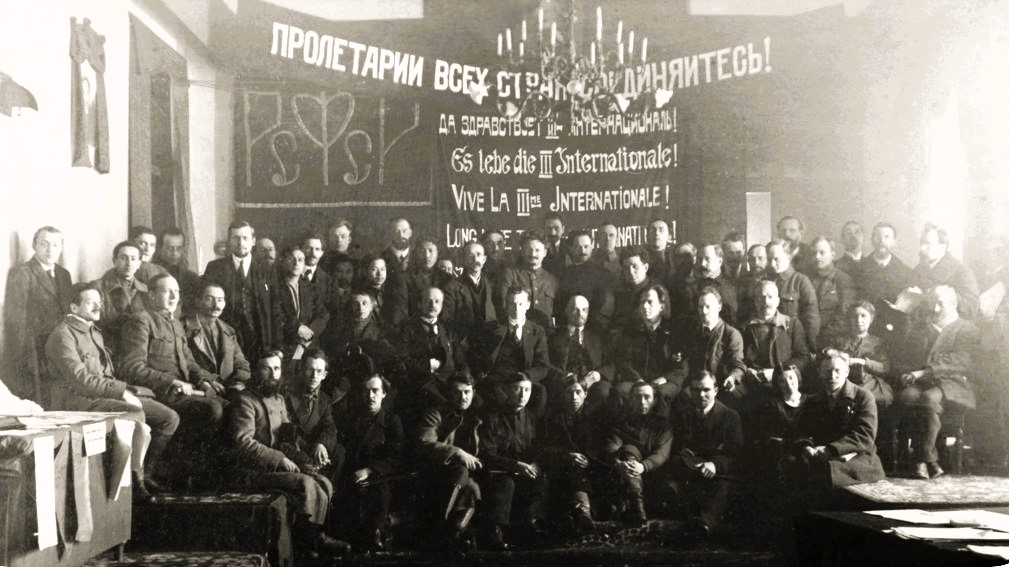
Lenin places the newly formed Communist International into the context of workers’ and Marxist history. Original English translation.
‘The Third International and its Place in History’ by N. Lenin from Communist International. Vol. 1 No. 1. May, 1919.
THE imperialists of the “Entente” are blockading Russia for the purpose of cutting off the Soviet Republic, as a hot-bed of infection, from the capitalist world. These people, who are boasting of the “democratic spirit” pervading their own institutions, are so blinded by their hatred of the Soviet Republic, that they do not perceive how preposterous their position is. Just think of it: the most advanced, civilised, and “democratic” countries, armed to the teeth and enjoying an undivided military supremacy over the world,–are frightened out of their wits by a mere spectre, by a contagious idea emanating from a ravaged, starving, ‘and, in their opinion, half-savage “country ! This inconsistency in itself is sufficiently great to help us in opening the eyes of the labouring masses in all countries, and in exposing the hypocrisy of the imperialists, such as Clemenceau, Lloyd George, Woodrow Wilson, and their governments.
We are helped in this respect not only by the blindness of the capitalists, by their hatred of the Soviets, but by their bickerings among themselves and the tricks they play upon each other. They have entered into a regular conspiracy of silence: since nothing terrifies them more than the spreading of correct information about the Soviet Republic in general, and its official documents in particular. One of the principal newspapers voicing the opinions of the French bourgeoisie, Le Temps, has, however, published the news of the foundation in Moscow of the Third Communist International.
We beg to tender to that mouthpiece of the French bourgeoisie, to the recognised leader of chauvinism and imperialism in France, our most respectful thanks for its valuable co-operation. We are prepared to send to the Temps newspaper a written address, couched in the most emphatic terms, expressing our gratitude for their able and timely assistance.
The method used by the Temps newspaper for compiling its communiqué from our wireless clearly discloses the motives by which that spokesman of Mammon was guided. Its idea was to annoy Woodrow Wilson, to nettle his susceptibilities. “These are the people,” it seemed to say, “with whom you think it possible to enter into negotiations!” The wiseacres writing at the orders of the money-bags are blissfully unaware of the fact that, in using the Bolsheviks as a bugbear to scare Woodrow Wilson, they merely supply the former with a free advertisement, and increase their popularity amongst the working masses. We feel we must reiterate our heartfelt thanks to the spokesman of the French millionaires!
The Third International has sprung into life under circumstances of such world-wide importance that no prohibitions, no mean and petty tricks of the Allied imperialists, or of the henchmen of capitalism, such as Scheidemann in Germany or Renner in Austria, can possibly prevent the news thereof spreading throughout the world and enlisting the sympathies of the working masses. These circumstances have been created by the proletarian revolution, which is spreading from day to day, from hour to hour. These circumstances have been created by the tendency of the labour movement to set up Soviets. This new movement has acquired such magnitude as to have become truly “international.”
The First International (1864–1872) laid the foundations of an international organisation of working men for the purpose of preparing their assault upon capital. The Second International (1889–1914) was an international organisation of the proletarian movement which eventually covered a wide field. This growth was accompanied by a temporary lowering of revolutionary standards, and a temporary increase of opportunism, which ultimately led to its ignominious breakdown.
The Third International was in reality created in 1918, after the protracted struggle with opportunism and “social-chauvinism,” especially during the war, had resulted in the formation of a Communist Party in various countries. The formal recognition of the International dates from the first congress of its members, held in Moscow in March, 1919. The most prominent feature of the Third International—namely, its mission to carry out the principles of Marxism and to realise the ideals of Socialism and the labour movement—manifested itself immediately in that this Third “International association of working men” has, to a certain extent, become identical with the League of Socialist “Soviet” Republics.
The First International laid the basis of the international struggle of the proletariat for Socialism.
The Second International marked a period of preparation, a period in which the soil was tilled with a view to the widest possible propagation of the movement in many countries.
The Third International has garnered the fruit of the labours of the Second International, casting off the refuse of its opportunist, social-chauvinistic, bourgeois, and lower-middle-class tendencies, and has set out to achieve the dictatorship of the proletariat.
The international union of parties directing the most revolutionary movement of the world—namely, the movement of the proletariat to throw off the yoke of capitalism–has the inestimable advantage of resting upon a basis of unprecedented solidity: on a number of “Soviet” Republics which are in a position to bring about, on an international scale, the dictatorship of the proletariat and its victory over capitalism.
The importance of the Third Communist International in the world’s history is that it was the first to put into life the greatest of all Marx’s principles, the principle summarising the process of the development of Socialism and the labour movement, and expressed in the words: the dictatorship of the proletariat.
This prescience, which only a genius could possess, this theory, which only a genius could conceive, has now become a reality.
These words have now been translated into all the languages of modern Europe, nay, into every language under the sun.
A new era in the world’s history has begun.
Mankind is throwing off slavery in its last surviving form: the slavery of wage earners oppressed by capitalism.
Mankind is throwing off its yoke, and, for the first time in its existence, it is achieving real freedom.
How could it come to pass that the first country to bring about the dictatorship of the proletariat and to form a Soviet Republic was one of the most backward countries in all Europe? It would not be misconstruing the facts to say that just this striking contrast between Russia’s backwardness and its sudden leap, over the head of bourgeois democracy, to the highest form of democracy—the Soviet or proletarian democracy—was one of the causes which (leaving aside the fact that most Socialist leaders are still influenced by opportunist habits of mind and middle-class prejudices) rendered it difficult for Western peoples to understand the role played by the Soviets.
The working masses throughout the world instinctively appreciated the value of the Soviets as a weapon in their struggle with capitalism and also as a form of the proletarian state. The “leaders,” however, demoralised as they are by their opportunist methods, still continue to worship “bourgeois democracy,” and call this “absolute democracy.”
Small wonder that the dictatorship of the proletariat, when put into practice, disclosed first of all a glaring “contradiction” between the backwardness of Russia and its “leap” over the head of bourgeois democracy. It would, indeed, have been wonderful had history made us the free gift of a new form of democracy, unattended by any contradictions.
Any Marxist, nay, anyone conversant with modern science, if asked whether he believed in the probability of a uniform, harmonious and perfectly-proportioned transition of various capitalist countries to the dictatorship of the proletariat, would undoubtedly answer that question in the negative. In the capitalist world, there has never been any room for uniformity, harmony, and perfect proportions. Every country has brought into prominence now one, now another feature, or features, of capitalism and of the labour movement. The rate of development has been varied.
While France was going through its great middle-class revolution, and opening vistas of a new historical life to the whole continent of Europe, England found itself at the head of the counter-revolutionary coalition, although it was far more advanced than France from the point of view of capitalism. The British labour movement of the period had, by a flash of intuition, arrived at some of the conclusions of latter-day Marxism.
At the time that it was giving to the world the first vast, politically-organised movement of revolutionary proletarians—Chartism—ineffective middle-class revolutions were taking place in various countries of Europe, and France was witnessing the first great civil war between the middle classes and the proletariat. The middle classes defeated the disjointed national battalions of proletarians one by one, using different methods in each country.
England offers a striking instance of a country, where, in the words of Engels, the middle-classes, acting in combination with an aristocracy gradually merging into the upper middle class, have created an upper stratum of the proletariat most akin to the middle classes. That advanced capitalistic country was, as far as the revolutionary struggle was concerned, several decades behind more backward countries. The proletariat of France seemed to have exhausted its strength in the two heroic risings of the working classes against the bourgeoisie in 1848 and 1871, the importance of which in the world’s history cannot be overrated. In the seventies, i.e., at a time when Germany was economically behind France and England, the supremacy in the international labour movement passed into her hands. When, however, Germany had out-distanced those two countries in the economic race, i.e., in the second decade of the twentieth century, the world-renowned party of German Marxists was headed by a gang of abominable rogues, by a band of scoundrels who had sold themselves to the capitalists, by Scheidemann and Noske, by David and Legien, the most villainous hangmen that were ever used against working men by monarchy and counter-revolutionary middle-classes.
The course of the world’s history inevitably points to the dictatorship of the proletariat, but its course is far from being straight, smooth, or simple.
At a time when Karl Kautsky was still a Marxist, and not the renegade he became when he joined Scheidemann in his struggle for unity with bourgeois democracy in its fight against the proletarian, or Soviet, democracy, he wrote (at the very beginning of the twentieth century) an article entitled “The Slavs and the Revolution.” In that article he drew attention to such historic conditions as were pointing to the possibility of the supremacy in the international labour movement passing into the hands of the Slavonic nations.
Now this has come true. For a time—certainly for a very short time—the supremacy in the proletarian revolutionary International belongs to the Russians, as in various periods of the nineteenth century it belonged successively w the English, the French, and the Germans.
I must repeat here what I have said many times: it was easier for the Russians than for any of the advanced nations to begin the great proletarian revolution, but they will experience greater difficulties in continuing it, in bringing it to a complete victory, i.e., in organising Socialist society.
It was easier for us to begin, firstly, because the extraordinary backwardness of the Tsarist regime resulted in an unprecedented violence of the revolutionary assault of the masses. Secondly, the backwardness of Russia had, in a manner peculiar to that country, merged the proletarian revolution directed against the bourgeoisie into the peasants’ revolution directed against the landlords. We began at that point in October, 1917, and our victory would not have been such an easy one had we started from any other point. As early as 1856, Marx, in speaking of Prussia, pointed to the possibility of revolutionary proletarians joining hands with revolutionary peasants. From the beginning of 1905; the Bolsheviks had upheld the idea of the revolutionary dictatorship of the proletariat and of the peasants. Thirdly, the revolution of 1905 proved an excellent political training ground for the working and peasant masses, both in bringing home to the most advanced amongst them the “latest in Western Socialism’” and in educating them in revolutionary action. But for the “dress rehearsal” of 1905, the revolutions of 1917, both the middle class one, in February, and the proletarian one, in October, would have been out of the question. Fourthly, the geographic conditions of Russia enabled it to hold out, for a longer time than was possible in other countries, against the seeming superiority of advanced capitalist countries. Fifthly, the peculiar inter-relations of the proletariat and the peasants facilitated the transition from a middle-class revolution to a Socialist one, by affording facilities for the urban proletarians to influence the poorest stratum of the peasantry. Sixthly, the lessons taught by many years of struggle by means of strikes, and the experience of the labour movement in Europe, combined with an extremely difficult and acute revolutionary situation, contributed to the springing up of that peculiar and unprecedented form of revolutionary organisations—the Soviets (workmen’s, soldiers’, and peasants’ councils).
This list is, of course, far from complete. But we may stop at that.
The Soviet, or proletarian democracy, has come to life in Russia. As compared with the Commune of Paris, this is the second step of paramount importance in the history of the world. The Soviet Republic of proletarians and peasants has proved to be the first stable and lasting Socialist Republic. As a new type of State, it can no longer die. It no longer stands alone.
A great deal, a very great deal, is still required to bring to completion the constructive work of Socialism. Such Soviet Republics as may be formed in countries more civilised than Russia, in countries where the proletariat carries more weight and has a greater influence, have all the chances of outdistancing Russia, provided they firmly adhere to the dictatorship of the proletariat.
The Second International, that has proved a signal failure, is now dying a natural death, and the period of putrefaction has already set in. It is now acting as a henchman to the international bourgeoisie. It may truly be termed the Yellow International, Its most prominent leaders, such as Kautsky, are now glorifying bourgeois democracy which they call “absolute democracy,” or—which is still more absurd and more coarse—”pure democracy.”
Bourgeois democracy is dead, as dead as the Second International, which did perform a very useful and historically inevitable task at a time when the preparation of the working masses for Socialism within the limits of that bourgeois democracy was the order of the day.
The most democratic bourgeois republic has never been, and cannot be, anything else but a machine for the oppression of labour by capital and a political weapon of capitalism, or anything but the dictatorship of the bourgeoisie. The democratic bourgeois republic promised to give power to the majority, but the principle so proclaimed could never be put into practice as long as the land and other instruments of production were objects of private ownership.
“Freedom,” in the interpretation of the bourgeois democratic republic, was reserved for the wealthy. The proletarians and the peasants could and ought to have utilised it for collecting their forces with a view to the ultimate overthrowing of capitalism and the annihilation of bourgeois democracy; but they could not, as a rule, actually enjoy the benefits of democracy under capitalism.
For the very first time the Soviet, or proletarian democracy, has created a democracy for the masses, for the toilers, for the working men and the poorest peasants.
Never in the history of mankind has the majority of the population wielded political power as completely as it does under the Soviet Republic.
The Soviet Republic suppresses the “freedom” of employers of sweated labour, of profiteers and their abettors; it prevents them from exploiting the working classes and from making fortunes out of starving people; it suppresses their “freedom” to join forces with the bourgeoisie of other countries against the workmen and peasants at home.
Let people like Kautsky defend such a freedom. No one but a renegade from Marxism, a renegade from Socialism, would uphold that kind of liberty.
The most striking manifestation of the failure of the leaders of the Second International, such as Hilferding and Kautsky, lies in their utter inability to grasp the importance of the Soviet, or proletarian, democracy, its relation to the Commune of Paris, its proper place in history, or its necessity as a form of the dictatorship of the proletariat.
No. 4 of the German periodical, Die Fretheit,–which voices the opinions of the so-called “Independent” (a misnomer for bourgeois, lower-middle-class) German Social-Democracy, published an February 11, 1919, contains an “Appeal to the Revolutionary Proletariat of Germany.”
The appeal is signed by the executive of the party and by the whole of its group in the “National Assembly,” a counterpart of our own contemptible “Constituent.”
That appeal accuses the Scheidemanns of a striving to do away with the Soviets, and purposes—this is not a jest—to combine the Soviets with the National Assembly, by conferring upon the former certain political rights, and giving them a definite place in the Constitution.
To reconcile the dictatorship of the bourgeoisie with the dictatorship of the proletariat! How simple! What a brilliantly philistine idea!
What a pity it has already been tried in Russia under Kerensky, by the united Mensheviks and the Socialist-Revolutionaries, those middle-class democrats who deem themselves the exponents of true Socialism.
Anyone who, in reading Marx, has failed to grasp the fact that, in capitalist society, any moment of acute struggle, any serious collision between the classes, must result in either the dictatorship of the proletariat or in the dictatorship of the bourgeoisie, has utterly misunderstood both the economic and the political doctrines of Marx.
The sublimely shallow suggestion of Messrs. Hilferding, Kautsky and Co. as to the peaceful co-existence of the dictatorship of the proletariat and the dictatorship of the bourgeoisie, calls for special analysis if all the economic and political fallacies heaped up in that most remarkable and most preposterous appeal of February 11 are to be fully discussed. This will be dealt with in another article.
N. LENIN.
Moscow, April 15, 1919.
The ECCI published the magazine ‘Communist International’ edited by Zinoviev and Karl Radek from 1919 until 1926 irregularly in German, French, Russian, and English. Restarting in 1927 until 1934. Unlike, Inprecorr, CI contained long-form articles by the leading figures of the International as well as proceedings, statements, and notices of the Comintern. No complete run of Communist International is available in English. Both were largely published outside of Soviet territory, with Communist International printed in London, to facilitate distribution and both were major contributors to the Communist press in the U.S. Communist International and Inprecorr are an invaluable English-language source on the history of the Communist International and its sections.
PDF of full issue: https://www.marxists.org/history/international/comintern/ci/old_series/v01-n01-1919-CI-grn-goog-r2.pdf
 Revolution's Newsstand