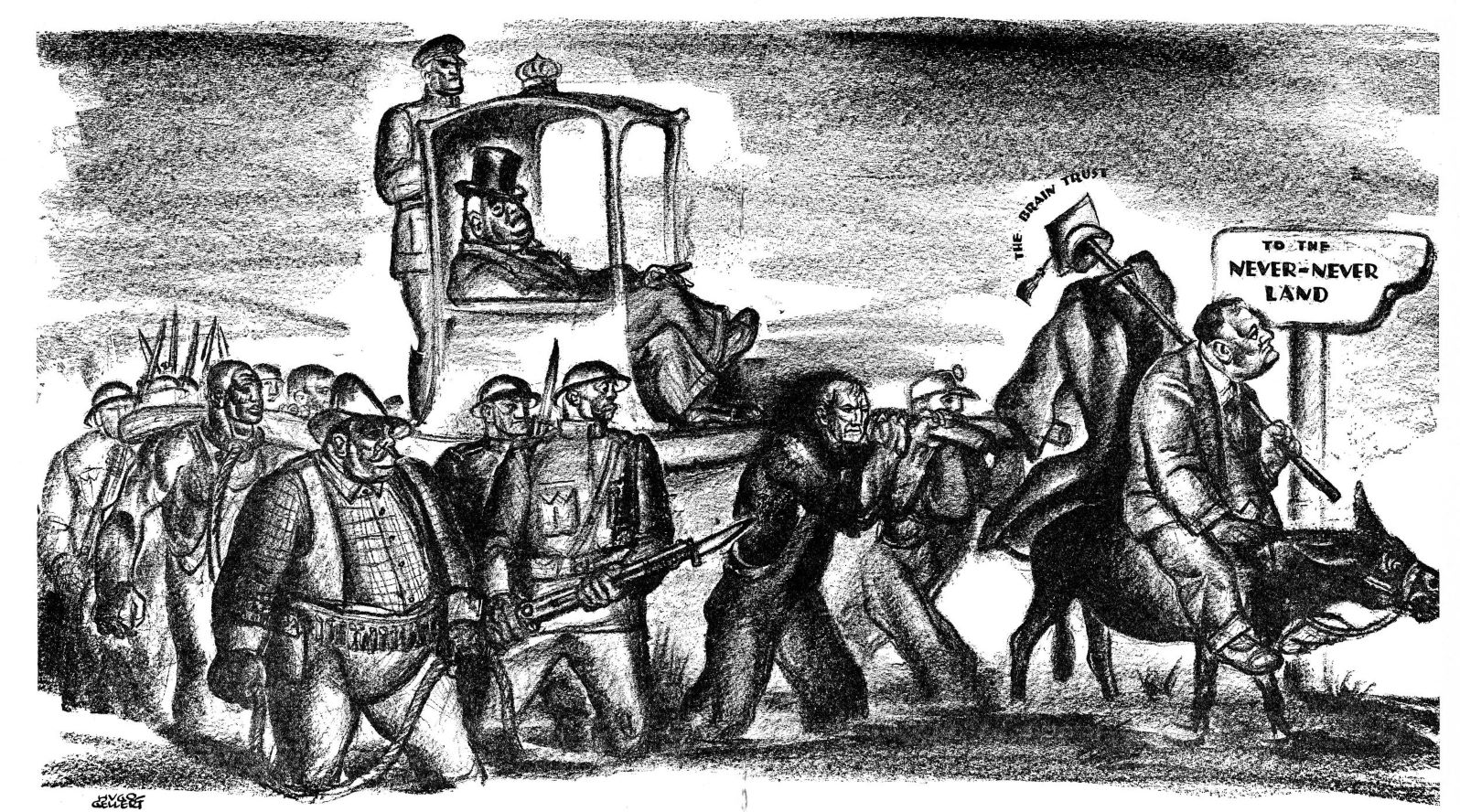
‘Three Months of the New Deal’ William F. Dunne from New Masses. Vol. 8 No. 10. June, 1933.
THREE months after the wet March day which witnessed the inauguration of Franklin Delano Roosevelt, scion of the Hudson River aristocracy in the role of St. George slaying the dragon of depression, the once shining halo is seen to be tilted at a precarious angle and more than a little tarnished in spite of the unlimited supply of 24-carat gilding available in the coffers of the House of Morgan — tax free.
In three months, with the aid of a press and propaganda campaign unequalled in intensity and scope since the Democratic predecessor of Roosevelt made war for Morgan, but which has served mostly to emphasize the growing acuteness of the crisis, President Roosevelt and his corps of high pressure pedagogues have succeeded in showing with considerable clarity that capitalism in the fourth year of the crisis is capitalism with its evils and contradictions increasing in geometric progression.
The developments of three months of “The New Deal” have shown again that business and especially “big business,” consists, as Marx said, largely of cheating, chicanery and fraud practiced on the masses and on the less adroit and weaker sections of the capitalist cliques.
The crisis, whirling with the speed of Poe’s maelstrom, engulfs the entire working class and the working farmers in ever greater misery; huge sections of the lower middle class continue to be dispossessed.
The bulging bulwark of the great dikes of faith, hope and promised charity built of pre-election propaganda and postelection ballyhoo of returning prosperity has so far prevented the stupendous Harriman, Mitchell and Morgan scandals from dissipating entirely the rosy mist of radio inspired optimism which many mistakenly took for the early gleams of the dawn of the new day.
But the mist thins and its place is being taken by a miasmatic fog indistinguishable, except for the mixture of New Deal perfume with its poisonous effects, from the vapors exuded by the Hoover collection of capitalist shamans.
The product distilled by the professorial witches of Endor whom Roosevelt has gathered around him differs from that of their predecessors, so far as the masses are concerned, only in its label.
The rim of the maelstrom now touches the steps of the White House. Into the sanctums of the President and his corps of pedagogues are being hurled scummy bits of “American business enterprise,” only samples of the worst that is yet to come. Large flecks of spume, some of them disgustingly slimy, are flung on to the sheets of nice white paper covered with diagrams of The New Deal. More than one deck of cards has had to be sent to the White House laundry, say the authors of the Washington Merry-Go-Round.
Carpets which have muffled the tread of the representatives of all countries of the world — except the country of the proletarian dictatorship — as they came to be urged to hitch their badly creaking wagons to the star of the Roosevelt dictatorship of Wall Street imperialism and agree to extinguish all others, are now cluttered up with an interesting and informative collection of flotsam and jetsam thrown off from the periphery of the crisis.
Much of it the menials dare not touch and most of the family circle are away, having been dispatched upon various lucrative missions or engaged in highly paid scribbling for journals of national circulation — pickings of the Presidency of the most powerful and richest imperialist country in the world. There it remains — and increases — much to the annoyance of the entirely well-bred and highly intellectual persons recruited by Roosevelt to shuffle and cut the neat piles of marked cards, irritating their delicate nostrils so sensitive to all unpleasant odors except those arising from the sweat, suffering and blood of millions of hungry working class men and women, employed and unemployed and myriads of their children.
In the growing pile of debris, swept from all corners of American capitalism, there are to be seen such contrasting bits as Morgan and a circus midget — exploited by a press agent almost as callous as those who thump the tub for The New Dealer; a grafting reforestation army toilet kit contract, involving the President’s law partner, the President’s confidential secretary and one Robert Fechner, for long years a high-salaried bureaucrat of the International Association of Machinists noted for the fervor with which he helped suppress rank and file revolts and now elevated, at the insistence of the ^Executive Council of the American Federation of Labor, to acting as the representative of “labor” as the head of the forced labor camps. So incredibly brazen, cheap and sordid is this piece of racketeering that the conclusion is forced that word must have gone out to the choice coterie of cappers and housemen gathered to operate the Roosevelt Palace of Chance that the picking up of all loose chips left lying around by careless gamblers is not the least of their activities in connection with the New Deal.
Another bit of wreckage over which the academic feet of the Roosevelt laboratory staff stumble is the twisted body of the piccolo-playing secretary of the treasury, touted only a few short weeks ago as the most brilliant ornament in the cabinet collection but caught with his exquisitely tailored trousers down around his ankles when inquisitive senators, with ears cocked to the roar coming from the cities and countryside, read out the list of Morgan’s companions and crumb-gatherers in a piratical enterprise entirely ethical from the viewpoint of bankers, brokers, three-card monte men and short change artists, but at which hungry toilers, ruined farmers and business and professional groups of the lower middle class look with angry eyes.
Morgan’s reluctant admission that he had been saving up to take a hand in the New Deal by not paying any income tax for the years 1930-31 and the revelation that he sat in on the game with a bank roll of some $338,000,000 has made it very hard for the Roosevelt press agency to explain what he meant by his remarks about freedom from Wall Street control during the election campaign. With Morgan’s man in the key post of secretary of the treasury, explanation becomes impossible and the Roosevelt halo has not only been tilted but dented so badly that the work of goldsmiths like Baruch and Davis can only make it worse.
While relief for the unemployed is being cut to dimes and pennies — paid in second and third class groceries — or discontinued entirely throughout the country, the President’s family confound the millions of jobless and underpaid employed workers by showing that there is no excuse for not securing pleasant and profitable employment if one really wishes to, and provided that one’s father or husband is president of the United States. Daughter Mrs. Curtis Dahl is reported reliably to have accepted a contract for a series of articles at a large but unstated remuneration from “Liberty.” A 22-year old son is now head of an aviation company in Southern California. A gifted boy — the youngest airways company president in the world.
The wife of the president sets a shining example of industry for all the homeless and hungry jobless. If she got no more than a cent per word, the income from her syndicated articles alone could support at least 50 unemployed families at a much higher standard than the present charity relief.
All the professors clustered around the throne, their brains bursting with blueprints for the Promethean task of planning production and distribution under capitalism, are writing voluminous paid-in-advance messages of hope and cheer for the American people. There is no unemployment and no want, no unpaid labor, in and around the White House.
The press has turned over its pages to news of industrial recovery. The purchase of a new wine press by Antonio Andisto is hailed as a sign of recovery in the grape growing region and much surprises Antonio who has hitherto been somewhat shy about his business activities. Budget Director Douglas announces that 1,400,000 men have gone back to work. The press does not question his figures. If they are correct, this leaves only 15,600,000 unemployed. It is clear that the professors, accustomed to abstractions like curves on graphs and charts, consider the problem of unemployment practically solved. They refrain with great care, however, from giving out any figures regarding the total amount of employment. The statistics on strikes and wage disputes, dispensed even by the arch-reactionaries Davis and Doak, have been discontinued by the “progressive” Miss Charlotte Perkins heading the Department of Labor. There are flies in the ointment but the Roosevelt policy is to keep them out of sight of those who get salved.
With this policy the Socialist Party leaders and the liberal journals like the New Republic are heartily in accord. They go out of their way to find something in the Roosevelt program they can sell to their followers. Space permits only two examples — both typical.
An Associated Press dispatch from Pittsburgh on May 16 said:
“Norman Thomas, Socialist candidate for President in 1932, mid tonight: ‘the best thing about President Roosevelt’s message to the nations is the fact that it was addressed also to Russia…I hope it will be followed by complete recognition of Russia.” The Socialist leader added: “l APPROVE OF THE MESSAGE AS A WHOLE” (My emphasis, W.F.D.).
Just one statesman to another!
The New Republic supports editorially, in spite of contradictory figures furnished by its own writers like John T. Flynn which show that the rocketlike “recovery” in iron and steel was based in the first week in June on an increase in demand of 1.5 percent, the Roosevelt thesis of “marked recovery.” It has selected perhaps the most reactionary of the Roosevelt “recovery” measures for its praise — the forced labor and militarization of 250,000 boys as a preliminary to including them in the armed reserves under the guise of creating employment. The New Republic italicizes “one dollar a day and board” This Roosevelt standard is that of farm labor 30 years ago. Progress! The Socialist Party leaders and the liberal journals are straining themselves to aid the New Deal. Their mild criticisms are directed only to various parts of it and this only because of the growing skepticism and distrust among the mass of the working population. The A.F. of L. press slobbers over with flunkey-like plaudits.
What accounts, then, given the almost undivided aid to and praise of the Roosevelt program by the orthodox press, for the increasing difficulties of the administration? The Communist Party press alone, and that of other working class organizations influenced by Communists, has exposed the Roosevelt program for what it is: An intensive extension, with its tempo dictated by the deepening crisis at home and internationally, of the basic program of Wall Street imperialism — multiplied exploitation of the working class and quadruple oppression of the masses, Negro and white; the most rapid concentration and centralization of wealth in fewer hands; more open throwing of the government authority and power behind finance capital — and speedy preparation for a new war of imperialist conquest.
The difficulties of the Roosevelt regime within three months of the inauguration are caused mainly by the fact that, with huge masses of workers and farmers believing in the New Deal at election time, the express train speed of the crisis and its results have brought great disillusionment, anger and action.
Every deed has its own logic, as Lenin was fond of saying. And what has Roosevelt done?
He has encouraged and permitted the use of troops against workers and farmers on an unprecedented scale. Not since the Whisky Rebellion has America witnessed the use of troops against poverty stricken farmers as in Wisconsin and Iowa by Roosevelt henchmen.
Troops against workers in New Hampshire textile mills and against Illinois miners.
Renewed persecution and deportations of foreign born workers. A new wave of attacks on Negroes in the Democratic south.
A united front with Japanese imperialism against the heroic Chinese workers and peasants fighting for liberation, and against the Soviet Union, through the medium of a $50,000,000 R.F.C. loan to the Nanking murder government just after it completed its betrayal of the Chinese people. At the same time, $235,000,000 have gone for warships. The National Guard is to be made part of the regular army.
Roosevelt has raised the cost of living for every worker and farmer in the United States by his taxation program for the benefit of the bankers. (In one week the cost of mutton increased from 17 to 23 cents per pound at retail.)
The working farmers, by the system of crop limitation and loan banks, have been placed still more under the thumb of Wall Street government.
The budget is balanced on the bodies of the toilers.
Roosevelt’s “industrial coordination” scheme is a reactionary improvement in the militarization of industry and the working class, more far-reaching than that put in force during the World War, and, like the Wilson scheme, to be carried out with the active cooperation of the A.F. of L. bureaucracy. Roosevelts ambassador-at-large, Davis, has endorsed the Four Power pact, directed against the Soviet Union, utilizing Fascist Germany and Fascist Italy as the main spokes in the wheels of Wall Street’s European chariot. Machado’s bloody rule in Cuba and the breaking of all pledges to the Filipino people are typical of the Roosevelt colonial policy.
The wave of strikes, many if not most of them by unorganized workers, fighting for wage increases, the wide spread and determined farm strikes and demonstrations, the anger aroused by the slash in ex-soldiers’ pensions, the mass struggle of the unemployed, contain the answer to the failure of the Roosevelt regime to make greater headway with its offensive.
In the face of the demagogy of the Roosevelt regime and on the basis of the necessity of the struggle for the right to work and live, for the elementary needs of food, clothing and shelter, in the growing consciousness of the need for uncompromising mass battle against imperialist war and the defense of the Soviet Union, in the need for the fight against capitalist dictatorship with democratic trappings and fascism following on its heels, against the betrayals of the Socialist Party leader and the agents of Wall Street at the head of the American Federation of Labor, the united front of the working class and its allies is being formed. There is every reason to believe that the revolutionary labor movement of American workers is taking shape on a broader base than ever before.
“Organization,” said Lenin, “is the only weapon of an oppressed class.” It is this weapon, tempered and welded in accord with the demands made upon Communists and the advanced sections of workers by the decline of capitalism, that must be placed in the hands of the American working class. With it can be defeated the imperialist program of robbery and war which Roosevelt attempts, more and more unsuccessfully, to conceal behind the phalanx of strutting professors and the phraseology of The New Deal.
In the most rapid building of militant mass trade and industrial unions in basic industries, in the rapid molding of a powerful fighting opposition in the A.F. of L. and railway unions, and the inculcation of these organizations with the spirit of resistance to capitalism at every point, the training of a corps of new leaders from the ranks, lies the rough but straight road to the victorious struggle for power by the American workers — the road to Communism.
This is the New Deal for which increasing numbers of American workers, farmers and intellectuals will work and fight.
The New Masses was the continuation of Workers Monthly which began publishing in 1924 as a merger of the ‘Liberator’, the Trade Union Educational League magazine ‘Labor Herald’, and Friends of Soviet Russia’s monthly ‘Soviet Russia Pictorial’ as an explicitly Communist Party publication, but drawing in a wide range of contributors and sympathizers. In 1927 Workers Monthly ceased and The New Masses began. A major left cultural magazine of the late 1920s and early 1940s, the early editors of The New Masses included Hugo Gellert, John F. Sloan, Max Eastman, Mike Gold, and Joseph Freeman. Writers included William Carlos Williams, Theodore Dreiser, John Dos Passos, Upton Sinclair, Richard Wright, Ralph Ellison, Dorothy Parker, Dorothy Day, John Breecher, Langston Hughes, Eugene O’Neill, Rex Stout and Ernest Hemingway. Artists included Hugo Gellert, Stuart Davis, Boardman Robinson, Wanda Gag, William Gropper and Otto Soglow. Over time, the New Masses became narrower politically and the articles more commentary than comment. However, particularly in it first years, New Masses was the epitome of the era’s finest revolutionary cultural and artistic traditions.
PDF of full issue: https://www.marxists.org/history/usa/pubs/new-masses/1933/v08n10-jun-1933-New-Masses.pdf
 Revolution's Newsstand