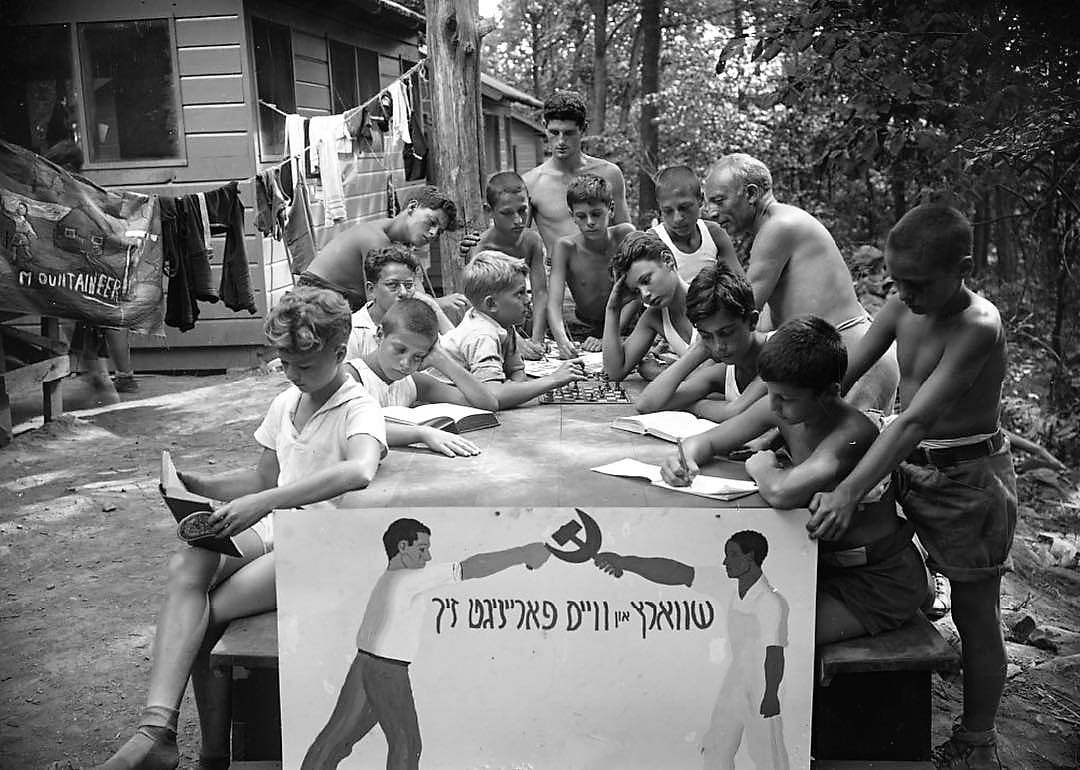
The work of a drama group at a Pioneer summer camp in 1932.
‘Theatre Work with Children at Last Summer’s Pioneer Camp’ by Preva Glusman from Workers Theatre. Vol. 3 No. 5-6. May-June, 1933.
Necessity for children’s dramatics: At the entrance to the Workers International Relief Pioneer Camp stands an old apple tree. It was against the rules of the camp to climb the tree; but the apples were a constant temptation–and the rules were constantly broken. One day Bill, one of the Pioneers, while crawling out after an apple, lost his hold and fell. There was great excitement at camp that day, for Bill was hurt pretty badly. From then on there was no more tree-climbing: the accident to Bill had dramatized the consequence of breaking the rules. With children especially, things that are actually seen and participated in, leave a deeper impression than mere verbal instruction.
We must have children’s dramatic groups to oppose the children’s theatres sponsored by the public school system and by other capitalist enterprises. The type of dramatics carried on with the children at the public schools is one that poisons the mind of the child and leads him far away from reality. Most of these plays deal with a far-fetched story and supernatural figures. They have no clarification to offer to the inquisitive mind of a child. When the plays venture to deal with current reality, they are inspired with reverence for the wealthy man “who has worked hard since childhood”, and point the moral that any child who tries enough can become a J.P. Morgan.
Our theatre must expose these evasions and lies. We must devote ourselves to the education of the workers child, bringing him to the realization that he will not become a J.P. Morgan but will remain a worker in the factory, the mine and the mill, slaving to accumulate profits for the very few J.P. Morgans, and taking his chances on the breadlines in times of business crisis. We must give our attention also to the specific problems of the worker’s child as a pupil in a capitalist school, as a child laborer, and as a member of the exploited working class.
Drama work at the W.I.R. Pioneer Camp: This summer for the first time, the New York Workers Laboratory Theatre of the W.I.R. sent one of its members to conduct dramatics with the children of the W.I.R. Pioneer Camp. The experiment proved highly successful, both in planning entertainment and in drawing workers’ children into the Pioneer movement. Members of the dramatic group met for an hour each day. This hour was spent in rehearsing plays and in acquainting children with the history of the theatre from the primitive stage to the present revolutionary theatre and agitprop brigades.
The children learned of the workers’ theatres now existing in capitalist countries (Japan, China Germany, England, America), the conditions under which these theatres function and the role they play in the everyday life and struggles of the workers. They were informed about the workers’ theatres of the Soviet Union. They learned how to approach a play analytically as well as emotionally, from the point of view of content and technique. They read and discussed plays, pageant and recitations, were taught how to write collectively, each contributing to a given theme.–a splendid, natural means of developing the thought and initiative of children.
At one of the camp fires a pageant on child-labor was presented, the ideas for the pageant being put together by the leaders and the Pioneers. A bookblack, a newsboy, and a young cotton-picker from the South, who were at the camp at that time took part; what they played in was no fairy tale, but a true picture of their lives. The pageant had as its theme: There are many child laborers in the United States. They work under intolerable conditions. The Pioneers must organize these children in order to win better conditions for them, to enable them to grow into rational and healthy men and women. Especially emphasized was the necessity for organization, and the role of the “New Pioneer” magazine in such organization. The show proved to be very interesting entertainment for both the children and the adults present.
The acting out of a strike-struggle was a very stimulating experience. The “strike”, which lasted an entire day, was not prepared or rehearsed; the children taking the various parts were merely given a certain situation and left to react to circumstances. A group of children, supposed to be workers on a dam, were given a ten percent wage cut; they decided to go out on strike. Around this evolved the entire day’s activity. A court scene took place. Red Pepper, a schoolboy, was tried because he played hookey in order to go on the picket line with his parents. Here was a Pioneer acting the part of a judge, another the part of a prosecuting attorney, and Red Pepper defending himself, the rest spontaneously shouting and cheering at the militancy of the young Pioneer. When the National Guard attacked the strikers on the picket line, an actual fight took place. The children went at it so earnestly that many were hurt. The strike ended in victory for the workers. Thus, in their play, the children came to understand by imitation the strike-struggles their parents carry on.
As far as possible the educational work of the camp was carried out in dramatic form. A shadow-graph illustrated the life and struggles of the Ohio miners. The drama circle produced a short sketch depicting how Harry Simms was murdered by Kentucky thugs and how the Pioneers pledged themselves to carry on the fight for which Herry Sims died. Lives of revolutionary leaders–Sacco, Vanzetti, Lenin, Karl Liebknecht, Joe York. Harry Baran, Foster– were presented in plays, sketches pantomimes. “On The Belt” was one of the best presentations of the drama group, from an artistic point of view. Other presentations–“The Backward Worker”, “Revolt of the Child Laborers”, “Fight Against Starvation”. “Scottsboro”, the reading of poms from the New Pioneer, and of the letter to Sacco’s s from Vanzetti–found an important place in the educational program of the camp.
The New Theater continued Workers Theater. Workers Theater began in New York City in 1931 as the publication of The Workers Laboratory Theater collective, an agitprop group associated with Workers International Relief, becoming the League of Workers Theaters, section of the International Union of Revolutionary Theater of the Comintern. The rough production values of the first years were replaced by a color magazine as it became primarily associated with the New Theater. It contains a wealth of left cultural history and ideas. Published roughly monthly were Workers Theater from April 1931-July/Aug 1933, New Theater from Sept/Oct 1933-November 1937, New Theater and Film from April and March of 1937, (only two issues).
PDF of full issue: https://www.marxists.org/history/usa/pubs/workers-theatre/v3n5-n6-1933-may-jun-Workers-Theatre-yale-mf.pdf
 Revolution's Newsstand